Questões de Concurso
Sobre vocabulário | vocabulary em inglês
Foram encontradas 3.148 questões


Ano: 2009
Banca:
CESPE / CEBRASPE
Órgão:
TCU
Prova:
CESPE - 2009 - TCU - Analista de Controle Externo - Tecnologia da Informação - Prova 1 |
Q34031
Inglês

"cracks" (L.8) means breakage.
Ano: 2009
Banca:
CESPE / CEBRASPE
Órgão:
TCU
Prova:
CESPE - 2009 - TCU - Analista de Controle Externo - Tecnologia da Informação - Prova 1 |
Q34030
Inglês
“which”, in “lacks a general model with which to investigate such failures” (L.3), refers to “investigate”.
Ano: 2009
Banca:
CESPE / CEBRASPE
Órgão:
TCU
Prova:
CESPE - 2009 - TCU - Analista de Controle Externo - Tecnologia da Informação - Prova 1 |
Q34029
Inglês
"shortage" (L.1) can be correctly replaced by abundance.
Ano: 2009
Banca:
ESAF
Órgão:
Receita Federal
Prova:
ESAF - 2009 - Receita Federal - Analista Tributário da Receita Federal - Prova 1 |
Q22374
Inglês
Texto associado
In June this year, the BRICs, the world's newest economic
grouping, ended their fi rst major summit by calling for a
stable, predictable and more diversifi ed international
monetary system. But the leaders of Brazil, Russia, India
and China, stopped short of criticising the world's dominant
currency, the US dollar. The group repeated calls for a
bigger say in the global fi nancial system through greater
representation at major institutions, such as the World
Bank.
But the fi nal statement issued by the leaders made no
reference to developing new reserve currencies to challenge
the dollar, which Russia had called for at a separate event
earlier in the day.
Analysts say that as the global recession bites, the four Bric
nations are showing a growing willingness to work together.
One expert claimed the signifi cance of the summit would
be political rather than economic
(BBC News 16/6/09, adapted)
grouping, ended their fi rst major summit by calling for a
stable, predictable and more diversifi ed international
monetary system. But the leaders of Brazil, Russia, India
and China, stopped short of criticising the world's dominant
currency, the US dollar. The group repeated calls for a
bigger say in the global fi nancial system through greater
representation at major institutions, such as the World
Bank.
But the fi nal statement issued by the leaders made no
reference to developing new reserve currencies to challenge
the dollar, which Russia had called for at a separate event
earlier in the day.
Analysts say that as the global recession bites, the four Bric
nations are showing a growing willingness to work together.
One expert claimed the signifi cance of the summit would
be political rather than economic
(BBC News 16/6/09, adapted)
The phrase "stopped short of" in paragraph 1 means
Ano: 2009
Banca:
CESPE / CEBRASPE
Órgão:
ANAC
Provas:
CESPE - 2009 - ANAC - Analista Administrativo
|
CESPE - 2009 - ANAC - Analista Administrativo - Tecnologia da Informação |
Q17637
Inglês
Texto associado

Judge the following items about the ideas and the linguistic
structures of the text above.
Judge the following items about the ideas and the linguistic
structures of the text above.
In "Some airlines, however, are wary of gearboxes" (l.15), "wary" is synonymous with cautious.
Ano: 2009
Banca:
CESPE / CEBRASPE
Órgão:
ANAC
Provas:
CESPE - 2009 - ANAC - Analista Administrativo
|
CESPE - 2009 - ANAC - Analista Administrativo - Tecnologia da Informação |
Q17636
Inglês
Texto associado
Judge the following items about the ideas and the linguistic
structures of the text above.
Judge the following items about the ideas and the linguistic
structures of the text above.
The word "rowdy" ( .5) is synonymous with quiet.
.5) is synonymous with quiet.
Ano: 2009
Banca:
CESPE / CEBRASPE
Órgão:
ANAC
Provas:
CESPE - 2009 - ANAC - Analista Administrativo
|
CESPE - 2009 - ANAC - Analista Administrativo - Tecnologia da Informação |
Q17632
Inglês
Texto associado

Judge the following items about the ideas and the linguistic structures
of the text above.
Judge the following items about the ideas and the linguistic structures
of the text above.
The word "wreckage" ( 5) refers to the remaining parts of something that has been wrecked.
5) refers to the remaining parts of something that has been wrecked.
Ano: 2009
Banca:
CESPE / CEBRASPE
Órgão:
ANAC
Provas:
CESPE - 2009 - ANAC - Analista Administrativo
|
CESPE - 2009 - ANAC - Analista Administrativo - Tecnologia da Informação |
Q17631
Inglês
Texto associado
Judge the following items about the ideas and the linguistic structures
of the text above.
Judge the following items about the ideas and the linguistic structures
of the text above.
The verb to plunge in "Airbus A330 plunged mysteriously into the southern Atlantic Ocean" ( .1-2) means to thrust or throw (something or oneself) forcibly or suddenly downwards.
.1-2) means to thrust or throw (something or oneself) forcibly or suddenly downwards.
Ano: 2009
Banca:
CESPE / CEBRASPE
Órgão:
ANAC
Provas:
CESPE - 2009 - ANAC - Analista Administrativo
|
CESPE - 2009 - ANAC - Analista Administrativo - Tecnologia da Informação |
Q17630
Inglês
Texto associado
Judge the following items about the ideas and the linguistic structures
of the text above.
Judge the following items about the ideas and the linguistic structures
of the text above.
The word "ill-fated" ( .1) is synonymous with doomed.
.1) is synonymous with doomed.
Q17477
Inglês

the word "stints" ( .13) refers to an unbroken period of time doing a certain job or activity.
.13) refers to an unbroken period of time doing a certain job or activity.
Ano: 2009
Banca:
CESPE / CEBRASPE
Órgão:
ANAC
Provas:
CESPE - 2009 - ANAC - Técnico Administrativo
|
CESPE - 2009 - ANAC - Técnico Administrativo - Informática |
Q17476
Inglês
the adjective "gangly" ( .5) means too big or long.
.5) means too big or long.
Ano: 2009
Banca:
FUNIVERSA
Órgão:
ADASA
Provas:
FUNIVERSA - 2009 - ADASA - Advogado
|
FUNIVERSA - 2009 - ADASA - Regulador de Serviços Públicos |
Q16596
Inglês
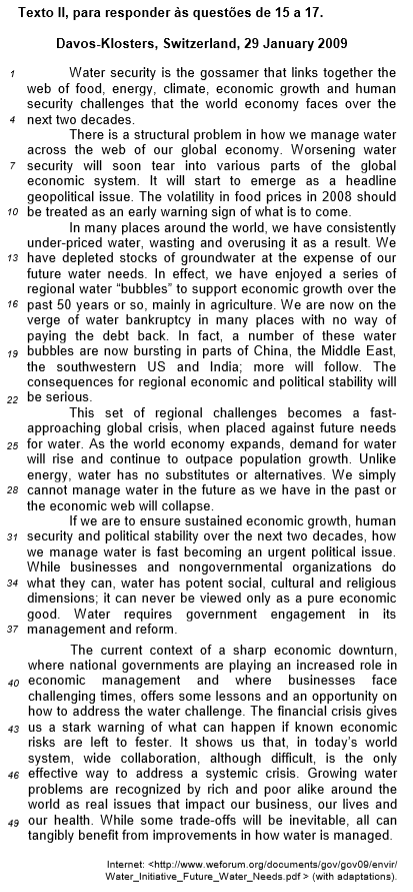
According to text II, mark the correct alternative.
Ano: 2009
Banca:
ESAF
Órgão:
MPO
Prova:
ESAF - 2009 - MPOG - Especialista em Políticas Públicas e Gestão Governamental - Prova 1 |
Q14978
Inglês

According to paragraph 2, "taxpayers had reason to be glum". In other words, they
Ano: 2009
Banca:
ESAF
Órgão:
ANA
Prova:
ESAF - 2009 - ANA - Analista Administrativo - Comum a todos |
Q14907
Inglês

In paragraph 1, the author refers to "a future marred by conflicts over water". In other words, a future
Ano: 2009
Banca:
CESPE / CEBRASPE
Órgão:
Instituto Rio Branco
Prova:
CESPE / CEBRASPE - 2009 - Instituto Rio Branco - Diplomata - 2ª Etapa - VERMELHO |
Q12314
Inglês

In the phrase "consumers in America feel cowed, while Asia is jittery" (l.29-30), the most appropriate synonyms for "cowed" and "jittery" are respectively
Ano: 2009
Banca:
CESPE / CEBRASPE
Órgão:
Instituto Rio Branco
Prova:
CESPE / CEBRASPE - 2009 - Instituto Rio Branco - Diplomata - 2ª Etapa - VERMELHO |
Q12310
Inglês
Judge - right (C) or wrong (E) - the following items with reference to the text.
In context, the phrase "household name" (R.7) could be appropriately replaced by synonym.
In context, the phrase "household name" (R.7) could be appropriately replaced by synonym.
Ano: 2009
Banca:
CESPE / CEBRASPE
Órgão:
Instituto Rio Branco
Prova:
CESPE / CEBRASPE - 2009 - Instituto Rio Branco - Diplomata - 2ª Etapa - VERMELHO |
Q12296
Inglês
Texto associado

Judge - right (C) or wrong (E) - the following items with
reference to the text.
Judge - right (C) or wrong (E) - the following items with
reference to the text.
The word "business" (l.15) could be appropriately replaced by concern.
Ano: 2009
Banca:
CESPE / CEBRASPE
Órgão:
Instituto Rio Branco
Prova:
CESPE / CEBRASPE - 2009 - Instituto Rio Branco - Diplomata - 2ª Etapa - VERMELHO |
Q12294
Inglês
Texto associado
Judge - right (C) or wrong (E) - the following items with
reference to the text.
Judge - right (C) or wrong (E) - the following items with
reference to the text.
The word "Rather" (l.8) means more or less.
Ano: 2008
Banca:
CESGRANRIO
Órgão:
ANP
Provas:
CESGRANRIO - 2008 - ANP - Técnico em Regulação - Química
|
CESGRANRIO - 2008 - ANP - Técnico em Regulação - Contabilidade |
CESGRANRIO - 2008 - ANP - Técnico em Regulação - Mecânica |
CESGRANRIO - 2008 - ANP - Técnico em Regulação - Instrumentação |
Q2908748
Inglês

“Although” (line 3) introduces an idea of contrast. The idea introduced by the discourse marker is correctly stated in
Ano: 2008
Banca:
CESGRANRIO
Órgão:
ANP
Provas:
CESGRANRIO - 2008 - ANP - Técnico em Regulação - Química
|
CESGRANRIO - 2008 - ANP - Técnico em Regulação - Contabilidade |
CESGRANRIO - 2008 - ANP - Técnico em Regulação - Mecânica |
CESGRANRIO - 2008 - ANP - Técnico em Regulação - Instrumentação |
Q2908746
Inglês
In “This is helping to drive up global soy prices,” (lines 33-34), “drive up” (line 33) could be replaced by

 Conheça nossos planos