Questões de Concurso
Sobre vocabulário | vocabulary em inglês
Foram encontradas 3.314 questões


Ano: 2012
Banca:
IDECAN
Órgão:
Banestes
Provas:
IDECAN - 2012 - Banestes - Analista de Tecnologia da Informação - Desenvolvimento de Sistemas
|
IDECAN - 2012 - Banestes - Analista de Tecnologia da Informação - Suporte e Infraestrutura |
Q365266
Inglês
Match the two columns.
1. Banking account.
2. Savings account.
3. Interests.
4. Profit.
5. Fine.
( ) Ammount of money that must be paid as a penalty.
( ) Income and expenses assigned to a person, business in a bank.
( ) A banking account to supply money for future use.
( ) Money made after all expenses are paid.
( ) Money a lender charges to someone who borrows money
Mark the option with the right sequence.
Ano: 2012
Banca:
Makiyama
Órgão:
CPTM
Provas:
Makiyama - 2012 - CPTM - Analista Administrativo Júnior
|
Makiyama - 2012 - CPTM - Analista de Recursos Humanos Júnior - Administração de Empresas |
Makiyama - 2012 - CPTM - Advogado Júnior |
Makiyama - 2012 - CPTM - Auditor Júnior |
Q328063
Inglês
Texto associado
Generation Y
By Sally Kane, About.com Guide
Born in the mid-1980's and later, Generation Y legal professionals are in their 20s and are just entering the workforce. With numbers estimated as high as 70 million, Generation Y (also -1- as the Millennials) is the fastest growing segment of today's workforce. As law firms compete for available talent, employers cannot ignore the needs, desires and attitudes of this vast generation. Below are a few common traits that define Generation Y.
Tech-Savvy: Generation Y grew up with technology and rely on it to perform their jobs better. Armed with BlackBerrys, laptops, cellphones and other gadgets, Generation Y is plugged-in 24 hours a day, 7 days a week. This generation prefers to communicate through e-mail and text messaging rather than face-to-face contact and -2- webinars and online technology to traditional lecture-based presentations.
Family-Centric: The fast-track has lost much of its appeal for Generation Y who is willing to trade high pay for fewer billable hours, flexible schedules and a better work/life balance. While older generations may view this attitude as narcissistic or lacking commitment, discipline and drive, Generation Y legal professionals have a different vision of workplace expectations and prioritize family over work.
Achievement-Oriented: Nurtured and pampered -3- parents who did not want to make the mistakes of the previous generation, Generation Y is confident, ambitious and achievement-oriented. They have high expectations of their employers, seek out new challenges and are not afraid to question authority. Generation Y wants meaningful work and a solid learning curve
Team-Oriented: As children, Generation Y participated in team sports, play groups and other group activities. They value teamwork and seek the input and affirmation of others. Part of a no-person-left-behind generation, Generation Y is loyal, committed and wants to be included and involved.
Attention-Craving: Generation Y craves attention in the forms of feedback and guidance. They appreciate being kept in the loop and seek frequent praise and reassurance. Generation Y may benefit greatly from mentors who can help guide and develop their young careers.
Font: http://legalcareers.about.com/od/practicetips/a/Ge...
No trecho:“Generation Y craves attention in the forms of feedback and guidance”, a melhor definição para o termo em destaque é:
Ano: 2012
Banca:
CESGRANRIO
Órgão:
TERMOBAHIA
Prova:
CESGRANRIO - 2012 - TERMOBAHIA - Técnico de Segurança Júnior |
Q326239
Inglês

In the text, the word in bold-face type is similar to the word/expression in italics in:
Ano: 2012
Banca:
UNEMAT
Órgão:
CEPROMAT
Prova:
UNEMAT - 2012 - CEPROMAT - Analista de Tecnologia da Informação |
Q299166
Inglês

Relacione as palavras da primeira coluna com as da segunda:
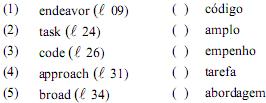
Assinale a alternativa que indica a sequência correta.
Assinale a alternativa que indica a sequência correta.
Ano: 2012
Banca:
IBFC
Órgão:
INEP
Prova:
IBFC - 2012 - INEP - Pesquisador-Tecnologista em Informações e Avaliações Educacionais - Área III |
Q297297
Inglês
Read the following sentences I, II, III: I.
I sent a letter to the airline company complaining about the problems I had during the flight and they have promised to look into the matter.
II. Although that doctor hasn't won the Nobel Prize, I look up to him.
III. I promised her that I would look after her kids if she weren't able to do that.
It's correct to say that the meaning of each underline bold phrasal verb is respectively
Ano: 2012
Banca:
IBFC
Órgão:
INEP
Prova:
IBFC - 2012 - INEP - Pesquisador-Tecnologista em Informações e Avaliações Educacionais - Área III |
Q297295
Inglês
Texto associado
Read the text and answer questions 19), 20), 21), 22), 23) and 24).
Lawsuits claim Knoedler made huge profits on fakes
For more than a dozen years the Upper East Side gallery Knoedler & Company was “substantially dependent” on profits it made from selling a mysterious collection of artwork that is at the center of a federal forgery investigation, former clients of this former gallery have charged in court papers. The analysis is based on financial records turned over as part of a lawsuit against the gallery filed by Domenico and Eleanore De Sole, who in 2004 paid $8.3 million for a painting attributed to Mark Rothko that they now say is a worthless fake. The Rothko is one of approximately 40 works that Knoedler, which closed last year, obtained from Glafira Rosales, a littleknown dealer whose collection of works attributed to Modernist masters has no documented provenance and is the subject of an F.B.I. investigation. Between 1996 and 2008, the suit asserts, Knoedler earned approximately $60 million from works that Ms. Rosales provided on consignment or sold outright to the gallery and cleared $40 million in profits. In one year, 2002, for example, the complaint says the gallery’s entire profit — $5.6 million — was derived from the sale of Ms. Rosales’s works. “Knoedler’s viability as a business was substantially — and, in some years, almost entirely — dependent on sales from the Rosales Collection,” the De Soles claimed last month in an amended version of the suit they filed this year. While the forgery allegations are well known and have been the subject of three federal lawsuits against Knoedler, the recent filings expand the known number of Rosales artworks that were handled by the gallery, which was in business for 165 years, and assert that they played a pivotal role in the gallery’s success. After the F.B.I. issued subpoenas to the gallery in the fall of 2009, Michael Hammer, Knoedler’s owner, halted the sale of any Rosales works. Knoedler ended up losing money that year and in 2010, the court papers say. http://www.nytimes.com/2012/10/22/arts/design/knoe...
In the passage “The analysis is based on financial records turned over as part of a lawsuit against the gallery filed by Domenico and Eleanore De Sole" the meaning of the phrasal verb is
Ano: 2012
Banca:
IBFC
Órgão:
INEP
Prova:
IBFC - 2012 - INEP - Pesquisador-Tecnologista em Informações e Avaliações Educacionais - Área III |
Q297294
Inglês
Texto associado
Read the text and answer questions 19), 20), 21), 22), 23) and 24).
Lawsuits claim Knoedler made huge profits on fakes
For more than a dozen years the Upper East Side gallery Knoedler & Company was “substantially dependent” on profits it made from selling a mysterious collection of artwork that is at the center of a federal forgery investigation, former clients of this former gallery have charged in court papers. The analysis is based on financial records turned over as part of a lawsuit against the gallery filed by Domenico and Eleanore De Sole, who in 2004 paid $8.3 million for a painting attributed to Mark Rothko that they now say is a worthless fake. The Rothko is one of approximately 40 works that Knoedler, which closed last year, obtained from Glafira Rosales, a littleknown dealer whose collection of works attributed to Modernist masters has no documented provenance and is the subject of an F.B.I. investigation. Between 1996 and 2008, the suit asserts, Knoedler earned approximately $60 million from works that Ms. Rosales provided on consignment or sold outright to the gallery and cleared $40 million in profits. In one year, 2002, for example, the complaint says the gallery’s entire profit — $5.6 million — was derived from the sale of Ms. Rosales’s works. “Knoedler’s viability as a business was substantially — and, in some years, almost entirely — dependent on sales from the Rosales Collection,” the De Soles claimed last month in an amended version of the suit they filed this year. While the forgery allegations are well known and have been the subject of three federal lawsuits against Knoedler, the recent filings expand the known number of Rosales artworks that were handled by the gallery, which was in business for 165 years, and assert that they played a pivotal role in the gallery’s success. After the F.B.I. issued subpoenas to the gallery in the fall of 2009, Michael Hammer, Knoedler’s owner, halted the sale of any Rosales works. Knoedler ended up losing money that year and in 2010, the court papers say. http://www.nytimes.com/2012/10/22/arts/design/knoe...
Lawsuits claim Knoedler made huge profits on fakes
For more than a dozen years the Upper East Side gallery Knoedler & Company was “substantially dependent” on profits it made from selling a mysterious collection of artwork that is at the center of a federal forgery investigation, former clients of this former gallery have charged in court papers. The analysis is based on financial records turned over as part of a lawsuit against the gallery filed by Domenico and Eleanore De Sole, who in 2004 paid $8.3 million for a painting attributed to Mark Rothko that they now say is a worthless fake. The Rothko is one of approximately 40 works that Knoedler, which closed last year, obtained from Glafira Rosales, a littleknown dealer whose collection of works attributed to Modernist masters has no documented provenance and is the subject of an F.B.I. investigation. Between 1996 and 2008, the suit asserts, Knoedler earned approximately $60 million from works that Ms. Rosales provided on consignment or sold outright to the gallery and cleared $40 million in profits. In one year, 2002, for example, the complaint says the gallery’s entire profit — $5.6 million — was derived from the sale of Ms. Rosales’s works. “Knoedler’s viability as a business was substantially — and, in some years, almost entirely — dependent on sales from the Rosales Collection,” the De Soles claimed last month in an amended version of the suit they filed this year. While the forgery allegations are well known and have been the subject of three federal lawsuits against Knoedler, the recent filings expand the known number of Rosales artworks that were handled by the gallery, which was in business for 165 years, and assert that they played a pivotal role in the gallery’s success. After the F.B.I. issued subpoenas to the gallery in the fall of 2009, Michael Hammer, Knoedler’s owner, halted the sale of any Rosales works. Knoedler ended up losing money that year and in 2010, the court papers say. http://www.nytimes.com/2012/10/22/arts/design/knoe...
The alternative that brings the best synonym to the bold underline idiom in the passage “Knoedler ended up losing money that year and in 2010" is
Q291547
Inglês

n Text II, the idea expressed by the word in boldface type is described in
Q291543
Inglês

In Text I, the idea expressed by the word in boldface type is described in
Ano: 2012
Banca:
CESPE / CEBRASPE
Órgão:
TCE-ES
Prova:
CESPE - 2012 - TCE-ES - Auditor de Controle Externo - Conhecimentos Básicos - Todos os Cargos |
Q286775
Inglês
Texto associado

Judge the following items according to the text.
Judge the following items according to the text.
The word “tangle” (L.8) can be correctly replaced by line.
Ano: 2012
Banca:
CESGRANRIO
Órgão:
DECEA
Prova:
CESGRANRIO - 2012 - DECEA - Controlador de Tráfego Aéreo Código |
Q277977
Inglês

In the fragments of Text II: “did not hand off control of a departing aircraft to another control center” (lines 33-35) and “It has taken decades to try to come up with new fatigue rules for pilots” (lines 71-72), the expressions hand off and come up with mean, respectively,
Ano: 2012
Banca:
CESGRANRIO
Órgão:
DECEA
Prova:
CESGRANRIO - 2012 - DECEA - Controlador de Tráfego Aéreo Código |
Q277972
Inglês
Based on the meanings in Text II,
Ano: 2012
Banca:
CESGRANRIO
Órgão:
DECEA
Prova:
CESGRANRIO - 2012 - DECEA - Controlador de Tráfego Aéreo Código |
Q277965
Inglês

In Text I, the expression downright scary in “Here’s some news of workers sleeping on the job that’s downright scary.” (lines 1-2) can be replaced, without change in meaning, by
Ano: 2012
Banca:
CESGRANRIO
Órgão:
Innova
Provas:
CESGRANRIO - 2012 - Innova - Advogado Júnior
|
CESGRANRIO - 2012 - Innova - Analista de Sistemas Júnior |
CESGRANRIO - 2012 - Innova - Administrador Júnior |
CESGRANRIO - 2012 - Innova - Contador Júnior |
CESGRANRIO - 2012 - Innova - Médico do Trabalho Júnior |
CESGRANRIO - 2012 - Innova - Engenheiro de Equipamento Júnior - Mecânica |
CESGRANRIO - 2012 - Innova - Engenheiro de Equipamento Júnior - Elétrica |
Q276490
Inglês
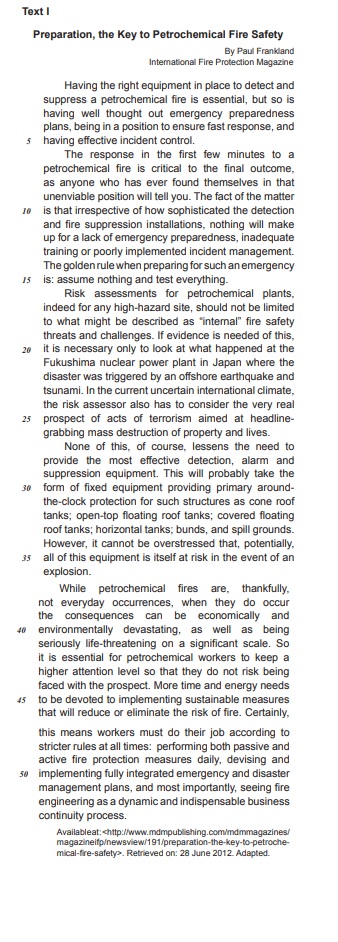
In Text I, the word/expression in boldface type is similar to the one in italics in
Ano: 2012
Banca:
ESAF
Órgão:
Receita Federal
Prova:
ESAF - 2012 - Receita Federal - Analista Tributário da Receita Federal - Prova 1 - Gabarito 1 |
Q264472
Inglês

In paragraph 3 line 8, the word "sorely" could best be replaced by
Ano: 2012
Banca:
ESAF
Órgão:
Receita Federal
Prova:
ESAF - 2012 - Receita Federal - Auditor Fiscal da Receita Federal - Prova 1 - Gabarito 1 |
Q264189
Inglês

In paragraph 2 line 3, the word "brokerages" refers to
Ano: 2012
Banca:
CESGRANRIO
Órgão:
Chesf
Provas:
CESGRANRIO - 2012 - Chesf - Profissional de Nível Superior - Analista de Sistemas
|
CESGRANRIO - 2012 - Chesf - Profissional de Nível Superior - Administração |
CESGRANRIO - 2012 - Chesf - Profissional de Nível Superior - Eletrônica ou Telecomunicações |
Q258803
Inglês

Based on the meanings in Text I, the two items are synonymous in
Ano: 2012
Banca:
CESGRANRIO
Órgão:
CMB
Prova:
CESGRANRIO - 2012 - CMB - Assistente Técnico Administrativo - Programador de Computador |
Q252850
Inglês

In the text, the word in parentheses that describes the idea expressed by the words in bold-face type is:
Ano: 2012
Banca:
CESGRANRIO
Órgão:
Transpetro
Provas:
CESGRANRIO - 2012 - Transpetro - Médico do Trabalho Júnior
|
CESGRANRIO - 2012 - Transpetro - Contador Júnior |
CESGRANRIO - 2012 - Transpetro - Químico de Petróleo Júnior |
CESGRANRIO - 2012 - Transpetro - Engenheiro Júnior - Naval |
CESGRANRIO - 2012 - Transpetro - Administrador Júnior |
CESGRANRIO - 2012 - Transpetro - Bibliotecário Júnior |
CESGRANRIO - 2012 - Transpetro - Analista de Sistemas Júnior - Infra-Estrutura |
CESGRANRIO - 2012 - Transpetro - Engenheiro Júnior - Automação |
CESGRANRIO - 2012 - Transpetro - Engenheiro Júnior - Elétrica |
CESGRANRIO - 2012 - Transpetro - Engenheiro Júnior - Segurança |
CESGRANRIO - 2012 - Transpetro - Profissional de Meio Ambiente Júnior |
CESGRANRIO - 2012 - Transpetro - Engenheiro Júnior - Mecânica |
Q252459
Inglês
Texto associado
Safety Meeting Presentation
Today's meeting is really about you. I can stand
in front of you and talk about working safely and what
procedures to follow until I'm blue in the face. But until
you understand the need for working safely, until you
are willing to be responsible for your safety, it doesn't
mean a whole lot.
Some of you may be familiar with OSHA - the Occupational Safety & Health Administration. The sole purpose of this agency is to keep American workers safe. Complying with OSHA regulations isn't always easy, but if we work together, we can do it. Yet, complying with regulations is not the real reason for working safely. Our real motive is simple. We care about each and every one of you and will do what is necessary to prevent you from being injured.
However, keeping our workplace safe takes input from everyone. Management, supervisor, and all of you have to come together on this issue, or we're in trouble. For example, upper management has to approve the purchase of safe equipment. Supervisors, including myself, have to ensure that each of you knows how to use that equipment safely. Then it's up to you to follow through the task and use the equipment as you were trained. If any one part of this chain fails, accidents are going to happen and people are going to get hurt.
Responsibility Number One - Recognize Hazards
At the core of your safety responsibilities lies the task of recognizing safety and health hazards. In order to do that, you must first understand what constitutes a hazard. Extreme hazards are often obvious. Our hopes are that you won't find too many of those around here.
There are, however, more subtle hazards that won't jump up and bite you. As a result of your safety training and meetings like these, some things may come to mind. For example, a machine may not be easy to lock out. Common practice may be to use a tag. This is a potential hazard and should be discussed. Maybe something can be changed to make it easier to use a lock. Other subtle hazards include such things as frayed electrical cords, a loose machine guard, a cluttered aisle, or maybe something that just doesn't look right.
Responsibility Number Two - Report Hazards
A big part of recognizing hazards is using your instincts. Nobody knows your job as well as you do, so we're counting on you to let us know about possible problems. Beyond recognizing hazards, you have to correct them or report them to someone who can. This too, is a judgement call. For example, if something spills in your work area you can probably clean it up yourself. However, if there is an unlabeled chemical container and you have no idea what it is, you should report it to your supervisor.
Additional Employee Responsibilities
Good housekeeping is a major part of keeping your work area safe. For example, you should take a few minutes each day to ensure that aisles, hallways, and stairways in your work area are not obstructed. If boxes, equipment, or anything else is left to pile up, you have a tripping hazard on your hands. Those obstructions could keep you from exiting the building quickly and safely should you face an emergency situation.
Also watch out for spills. These can lead to slips and falls. Flammable materials are another thing to be aware of. Make sure they are disposed of properly.
Keep Thinking. Even if you're doing your job safely and you are avoiding hazards, there are often even better ways to work safely. If you have ideas for improving the safety of your job or that of co-workers, share them.
Concluding Remarks
While nothing we do can completely eliminate the threat of an incident, we can work together to improve our odds. As I said, this must be a real team effort and I'm counting on input from all of you. Let's keep communicating and continue to improve safety.
Available at: <http://www.ncsu.edu/ehs/www99/right/training/meeting/emplores.html>.Retrieved on: April 1st, 2012. Adapted.
Based on the meanings in the text, it is clear that
Ano: 2012
Banca:
CESGRANRIO
Órgão:
Transpetro
Provas:
CESGRANRIO - 2012 - Transpetro - Médico do Trabalho Júnior
|
CESGRANRIO - 2012 - Transpetro - Contador Júnior |
CESGRANRIO - 2012 - Transpetro - Químico de Petróleo Júnior |
CESGRANRIO - 2012 - Transpetro - Engenheiro Júnior - Naval |
CESGRANRIO - 2012 - Transpetro - Administrador Júnior |
CESGRANRIO - 2012 - Transpetro - Bibliotecário Júnior |
CESGRANRIO - 2012 - Transpetro - Analista de Sistemas Júnior - Infra-Estrutura |
CESGRANRIO - 2012 - Transpetro - Engenheiro Júnior - Automação |
CESGRANRIO - 2012 - Transpetro - Engenheiro Júnior - Elétrica |
CESGRANRIO - 2012 - Transpetro - Engenheiro Júnior - Segurança |
CESGRANRIO - 2012 - Transpetro - Profissional de Meio Ambiente Júnior |
CESGRANRIO - 2012 - Transpetro - Engenheiro Júnior - Mecânica |
Q252455
Inglês
Texto associado
Safety Meeting Presentation
Today's meeting is really about you. I can stand
in front of you and talk about working safely and what
procedures to follow until I'm blue in the face. But until
you understand the need for working safely, until you
are willing to be responsible for your safety, it doesn't
mean a whole lot.
Some of you may be familiar with OSHA - the Occupational Safety & Health Administration. The sole purpose of this agency is to keep American workers safe. Complying with OSHA regulations isn't always easy, but if we work together, we can do it. Yet, complying with regulations is not the real reason for working safely. Our real motive is simple. We care about each and every one of you and will do what is necessary to prevent you from being injured.
However, keeping our workplace safe takes input from everyone. Management, supervisor, and all of you have to come together on this issue, or we're in trouble. For example, upper management has to approve the purchase of safe equipment. Supervisors, including myself, have to ensure that each of you knows how to use that equipment safely. Then it's up to you to follow through the task and use the equipment as you were trained. If any one part of this chain fails, accidents are going to happen and people are going to get hurt.
Responsibility Number One - Recognize Hazards
At the core of your safety responsibilities lies the task of recognizing safety and health hazards. In order to do that, you must first understand what constitutes a hazard. Extreme hazards are often obvious. Our hopes are that you won't find too many of those around here.
There are, however, more subtle hazards that won't jump up and bite you. As a result of your safety training and meetings like these, some things may come to mind. For example, a machine may not be easy to lock out. Common practice may be to use a tag. This is a potential hazard and should be discussed. Maybe something can be changed to make it easier to use a lock. Other subtle hazards include such things as frayed electrical cords, a loose machine guard, a cluttered aisle, or maybe something that just doesn't look right.
Responsibility Number Two - Report Hazards
A big part of recognizing hazards is using your instincts. Nobody knows your job as well as you do, so we're counting on you to let us know about possible problems. Beyond recognizing hazards, you have to correct them or report them to someone who can. This too, is a judgement call. For example, if something spills in your work area you can probably clean it up yourself. However, if there is an unlabeled chemical container and you have no idea what it is, you should report it to your supervisor.
Additional Employee Responsibilities
Good housekeeping is a major part of keeping your work area safe. For example, you should take a few minutes each day to ensure that aisles, hallways, and stairways in your work area are not obstructed. If boxes, equipment, or anything else is left to pile up, you have a tripping hazard on your hands. Those obstructions could keep you from exiting the building quickly and safely should you face an emergency situation.
Also watch out for spills. These can lead to slips and falls. Flammable materials are another thing to be aware of. Make sure they are disposed of properly.
Keep Thinking. Even if you're doing your job safely and you are avoiding hazards, there are often even better ways to work safely. If you have ideas for improving the safety of your job or that of co-workers, share them.
Concluding Remarks
While nothing we do can completely eliminate the threat of an incident, we can work together to improve our odds. As I said, this must be a real team effort and I'm counting on input from all of you. Let's keep communicating and continue to improve safety.
Available at: <http://www.ncsu.edu/ehs/www99/right/training/meeting/emplores.html>.Retrieved on: April 1st, 2012. Adapted.
Some of you may be familiar with OSHA - the Occupational Safety & Health Administration. The sole purpose of this agency is to keep American workers safe. Complying with OSHA regulations isn't always easy, but if we work together, we can do it. Yet, complying with regulations is not the real reason for working safely. Our real motive is simple. We care about each and every one of you and will do what is necessary to prevent you from being injured.
However, keeping our workplace safe takes input from everyone. Management, supervisor, and all of you have to come together on this issue, or we're in trouble. For example, upper management has to approve the purchase of safe equipment. Supervisors, including myself, have to ensure that each of you knows how to use that equipment safely. Then it's up to you to follow through the task and use the equipment as you were trained. If any one part of this chain fails, accidents are going to happen and people are going to get hurt.
Responsibility Number One - Recognize Hazards
At the core of your safety responsibilities lies the task of recognizing safety and health hazards. In order to do that, you must first understand what constitutes a hazard. Extreme hazards are often obvious. Our hopes are that you won't find too many of those around here.
There are, however, more subtle hazards that won't jump up and bite you. As a result of your safety training and meetings like these, some things may come to mind. For example, a machine may not be easy to lock out. Common practice may be to use a tag. This is a potential hazard and should be discussed. Maybe something can be changed to make it easier to use a lock. Other subtle hazards include such things as frayed electrical cords, a loose machine guard, a cluttered aisle, or maybe something that just doesn't look right.
Responsibility Number Two - Report Hazards
A big part of recognizing hazards is using your instincts. Nobody knows your job as well as you do, so we're counting on you to let us know about possible problems. Beyond recognizing hazards, you have to correct them or report them to someone who can. This too, is a judgement call. For example, if something spills in your work area you can probably clean it up yourself. However, if there is an unlabeled chemical container and you have no idea what it is, you should report it to your supervisor.
Additional Employee Responsibilities
Good housekeeping is a major part of keeping your work area safe. For example, you should take a few minutes each day to ensure that aisles, hallways, and stairways in your work area are not obstructed. If boxes, equipment, or anything else is left to pile up, you have a tripping hazard on your hands. Those obstructions could keep you from exiting the building quickly and safely should you face an emergency situation.
Also watch out for spills. These can lead to slips and falls. Flammable materials are another thing to be aware of. Make sure they are disposed of properly.
Keep Thinking. Even if you're doing your job safely and you are avoiding hazards, there are often even better ways to work safely. If you have ideas for improving the safety of your job or that of co-workers, share them.
Concluding Remarks
While nothing we do can completely eliminate the threat of an incident, we can work together to improve our odds. As I said, this must be a real team effort and I'm counting on input from all of you. Let's keep communicating and continue to improve safety.
Available at: <http://www.ncsu.edu/ehs/www99/right/training/meeting/emplores.html>.Retrieved on: April 1st, 2012. Adapted.
The expressions “Complying with" and “follow through" in the fragments “Complying with OSHA regulations isn't always easy," (lines 10-11) and “Then it's up to you to follow through the task and use the equipment as you were trained." (lines 23-24) may, respectively, be substituted, without change in meaning, by

 Conheça nossos planos