Questões de Concurso Sobre inglês
Foram encontradas 25.994 questões


In 1977, during his first official visit abroad as President of the United States, Jimmy Carter was betrayed by the language barrier and the choices of his translator. In the course of meeting his Polish counterpart, Edward Gierek, the translator was on hand to provide a translation of his president’s words into Polish. Unfortunately, his translations could, perhaps, have not been farther from the truth of what Carter said.
Announcing that he was extremely glad to be in Poland for his first trip abroad, the translator somehow managed to mistranslate the friendly statement into the announcement of seeming defection by the American President, turning "I left the United States this morning" into "I left the United States, never to return". Furthermore, Carter’s warm statement of his visit to the nation was bizarrely mistranslated into the comment that President Carter "was happy to grasp at Poland’s private parts". Following up this colossal mistake, the interpreter then successively translated Carter’s expression of a hope to learn more about the Polish people’s "desires for the future" into "I desire the Poles carnally". Adding insult to injury, during Carter’s toast at a state banquet later during the same trip, a different interpreter providing a translation could not understand the American President’s Georgia accent and consequently chose to simply not translate his words at all rather than offer an inaccurate depiction. In hindsight, the latter interpreter opted for the better path in the face of confusion.
17 Mishandled International Events Throughout History.
Internet: <historycollection.com> (adapted).
About the previous text, judge the item bellow.
With the expression "Adding insult to injury" (fourth sentence of the second paragraph), the author suggests that Carter took the first translator’s mistakes as a case of injury.
In 1977, during his first official visit abroad as President of the United States, Jimmy Carter was betrayed by the language barrier and the choices of his translator. In the course of meeting his Polish counterpart, Edward Gierek, the translator was on hand to provide a translation of his president’s words into Polish. Unfortunately, his translations could, perhaps, have not been farther from the truth of what Carter said.
Announcing that he was extremely glad to be in Poland for his first trip abroad, the translator somehow managed to mistranslate the friendly statement into the announcement of seeming defection by the American President, turning "I left the United States this morning" into "I left the United States, never to return". Furthermore, Carter’s warm statement of his visit to the nation was bizarrely mistranslated into the comment that President Carter "was happy to grasp at Poland’s private parts". Following up this colossal mistake, the interpreter then successively translated Carter’s expression of a hope to learn more about the Polish people’s "desires for the future" into "I desire the Poles carnally". Adding insult to injury, during Carter’s toast at a state banquet later during the same trip, a different interpreter providing a translation could not understand the American President’s Georgia accent and consequently chose to simply not translate his words at all rather than offer an inaccurate depiction. In hindsight, the latter interpreter opted for the better path in the face of confusion.
17 Mishandled International Events Throughout History.
Internet: <historycollection.com> (adapted).
About the previous text, judge the item bellow.
There is an ambiguity in the second sentence of the text, resolved by the mentioning of a politician’s name.
Qatar has made itself into the diplomatic capital of the world. Dotted across Doha are the many palaces and offices that have hosted, over recent years, negotiations about the many intractable diplomatic issues that have taken place the world over.
The power Qatar has come to wield has taken many observers by surprise. As a traditional Muslim monarchy in the Middle East, Qatar is a new kind of location for the sort of high-stakes geopolitical deal-making transacted until recently in Geneva and Oslo. Yet since October, the nation’s massive investment in becoming the world’s go-between has come into its own. Having long cultivated close relations with both the US and Hamas, Qatar became the locus of ceasefire negotiations in major local conflicts, as well as discussions over aid and evacuating the wounded. Its mediation has grown from a strategy to enhance its own safety into a role that underpins the entire world’s security.
Nesrine Malik. The go-between: how Qatar became the global capital of diplomacy.
In: The Guardian. Internet: <www.theguardian.com> (adapted).
About the preceding text, judge the following item.
It is correct to infer from the text that European diplomacy, represented in the text by reference to "Geneva and Oslo" (second sentence of the second paragraph), is not paying much attention to conflicts "that have taken place the world over".
Qatar has made itself into the diplomatic capital of the world. Dotted across Doha are the many palaces and offices that have hosted, over recent years, negotiations about the many intractable diplomatic issues that have taken place the world over.
The power Qatar has come to wield has taken many observers by surprise. As a traditional Muslim monarchy in the Middle East, Qatar is a new kind of location for the sort of high-stakes geopolitical deal-making transacted until recently in Geneva and Oslo. Yet since October, the nation’s massive investment in becoming the world’s go-between has come into its own. Having long cultivated close relations with both the US and Hamas, Qatar became the locus of ceasefire negotiations in major local conflicts, as well as discussions over aid and evacuating the wounded. Its mediation has grown from a strategy to enhance its own safety into a role that underpins the entire world’s security.
Nesrine Malik. The go-between: how Qatar became the global capital of diplomacy.
In: The Guardian. Internet: <www.theguardian.com> (adapted).
About the preceding text, judge the following item.
With "has come into its own" (third sentence of the second paragraph), the author means that Qatar is struggling to keep its role as a diplomatic broker after becoming a major investor in the resolution of conflicts.
Qatar has made itself into the diplomatic capital of the world. Dotted across Doha are the many palaces and offices that have hosted, over recent years, negotiations about the many intractable diplomatic issues that have taken place the world over.
The power Qatar has come to wield has taken many observers by surprise. As a traditional Muslim monarchy in the Middle East, Qatar is a new kind of location for the sort of high-stakes geopolitical deal-making transacted until recently in Geneva and Oslo. Yet since October, the nation’s massive investment in becoming the world’s go-between has come into its own. Having long cultivated close relations with both the US and Hamas, Qatar became the locus of ceasefire negotiations in major local conflicts, as well as discussions over aid and evacuating the wounded. Its mediation has grown from a strategy to enhance its own safety into a role that underpins the entire world’s security.
Nesrine Malik. The go-between: how Qatar became the global capital of diplomacy.
In: The Guardian. Internet: <www.theguardian.com> (adapted).
About the preceding text, judge the following item.
In the last sentence of the text, stating that Qatar has a "role that underpins the entire world’s security" should be understood as affirming that the safety of all humanity is significantly affected by decisions mediated by Qatar in the Middle East.
Qatar has made itself into the diplomatic capital of the world. Dotted across Doha are the many palaces and offices that have hosted, over recent years, negotiations about the many intractable diplomatic issues that have taken place the world over.
The power Qatar has come to wield has taken many observers by surprise. As a traditional Muslim monarchy in the Middle East, Qatar is a new kind of location for the sort of high-stakes geopolitical deal-making transacted until recently in Geneva and Oslo. Yet since October, the nation’s massive investment in becoming the world’s go-between has come into its own. Having long cultivated close relations with both the US and Hamas, Qatar became the locus of ceasefire negotiations in major local conflicts, as well as discussions over aid and evacuating the wounded. Its mediation has grown from a strategy to enhance its own safety into a role that underpins the entire world’s security.
Nesrine Malik. The go-between: how Qatar became the global capital of diplomacy.
In: The Guardian. Internet: <www.theguardian.com> (adapted).
About the preceding text, judge the following item.
It can be correctly inferred from the text that the surprise mentioned in the second paragraph can be explained by people having some preconceived notion of the role played by Middle Eastern countries in the international arena.
Culture is ordinary. Every human society has its own shape, its own purposes, its own meanings. Every human society expresses these, in institutions, and in arts and learning. The making of a society is the finding of common meanings and directions, and its growth is an active debate and amendment under the pressures of experience, contact, and discovery, writing themselves into the land. The growing society is there, yet it is also made and remade in every individual mind.
The making of a mind is, first, the slow learning of shapes, purposes, and meanings, so that work, observation and communication are possible. Then, second, but equal in importance, is the testing of these in experience, the making of new observations, comparisons, and meanings.
A culture has two aspects: the known meanings and directions, which its members are trained to; the new observations and meanings, which are offered and tested. These are the ordinary processes of human societies and human minds, and we see through them the nature of a culture: that it is always both traditional and creative; that it is both the most ordinary common meanings and the finest individual meanings.
We use the word culture in these two senses: to mean a whole way of life ⸺ the common meanings; to mean the arts and learning ⸺ the special processes of discovery and creative effort. Some writers reserve the word for one or other of these senses; I insist on both, and on the significance of their conjunction. The questions I ask about our culture are questions about our general and common purposes, yet also questions about deep personal meanings.
Culture is ordinary, in every society and in every mind.
Raymond Williams. Culture is Ordinary. In: R. Williams.
Resources of Hope: Culture, Democracy, Socialism.
London: Verso, 1989. p. 3-14 (adapted).
Based on the grammatical and semantic aspects of the preceding text, judge the item that follow.
Although immigration is not mentioned explicitly in the text, it is reasonable to infer that the author’s description of society’s growth in the fourth sentence of the first paragraph may include cultural changes resulting from the arrival of new populations.
Culture is ordinary. Every human society has its own shape, its own purposes, its own meanings. Every human society expresses these, in institutions, and in arts and learning. The making of a society is the finding of common meanings and directions, and its growth is an active debate and amendment under the pressures of experience, contact, and discovery, writing themselves into the land. The growing society is there, yet it is also made and remade in every individual mind.
The making of a mind is, first, the slow learning of shapes, purposes, and meanings, so that work, observation and communication are possible. Then, second, but equal in importance, is the testing of these in experience, the making of new observations, comparisons, and meanings.
A culture has two aspects: the known meanings and directions, which its members are trained to; the new observations and meanings, which are offered and tested. These are the ordinary processes of human societies and human minds, and we see through them the nature of a culture: that it is always both traditional and creative; that it is both the most ordinary common meanings and the finest individual meanings.
We use the word culture in these two senses: to mean a whole way of life ⸺ the common meanings; to mean the arts and learning ⸺ the special processes of discovery and creative effort. Some writers reserve the word for one or other of these senses; I insist on both, and on the significance of their conjunction. The questions I ask about our culture are questions about our general and common purposes, yet also questions about deep personal meanings.
Culture is ordinary, in every society and in every mind.
Raymond Williams. Culture is Ordinary. In: R. Williams.
Resources of Hope: Culture, Democracy, Socialism.
London: Verso, 1989. p. 3-14 (adapted).
Based on the grammatical and semantic aspects of the preceding text, judge the item that follow.
The statement "The making of a society is the finding of common meanings and directions" (fourth sentence of the first paragraph) can be correctly rephrased as A society is formed through the discovery of everyday meanings and directions, without this changing the original meaning of the text.
Culture is ordinary. Every human society has its own shape, its own purposes, its own meanings. Every human society expresses these, in institutions, and in arts and learning. The making of a society is the finding of common meanings and directions, and its growth is an active debate and amendment under the pressures of experience, contact, and discovery, writing themselves into the land. The growing society is there, yet it is also made and remade in every individual mind.
The making of a mind is, first, the slow learning of shapes, purposes, and meanings, so that work, observation and communication are possible. Then, second, but equal in importance, is the testing of these in experience, the making of new observations, comparisons, and meanings.
A culture has two aspects: the known meanings and directions, which its members are trained to; the new observations and meanings, which are offered and tested. These are the ordinary processes of human societies and human minds, and we see through them the nature of a culture: that it is always both traditional and creative; that it is both the most ordinary common meanings and the finest individual meanings.
We use the word culture in these two senses: to mean a whole way of life ⸺ the common meanings; to mean the arts and learning ⸺ the special processes of discovery and creative effort. Some writers reserve the word for one or other of these senses; I insist on both, and on the significance of their conjunction. The questions I ask about our culture are questions about our general and common purposes, yet also questions about deep personal meanings.
Culture is ordinary, in every society and in every mind.
Raymond Williams. Culture is Ordinary. In: R. Williams.
Resources of Hope: Culture, Democracy, Socialism.
London: Verso, 1989. p. 3-14 (adapted).
Based on the grammatical and semantic aspects of the preceding text, judge the item that follow.
In the last sentence of the text ⸺ "Culture is ordinary, in every society and in every mind" ⸺, "every" can be replaced with either each or all without compromising grammatical correctness or altering the overall meaning, but the change nonetheless alters the emphasis of the original wording.
Culture is ordinary. Every human society has its own shape, its own purposes, its own meanings. Every human society expresses these, in institutions, and in arts and learning. The making of a society is the finding of common meanings and directions, and its growth is an active debate and amendment under the pressures of experience, contact, and discovery, writing themselves into the land. The growing society is there, yet it is also made and remade in every individual mind.
The making of a mind is, first, the slow learning of shapes, purposes, and meanings, so that work, observation and communication are possible. Then, second, but equal in importance, is the testing of these in experience, the making of new observations, comparisons, and meanings.
A culture has two aspects: the known meanings and directions, which its members are trained to; the new observations and meanings, which are offered and tested. These are the ordinary processes of human societies and human minds, and we see through them the nature of a culture: that it is always both traditional and creative; that it is both the most ordinary common meanings and the finest individual meanings.
We use the word culture in these two senses: to mean a whole way of life ⸺ the common meanings; to mean the arts and learning ⸺ the special processes of discovery and creative effort. Some writers reserve the word for one or other of these senses; I insist on both, and on the significance of their conjunction. The questions I ask about our culture are questions about our general and common purposes, yet also questions about deep personal meanings.
Culture is ordinary, in every society and in every mind.
Raymond Williams. Culture is Ordinary. In: R. Williams.
Resources of Hope: Culture, Democracy, Socialism.
London: Verso, 1989. p. 3-14 (adapted).
Based on the grammatical and semantic aspects of the preceding text, judge the item that follow.
In the passage "The growing society is there, yet it is also made and remade in every individual mind" (last sentence of the first paragraph), "yet" could be replaced with and yet without altering the overall meaning of the fragment.
Culture is ordinary. Every human society has its own shape, its own purposes, its own meanings. Every human society expresses these, in institutions, and in arts and learning. The making of a society is the finding of common meanings and directions, and its growth is an active debate and amendment under the pressures of experience, contact, and discovery, writing themselves into the land. The growing society is there, yet it is also made and remade in every individual mind.
The making of a mind is, first, the slow learning of shapes, purposes, and meanings, so that work, observation and communication are possible. Then, second, but equal in importance, is the testing of these in experience, the making of new observations, comparisons, and meanings.
A culture has two aspects: the known meanings and directions, which its members are trained to; the new observations and meanings, which are offered and tested. These are the ordinary processes of human societies and human minds, and we see through them the nature of a culture: that it is always both traditional and creative; that it is both the most ordinary common meanings and the finest individual meanings.
We use the word culture in these two senses: to mean a whole way of life ⸺ the common meanings; to mean the arts and learning ⸺ the special processes of discovery and creative effort. Some writers reserve the word for one or other of these senses; I insist on both, and on the significance of their conjunction. The questions I ask about our culture are questions about our general and common purposes, yet also questions about deep personal meanings.
Culture is ordinary, in every society and in every mind.
Raymond Williams. Culture is Ordinary. In: R. Williams.
Resources of Hope: Culture, Democracy, Socialism.
London: Verso, 1989. p. 3-14 (adapted).
Based on the grammatical and semantic aspects of the preceding text, judge the item that follow.
According to the author of the text, every member of society is cultured, refined, and, through social experience and discovery, plays a role in shaping cultural development, both individually and collectively.
In recent years, awareness has grown of the scope and scale of violence and discrimination directed at lesbian, gay, bi, trans (LGBT) and intersex people around the world ⸺ including killings, torture, arbitrary detention and widespread discrimination in access to health care, education, employment and housing.
United Nations, regional and national human rights bodies have identified critical gaps in the implementation of international standards to address these and related violations, and have issued a plethora of recommendations, including, among them, the repeal of discriminatory legislation and measures to protect LGBT and intersex people from discrimination, violence, torture and ill treatment, and safeguard rights to freedom of expression, association and peaceful assembly.
Increasingly, governments are taking action ⸺ whether in the form of legislation and policy measures or through targeted social and education programmes. At the United Nations Human Rights Council, more than one hundred countries from all regions around the world have voluntarily committed to take measures to end violence and discrimination linked to sexual orientation and gender identity, based on recommendations generated during the first two cycles of the Universal Periodic Review.
However, serious challenges remain. While many countries have taken encouraging steps, in most cases, these efforts have fallen short of the concerted strategy required to tackle violence and discrimination against LGBT and intersex people. Even in countries that have arguably recorded the most progress in respect of the rights of gay men and lesbians, there has been far less attention given to protecting the rights of trans people and only incipient attention to the rights of intersex people.
United Nations Office of the High Commissioner for Human Rights (OHCHR).
Living Free and Equal: What States are doing to tackle violence and
discrimination against lesbian, gay, bisexual, transgender and intersex people. (2016).
Internet: <www.ohchr.org> (adapted).
Considering the ideas and linguistic aspects of the previous text, judge the following item.
It is correct to infer from the text that the United Nations’ engagement with the problem of violence and discrimination against LGBT and intersex people favored the expansion of access to preferential policies of government-mandated, legalized advantage, thereby benefiting a larger number of people from this group on a global scale.
In recent years, awareness has grown of the scope and scale of violence and discrimination directed at lesbian, gay, bi, trans (LGBT) and intersex people around the world ⸺ including killings, torture, arbitrary detention and widespread discrimination in access to health care, education, employment and housing.
United Nations, regional and national human rights bodies have identified critical gaps in the implementation of international standards to address these and related violations, and have issued a plethora of recommendations, including, among them, the repeal of discriminatory legislation and measures to protect LGBT and intersex people from discrimination, violence, torture and ill treatment, and safeguard rights to freedom of expression, association and peaceful assembly.
Increasingly, governments are taking action ⸺ whether in the form of legislation and policy measures or through targeted social and education programmes. At the United Nations Human Rights Council, more than one hundred countries from all regions around the world have voluntarily committed to take measures to end violence and discrimination linked to sexual orientation and gender identity, based on recommendations generated during the first two cycles of the Universal Periodic Review.
However, serious challenges remain. While many countries have taken encouraging steps, in most cases, these efforts have fallen short of the concerted strategy required to tackle violence and discrimination against LGBT and intersex people. Even in countries that have arguably recorded the most progress in respect of the rights of gay men and lesbians, there has been far less attention given to protecting the rights of trans people and only incipient attention to the rights of intersex people.
United Nations Office of the High Commissioner for Human Rights (OHCHR).
Living Free and Equal: What States are doing to tackle violence and
discrimination against lesbian, gay, bisexual, transgender and intersex people. (2016).
Internet: <www.ohchr.org> (adapted).
Considering the ideas and linguistic aspects of the previous text, judge the following item.
The statement made in the last sentence of the text stops short of making a categorical claim that the countries referred to have achieved the greatest progress in protecting the rights of gay men and lesbians.
In recent years, awareness has grown of the scope and scale of violence and discrimination directed at lesbian, gay, bi, trans (LGBT) and intersex people around the world ⸺ including killings, torture, arbitrary detention and widespread discrimination in access to health care, education, employment and housing.
United Nations, regional and national human rights bodies have identified critical gaps in the implementation of international standards to address these and related violations, and have issued a plethora of recommendations, including, among them, the repeal of discriminatory legislation and measures to protect LGBT and intersex people from discrimination, violence, torture and ill treatment, and safeguard rights to freedom of expression, association and peaceful assembly.
Increasingly, governments are taking action ⸺ whether in the form of legislation and policy measures or through targeted social and education programmes. At the United Nations Human Rights Council, more than one hundred countries from all regions around the world have voluntarily committed to take measures to end violence and discrimination linked to sexual orientation and gender identity, based on recommendations generated during the first two cycles of the Universal Periodic Review.
However, serious challenges remain. While many countries have taken encouraging steps, in most cases, these efforts have fallen short of the concerted strategy required to tackle violence and discrimination against LGBT and intersex people. Even in countries that have arguably recorded the most progress in respect of the rights of gay men and lesbians, there has been far less attention given to protecting the rights of trans people and only incipient attention to the rights of intersex people.
United Nations Office of the High Commissioner for Human Rights (OHCHR).
Living Free and Equal: What States are doing to tackle violence and
discrimination against lesbian, gay, bisexual, transgender and intersex people. (2016).
Internet: <www.ohchr.org> (adapted).
Considering the ideas and linguistic aspects of the previous text, judge the following item.
Throughout the text, references to violence and discrimination against LGBT and intersex people highlight violations characteristic of state actors, as well as others that may also result from the actions of private individuals.
In recent years, awareness has grown of the scope and scale of violence and discrimination directed at lesbian, gay, bi, trans (LGBT) and intersex people around the world ⸺ including killings, torture, arbitrary detention and widespread discrimination in access to health care, education, employment and housing.
United Nations, regional and national human rights bodies have identified critical gaps in the implementation of international standards to address these and related violations, and have issued a plethora of recommendations, including, among them, the repeal of discriminatory legislation and measures to protect LGBT and intersex people from discrimination, violence, torture and ill treatment, and safeguard rights to freedom of expression, association and peaceful assembly.
Increasingly, governments are taking action ⸺ whether in the form of legislation and policy measures or through targeted social and education programmes. At the United Nations Human Rights Council, more than one hundred countries from all regions around the world have voluntarily committed to take measures to end violence and discrimination linked to sexual orientation and gender identity, based on recommendations generated during the first two cycles of the Universal Periodic Review.
However, serious challenges remain. While many countries have taken encouraging steps, in most cases, these efforts have fallen short of the concerted strategy required to tackle violence and discrimination against LGBT and intersex people. Even in countries that have arguably recorded the most progress in respect of the rights of gay men and lesbians, there has been far less attention given to protecting the rights of trans people and only incipient attention to the rights of intersex people.
United Nations Office of the High Commissioner for Human Rights (OHCHR).
Living Free and Equal: What States are doing to tackle violence and
discrimination against lesbian, gay, bisexual, transgender and intersex people. (2016).
Internet: <www.ohchr.org> (adapted).
Considering the ideas and linguistic aspects of the previous text, judge the following item.
The excerpt "awareness has grown of the scope and scale of violence and discrimination" (first sentence of the text) means that awareness has grown from a better understanding of the scope and scale of violence and discrimination
Cyber issues have become increasingly central in international affairs and the breadth of issues discussed under this rubric has grown, including questions of peace and conflict, the fight against cybercrime and controversies around internet governance. In this context, three issue characteristics have affected the practice of cyber diplomacy.
First, cybersecurity retains a strong technical undercurrent that not only poses a challenge to conventional diplomatic skills but also introduces a distinct temporal quality. Reflecting broader trends in digital connectivity, cybersecurity evolves at the speed of technology, contributing to the transient nature of diplomatic practices, the limits of which are "constantly being renegotiated". These conceptual ambiguities have imbued cyber governance with a distinct political dynamic, offering ample opportunity for varied policy solutions to find "rhetorical shelter".
Second, perceptions of the stakes involved are equally evolving, with initial concerns about cyber war and cyberterrorism being supplemented with a focus on attacks below the level of armed attack. Relatedly, dichotomies across cybercrime and international security are blurring as cybercriminals are enlisted in state-sponsored campaigns.
Third, cyber issues exhibit a cross-cutting nature that breaches institutional and epistemic boundaries, calling into action a swath of actors across the public-private divide and requiring coordination across knowledge domains, including technical, legal and policy knowledge.
Johann Ole Willers, Lars Gjesvik. Cybersecurity as an issue of international affairs.
In: Diplomacy in the age of expertise: the case of cyber diplomacy.
International Affairs, Oxford University Press, fev./2026.
Internet: <academic.oup.com> (adapted).
Based on the ideas presented in the preceding text, as well as on its linguistic aspects, judge the following item.
In "issue characteristics" (second sentence of the first paragraph), the word "issue" can be correctly replaced with key without altering the meaning of this expression.
Cyber issues have become increasingly central in international affairs and the breadth of issues discussed under this rubric has grown, including questions of peace and conflict, the fight against cybercrime and controversies around internet governance. In this context, three issue characteristics have affected the practice of cyber diplomacy.
First, cybersecurity retains a strong technical undercurrent that not only poses a challenge to conventional diplomatic skills but also introduces a distinct temporal quality. Reflecting broader trends in digital connectivity, cybersecurity evolves at the speed of technology, contributing to the transient nature of diplomatic practices, the limits of which are "constantly being renegotiated". These conceptual ambiguities have imbued cyber governance with a distinct political dynamic, offering ample opportunity for varied policy solutions to find "rhetorical shelter".
Second, perceptions of the stakes involved are equally evolving, with initial concerns about cyber war and cyberterrorism being supplemented with a focus on attacks below the level of armed attack. Relatedly, dichotomies across cybercrime and international security are blurring as cybercriminals are enlisted in state-sponsored campaigns.
Third, cyber issues exhibit a cross-cutting nature that breaches institutional and epistemic boundaries, calling into action a swath of actors across the public-private divide and requiring coordination across knowledge domains, including technical, legal and policy knowledge.
Johann Ole Willers, Lars Gjesvik. Cybersecurity as an issue of international affairs.
In: Diplomacy in the age of expertise: the case of cyber diplomacy.
International Affairs, Oxford University Press, fev./2026.
Internet: <academic.oup.com> (adapted).
Based on the ideas presented in the preceding text, as well as on its linguistic aspects, judge the following item.
It is correct to conclude from the text that, when the authors state that the limits of diplomatic practices are 'constantly being renegotiated' (second sentence of the second paragraph), they mean that diplomatic boundaries are not fixed but are continually revised as political and technological conditions evolve.
Cyber issues have become increasingly central in international affairs and the breadth of issues discussed under this rubric has grown, including questions of peace and conflict, the fight against cybercrime and controversies around internet governance. In this context, three issue characteristics have affected the practice of cyber diplomacy.
First, cybersecurity retains a strong technical undercurrent that not only poses a challenge to conventional diplomatic skills but also introduces a distinct temporal quality. Reflecting broader trends in digital connectivity, cybersecurity evolves at the speed of technology, contributing to the transient nature of diplomatic practices, the limits of which are "constantly being renegotiated". These conceptual ambiguities have imbued cyber governance with a distinct political dynamic, offering ample opportunity for varied policy solutions to find "rhetorical shelter".
Second, perceptions of the stakes involved are equally evolving, with initial concerns about cyber war and cyberterrorism being supplemented with a focus on attacks below the level of armed attack. Relatedly, dichotomies across cybercrime and international security are blurring as cybercriminals are enlisted in state-sponsored campaigns.
Third, cyber issues exhibit a cross-cutting nature that breaches institutional and epistemic boundaries, calling into action a swath of actors across the public-private divide and requiring coordination across knowledge domains, including technical, legal and policy knowledge.
Johann Ole Willers, Lars Gjesvik. Cybersecurity as an issue of international affairs.
In: Diplomacy in the age of expertise: the case of cyber diplomacy.
International Affairs, Oxford University Press, fev./2026.
Internet: <academic.oup.com> (adapted).
Based on the ideas presented in the preceding text, as well as on its linguistic aspects, judge the following item.
By stating that "cybercriminals are enlisted in state-sponsored campaigns" (last sentence of the third paragraph), the text suggests that they are officially classified as threats to national security.
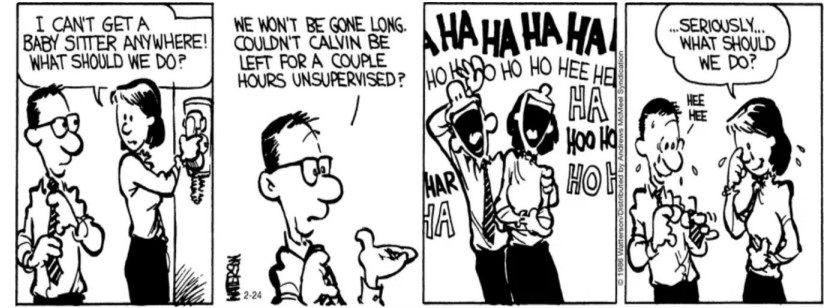
Available at: https://www.gocomics.com/calvinandhobbes/2026/02/24
After the father asks, “Couldn’t Calvin be left for a couple hours unsupervised?”, the parents immediately burst into laughter. This reaction suggests that:
A teacher in the final years of lower secondary education organizes lessons around real-life situations. Students work in small groups to investigate a problem, collect information, discuss possible solutions, and present their findings to the class. The teacher acts mainly as a facilitator, guiding the process rather than delivering long explanations.
This description best represents which teaching approach?

 Conheça nossos planos