Questões de Concurso Sobre inglês
Foram encontradas 25.994 questões


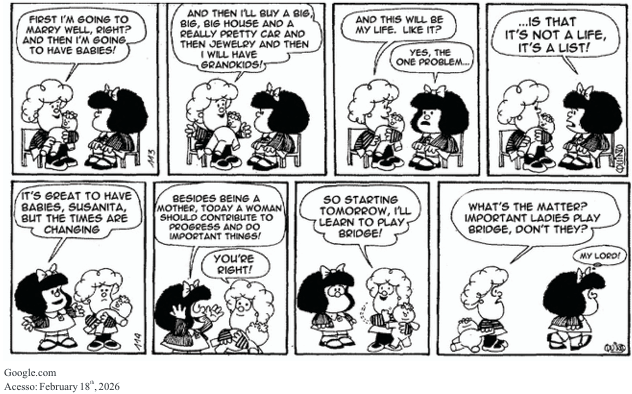
In the comic strip featuring Mafalda and Susanita, the humor and the underlying social commentary arise from the divergent worldviews of the two characters. Based on the dialogue, which of the following statements CORRECTLY interprets the conclusion of their conversation?
Text for question
Hero boy swims for four hours to save his family (9th February 2026)
A 13-year-old Australian boy has been hailed a hero after an epic swim that saved his family. The boy, Austin Appelbee, and his family were on a beach holiday in Western Australia. They were kayaking and paddleboarding in shallow water when strong winds pushed them farther offshore. They ended up over four kilometres away from land, and the daylight was fading. Austin decided to kayak to shore to get help. However, the waves had damaged his kayak, which had taken in water and flipped over. He said he then lost an oar and knew he was in trouble. He decided he had no alternative but to swim back to land. He swam through shark-frequented waters to raise the alarm.
Austin made it to the beach and phoned for help. This sparked a huge rescue operation, which resulted in coastguards finding the teenager's mother and two younger sisters. The boy said: "I hit the bottom of the beach and I just collapsed, and then, after that, I had to “ sprint two kilometres to get to the phone." Rescuers called his efforts "superhuman". One rescuer said Austin's actions could not "be praised highly enough." He added that the teenager's "determination and courage ultimately saved the lives of his mother and siblings." Austin's mother Joanne, 47, told reporters: "The wind picked up. We lost oars, and we drifted out further. It was an absolute nightmare."

Text for question
Hero boy swims for four hours to save his family (9th February 2026)
A 13-year-old Australian boy has been hailed a hero after an epic swim that saved his family. The boy, Austin Appelbee, and his family were on a beach holiday in Western Australia. They were kayaking and paddleboarding in shallow water when strong winds pushed them farther offshore. They ended up over four kilometres away from land, and the daylight was fading. Austin decided to kayak to shore to get help. However, the waves had damaged his kayak, which had taken in water and flipped over. He said he then lost an oar and knew he was in trouble. He decided he had no alternative but to swim back to land. He swam through shark-frequented waters to raise the alarm.
Austin made it to the beach and phoned for help. This sparked a huge rescue operation, which resulted in coastguards finding the teenager's mother and two younger sisters. The boy said: "I hit the bottom of the beach and I just collapsed, and then, after that, I had to “ sprint two kilometres to get to the phone." Rescuers called his efforts "superhuman". One rescuer said Austin's actions could not "be praised highly enough." He added that the teenager's "determination and courage ultimately saved the lives of his mother and siblings." Austin's mother Joanne, 47, told reporters: "The wind picked up. We lost oars, and we drifted out further. It was an absolute nightmare."
Text for question
Hero boy swims for four hours to save his family (9th February 2026)
A 13-year-old Australian boy has been hailed a hero after an epic swim that saved his family. The boy, Austin Appelbee, and his family were on a beach holiday in Western Australia. They were kayaking and paddleboarding in shallow water when strong winds pushed them farther offshore. They ended up over four kilometres away from land, and the daylight was fading. Austin decided to kayak to shore to get help. However, the waves had damaged his kayak, which had taken in water and flipped over. He said he then lost an oar and knew he was in trouble. He decided he had no alternative but to swim back to land. He swam through shark-frequented waters to raise the alarm.
Austin made it to the beach and phoned for help. This sparked a huge rescue operation, which resulted in coastguards finding the teenager's mother and two younger sisters. The boy said: "I hit the bottom of the beach and I just collapsed, and then, after that, I had to “ sprint two kilometres to get to the phone." Rescuers called his efforts "superhuman". One rescuer said Austin's actions could not "be praised highly enough." He added that the teenager's "determination and courage ultimately saved the lives of his mother and siblings." Austin's mother Joanne, 47, told reporters: "The wind picked up. We lost oars, and we drifted out further. It was an absolute nightmare."
Text for question
Hero boy swims for four hours to save his family (9th February 2026)
A 13-year-old Australian boy has been hailed a hero after an epic swim that saved his family. The boy, Austin Appelbee, and his family were on a beach holiday in Western Australia. They were kayaking and paddleboarding in shallow water when strong winds pushed them farther offshore. They ended up over four kilometres away from land, and the daylight was fading. Austin decided to kayak to shore to get help. However, the waves had damaged his kayak, which had taken in water and flipped over. He said he then lost an oar and knew he was in trouble. He decided he had no alternative but to swim back to land. He swam through shark-frequented waters to raise the alarm.
Austin made it to the beach and phoned for help. This sparked a huge rescue operation, which resulted in coastguards finding the teenager's mother and two younger sisters. The boy said: "I hit the bottom of the beach and I just collapsed, and then, after that, I had to “ sprint two kilometres to get to the phone." Rescuers called his efforts "superhuman". One rescuer said Austin's actions could not "be praised highly enough." He added that the teenager's "determination and courage ultimately saved the lives of his mother and siblings." Austin's mother Joanne, 47, told reporters: "The wind picked up. We lost oars, and we drifted out further. It was an absolute nightmare."
“ This sparked a huge rescue operation, which resulted in coastguards finding the teenager s mother and two younger sisters . The boy said: I hit the bottom of the beach and I just collapsed, and then, after that, I had to sprint two kilometres to get to the phone. Rescuers called his efforts ‘superhuman’.”
Select the alternative that presents the CORRECT verbal structure according to formal English grammar, specifically regarding the use of the subjunctive mood in a professional context.
"The candidate possessed all the necessary technical qualifications for the executive position; nevertheless, he was not selected by the board of directors due to a perceived lack of cultural fit."

In the political cartoon provided, the humor and social critique are primarily derived from the rhetorical use of irony. Which of the following statements best explains the underlying message of the dialogue between the two characters?
Text for question
Students using A.I. over humans to learn English (23rd December 2024)
More and more students in Japan are using artificial intelligence (AI) to learn English and other languages. The language learning app Duolingo conducted a survey on how students study languages. More than 4,700 Japanese students answered questions about their language-learning habits. The survey found that the number of people using ChatGPT and other AI tools increased by more than 80 per cent in 2024. AI was particularly popular with younger people. The researchers said more young people used AI than took face-to-face lessons. However, some people in their 20s were not totally happy with AI lessons. They said AI lacked natural responses and was a little boring.
Duolingo said: "We're in the midst of an AI revolution.…Technology has long had an impact on language learning." It found that apps were the most popular method in Japan to learn languages. English was the most studied language, followed by Korean. People are studying Korean "to understand the language as spoken by…favourite artists and celebrities." Duolingo said around 58 per cent of people who took the survey used language-learning apps. This was followed by video streaming platforms like YouTube and Netflix (37%), textbooks (36%) and online lessons (16%). The number of people going to a language school is decreasing. Just 13.8 per cent of people went to classes with a teacher.
https://www.japantimes.co.jp/news/2024/12/19/japan/chatgpt-english-lessons/
https://mainichi.jp/english/articles/20241218/p2a/00m/0li/017000c
https://blog.duolingo.com/2024-duolingo-language-report/
Text for question
Students using A.I. over humans to learn English (23rd December 2024)
More and more students in Japan are using artificial intelligence (AI) to learn English and other languages. The language learning app Duolingo conducted a survey on how students study languages. More than 4,700 Japanese students answered questions about their language-learning habits. The survey found that the number of people using ChatGPT and other AI tools increased by more than 80 per cent in 2024. AI was particularly popular with younger people. The researchers said more young people used AI than took face-to-face lessons. However, some people in their 20s were not totally happy with AI lessons. They said AI lacked natural responses and was a little boring.
Duolingo said: "We're in the midst of an AI revolution.…Technology has long had an impact on language learning." It found that apps were the most popular method in Japan to learn languages. English was the most studied language, followed by Korean. People are studying Korean "to understand the language as spoken by…favourite artists and celebrities." Duolingo said around 58 per cent of people who took the survey used language-learning apps. This was followed by video streaming platforms like YouTube and Netflix (37%), textbooks (36%) and online lessons (16%). The number of people going to a language school is decreasing. Just 13.8 per cent of people went to classes with a teacher.
https://www.japantimes.co.jp/news/2024/12/19/japan/chatgpt-english-lessons/
https://mainichi.jp/english/articles/20241218/p2a/00m/0li/017000c
https://blog.duolingo.com/2024-duolingo-language-report/
Text for question
Students using A.I. over humans to learn English (23rd December 2024)
More and more students in Japan are using artificial intelligence (AI) to learn English and other languages. The language learning app Duolingo conducted a survey on how students study languages. More than 4,700 Japanese students answered questions about their language-learning habits. The survey found that the number of people using ChatGPT and other AI tools increased by more than 80 per cent in 2024. AI was particularly popular with younger people. The researchers said more young people used AI than took face-to-face lessons. However, some people in their 20s were not totally happy with AI lessons. They said AI lacked natural responses and was a little boring.
Duolingo said: "We're in the midst of an AI revolution.…Technology has long had an impact on language learning." It found that apps were the most popular method in Japan to learn languages. English was the most studied language, followed by Korean. People are studying Korean "to understand the language as spoken by…favourite artists and celebrities." Duolingo said around 58 per cent of people who took the survey used language-learning apps. This was followed by video streaming platforms like YouTube and Netflix (37%), textbooks (36%) and online lessons (16%). The number of people going to a language school is decreasing. Just 13.8 per cent of people went to classes with a teacher.
https://www.japantimes.co.jp/news/2024/12/19/japan/chatgpt-english-lessons/
https://mainichi.jp/english/articles/20241218/p2a/00m/0li/017000c
https://blog.duolingo.com/2024-duolingo-language-report/
Text for question
Students using A.I. over humans to learn English (23rd December 2024)
More and more students in Japan are using artificial intelligence (AI) to learn English and other languages. The language learning app Duolingo conducted a survey on how students study languages. More than 4,700 Japanese students answered questions about their language-learning habits. The survey found that the number of people using ChatGPT and other AI tools increased by more than 80 per cent in 2024. AI was particularly popular with younger people. The researchers said more young people used AI than took face-to-face lessons. However, some people in their 20s were not totally happy with AI lessons. They said AI lacked natural responses and was a little boring.
Duolingo said: "We're in the midst of an AI revolution.…Technology has long had an impact on language learning." It found that apps were the most popular method in Japan to learn languages. English was the most studied language, followed by Korean. People are studying Korean "to understand the language as spoken by…favourite artists and celebrities." Duolingo said around 58 per cent of people who took the survey used language-learning apps. This was followed by video streaming platforms like YouTube and Netflix (37%), textbooks (36%) and online lessons (16%). The number of people going to a language school is decreasing. Just 13.8 per cent of people went to classes with a teacher.
https://www.japantimes.co.jp/news/2024/12/19/japan/chatgpt-english-lessons/
https://mainichi.jp/english/articles/20241218/p2a/00m/0li/017000c
https://blog.duolingo.com/2024-duolingo-language-report/
Text for question
Students using A.I. over humans to learn English (23rd December 2024)
More and more students in Japan are using artificial intelligence (AI) to learn English and other languages. The language learning app Duolingo conducted a survey on how students study languages. More than 4,700 Japanese students answered questions about their language-learning habits. The survey found that the number of people using ChatGPT and other AI tools increased by more than 80 per cent in 2024. AI was particularly popular with younger people. The researchers said more young people used AI than took face-to-face lessons. However, some people in their 20s were not totally happy with AI lessons. They said AI lacked natural responses and was a little boring.
Duolingo said: "We're in the midst of an AI revolution.…Technology has long had an impact on language learning." It found that apps were the most popular method in Japan to learn languages. English was the most studied language, followed by Korean. People are studying Korean "to understand the language as spoken by…favourite artists and celebrities." Duolingo said around 58 per cent of people who took the survey used language-learning apps. This was followed by video streaming platforms like YouTube and Netflix (37%), textbooks (36%) and online lessons (16%). The number of people going to a language school is decreasing. Just 13.8 per cent of people went to classes with a teacher.
https://www.japantimes.co.jp/news/2024/12/19/japan/chatgpt-english-lessons/
https://mainichi.jp/english/articles/20241218/p2a/00m/0li/017000c
https://blog.duolingo.com/2024-duolingo-language-report/
The claim to reason or rationality is the ultimate validation of the affirmation and assertion of the human condition. Aristotle’s definition of man as "a rational animal" was not spoken of the African and the Amerindian. Little did he realise that his definition of "man" laid down the foundation for the struggle for reason between colonialists and colonized peoples.
Aristotle’s definition of man was deeply inscribed in the social ethos of those communities and societies which undertook the so-called voyages of discovery apparently driven by innocent curiosity. It seems then that the entire process of decolonisation has upheld and not jettisoned the questionable belief that "man is a rational animal" was not spoken of the African and of the Amerindian.
The term African philosophy renders the idea that history repeats itself easy to believe. The term tends to revive innate skepticism on the one hand and to stimulate ingrained condescension on the other. The skeptic, unswervingly committed to the will to remain ignorant, is simply dismissive of any possibility let alone the probability of African philosophy. Impelled by the will to dominate, the condescendor is often ready to entertain the probability of African philosophy provided the judgement pertaining to the experience, knowledge and truth about African philosophy is recognised as the sole and exclusive right of the condescendor. The self-appointed heirs to the right to reason have thus established themselves as the producers of all knowledge and the only holders of the truth.
Mogobe B. Ramose. African philosophy through Ubuntu.
Harare, Zimbabwe: Mond Books Publishers, 2005, pp. 5-6 (adapted).
Considering the preceding text, judge the following item.
At the end of the second paragraph, if the fragment "questionable belief" were replaced with questionable beliefs, the change would require "was" to be replaced with were for the sentence to remain grammatically correct.
The claim to reason or rationality is the ultimate validation of the affirmation and assertion of the human condition. Aristotle’s definition of man as "a rational animal" was not spoken of the African and the Amerindian. Little did he realise that his definition of "man" laid down the foundation for the struggle for reason between colonialists and colonized peoples.
Aristotle’s definition of man was deeply inscribed in the social ethos of those communities and societies which undertook the so-called voyages of discovery apparently driven by innocent curiosity. It seems then that the entire process of decolonisation has upheld and not jettisoned the questionable belief that "man is a rational animal" was not spoken of the African and of the Amerindian.
The term African philosophy renders the idea that history repeats itself easy to believe. The term tends to revive innate skepticism on the one hand and to stimulate ingrained condescension on the other. The skeptic, unswervingly committed to the will to remain ignorant, is simply dismissive of any possibility let alone the probability of African philosophy. Impelled by the will to dominate, the condescendor is often ready to entertain the probability of African philosophy provided the judgement pertaining to the experience, knowledge and truth about African philosophy is recognised as the sole and exclusive right of the condescendor. The self-appointed heirs to the right to reason have thus established themselves as the producers of all knowledge and the only holders of the truth.
Mogobe B. Ramose. African philosophy through Ubuntu.
Harare, Zimbabwe: Mond Books Publishers, 2005, pp. 5-6 (adapted).
Considering the preceding text, judge the following item.
In the third sentence of the first paragraph, the fragment "Little did he realise" emphasizes the fact that Aristotle had no idea of the consequences of his definition of "man".
The claim to reason or rationality is the ultimate validation of the affirmation and assertion of the human condition. Aristotle’s definition of man as "a rational animal" was not spoken of the African and the Amerindian. Little did he realise that his definition of "man" laid down the foundation for the struggle for reason between colonialists and colonized peoples.
Aristotle’s definition of man was deeply inscribed in the social ethos of those communities and societies which undertook the so-called voyages of discovery apparently driven by innocent curiosity. It seems then that the entire process of decolonisation has upheld and not jettisoned the questionable belief that "man is a rational animal" was not spoken of the African and of the Amerindian.
The term African philosophy renders the idea that history repeats itself easy to believe. The term tends to revive innate skepticism on the one hand and to stimulate ingrained condescension on the other. The skeptic, unswervingly committed to the will to remain ignorant, is simply dismissive of any possibility let alone the probability of African philosophy. Impelled by the will to dominate, the condescendor is often ready to entertain the probability of African philosophy provided the judgement pertaining to the experience, knowledge and truth about African philosophy is recognised as the sole and exclusive right of the condescendor. The self-appointed heirs to the right to reason have thus established themselves as the producers of all knowledge and the only holders of the truth.
Mogobe B. Ramose. African philosophy through Ubuntu.
Harare, Zimbabwe: Mond Books Publishers, 2005, pp. 5-6 (adapted).
Considering the preceding text, judge the following item.
Due to the grammatical function the pronoun "which" has in the first sentence of the second paragraph, it would be grammatically correct to add a comma after "societies".
The claim to reason or rationality is the ultimate validation of the affirmation and assertion of the human condition. Aristotle’s definition of man as "a rational animal" was not spoken of the African and the Amerindian. Little did he realise that his definition of "man" laid down the foundation for the struggle for reason between colonialists and colonized peoples.
Aristotle’s definition of man was deeply inscribed in the social ethos of those communities and societies which undertook the so-called voyages of discovery apparently driven by innocent curiosity. It seems then that the entire process of decolonisation has upheld and not jettisoned the questionable belief that "man is a rational animal" was not spoken of the African and of the Amerindian.
The term African philosophy renders the idea that history repeats itself easy to believe. The term tends to revive innate skepticism on the one hand and to stimulate ingrained condescension on the other. The skeptic, unswervingly committed to the will to remain ignorant, is simply dismissive of any possibility let alone the probability of African philosophy. Impelled by the will to dominate, the condescendor is often ready to entertain the probability of African philosophy provided the judgement pertaining to the experience, knowledge and truth about African philosophy is recognised as the sole and exclusive right of the condescendor. The self-appointed heirs to the right to reason have thus established themselves as the producers of all knowledge and the only holders of the truth.
Mogobe B. Ramose. African philosophy through Ubuntu.
Harare, Zimbabwe: Mond Books Publishers, 2005, pp. 5-6 (adapted).
Considering the preceding text, judge the following item.
The third sentence of the last paragraph has a similar meaning to Those who are skeptic and who have an unremitting desire to remain ignorant play down the idea that there could be an African philosophy.
In 1977, during his first official visit abroad as President of the United States, Jimmy Carter was betrayed by the language barrier and the choices of his translator. In the course of meeting his Polish counterpart, Edward Gierek, the translator was on hand to provide a translation of his president’s words into Polish. Unfortunately, his translations could, perhaps, have not been farther from the truth of what Carter said.
Announcing that he was extremely glad to be in Poland for his first trip abroad, the translator somehow managed to mistranslate the friendly statement into the announcement of seeming defection by the American President, turning "I left the United States this morning" into "I left the United States, never to return". Furthermore, Carter’s warm statement of his visit to the nation was bizarrely mistranslated into the comment that President Carter "was happy to grasp at Poland’s private parts". Following up this colossal mistake, the interpreter then successively translated Carter’s expression of a hope to learn more about the Polish people’s "desires for the future" into "I desire the Poles carnally". Adding insult to injury, during Carter’s toast at a state banquet later during the same trip, a different interpreter providing a translation could not understand the American President’s Georgia accent and consequently chose to simply not translate his words at all rather than offer an inaccurate depiction. In hindsight, the latter interpreter opted for the better path in the face of confusion.
17 Mishandled International Events Throughout History.
Internet: <historycollection.com> (adapted).
About the previous text, judge the item bellow.
It would be acceptable to infer from the text that the first translator it mentioned was an American rather than a Polish citizen.

 Conheça nossos planos