Questões de Concurso Sobre inglês
Foram encontradas 25.994 questões


Ano: 2026
Banca:
FGV
Órgão:
Prefeitura de São José dos Campos - SP
Prova:
FGV - 2026 - Prefeitura de São José dos Campos - SP - Professor II - Inglês |
Q3998584
Inglês
Texto associado
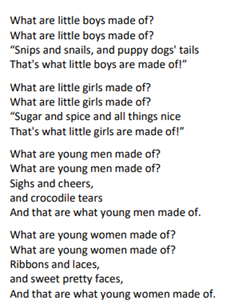
Read Text III and answer the following question.
Text III
Adapted from https://nurseryrhymescollections.com
/lyrics/what-are-little-boys-made-of.html
“That’s” in “That's what little girls are made of” can be used as an
example of:
Ano: 2026
Banca:
FGV
Órgão:
Prefeitura de São José dos Campos - SP
Prova:
FGV - 2026 - Prefeitura de São José dos Campos - SP - Professor II - Inglês |
Q3998583
Inglês
Texto associado
Read Text III and answer the following question.
Text III
Adapted from https://nurseryrhymescollections.com
/lyrics/what-are-little-boys-made-of.html
“Crocodile tears” helps define young men as being:
Ano: 2026
Banca:
FGV
Órgão:
Prefeitura de São José dos Campos - SP
Prova:
FGV - 2026 - Prefeitura de São José dos Campos - SP - Professor II - Inglês |
Q3998582
Inglês
Texto associado
Read Text III and answer the following question.
Text III
Adapted from https://nurseryrhymescollections.com
/lyrics/what-are-little-boys-made-of.html
This nursery rhyme presents a series of:
Ano: 2026
Banca:
FGV
Órgão:
Prefeitura de São José dos Campos - SP
Prova:
FGV - 2026 - Prefeitura de São José dos Campos - SP - Professor II - Inglês |
Q3998581
Inglês
Texto associado
Read Text II and answer the following question.
Text II
They were nearly born on a bus, Estha and Rahel. The car in
which Babà, their father, was taking Ammu, their mother, to
hospital in Shillong to have them, broke down on the winding teaestate road in Assam. They abandoned the car and flagged down a
crowded State Transport bus. With the queer compassion of the
very poor for the comparatively well off, or perhaps only because
they saw how hugely pregnant Ammu was, seated passengers
made room for the couple, and for the rest of the journey Estha
and Rahel’s father had to hold their mother’s stomach (with them
in it) to prevent it from wobbling. That was before they were
divorced and Ammu came back to live in Kerala.
According to Estha, if they’d been born on the bus, they’d have
got free bus rides for the rest of their lives. It wasn’t clear where
he’d got this information from, or how he knew these things, but
for years the twins harbored a faint resentment against their
parents for having diddled them out of a lifetime of free bus rides.
From: https://www.penguinrandomhouse.ca/books/158400/the-god-of-smallthings-by-arundhati-roy/9780735273283/excerpt
The verb phrase in “where he’d got this information from” (2nd
paragraph) is in the:
Ano: 2026
Banca:
FGV
Órgão:
Prefeitura de São José dos Campos - SP
Prova:
FGV - 2026 - Prefeitura de São José dos Campos - SP - Professor II - Inglês |
Q3998580
Inglês
Texto associado
Read Text II and answer the following question.
Text II
They were nearly born on a bus, Estha and Rahel. The car in
which Babà, their father, was taking Ammu, their mother, to
hospital in Shillong to have them, broke down on the winding teaestate road in Assam. They abandoned the car and flagged down a
crowded State Transport bus. With the queer compassion of the
very poor for the comparatively well off, or perhaps only because
they saw how hugely pregnant Ammu was, seated passengers
made room for the couple, and for the rest of the journey Estha
and Rahel’s father had to hold their mother’s stomach (with them
in it) to prevent it from wobbling. That was before they were
divorced and Ammu came back to live in Kerala.
According to Estha, if they’d been born on the bus, they’d have
got free bus rides for the rest of their lives. It wasn’t clear where
he’d got this information from, or how he knew these things, but
for years the twins harbored a faint resentment against their
parents for having diddled them out of a lifetime of free bus rides.
From: https://www.penguinrandomhouse.ca/books/158400/the-god-of-smallthings-by-arundhati-roy/9780735273283/excerpt
The phrase “the comparatively well off” (1st paragraph) refers to
those who are:
Ano: 2026
Banca:
FGV
Órgão:
Prefeitura de São José dos Campos - SP
Prova:
FGV - 2026 - Prefeitura de São José dos Campos - SP - Professor II - Inglês |
Q3998579
Inglês
Texto associado
Read Text II and answer the following question.
Text II
They were nearly born on a bus, Estha and Rahel. The car in
which Babà, their father, was taking Ammu, their mother, to
hospital in Shillong to have them, broke down on the winding teaestate road in Assam. They abandoned the car and flagged down a
crowded State Transport bus. With the queer compassion of the
very poor for the comparatively well off, or perhaps only because
they saw how hugely pregnant Ammu was, seated passengers
made room for the couple, and for the rest of the journey Estha
and Rahel’s father had to hold their mother’s stomach (with them
in it) to prevent it from wobbling. That was before they were
divorced and Ammu came back to live in Kerala.
According to Estha, if they’d been born on the bus, they’d have
got free bus rides for the rest of their lives. It wasn’t clear where
he’d got this information from, or how he knew these things, but
for years the twins harbored a faint resentment against their
parents for having diddled them out of a lifetime of free bus rides.
From: https://www.penguinrandomhouse.ca/books/158400/the-god-of-smallthings-by-arundhati-roy/9780735273283/excerpt
The pronoun in “They abandoned the car and flagged down a
crowded State Transport bus” (1st paragraph) refers to:
Ano: 2026
Banca:
FGV
Órgão:
Prefeitura de São José dos Campos - SP
Prova:
FGV - 2026 - Prefeitura de São José dos Campos - SP - Professor II - Inglês |
Q3998578
Inglês
Texto associado
Read Text II and answer the following question.
Text II
They were nearly born on a bus, Estha and Rahel. The car in
which Babà, their father, was taking Ammu, their mother, to
hospital in Shillong to have them, broke down on the winding teaestate road in Assam. They abandoned the car and flagged down a
crowded State Transport bus. With the queer compassion of the
very poor for the comparatively well off, or perhaps only because
they saw how hugely pregnant Ammu was, seated passengers
made room for the couple, and for the rest of the journey Estha
and Rahel’s father had to hold their mother’s stomach (with them
in it) to prevent it from wobbling. That was before they were
divorced and Ammu came back to live in Kerala.
According to Estha, if they’d been born on the bus, they’d have
got free bus rides for the rest of their lives. It wasn’t clear where
he’d got this information from, or how he knew these things, but
for years the twins harbored a faint resentment against their
parents for having diddled them out of a lifetime of free bus rides.
From: https://www.penguinrandomhouse.ca/books/158400/the-god-of-smallthings-by-arundhati-roy/9780735273283/excerpt
The phrase “winding estate road” (1st paragraph) describes the
road as being:
Ano: 2026
Banca:
FGV
Órgão:
Prefeitura de São José dos Campos - SP
Prova:
FGV - 2026 - Prefeitura de São José dos Campos - SP - Professor II - Inglês |
Q3998577
Inglês
Texto associado
Read Text II and answer the following question.
Text II
They were nearly born on a bus, Estha and Rahel. The car in
which Babà, their father, was taking Ammu, their mother, to
hospital in Shillong to have them, broke down on the winding teaestate road in Assam. They abandoned the car and flagged down a
crowded State Transport bus. With the queer compassion of the
very poor for the comparatively well off, or perhaps only because
they saw how hugely pregnant Ammu was, seated passengers
made room for the couple, and for the rest of the journey Estha
and Rahel’s father had to hold their mother’s stomach (with them
in it) to prevent it from wobbling. That was before they were
divorced and Ammu came back to live in Kerala.
According to Estha, if they’d been born on the bus, they’d have
got free bus rides for the rest of their lives. It wasn’t clear where
he’d got this information from, or how he knew these things, but
for years the twins harbored a faint resentment against their
parents for having diddled them out of a lifetime of free bus rides.
From: https://www.penguinrandomhouse.ca/books/158400/the-god-of-smallthings-by-arundhati-roy/9780735273283/excerpt
The idiom in “seated passengers made room for the couple”
(1st paragraph) means the passengers:
Ano: 2026
Banca:
FGV
Órgão:
Prefeitura de São José dos Campos - SP
Prova:
FGV - 2026 - Prefeitura de São José dos Campos - SP - Professor II - Inglês |
Q3998576
Inglês
Texto associado
Read Text II and answer the following question.
Text II
They were nearly born on a bus, Estha and Rahel. The car in
which Babà, their father, was taking Ammu, their mother, to
hospital in Shillong to have them, broke down on the winding teaestate road in Assam. They abandoned the car and flagged down a
crowded State Transport bus. With the queer compassion of the
very poor for the comparatively well off, or perhaps only because
they saw how hugely pregnant Ammu was, seated passengers
made room for the couple, and for the rest of the journey Estha
and Rahel’s father had to hold their mother’s stomach (with them
in it) to prevent it from wobbling. That was before they were
divorced and Ammu came back to live in Kerala.
According to Estha, if they’d been born on the bus, they’d have
got free bus rides for the rest of their lives. It wasn’t clear where
he’d got this information from, or how he knew these things, but
for years the twins harbored a faint resentment against their
parents for having diddled them out of a lifetime of free bus rides.
From: https://www.penguinrandomhouse.ca/books/158400/the-god-of-smallthings-by-arundhati-roy/9780735273283/excerpt
In the end of the text, it is clear the twins:
Ano: 2026
Banca:
FGV
Órgão:
Prefeitura de São José dos Campos - SP
Prova:
FGV - 2026 - Prefeitura de São José dos Campos - SP - Professor II - Inglês |
Q3998575
Inglês
Texto associado
Read Text II and answer the following question.
Text II
They were nearly born on a bus, Estha and Rahel. The car in
which Babà, their father, was taking Ammu, their mother, to
hospital in Shillong to have them, broke down on the winding teaestate road in Assam. They abandoned the car and flagged down a
crowded State Transport bus. With the queer compassion of the
very poor for the comparatively well off, or perhaps only because
they saw how hugely pregnant Ammu was, seated passengers
made room for the couple, and for the rest of the journey Estha
and Rahel’s father had to hold their mother’s stomach (with them
in it) to prevent it from wobbling. That was before they were
divorced and Ammu came back to live in Kerala.
According to Estha, if they’d been born on the bus, they’d have
got free bus rides for the rest of their lives. It wasn’t clear where
he’d got this information from, or how he knew these things, but
for years the twins harbored a faint resentment against their
parents for having diddled them out of a lifetime of free bus rides.
From: https://www.penguinrandomhouse.ca/books/158400/the-god-of-smallthings-by-arundhati-roy/9780735273283/excerpt
The situation described in the first paragraph reflects:
Ano: 2026
Banca:
FGV
Órgão:
Prefeitura de São José dos Campos - SP
Prova:
FGV - 2026 - Prefeitura de São José dos Campos - SP - Professor II - Inglês |
Q3998574
Inglês
Texto associado
Read Text I and answer the question that follows.
Text I
Multiliteracy: the new basic skill for the 21st century classroom
We increasingly engage with texts that draw meaning beyond
written words from other sources. Images, sound, video clips and
gestures (alone and in combination) all play central roles in how
we communicate and interpret content.
This multimedia approach is especially evident in online
platforms and social media, where a single piece of content may
blend written language with videos, graphics, photos and other
visual elements. This change requires us to rethink what we mean
by literacy.
Nearly 30 years ago, a group of scholars, the New London
Group, recognised the need for a broader understanding of
literacy after observing a growing gap between the literacy needs
students faced outside of school and the print-based practices still
dominant in classrooms.
They introduced a concept of multiliteracies which
acknowledges that we now engage with texts that use multiple
modes of communication. We engage with these texts in different
media environments, each with their own practices and strategies.
The concept incorporates the literacy skills needed to acquire,
interpret, produce and evaluate the multimodal and multimedia
texts we encounter today.
For literacy education, this shift means updating classroom
aims, content and activities. The group developed a pedagogical
framework to help schools respond to the growing inequalities and
rapid changes in technology and the textual landscape.
The process starts with examining pupils’ everyday literacy
practices and experiences together. Then these practices are
approached analytically by introducing a metalanguage for
discussing the resources they use to create meaning. Students can
use this metalanguage to critically evaluate their literacy practices
which helps them understand how different modes of
communication work and how to use them effectively.
The pedagogy of multiliteracies also emphasises the design
and production of multimodal texts and collaborative learning in
linguistically and culturally diverse groups, rather than individual
reading activities. […]
Multiliteracies are already included in many European
curricula, and the European framework for key competencies for
lifelong learning defines literacy in a way that aligns with the
concept of multiliteracies. These policy documents and guidelines
provide a foundation for integrating multiliteracies into literacy
education.
Yet, research shows that there is still work to be done to
incorporate teaching multimodal literacy practices into
mainstream literacy education. While many teachers do include
multimodal texts in their classroom activities, tensions between
multimodal and traditional practices still exist.
Studies point out the huge challenges teachers face when they
adapt their teaching to the redefined literacies, and there are
concerns about teachers’ preparedness to teach multiliteracies.
They need support with training and appropriate materials. Teacher educators and policy makers must ensure that teachers
have substantial and concrete support.
Adapted from https://school-education.ec.europa.eu/en/discover/expertviews/multiliteracy-new-basic-skill-21st-century-classroom
The phrasal verb in “Studies point out the huge challenges” (last
paragraph) is similar in meaning to:
Ano: 2026
Banca:
FGV
Órgão:
Prefeitura de São José dos Campos - SP
Prova:
FGV - 2026 - Prefeitura de São José dos Campos - SP - Professor II - Inglês |
Q3998573
Inglês
Texto associado
Read Text I and answer the question that follows.
Text I
Multiliteracy: the new basic skill for the 21st century classroom
We increasingly engage with texts that draw meaning beyond
written words from other sources. Images, sound, video clips and
gestures (alone and in combination) all play central roles in how
we communicate and interpret content.
This multimedia approach is especially evident in online
platforms and social media, where a single piece of content may
blend written language with videos, graphics, photos and other
visual elements. This change requires us to rethink what we mean
by literacy.
Nearly 30 years ago, a group of scholars, the New London
Group, recognised the need for a broader understanding of
literacy after observing a growing gap between the literacy needs
students faced outside of school and the print-based practices still
dominant in classrooms.
They introduced a concept of multiliteracies which
acknowledges that we now engage with texts that use multiple
modes of communication. We engage with these texts in different
media environments, each with their own practices and strategies.
The concept incorporates the literacy skills needed to acquire,
interpret, produce and evaluate the multimodal and multimedia
texts we encounter today.
For literacy education, this shift means updating classroom
aims, content and activities. The group developed a pedagogical
framework to help schools respond to the growing inequalities and
rapid changes in technology and the textual landscape.
The process starts with examining pupils’ everyday literacy
practices and experiences together. Then these practices are
approached analytically by introducing a metalanguage for
discussing the resources they use to create meaning. Students can
use this metalanguage to critically evaluate their literacy practices
which helps them understand how different modes of
communication work and how to use them effectively.
The pedagogy of multiliteracies also emphasises the design
and production of multimodal texts and collaborative learning in
linguistically and culturally diverse groups, rather than individual
reading activities. […]
Multiliteracies are already included in many European
curricula, and the European framework for key competencies for
lifelong learning defines literacy in a way that aligns with the
concept of multiliteracies. These policy documents and guidelines
provide a foundation for integrating multiliteracies into literacy
education.
Yet, research shows that there is still work to be done to
incorporate teaching multimodal literacy practices into
mainstream literacy education. While many teachers do include
multimodal texts in their classroom activities, tensions between
multimodal and traditional practices still exist.
Studies point out the huge challenges teachers face when they
adapt their teaching to the redefined literacies, and there are
concerns about teachers’ preparedness to teach multiliteracies.
They need support with training and appropriate materials. Teacher educators and policy makers must ensure that teachers
have substantial and concrete support.
Adapted from https://school-education.ec.europa.eu/en/discover/expertviews/multiliteracy-new-basic-skill-21st-century-classroom
The first word in “Yet, research shows that there is still work to be
done” (10th paragraph) can be replaced, without significant change
of meaning, by:
Ano: 2026
Banca:
FGV
Órgão:
Prefeitura de São José dos Campos - SP
Prova:
FGV - 2026 - Prefeitura de São José dos Campos - SP - Professor II - Inglês |
Q3998572
Inglês
Texto associado
Read Text I and answer the question that follows.
Text I
Multiliteracy: the new basic skill for the 21st century classroom
We increasingly engage with texts that draw meaning beyond
written words from other sources. Images, sound, video clips and
gestures (alone and in combination) all play central roles in how
we communicate and interpret content.
This multimedia approach is especially evident in online
platforms and social media, where a single piece of content may
blend written language with videos, graphics, photos and other
visual elements. This change requires us to rethink what we mean
by literacy.
Nearly 30 years ago, a group of scholars, the New London
Group, recognised the need for a broader understanding of
literacy after observing a growing gap between the literacy needs
students faced outside of school and the print-based practices still
dominant in classrooms.
They introduced a concept of multiliteracies which
acknowledges that we now engage with texts that use multiple
modes of communication. We engage with these texts in different
media environments, each with their own practices and strategies.
The concept incorporates the literacy skills needed to acquire,
interpret, produce and evaluate the multimodal and multimedia
texts we encounter today.
For literacy education, this shift means updating classroom
aims, content and activities. The group developed a pedagogical
framework to help schools respond to the growing inequalities and
rapid changes in technology and the textual landscape.
The process starts with examining pupils’ everyday literacy
practices and experiences together. Then these practices are
approached analytically by introducing a metalanguage for
discussing the resources they use to create meaning. Students can
use this metalanguage to critically evaluate their literacy practices
which helps them understand how different modes of
communication work and how to use them effectively.
The pedagogy of multiliteracies also emphasises the design
and production of multimodal texts and collaborative learning in
linguistically and culturally diverse groups, rather than individual
reading activities. […]
Multiliteracies are already included in many European
curricula, and the European framework for key competencies for
lifelong learning defines literacy in a way that aligns with the
concept of multiliteracies. These policy documents and guidelines
provide a foundation for integrating multiliteracies into literacy
education.
Yet, research shows that there is still work to be done to
incorporate teaching multimodal literacy practices into
mainstream literacy education. While many teachers do include
multimodal texts in their classroom activities, tensions between
multimodal and traditional practices still exist.
Studies point out the huge challenges teachers face when they
adapt their teaching to the redefined literacies, and there are
concerns about teachers’ preparedness to teach multiliteracies.
They need support with training and appropriate materials. Teacher educators and policy makers must ensure that teachers
have substantial and concrete support.
Adapted from https://school-education.ec.europa.eu/en/discover/expertviews/multiliteracy-new-basic-skill-21st-century-classroom
The word “lifelong” (9th paragraph) is formed by:
Ano: 2026
Banca:
FGV
Órgão:
Prefeitura de São José dos Campos - SP
Prova:
FGV - 2026 - Prefeitura de São José dos Campos - SP - Professor II - Inglês |
Q3998571
Inglês
Texto associado
Read Text I and answer the question that follows.
Text I
Multiliteracy: the new basic skill for the 21st century classroom
We increasingly engage with texts that draw meaning beyond
written words from other sources. Images, sound, video clips and
gestures (alone and in combination) all play central roles in how
we communicate and interpret content.
This multimedia approach is especially evident in online
platforms and social media, where a single piece of content may
blend written language with videos, graphics, photos and other
visual elements. This change requires us to rethink what we mean
by literacy.
Nearly 30 years ago, a group of scholars, the New London
Group, recognised the need for a broader understanding of
literacy after observing a growing gap between the literacy needs
students faced outside of school and the print-based practices still
dominant in classrooms.
They introduced a concept of multiliteracies which
acknowledges that we now engage with texts that use multiple
modes of communication. We engage with these texts in different
media environments, each with their own practices and strategies.
The concept incorporates the literacy skills needed to acquire,
interpret, produce and evaluate the multimodal and multimedia
texts we encounter today.
For literacy education, this shift means updating classroom
aims, content and activities. The group developed a pedagogical
framework to help schools respond to the growing inequalities and
rapid changes in technology and the textual landscape.
The process starts with examining pupils’ everyday literacy
practices and experiences together. Then these practices are
approached analytically by introducing a metalanguage for
discussing the resources they use to create meaning. Students can
use this metalanguage to critically evaluate their literacy practices
which helps them understand how different modes of
communication work and how to use them effectively.
The pedagogy of multiliteracies also emphasises the design
and production of multimodal texts and collaborative learning in
linguistically and culturally diverse groups, rather than individual
reading activities. […]
Multiliteracies are already included in many European
curricula, and the European framework for key competencies for
lifelong learning defines literacy in a way that aligns with the
concept of multiliteracies. These policy documents and guidelines
provide a foundation for integrating multiliteracies into literacy
education.
Yet, research shows that there is still work to be done to
incorporate teaching multimodal literacy practices into
mainstream literacy education. While many teachers do include
multimodal texts in their classroom activities, tensions between
multimodal and traditional practices still exist.
Studies point out the huge challenges teachers face when they
adapt their teaching to the redefined literacies, and there are
concerns about teachers’ preparedness to teach multiliteracies.
They need support with training and appropriate materials. Teacher educators and policy makers must ensure that teachers
have substantial and concrete support.
Adapted from https://school-education.ec.europa.eu/en/discover/expertviews/multiliteracy-new-basic-skill-21st-century-classroom
The last word in “the print-based practices” (3rd paragraph)
functions, in this context, as a(n):
Ano: 2026
Banca:
FGV
Órgão:
Prefeitura de São José dos Campos - SP
Prova:
FGV - 2026 - Prefeitura de São José dos Campos - SP - Professor II - Inglês |
Q3998570
Inglês
Texto associado
Read Text I and answer the question that follows.
Text I
Multiliteracy: the new basic skill for the 21st century classroom
We increasingly engage with texts that draw meaning beyond
written words from other sources. Images, sound, video clips and
gestures (alone and in combination) all play central roles in how
we communicate and interpret content.
This multimedia approach is especially evident in online
platforms and social media, where a single piece of content may
blend written language with videos, graphics, photos and other
visual elements. This change requires us to rethink what we mean
by literacy.
Nearly 30 years ago, a group of scholars, the New London
Group, recognised the need for a broader understanding of
literacy after observing a growing gap between the literacy needs
students faced outside of school and the print-based practices still
dominant in classrooms.
They introduced a concept of multiliteracies which
acknowledges that we now engage with texts that use multiple
modes of communication. We engage with these texts in different
media environments, each with their own practices and strategies.
The concept incorporates the literacy skills needed to acquire,
interpret, produce and evaluate the multimodal and multimedia
texts we encounter today.
For literacy education, this shift means updating classroom
aims, content and activities. The group developed a pedagogical
framework to help schools respond to the growing inequalities and
rapid changes in technology and the textual landscape.
The process starts with examining pupils’ everyday literacy
practices and experiences together. Then these practices are
approached analytically by introducing a metalanguage for
discussing the resources they use to create meaning. Students can
use this metalanguage to critically evaluate their literacy practices
which helps them understand how different modes of
communication work and how to use them effectively.
The pedagogy of multiliteracies also emphasises the design
and production of multimodal texts and collaborative learning in
linguistically and culturally diverse groups, rather than individual
reading activities. […]
Multiliteracies are already included in many European
curricula, and the European framework for key competencies for
lifelong learning defines literacy in a way that aligns with the
concept of multiliteracies. These policy documents and guidelines
provide a foundation for integrating multiliteracies into literacy
education.
Yet, research shows that there is still work to be done to
incorporate teaching multimodal literacy practices into
mainstream literacy education. While many teachers do include
multimodal texts in their classroom activities, tensions between
multimodal and traditional practices still exist.
Studies point out the huge challenges teachers face when they
adapt their teaching to the redefined literacies, and there are
concerns about teachers’ preparedness to teach multiliteracies.
They need support with training and appropriate materials. Teacher educators and policy makers must ensure that teachers
have substantial and concrete support.
Adapted from https://school-education.ec.europa.eu/en/discover/expertviews/multiliteracy-new-basic-skill-21st-century-classroom
The opposite of the adjective in “broader understanding”
(3rd paragraph) is:
Ano: 2026
Banca:
FGV
Órgão:
Prefeitura de São José dos Campos - SP
Prova:
FGV - 2026 - Prefeitura de São José dos Campos - SP - Professor II - Inglês |
Q3998569
Inglês
Texto associado
Read Text I and answer the question that follows.
Text I
Multiliteracy: the new basic skill for the 21st century classroom
We increasingly engage with texts that draw meaning beyond
written words from other sources. Images, sound, video clips and
gestures (alone and in combination) all play central roles in how
we communicate and interpret content.
This multimedia approach is especially evident in online
platforms and social media, where a single piece of content may
blend written language with videos, graphics, photos and other
visual elements. This change requires us to rethink what we mean
by literacy.
Nearly 30 years ago, a group of scholars, the New London
Group, recognised the need for a broader understanding of
literacy after observing a growing gap between the literacy needs
students faced outside of school and the print-based practices still
dominant in classrooms.
They introduced a concept of multiliteracies which
acknowledges that we now engage with texts that use multiple
modes of communication. We engage with these texts in different
media environments, each with their own practices and strategies.
The concept incorporates the literacy skills needed to acquire,
interpret, produce and evaluate the multimodal and multimedia
texts we encounter today.
For literacy education, this shift means updating classroom
aims, content and activities. The group developed a pedagogical
framework to help schools respond to the growing inequalities and
rapid changes in technology and the textual landscape.
The process starts with examining pupils’ everyday literacy
practices and experiences together. Then these practices are
approached analytically by introducing a metalanguage for
discussing the resources they use to create meaning. Students can
use this metalanguage to critically evaluate their literacy practices
which helps them understand how different modes of
communication work and how to use them effectively.
The pedagogy of multiliteracies also emphasises the design
and production of multimodal texts and collaborative learning in
linguistically and culturally diverse groups, rather than individual
reading activities. […]
Multiliteracies are already included in many European
curricula, and the European framework for key competencies for
lifelong learning defines literacy in a way that aligns with the
concept of multiliteracies. These policy documents and guidelines
provide a foundation for integrating multiliteracies into literacy
education.
Yet, research shows that there is still work to be done to
incorporate teaching multimodal literacy practices into
mainstream literacy education. While many teachers do include
multimodal texts in their classroom activities, tensions between
multimodal and traditional practices still exist.
Studies point out the huge challenges teachers face when they
adapt their teaching to the redefined literacies, and there are
concerns about teachers’ preparedness to teach multiliteracies.
They need support with training and appropriate materials. Teacher educators and policy makers must ensure that teachers
have substantial and concrete support.
Adapted from https://school-education.ec.europa.eu/en/discover/expertviews/multiliteracy-new-basic-skill-21st-century-classroom
In the phrase “Nearly 30 years ago” (3rd paragraph), the adverb
expresses:
Ano: 2026
Banca:
FGV
Órgão:
Prefeitura de São José dos Campos - SP
Prova:
FGV - 2026 - Prefeitura de São José dos Campos - SP - Professor II - Inglês |
Q3998568
Inglês
Texto associado
Read Text I and answer the question that follows.
Text I
Multiliteracy: the new basic skill for the 21st century classroom
We increasingly engage with texts that draw meaning beyond
written words from other sources. Images, sound, video clips and
gestures (alone and in combination) all play central roles in how
we communicate and interpret content.
This multimedia approach is especially evident in online
platforms and social media, where a single piece of content may
blend written language with videos, graphics, photos and other
visual elements. This change requires us to rethink what we mean
by literacy.
Nearly 30 years ago, a group of scholars, the New London
Group, recognised the need for a broader understanding of
literacy after observing a growing gap between the literacy needs
students faced outside of school and the print-based practices still
dominant in classrooms.
They introduced a concept of multiliteracies which
acknowledges that we now engage with texts that use multiple
modes of communication. We engage with these texts in different
media environments, each with their own practices and strategies.
The concept incorporates the literacy skills needed to acquire,
interpret, produce and evaluate the multimodal and multimedia
texts we encounter today.
For literacy education, this shift means updating classroom
aims, content and activities. The group developed a pedagogical
framework to help schools respond to the growing inequalities and
rapid changes in technology and the textual landscape.
The process starts with examining pupils’ everyday literacy
practices and experiences together. Then these practices are
approached analytically by introducing a metalanguage for
discussing the resources they use to create meaning. Students can
use this metalanguage to critically evaluate their literacy practices
which helps them understand how different modes of
communication work and how to use them effectively.
The pedagogy of multiliteracies also emphasises the design
and production of multimodal texts and collaborative learning in
linguistically and culturally diverse groups, rather than individual
reading activities. […]
Multiliteracies are already included in many European
curricula, and the European framework for key competencies for
lifelong learning defines literacy in a way that aligns with the
concept of multiliteracies. These policy documents and guidelines
provide a foundation for integrating multiliteracies into literacy
education.
Yet, research shows that there is still work to be done to
incorporate teaching multimodal literacy practices into
mainstream literacy education. While many teachers do include
multimodal texts in their classroom activities, tensions between
multimodal and traditional practices still exist.
Studies point out the huge challenges teachers face when they
adapt their teaching to the redefined literacies, and there are
concerns about teachers’ preparedness to teach multiliteracies.
They need support with training and appropriate materials. Teacher educators and policy makers must ensure that teachers
have substantial and concrete support.
Adapted from https://school-education.ec.europa.eu/en/discover/expertviews/multiliteracy-new-basic-skill-21st-century-classroom
The modal verb in “where a single piece of content may blend” (2nd
paragraph) expresses a(n):
Ano: 2026
Banca:
FGV
Órgão:
Prefeitura de São José dos Campos - SP
Prova:
FGV - 2026 - Prefeitura de São José dos Campos - SP - Professor II - Inglês |
Q3998567
Inglês
Texto associado
Read Text I and answer the question that follows.
Text I
Multiliteracy: the new basic skill for the 21st century classroom
We increasingly engage with texts that draw meaning beyond
written words from other sources. Images, sound, video clips and
gestures (alone and in combination) all play central roles in how
we communicate and interpret content.
This multimedia approach is especially evident in online
platforms and social media, where a single piece of content may
blend written language with videos, graphics, photos and other
visual elements. This change requires us to rethink what we mean
by literacy.
Nearly 30 years ago, a group of scholars, the New London
Group, recognised the need for a broader understanding of
literacy after observing a growing gap between the literacy needs
students faced outside of school and the print-based practices still
dominant in classrooms.
They introduced a concept of multiliteracies which
acknowledges that we now engage with texts that use multiple
modes of communication. We engage with these texts in different
media environments, each with their own practices and strategies.
The concept incorporates the literacy skills needed to acquire,
interpret, produce and evaluate the multimodal and multimedia
texts we encounter today.
For literacy education, this shift means updating classroom
aims, content and activities. The group developed a pedagogical
framework to help schools respond to the growing inequalities and
rapid changes in technology and the textual landscape.
The process starts with examining pupils’ everyday literacy
practices and experiences together. Then these practices are
approached analytically by introducing a metalanguage for
discussing the resources they use to create meaning. Students can
use this metalanguage to critically evaluate their literacy practices
which helps them understand how different modes of
communication work and how to use them effectively.
The pedagogy of multiliteracies also emphasises the design
and production of multimodal texts and collaborative learning in
linguistically and culturally diverse groups, rather than individual
reading activities. […]
Multiliteracies are already included in many European
curricula, and the European framework for key competencies for
lifelong learning defines literacy in a way that aligns with the
concept of multiliteracies. These policy documents and guidelines
provide a foundation for integrating multiliteracies into literacy
education.
Yet, research shows that there is still work to be done to
incorporate teaching multimodal literacy practices into
mainstream literacy education. While many teachers do include
multimodal texts in their classroom activities, tensions between
multimodal and traditional practices still exist.
Studies point out the huge challenges teachers face when they
adapt their teaching to the redefined literacies, and there are
concerns about teachers’ preparedness to teach multiliteracies.
They need support with training and appropriate materials. Teacher educators and policy makers must ensure that teachers
have substantial and concrete support.
Adapted from https://school-education.ec.europa.eu/en/discover/expertviews/multiliteracy-new-basic-skill-21st-century-classroom
The simple past and the past participle forms of the verb in “draw
meaning” (1st paragraph) are, respectively:
Ano: 2026
Banca:
FGV
Órgão:
Prefeitura de São José dos Campos - SP
Prova:
FGV - 2026 - Prefeitura de São José dos Campos - SP - Professor II - Inglês |
Q3998566
Inglês
Texto associado
Read Text I and answer the question that follows.
Text I
Multiliteracy: the new basic skill for the 21st century classroom
We increasingly engage with texts that draw meaning beyond
written words from other sources. Images, sound, video clips and
gestures (alone and in combination) all play central roles in how
we communicate and interpret content.
This multimedia approach is especially evident in online
platforms and social media, where a single piece of content may
blend written language with videos, graphics, photos and other
visual elements. This change requires us to rethink what we mean
by literacy.
Nearly 30 years ago, a group of scholars, the New London
Group, recognised the need for a broader understanding of
literacy after observing a growing gap between the literacy needs
students faced outside of school and the print-based practices still
dominant in classrooms.
They introduced a concept of multiliteracies which
acknowledges that we now engage with texts that use multiple
modes of communication. We engage with these texts in different
media environments, each with their own practices and strategies.
The concept incorporates the literacy skills needed to acquire,
interpret, produce and evaluate the multimodal and multimedia
texts we encounter today.
For literacy education, this shift means updating classroom
aims, content and activities. The group developed a pedagogical
framework to help schools respond to the growing inequalities and
rapid changes in technology and the textual landscape.
The process starts with examining pupils’ everyday literacy
practices and experiences together. Then these practices are
approached analytically by introducing a metalanguage for
discussing the resources they use to create meaning. Students can
use this metalanguage to critically evaluate their literacy practices
which helps them understand how different modes of
communication work and how to use them effectively.
The pedagogy of multiliteracies also emphasises the design
and production of multimodal texts and collaborative learning in
linguistically and culturally diverse groups, rather than individual
reading activities. […]
Multiliteracies are already included in many European
curricula, and the European framework for key competencies for
lifelong learning defines literacy in a way that aligns with the
concept of multiliteracies. These policy documents and guidelines
provide a foundation for integrating multiliteracies into literacy
education.
Yet, research shows that there is still work to be done to
incorporate teaching multimodal literacy practices into
mainstream literacy education. While many teachers do include
multimodal texts in their classroom activities, tensions between
multimodal and traditional practices still exist.
Studies point out the huge challenges teachers face when they
adapt their teaching to the redefined literacies, and there are
concerns about teachers’ preparedness to teach multiliteracies.
They need support with training and appropriate materials. Teacher educators and policy makers must ensure that teachers
have substantial and concrete support.
Adapted from https://school-education.ec.europa.eu/en/discover/expertviews/multiliteracy-new-basic-skill-21st-century-classroom
Analyse the assertions below based on Text I:
I. The pedagogy of multiliteracies privileges individual reading tasks.
II. European curricula are unaware of the new multimedia approach discussed in the text.
III. Teacher assistance must be considered when a pedagogy of multiliteracies is implemented.
Choose the correct answer:
I. The pedagogy of multiliteracies privileges individual reading tasks.
II. European curricula are unaware of the new multimedia approach discussed in the text.
III. Teacher assistance must be considered when a pedagogy of multiliteracies is implemented.
Choose the correct answer:
Ano: 2026
Banca:
FGV
Órgão:
Prefeitura de São José dos Campos - SP
Prova:
FGV - 2026 - Prefeitura de São José dos Campos - SP - Professor II - Inglês |
Q3998565
Inglês
Texto associado
Read Text I and answer the question that follows.
Text I
Multiliteracy: the new basic skill for the 21st century classroom
We increasingly engage with texts that draw meaning beyond
written words from other sources. Images, sound, video clips and
gestures (alone and in combination) all play central roles in how
we communicate and interpret content.
This multimedia approach is especially evident in online
platforms and social media, where a single piece of content may
blend written language with videos, graphics, photos and other
visual elements. This change requires us to rethink what we mean
by literacy.
Nearly 30 years ago, a group of scholars, the New London
Group, recognised the need for a broader understanding of
literacy after observing a growing gap between the literacy needs
students faced outside of school and the print-based practices still
dominant in classrooms.
They introduced a concept of multiliteracies which
acknowledges that we now engage with texts that use multiple
modes of communication. We engage with these texts in different
media environments, each with their own practices and strategies.
The concept incorporates the literacy skills needed to acquire,
interpret, produce and evaluate the multimodal and multimedia
texts we encounter today.
For literacy education, this shift means updating classroom
aims, content and activities. The group developed a pedagogical
framework to help schools respond to the growing inequalities and
rapid changes in technology and the textual landscape.
The process starts with examining pupils’ everyday literacy
practices and experiences together. Then these practices are
approached analytically by introducing a metalanguage for
discussing the resources they use to create meaning. Students can
use this metalanguage to critically evaluate their literacy practices
which helps them understand how different modes of
communication work and how to use them effectively.
The pedagogy of multiliteracies also emphasises the design
and production of multimodal texts and collaborative learning in
linguistically and culturally diverse groups, rather than individual
reading activities. […]
Multiliteracies are already included in many European
curricula, and the European framework for key competencies for
lifelong learning defines literacy in a way that aligns with the
concept of multiliteracies. These policy documents and guidelines
provide a foundation for integrating multiliteracies into literacy
education.
Yet, research shows that there is still work to be done to
incorporate teaching multimodal literacy practices into
mainstream literacy education. While many teachers do include
multimodal texts in their classroom activities, tensions between
multimodal and traditional practices still exist.
Studies point out the huge challenges teachers face when they
adapt their teaching to the redefined literacies, and there are
concerns about teachers’ preparedness to teach multiliteracies.
They need support with training and appropriate materials. Teacher educators and policy makers must ensure that teachers
have substantial and concrete support.
Adapted from https://school-education.ec.europa.eu/en/discover/expertviews/multiliteracy-new-basic-skill-21st-century-classroom
Based on the text, mark the statements below as TRUE (T) or FALSE
(F).
( ) Understanding a text depends solely on the words the writer provides.
( ) The New London Group realized schools had to address realworld literacy demands.
( ) Problems in reconciling multimodal and traditional practices still remain.
The statements are, respectively:
( ) Understanding a text depends solely on the words the writer provides.
( ) The New London Group realized schools had to address realworld literacy demands.
( ) Problems in reconciling multimodal and traditional practices still remain.
The statements are, respectively:

 Conheça nossos planos