Questões de Concurso Sobre inglês
Foram encontradas 26.001 questões


Reasons To Make A ‘Reverse Bucket List’, By A Psychologist
By Mark Travers
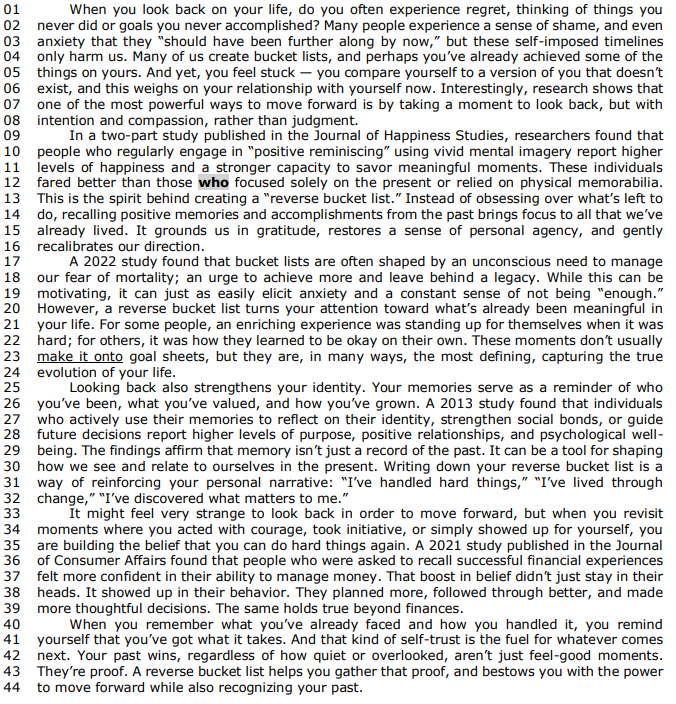
(Available at: https://www.forbes.com/sites/traversmark/2025/07/18/3-reasons-to-make-a-reverse-bucketlist-by-a-psychologist – text specially adapted for this test.) *Bucket list: a list of the things that a person would like to do or achieve before they die. (Available at: https://dictionary.cambridge.org/us/dictionary/english/bucket-list)
Reasons To Make A ‘Reverse Bucket List’, By A Psychologist
By Mark Travers
(Available at: https://www.forbes.com/sites/traversmark/2025/07/18/3-reasons-to-make-a-reverse-bucketlist-by-a-psychologist – text specially adapted for this test.) *Bucket list: a list of the things that a person would like to do or achieve before they die. (Available at: https://dictionary.cambridge.org/us/dictionary/english/bucket-list)
In today’s fast‑paced business environment, hardly anything is more vital for growth and survival than innovation. And this is especially the case when it comes to technologies
IT innovation may sound like an area that’s purely the domain of IT companies, but really, it’s something that every business should be working towards. With new IT solutions coming out practically daily, it’s critical to find the ones that are going to boost operations, that are going to help companies to reach and exceed business goals. And it’s important to not just put innovative IT services in place, but to find the ones that are going to add the most value, and to find ways of using IT services in unique and innovative ways to enhance the way businesses are done.
Imagine IT innovation as a breath of fresh air into the sometimes stale corporate world, refreshing and reinvigorating business models, product development processes, and the very fabric of operational efficiency. Innovative IT breakthroughs like artificial intelligence (AI), cloud computing, or the Internet of Things (IoT), are not just buzzwords but actual business growth strategies.
The ways in which businesses can leverage innovative IT solutions are as varied as the businesses themselves. From using AI to offer personalised customer experiences, to using conversational AI as training aids for new team members, to taking advantage of platforms like Microsoft Copilot and enhancing humans’ daily workflows – the potential is limitless.
One of the real‑world IT innovation examples that showcases the power of forward‑thinking is the adoption of chatbots for customer service. With AI and natural language processing, chatbots can handle simple inquiries, freeing up human staff to tackle more complex issues. More than that, it is possible to feed chatbot information that it can learn from in turn, helping it to provide answers that are unique to a specific business. For example, it could upload responses to the most common questions received, and the chatbot will not only provide this information to potential clients and customers that ask those questions, but will adapt them to the client’s unique situation. This not only improves efficiency but also enhances the customer experience.
IT innovation doesn’t take a single form. Because there are so many different ways to take advantage of innovative technology solutions, the IT innovation types can be broadly broken down into two different categories, but even these aren’t definitive.
Businesses are always looking for ways to enhance the products and services that they offer, and using innovative IT solutions to both pinpoint new product offerings or enhance the services that companies are already specialised in can setting in an increasingly competitive market space. Using IT innovation in product development can involve finding new ways to analyse data to get more meaningful insights, finding ways to incorporate solutions into technologies like apps, smart watches, or IoT devices.
The second category of IT innovation is improving the existing processes within companies. By taking advantage of innovative technologies, they can enhance their internal operations and help the humans behind business to work smarter, not necessarily harder. This will see efficiency at an all‑time high, and more being done in less time. Some examples of ways that innovation can improve processes include using machine learning and AI to automate tasks, streamlining workflows, and both simplifying and enhancing data management.
Internet: <www.solidsystems.co.za> (adapted).
In today’s fast‑paced business environment, hardly anything is more vital for growth and survival than innovation. And this is especially the case when it comes to technologies
IT innovation may sound like an area that’s purely the domain of IT companies, but really, it’s something that every business should be working towards. With new IT solutions coming out practically daily, it’s critical to find the ones that are going to boost operations, that are going to help companies to reach and exceed business goals. And it’s important to not just put innovative IT services in place, but to find the ones that are going to add the most value, and to find ways of using IT services in unique and innovative ways to enhance the way businesses are done.
Imagine IT innovation as a breath of fresh air into the sometimes stale corporate world, refreshing and reinvigorating business models, product development processes, and the very fabric of operational efficiency. Innovative IT breakthroughs like artificial intelligence (AI), cloud computing, or the Internet of Things (IoT), are not just buzzwords but actual business growth strategies.
The ways in which businesses can leverage innovative IT solutions are as varied as the businesses themselves. From using AI to offer personalised customer experiences, to using conversational AI as training aids for new team members, to taking advantage of platforms like Microsoft Copilot and enhancing humans’ daily workflows – the potential is limitless.
One of the real‑world IT innovation examples that showcases the power of forward‑thinking is the adoption of chatbots for customer service. With AI and natural language processing, chatbots can handle simple inquiries, freeing up human staff to tackle more complex issues. More than that, it is possible to feed chatbot information that it can learn from in turn, helping it to provide answers that are unique to a specific business. For example, it could upload responses to the most common questions received, and the chatbot will not only provide this information to potential clients and customers that ask those questions, but will adapt them to the client’s unique situation. This not only improves efficiency but also enhances the customer experience.
IT innovation doesn’t take a single form. Because there are so many different ways to take advantage of innovative technology solutions, the IT innovation types can be broadly broken down into two different categories, but even these aren’t definitive.
Businesses are always looking for ways to enhance the products and services that they offer, and using innovative IT solutions to both pinpoint new product offerings or enhance the services that companies are already specialised in can setting in an increasingly competitive market space. Using IT innovation in product development can involve finding new ways to analyse data to get more meaningful insights, finding ways to incorporate solutions into technologies like apps, smart watches, or IoT devices.
The second category of IT innovation is improving the existing processes within companies. By taking advantage of innovative technologies, they can enhance their internal operations and help the humans behind business to work smarter, not necessarily harder. This will see efficiency at an all‑time high, and more being done in less time. Some examples of ways that innovation can improve processes include using machine learning and AI to automate tasks, streamlining workflows, and both simplifying and enhancing data management.
Internet: <www.solidsystems.co.za> (adapted).
In today’s fast‑paced business environment, hardly anything is more vital for growth and survival than innovation. And this is especially the case when it comes to technologies
IT innovation may sound like an area that’s purely the domain of IT companies, but really, it’s something that every business should be working towards. With new IT solutions coming out practically daily, it’s critical to find the ones that are going to boost operations, that are going to help companies to reach and exceed business goals. And it’s important to not just put innovative IT services in place, but to find the ones that are going to add the most value, and to find ways of using IT services in unique and innovative ways to enhance the way businesses are done.
Imagine IT innovation as a breath of fresh air into the sometimes stale corporate world, refreshing and reinvigorating business models, product development processes, and the very fabric of operational efficiency. Innovative IT breakthroughs like artificial intelligence (AI), cloud computing, or the Internet of Things (IoT), are not just buzzwords but actual business growth strategies.
The ways in which businesses can leverage innovative IT solutions are as varied as the businesses themselves. From using AI to offer personalised customer experiences, to using conversational AI as training aids for new team members, to taking advantage of platforms like Microsoft Copilot and enhancing humans’ daily workflows – the potential is limitless.
One of the real‑world IT innovation examples that showcases the power of forward‑thinking is the adoption of chatbots for customer service. With AI and natural language processing, chatbots can handle simple inquiries, freeing up human staff to tackle more complex issues. More than that, it is possible to feed chatbot information that it can learn from in turn, helping it to provide answers that are unique to a specific business. For example, it could upload responses to the most common questions received, and the chatbot will not only provide this information to potential clients and customers that ask those questions, but will adapt them to the client’s unique situation. This not only improves efficiency but also enhances the customer experience.
IT innovation doesn’t take a single form. Because there are so many different ways to take advantage of innovative technology solutions, the IT innovation types can be broadly broken down into two different categories, but even these aren’t definitive.
Businesses are always looking for ways to enhance the products and services that they offer, and using innovative IT solutions to both pinpoint new product offerings or enhance the services that companies are already specialised in can setting in an increasingly competitive market space. Using IT innovation in product development can involve finding new ways to analyse data to get more meaningful insights, finding ways to incorporate solutions into technologies like apps, smart watches, or IoT devices.
The second category of IT innovation is improving the existing processes within companies. By taking advantage of innovative technologies, they can enhance their internal operations and help the humans behind business to work smarter, not necessarily harder. This will see efficiency at an all‑time high, and more being done in less time. Some examples of ways that innovation can improve processes include using machine learning and AI to automate tasks, streamlining workflows, and both simplifying and enhancing data management.
Internet: <www.solidsystems.co.za> (adapted).
In today’s fast‑paced business environment, hardly anything is more vital for growth and survival than innovation. And this is especially the case when it comes to technologies
IT innovation may sound like an area that’s purely the domain of IT companies, but really, it’s something that every business should be working towards. With new IT solutions coming out practically daily, it’s critical to find the ones that are going to boost operations, that are going to help companies to reach and exceed business goals. And it’s important to not just put innovative IT services in place, but to find the ones that are going to add the most value, and to find ways of using IT services in unique and innovative ways to enhance the way businesses are done.
Imagine IT innovation as a breath of fresh air into the sometimes stale corporate world, refreshing and reinvigorating business models, product development processes, and the very fabric of operational efficiency. Innovative IT breakthroughs like artificial intelligence (AI), cloud computing, or the Internet of Things (IoT), are not just buzzwords but actual business growth strategies.
The ways in which businesses can leverage innovative IT solutions are as varied as the businesses themselves. From using AI to offer personalised customer experiences, to using conversational AI as training aids for new team members, to taking advantage of platforms like Microsoft Copilot and enhancing humans’ daily workflows – the potential is limitless.
One of the real‑world IT innovation examples that showcases the power of forward‑thinking is the adoption of chatbots for customer service. With AI and natural language processing, chatbots can handle simple inquiries, freeing up human staff to tackle more complex issues. More than that, it is possible to feed chatbot information that it can learn from in turn, helping it to provide answers that are unique to a specific business. For example, it could upload responses to the most common questions received, and the chatbot will not only provide this information to potential clients and customers that ask those questions, but will adapt them to the client’s unique situation. This not only improves efficiency but also enhances the customer experience.
IT innovation doesn’t take a single form. Because there are so many different ways to take advantage of innovative technology solutions, the IT innovation types can be broadly broken down into two different categories, but even these aren’t definitive.
Businesses are always looking for ways to enhance the products and services that they offer, and using innovative IT solutions to both pinpoint new product offerings or enhance the services that companies are already specialised in can setting in an increasingly competitive market space. Using IT innovation in product development can involve finding new ways to analyse data to get more meaningful insights, finding ways to incorporate solutions into technologies like apps, smart watches, or IoT devices.
The second category of IT innovation is improving the existing processes within companies. By taking advantage of innovative technologies, they can enhance their internal operations and help the humans behind business to work smarter, not necessarily harder. This will see efficiency at an all‑time high, and more being done in less time. Some examples of ways that innovation can improve processes include using machine learning and AI to automate tasks, streamlining workflows, and both simplifying and enhancing data management.
Internet: <www.solidsystems.co.za> (adapted).
In today’s fast‑paced business environment, hardly anything is more vital for growth and survival than innovation. And this is especially the case when it comes to technologies
IT innovation may sound like an area that’s purely the domain of IT companies, but really, it’s something that every business should be working towards. With new IT solutions coming out practically daily, it’s critical to find the ones that are going to boost operations, that are going to help companies to reach and exceed business goals. And it’s important to not just put innovative IT services in place, but to find the ones that are going to add the most value, and to find ways of using IT services in unique and innovative ways to enhance the way businesses are done.
Imagine IT innovation as a breath of fresh air into the sometimes stale corporate world, refreshing and reinvigorating business models, product development processes, and the very fabric of operational efficiency. Innovative IT breakthroughs like artificial intelligence (AI), cloud computing, or the Internet of Things (IoT), are not just buzzwords but actual business growth strategies.
The ways in which businesses can leverage innovative IT solutions are as varied as the businesses themselves. From using AI to offer personalised customer experiences, to using conversational AI as training aids for new team members, to taking advantage of platforms like Microsoft Copilot and enhancing humans’ daily workflows – the potential is limitless.
One of the real‑world IT innovation examples that showcases the power of forward‑thinking is the adoption of chatbots for customer service. With AI and natural language processing, chatbots can handle simple inquiries, freeing up human staff to tackle more complex issues. More than that, it is possible to feed chatbot information that it can learn from in turn, helping it to provide answers that are unique to a specific business. For example, it could upload responses to the most common questions received, and the chatbot will not only provide this information to potential clients and customers that ask those questions, but will adapt them to the client’s unique situation. This not only improves efficiency but also enhances the customer experience.
IT innovation doesn’t take a single form. Because there are so many different ways to take advantage of innovative technology solutions, the IT innovation types can be broadly broken down into two different categories, but even these aren’t definitive.
Businesses are always looking for ways to enhance the products and services that they offer, and using innovative IT solutions to both pinpoint new product offerings or enhance the services that companies are already specialised in can setting in an increasingly competitive market space. Using IT innovation in product development can involve finding new ways to analyse data to get more meaningful insights, finding ways to incorporate solutions into technologies like apps, smart watches, or IoT devices.
The second category of IT innovation is improving the existing processes within companies. By taking advantage of innovative technologies, they can enhance their internal operations and help the humans behind business to work smarter, not necessarily harder. This will see efficiency at an all‑time high, and more being done in less time. Some examples of ways that innovation can improve processes include using machine learning and AI to automate tasks, streamlining workflows, and both simplifying and enhancing data management.
Internet: <www.solidsystems.co.za> (adapted).
O texto seguinte servirá de base para responder à questão.
Inside the charming city named 'Europe's highest capital' - with no trains or airports
Most of Europe's capital cities are full of tourists wanting to come and see the beautiful scenery and architecture.
But only one can say it's the highest in the continent.
High up in the Pyrenees mountains, 1,023m (3,356ft) above sea level, is Andorra la Vella, in Andorra.
The capital city - also one of the smallest in Europe - spans just five square miles, making London more than 120 times bigger than it.
And it's very hard to get to - due to the fact that no airport or train station can be found throughout the entire country of Andorra.
But that hasn't stopped 8 to 10 million people visiting the tiny place every year.
The best way of getting to Andorra is by flying to Barcelona, Girona or Lleida, in Spain, or Toulouse, France, and driving from any of them.
And while there, you can take advantage of Avinguda Meritxell, the Shopping Mile, filled with huge department stores and duty-free shopping, as Andorra has one of the lowest VATs in Europe.
One person on Tripadvisor described: 'It is a giant duty free shopping haven.
'Selling cigarettes, alcoholic drinks, perfumes and, more cigarettes, alcoholic drinks, perfumes, and even more clothes, shoes and the likes.
'Very good for local economy, very boring.'
Another draw for tourists to Andorra is the Caldea spa, the largest thermal spa in southern Europe - designed in 1987, using the hot springs that naturally flow in the region.
Here, you'll find indoor saunas, hammams and various types of baths, as well as an outdoor lagoon, surrounded by awe-inspiring mountain views.
The basic package for three hours access starts from ?30.50.
One person on Tripadvisor said: 'Fantastic spa with hydro massage pools and overlapping pools with futuristic design.'
Another visitor, who booked the basic entry, added: 'Very clean, very nicely designed and enjoyable. Absolutely worth it, 3 hours is more than enough.'
For the historians, Andorra's Old Town has a pre-Roman church, called Sant Esteve, dating back to the 9th century.
And Andorra La Vella is also an excellent place to stay if you want to head into the Pyrenees mountains.
When it comes to the weather, don't expect too much sun in Andorra.
In the mountains, the highs are as little as 8C in January and February, with the country having an average annual snowfall of 228cm.
Meanwhile, temperatures peak at 24C in July and August.
https://www.dailymail.co.uk/travel/article-15003409/Inside-charming-city -named-Europes-highest-capital-no-trains-airports.html (Adapted)
Mark the correct alternative:
O texto seguinte servirá de base para responder à questão.
Inside the charming city named 'Europe's highest capital' - with no trains or airports
Most of Europe's capital cities are full of tourists wanting to come and see the beautiful scenery and architecture.
But only one can say it's the highest in the continent.
High up in the Pyrenees mountains, 1,023m (3,356ft) above sea level, is Andorra la Vella, in Andorra.
The capital city - also one of the smallest in Europe - spans just five square miles, making London more than 120 times bigger than it.
And it's very hard to get to - due to the fact that no airport or train station can be found throughout the entire country of Andorra.
But that hasn't stopped 8 to 10 million people visiting the tiny place every year.
The best way of getting to Andorra is by flying to Barcelona, Girona or Lleida, in Spain, or Toulouse, France, and driving from any of them.
And while there, you can take advantage of Avinguda Meritxell, the Shopping Mile, filled with huge department stores and duty-free shopping, as Andorra has one of the lowest VATs in Europe.
One person on Tripadvisor described: 'It is a giant duty free shopping haven.
'Selling cigarettes, alcoholic drinks, perfumes and, more cigarettes, alcoholic drinks, perfumes, and even more clothes, shoes and the likes.
'Very good for local economy, very boring.'
Another draw for tourists to Andorra is the Caldea spa, the largest thermal spa in southern Europe - designed in 1987, using the hot springs that naturally flow in the region.
Here, you'll find indoor saunas, hammams and various types of baths, as well as an outdoor lagoon, surrounded by awe-inspiring mountain views.
The basic package for three hours access starts from ?30.50.
One person on Tripadvisor said: 'Fantastic spa with hydro massage pools and overlapping pools with futuristic design.'
Another visitor, who booked the basic entry, added: 'Very clean, very nicely designed and enjoyable. Absolutely worth it, 3 hours is more than enough.'
For the historians, Andorra's Old Town has a pre-Roman church, called Sant Esteve, dating back to the 9th century.
And Andorra La Vella is also an excellent place to stay if you want to head into the Pyrenees mountains.
When it comes to the weather, don't expect too much sun in Andorra.
In the mountains, the highs are as little as 8C in January and February, with the country having an average annual snowfall of 228cm.
Meanwhile, temperatures peak at 24C in July and August.
https://www.dailymail.co.uk/travel/article-15003409/Inside-charming-city -named-Europes-highest-capital-no-trains-airports.html (Adapted)
Which statements are correct?
I."High up in the Pyrenees mountains" demonstrates the use of prepositions to indicate location and position.
II."But that hasn't stopped..." uses a coordinating conjunction to introduce contrasting information.
III."Due to the fact that" functions as a subordinating conjunction expressing cause and effect relationships.
IV."As Andorra has one of the lowest VATs" introduces a reason using a subordinating conjunction.
O texto seguinte servirá de base para responder à questão.
Inside the charming city named 'Europe's highest capital' - with no trains or airports
Most of Europe's capital cities are full of tourists wanting to come and see the beautiful scenery and architecture.
But only one can say it's the highest in the continent.
High up in the Pyrenees mountains, 1,023m (3,356ft) above sea level, is Andorra la Vella, in Andorra.
The capital city - also one of the smallest in Europe - spans just five square miles, making London more than 120 times bigger than it.
And it's very hard to get to - due to the fact that no airport or train station can be found throughout the entire country of Andorra.
But that hasn't stopped 8 to 10 million people visiting the tiny place every year.
The best way of getting to Andorra is by flying to Barcelona, Girona or Lleida, in Spain, or Toulouse, France, and driving from any of them.
And while there, you can take advantage of Avinguda Meritxell, the Shopping Mile, filled with huge department stores and duty-free shopping, as Andorra has one of the lowest VATs in Europe.
One person on Tripadvisor described: 'It is a giant duty free shopping haven.
'Selling cigarettes, alcoholic drinks, perfumes and, more cigarettes, alcoholic drinks, perfumes, and even more clothes, shoes and the likes.
'Very good for local economy, very boring.'
Another draw for tourists to Andorra is the Caldea spa, the largest thermal spa in southern Europe - designed in 1987, using the hot springs that naturally flow in the region.
Here, you'll find indoor saunas, hammams and various types of baths, as well as an outdoor lagoon, surrounded by awe-inspiring mountain views.
The basic package for three hours access starts from ?30.50.
One person on Tripadvisor said: 'Fantastic spa with hydro massage pools and overlapping pools with futuristic design.'
Another visitor, who booked the basic entry, added: 'Very clean, very nicely designed and enjoyable. Absolutely worth it, 3 hours is more than enough.'
For the historians, Andorra's Old Town has a pre-Roman church, called Sant Esteve, dating back to the 9th century.
And Andorra La Vella is also an excellent place to stay if you want to head into the Pyrenees mountains.
When it comes to the weather, don't expect too much sun in Andorra.
In the mountains, the highs are as little as 8C in January and February, with the country having an average annual snowfall of 228cm.
Meanwhile, temperatures peak at 24C in July and August.
https://www.dailymail.co.uk/travel/article-15003409/Inside-charming-city -named-Europes-highest-capital-no-trains-airports.html (Adapted)
Choose the incorrect alternative:
O texto seguinte servirá de base para responder à questão.
Inside the charming city named 'Europe's highest capital' - with no trains or airports
Most of Europe's capital cities are full of tourists wanting to come and see the beautiful scenery and architecture.
But only one can say it's the highest in the continent.
High up in the Pyrenees mountains, 1,023m (3,356ft) above sea level, is Andorra la Vella, in Andorra.
The capital city - also one of the smallest in Europe - spans just five square miles, making London more than 120 times bigger than it.
And it's very hard to get to - due to the fact that no airport or train station can be found throughout the entire country of Andorra.
But that hasn't stopped 8 to 10 million people visiting the tiny place every year.
The best way of getting to Andorra is by flying to Barcelona, Girona or Lleida, in Spain, or Toulouse, France, and driving from any of them.
And while there, you can take advantage of Avinguda Meritxell, the Shopping Mile, filled with huge department stores and duty-free shopping, as Andorra has one of the lowest VATs in Europe.
One person on Tripadvisor described: 'It is a giant duty free shopping haven.
'Selling cigarettes, alcoholic drinks, perfumes and, more cigarettes, alcoholic drinks, perfumes, and even more clothes, shoes and the likes.
'Very good for local economy, very boring.'
Another draw for tourists to Andorra is the Caldea spa, the largest thermal spa in southern Europe - designed in 1987, using the hot springs that naturally flow in the region.
Here, you'll find indoor saunas, hammams and various types of baths, as well as an outdoor lagoon, surrounded by awe-inspiring mountain views.
The basic package for three hours access starts from ?30.50.
One person on Tripadvisor said: 'Fantastic spa with hydro massage pools and overlapping pools with futuristic design.'
Another visitor, who booked the basic entry, added: 'Very clean, very nicely designed and enjoyable. Absolutely worth it, 3 hours is more than enough.'
For the historians, Andorra's Old Town has a pre-Roman church, called Sant Esteve, dating back to the 9th century.
And Andorra La Vella is also an excellent place to stay if you want to head into the Pyrenees mountains.
When it comes to the weather, don't expect too much sun in Andorra.
In the mountains, the highs are as little as 8C in January and February, with the country having an average annual snowfall of 228cm.
Meanwhile, temperatures peak at 24C in July and August.
https://www.dailymail.co.uk/travel/article-15003409/Inside-charming-city -named-Europes-highest-capital-no-trains-airports.html (Adapted)
Choose the incorrect alternative:
O texto seguinte servirá de base para responder à questão.
Inside the charming city named 'Europe's highest capital' - with no trains or airports
Most of Europe's capital cities are full of tourists wanting to come and see the beautiful scenery and architecture.
But only one can say it's the highest in the continent.
High up in the Pyrenees mountains, 1,023m (3,356ft) above sea level, is Andorra la Vella, in Andorra.
The capital city - also one of the smallest in Europe - spans just five square miles, making London more than 120 times bigger than it.
And it's very hard to get to - due to the fact that no airport or train station can be found throughout the entire country of Andorra.
But that hasn't stopped 8 to 10 million people visiting the tiny place every year.
The best way of getting to Andorra is by flying to Barcelona, Girona or Lleida, in Spain, or Toulouse, France, and driving from any of them.
And while there, you can take advantage of Avinguda Meritxell, the Shopping Mile, filled with huge department stores and duty-free shopping, as Andorra has one of the lowest VATs in Europe.
One person on Tripadvisor described: 'It is a giant duty free shopping haven.
'Selling cigarettes, alcoholic drinks, perfumes and, more cigarettes, alcoholic drinks, perfumes, and even more clothes, shoes and the likes.
'Very good for local economy, very boring.'
Another draw for tourists to Andorra is the Caldea spa, the largest thermal spa in southern Europe - designed in 1987, using the hot springs that naturally flow in the region.
Here, you'll find indoor saunas, hammams and various types of baths, as well as an outdoor lagoon, surrounded by awe-inspiring mountain views.
The basic package for three hours access starts from ?30.50.
One person on Tripadvisor said: 'Fantastic spa with hydro massage pools and overlapping pools with futuristic design.'
Another visitor, who booked the basic entry, added: 'Very clean, very nicely designed and enjoyable. Absolutely worth it, 3 hours is more than enough.'
For the historians, Andorra's Old Town has a pre-Roman church, called Sant Esteve, dating back to the 9th century.
And Andorra La Vella is also an excellent place to stay if you want to head into the Pyrenees mountains.
When it comes to the weather, don't expect too much sun in Andorra.
In the mountains, the highs are as little as 8C in January and February, with the country having an average annual snowfall of 228cm.
Meanwhile, temperatures peak at 24C in July and August.
https://www.dailymail.co.uk/travel/article-15003409/Inside-charming-city -named-Europes-highest-capital-no-trains-airports.html (Adapted)
Choose the incorrect alternative:
O texto seguinte servirá de base para responder à questão.
Inside the charming city named 'Europe's highest capital' - with no trains or airports
Most of Europe's capital cities are full of tourists wanting to come and see the beautiful scenery and architecture.
But only one can say it's the highest in the continent.
High up in the Pyrenees mountains, 1,023m (3,356ft) above sea level, is Andorra la Vella, in Andorra.
The capital city - also one of the smallest in Europe - spans just five square miles, making London more than 120 times bigger than it.
And it's very hard to get to - due to the fact that no airport or train station can be found throughout the entire country of Andorra.
But that hasn't stopped 8 to 10 million people visiting the tiny place every year.
The best way of getting to Andorra is by flying to Barcelona, Girona or Lleida, in Spain, or Toulouse, France, and driving from any of them.
And while there, you can take advantage of Avinguda Meritxell, the Shopping Mile, filled with huge department stores and duty-free shopping, as Andorra has one of the lowest VATs in Europe.
One person on Tripadvisor described: 'It is a giant duty free shopping haven.
'Selling cigarettes, alcoholic drinks, perfumes and, more cigarettes, alcoholic drinks, perfumes, and even more clothes, shoes and the likes.
'Very good for local economy, very boring.'
Another draw for tourists to Andorra is the Caldea spa, the largest thermal spa in southern Europe - designed in 1987, using the hot springs that naturally flow in the region.
Here, you'll find indoor saunas, hammams and various types of baths, as well as an outdoor lagoon, surrounded by awe-inspiring mountain views.
The basic package for three hours access starts from ?30.50.
One person on Tripadvisor said: 'Fantastic spa with hydro massage pools and overlapping pools with futuristic design.'
Another visitor, who booked the basic entry, added: 'Very clean, very nicely designed and enjoyable. Absolutely worth it, 3 hours is more than enough.'
For the historians, Andorra's Old Town has a pre-Roman church, called Sant Esteve, dating back to the 9th century.
And Andorra La Vella is also an excellent place to stay if you want to head into the Pyrenees mountains.
When it comes to the weather, don't expect too much sun in Andorra.
In the mountains, the highs are as little as 8C in January and February, with the country having an average annual snowfall of 228cm.
Meanwhile, temperatures peak at 24C in July and August.
https://www.dailymail.co.uk/travel/article-15003409/Inside-charming-city -named-Europes-highest-capital-no-trains-airports.html (Adapted)
Mark the correct alternative:
O texto seguinte servirá de base para responder à questão.
Inside the charming city named 'Europe's highest capital' - with no trains or airports
Most of Europe's capital cities are full of tourists wanting to come and see the beautiful scenery and architecture.
But only one can say it's the highest in the continent.
High up in the Pyrenees mountains, 1,023m (3,356ft) above sea level, is Andorra la Vella, in Andorra.
The capital city - also one of the smallest in Europe - spans just five square miles, making London more than 120 times bigger than it.
And it's very hard to get to - due to the fact that no airport or train station can be found throughout the entire country of Andorra.
But that hasn't stopped 8 to 10 million people visiting the tiny place every year.
The best way of getting to Andorra is by flying to Barcelona, Girona or Lleida, in Spain, or Toulouse, France, and driving from any of them.
And while there, you can take advantage of Avinguda Meritxell, the Shopping Mile, filled with huge department stores and duty-free shopping, as Andorra has one of the lowest VATs in Europe.
One person on Tripadvisor described: 'It is a giant duty free shopping haven.
'Selling cigarettes, alcoholic drinks, perfumes and, more cigarettes, alcoholic drinks, perfumes, and even more clothes, shoes and the likes.
'Very good for local economy, very boring.'
Another draw for tourists to Andorra is the Caldea spa, the largest thermal spa in southern Europe - designed in 1987, using the hot springs that naturally flow in the region.
Here, you'll find indoor saunas, hammams and various types of baths, as well as an outdoor lagoon, surrounded by awe-inspiring mountain views.
The basic package for three hours access starts from ?30.50.
One person on Tripadvisor said: 'Fantastic spa with hydro massage pools and overlapping pools with futuristic design.'
Another visitor, who booked the basic entry, added: 'Very clean, very nicely designed and enjoyable. Absolutely worth it, 3 hours is more than enough.'
For the historians, Andorra's Old Town has a pre-Roman church, called Sant Esteve, dating back to the 9th century.
And Andorra La Vella is also an excellent place to stay if you want to head into the Pyrenees mountains.
When it comes to the weather, don't expect too much sun in Andorra.
In the mountains, the highs are as little as 8C in January and February, with the country having an average annual snowfall of 228cm.
Meanwhile, temperatures peak at 24C in July and August.
https://www.dailymail.co.uk/travel/article-15003409/Inside-charming-city -named-Europes-highest-capital-no-trains-airports.html (Adapted)
Complete the sentence correctly:
Effective English lesson planning should _____________ to ensure comprehensive language development and meaningful learning experiences.
O texto seguinte servirá de base para responder à questão.
Inside the charming city named 'Europe's highest capital' - with no trains or airports
Most of Europe's capital cities are full of tourists wanting to come and see the beautiful scenery and architecture.
But only one can say it's the highest in the continent.
High up in the Pyrenees mountains, 1,023m (3,356ft) above sea level, is Andorra la Vella, in Andorra.
The capital city - also one of the smallest in Europe - spans just five square miles, making London more than 120 times bigger than it.
And it's very hard to get to - due to the fact that no airport or train station can be found throughout the entire country of Andorra.
But that hasn't stopped 8 to 10 million people visiting the tiny place every year.
The best way of getting to Andorra is by flying to Barcelona, Girona or Lleida, in Spain, or Toulouse, France, and driving from any of them.
And while there, you can take advantage of Avinguda Meritxell, the Shopping Mile, filled with huge department stores and duty-free shopping, as Andorra has one of the lowest VATs in Europe.
One person on Tripadvisor described: 'It is a giant duty free shopping haven.
'Selling cigarettes, alcoholic drinks, perfumes and, more cigarettes, alcoholic drinks, perfumes, and even more clothes, shoes and the likes.
'Very good for local economy, very boring.'
Another draw for tourists to Andorra is the Caldea spa, the largest thermal spa in southern Europe - designed in 1987, using the hot springs that naturally flow in the region.
Here, you'll find indoor saunas, hammams and various types of baths, as well as an outdoor lagoon, surrounded by awe-inspiring mountain views.
The basic package for three hours access starts from ?30.50.
One person on Tripadvisor said: 'Fantastic spa with hydro massage pools and overlapping pools with futuristic design.'
Another visitor, who booked the basic entry, added: 'Very clean, very nicely designed and enjoyable. Absolutely worth it, 3 hours is more than enough.'
For the historians, Andorra's Old Town has a pre-Roman church, called Sant Esteve, dating back to the 9th century.
And Andorra La Vella is also an excellent place to stay if you want to head into the Pyrenees mountains.
When it comes to the weather, don't expect too much sun in Andorra.
In the mountains, the highs are as little as 8C in January and February, with the country having an average annual snowfall of 228cm.
Meanwhile, temperatures peak at 24C in July and August.
https://www.dailymail.co.uk/travel/article-15003409/Inside-charming-city -named-Europes-highest-capital-no-trains-airports.html (Adapted)
Complete the sentence correctly:
Effective assessment of reading comprehension in English should _____________ to ensure students develop the necessary skills for autonomous reading.
O texto seguinte servirá de base para responder à questão.
Inside the charming city named 'Europe's highest capital' - with no trains or airports
Most of Europe's capital cities are full of tourists wanting to come and see the beautiful scenery and architecture.
But only one can say it's the highest in the continent.
High up in the Pyrenees mountains, 1,023m (3,356ft) above sea level, is Andorra la Vella, in Andorra.
The capital city - also one of the smallest in Europe - spans just five square miles, making London more than 120 times bigger than it.
And it's very hard to get to - due to the fact that no airport or train station can be found throughout the entire country of Andorra.
But that hasn't stopped 8 to 10 million people visiting the tiny place every year.
The best way of getting to Andorra is by flying to Barcelona, Girona or Lleida, in Spain, or Toulouse, France, and driving from any of them.
And while there, you can take advantage of Avinguda Meritxell, the Shopping Mile, filled with huge department stores and duty-free shopping, as Andorra has one of the lowest VATs in Europe.
One person on Tripadvisor described: 'It is a giant duty free shopping haven.
'Selling cigarettes, alcoholic drinks, perfumes and, more cigarettes, alcoholic drinks, perfumes, and even more clothes, shoes and the likes.
'Very good for local economy, very boring.'
Another draw for tourists to Andorra is the Caldea spa, the largest thermal spa in southern Europe - designed in 1987, using the hot springs that naturally flow in the region.
Here, you'll find indoor saunas, hammams and various types of baths, as well as an outdoor lagoon, surrounded by awe-inspiring mountain views.
The basic package for three hours access starts from ?30.50.
One person on Tripadvisor said: 'Fantastic spa with hydro massage pools and overlapping pools with futuristic design.'
Another visitor, who booked the basic entry, added: 'Very clean, very nicely designed and enjoyable. Absolutely worth it, 3 hours is more than enough.'
For the historians, Andorra's Old Town has a pre-Roman church, called Sant Esteve, dating back to the 9th century.
And Andorra La Vella is also an excellent place to stay if you want to head into the Pyrenees mountains.
When it comes to the weather, don't expect too much sun in Andorra.
In the mountains, the highs are as little as 8C in January and February, with the country having an average annual snowfall of 228cm.
Meanwhile, temperatures peak at 24C in July and August.
https://www.dailymail.co.uk/travel/article-15003409/Inside-charming-city -named-Europes-highest-capital-no-trains-airports.html (Adapted)
(__)Technology integration should completely replace traditional reading activities and printed materials in English classes.
(__)Virtual tours and online travel resources can enhance students' understanding of places mentioned in reading texts.
(__)Digital tools enable students to access authentic materials and current information about global destinations.
(__)Technology-enhanced lessons can promote intercultural competence by connecting students with diverse English-speaking contexts.
Indicate the correct order of true (T) or false (F) statements:
O texto seguinte servirá de base para responder à questão.
Inside the charming city named 'Europe's highest capital' - with no trains or airports
Most of Europe's capital cities are full of tourists wanting to come and see the beautiful scenery and architecture.
But only one can say it's the highest in the continent.
High up in the Pyrenees mountains, 1,023m (3,356ft) above sea level, is Andorra la Vella, in Andorra.
The capital city - also one of the smallest in Europe - spans just five square miles, making London more than 120 times bigger than it.
And it's very hard to get to - due to the fact that no airport or train station can be found throughout the entire country of Andorra.
But that hasn't stopped 8 to 10 million people visiting the tiny place every year.
The best way of getting to Andorra is by flying to Barcelona, Girona or Lleida, in Spain, or Toulouse, France, and driving from any of them.
And while there, you can take advantage of Avinguda Meritxell, the Shopping Mile, filled with huge department stores and duty-free shopping, as Andorra has one of the lowest VATs in Europe.
One person on Tripadvisor described: 'It is a giant duty free shopping haven.
'Selling cigarettes, alcoholic drinks, perfumes and, more cigarettes, alcoholic drinks, perfumes, and even more clothes, shoes and the likes.
'Very good for local economy, very boring.'
Another draw for tourists to Andorra is the Caldea spa, the largest thermal spa in southern Europe - designed in 1987, using the hot springs that naturally flow in the region.
Here, you'll find indoor saunas, hammams and various types of baths, as well as an outdoor lagoon, surrounded by awe-inspiring mountain views.
The basic package for three hours access starts from ?30.50.
One person on Tripadvisor said: 'Fantastic spa with hydro massage pools and overlapping pools with futuristic design.'
Another visitor, who booked the basic entry, added: 'Very clean, very nicely designed and enjoyable. Absolutely worth it, 3 hours is more than enough.'
For the historians, Andorra's Old Town has a pre-Roman church, called Sant Esteve, dating back to the 9th century.
And Andorra La Vella is also an excellent place to stay if you want to head into the Pyrenees mountains.
When it comes to the weather, don't expect too much sun in Andorra.
In the mountains, the highs are as little as 8C in January and February, with the country having an average annual snowfall of 228cm.
Meanwhile, temperatures peak at 24C in July and August.
https://www.dailymail.co.uk/travel/article-15003409/Inside-charming-city -named-Europes-highest-capital-no-trains-airports.html (Adapted)
(__)"Take advantage of" means to make good use of an opportunity or situation.
(__)"Duty-free shopping haven" refers to a place where taxes on goods are reduced or eliminated.
(__)"Awe-inspiring mountain views" means views that cause fear and anxiety about mountains.
(__)"The likes" in "clothes, shoes and the likes" means similar items or things of the same type.
Indicate the correct order of true (T) or false (F) statements:
O texto seguinte servirá de base para responder à questão.
Inside the charming city named 'Europe's highest capital' - with no trains or airports
Most of Europe's capital cities are full of tourists wanting to come and see the beautiful scenery and architecture.
But only one can say it's the highest in the continent.
High up in the Pyrenees mountains, 1,023m (3,356ft) above sea level, is Andorra la Vella, in Andorra.
The capital city - also one of the smallest in Europe - spans just five square miles, making London more than 120 times bigger than it.
And it's very hard to get to - due to the fact that no airport or train station can be found throughout the entire country of Andorra.
But that hasn't stopped 8 to 10 million people visiting the tiny place every year.
The best way of getting to Andorra is by flying to Barcelona, Girona or Lleida, in Spain, or Toulouse, France, and driving from any of them.
And while there, you can take advantage of Avinguda Meritxell, the Shopping Mile, filled with huge department stores and duty-free shopping, as Andorra has one of the lowest VATs in Europe.
One person on Tripadvisor described: 'It is a giant duty free shopping haven.
'Selling cigarettes, alcoholic drinks, perfumes and, more cigarettes, alcoholic drinks, perfumes, and even more clothes, shoes and the likes.
'Very good for local economy, very boring.'
Another draw for tourists to Andorra is the Caldea spa, the largest thermal spa in southern Europe - designed in 1987, using the hot springs that naturally flow in the region.
Here, you'll find indoor saunas, hammams and various types of baths, as well as an outdoor lagoon, surrounded by awe-inspiring mountain views.
The basic package for three hours access starts from ?30.50.
One person on Tripadvisor said: 'Fantastic spa with hydro massage pools and overlapping pools with futuristic design.'
Another visitor, who booked the basic entry, added: 'Very clean, very nicely designed and enjoyable. Absolutely worth it, 3 hours is more than enough.'
For the historians, Andorra's Old Town has a pre-Roman church, called Sant Esteve, dating back to the 9th century.
And Andorra La Vella is also an excellent place to stay if you want to head into the Pyrenees mountains.
When it comes to the weather, don't expect too much sun in Andorra.
In the mountains, the highs are as little as 8C in January and February, with the country having an average annual snowfall of 228cm.
Meanwhile, temperatures peak at 24C in July and August.
https://www.dailymail.co.uk/travel/article-15003409/Inside-charming-city -named-Europes-highest-capital-no-trains-airports.html (Adapted)
Which statements are correct?
I.Travel texts can develop empathy by exposing students to different cultures and ways of life around the world.
II.Socioemotional learning in English classes should be avoided because it distracts from language skill development.
III.Discussion activities about travel destinations can promote tolerance and respect for cultural diversity.
IV.English learning environments can foster global citizenship by connecting students with international perspectives and experiences.
O texto seguinte servirá de base para responder à questão.
Inside the charming city named 'Europe's highest capital' - with no trains or airports
Most of Europe's capital cities are full of tourists wanting to come and see the beautiful scenery and architecture.
But only one can say it's the highest in the continent.
High up in the Pyrenees mountains, 1,023m (3,356ft) above sea level, is Andorra la Vella, in Andorra.
The capital city - also one of the smallest in Europe - spans just five square miles, making London more than 120 times bigger than it.
And it's very hard to get to - due to the fact that no airport or train station can be found throughout the entire country of Andorra.
But that hasn't stopped 8 to 10 million people visiting the tiny place every year.
The best way of getting to Andorra is by flying to Barcelona, Girona or Lleida, in Spain, or Toulouse, France, and driving from any of them.
And while there, you can take advantage of Avinguda Meritxell, the Shopping Mile, filled with huge department stores and duty-free shopping, as Andorra has one of the lowest VATs in Europe.
One person on Tripadvisor described: 'It is a giant duty free shopping haven.
'Selling cigarettes, alcoholic drinks, perfumes and, more cigarettes, alcoholic drinks, perfumes, and even more clothes, shoes and the likes.
'Very good for local economy, very boring.'
Another draw for tourists to Andorra is the Caldea spa, the largest thermal spa in southern Europe - designed in 1987, using the hot springs that naturally flow in the region.
Here, you'll find indoor saunas, hammams and various types of baths, as well as an outdoor lagoon, surrounded by awe-inspiring mountain views.
The basic package for three hours access starts from ?30.50.
One person on Tripadvisor said: 'Fantastic spa with hydro massage pools and overlapping pools with futuristic design.'
Another visitor, who booked the basic entry, added: 'Very clean, very nicely designed and enjoyable. Absolutely worth it, 3 hours is more than enough.'
For the historians, Andorra's Old Town has a pre-Roman church, called Sant Esteve, dating back to the 9th century.
And Andorra La Vella is also an excellent place to stay if you want to head into the Pyrenees mountains.
When it comes to the weather, don't expect too much sun in Andorra.
In the mountains, the highs are as little as 8C in January and February, with the country having an average annual snowfall of 228cm.
Meanwhile, temperatures peak at 24C in July and August.
https://www.dailymail.co.uk/travel/article-15003409/Inside-charming-city -named-Europes-highest-capital-no-trains-airports.html (Adapted)
Mark the correct alternative:

 Conheça nossos planos