Questões de Concurso Sobre inglês
Foram encontradas 26.001 questões


Ano: 2025
Banca:
IMPARH
Órgão:
Prefeitura de Fortaleza - CE
Prova:
IMPARH - 2025 - Prefeitura de Fortaleza - CE - Professor Substituto - Língua Inglesa |
Q3598100
Inglês
Texto associado
For this question choose the correct answer.
She didn't have to lend her son any money. He bought a
new house by __________.
Ano: 2025
Banca:
IMPARH
Órgão:
Prefeitura de Fortaleza - CE
Prova:
IMPARH - 2025 - Prefeitura de Fortaleza - CE - Professor Substituto - Língua Inglesa |
Q3598099
Inglês
Texto associado
For this question choose the correct answer.
Please be quiet. My grandmother ___________.
Ano: 2025
Banca:
IMPARH
Órgão:
Prefeitura de Fortaleza - CE
Prova:
IMPARH - 2025 - Prefeitura de Fortaleza - CE - Professor Substituto - Língua Inglesa |
Q3598098
Inglês
Texto associado
For this question choose the correct answer.
He is good at basketball but he _____ want to play now.
Ano: 2025
Banca:
IMPARH
Órgão:
Prefeitura de Fortaleza - CE
Prova:
IMPARH - 2025 - Prefeitura de Fortaleza - CE - Professor Substituto - Língua Inglesa |
Q3598097
Inglês
Texto associado
For this question choose the correct answer.
Before she ___________ to work, Mr. Wilson ____________
breakfast with his brother.
Ano: 2025
Banca:
IMPARH
Órgão:
Prefeitura de Fortaleza - CE
Prova:
IMPARH - 2025 - Prefeitura de Fortaleza - CE - Professor Substituto - Língua Inglesa |
Q3598096
Inglês
Texto associado
For this question choose the correct alternative to
complete the sentences.
“When I _________ Julia this morning, she ____________
Macbeth.”
Ano: 2025
Banca:
IMPARH
Órgão:
Prefeitura de Fortaleza - CE
Prova:
IMPARH - 2025 - Prefeitura de Fortaleza - CE - Professor Substituto - Língua Inglesa |
Q3598095
Inglês
Texto associado
For this question choose the correct alternative to
complete the sentences.
While the students _________ for the test, the teachers
__________.
Ano: 2025
Banca:
IMPARH
Órgão:
Prefeitura de Fortaleza - CE
Prova:
IMPARH - 2025 - Prefeitura de Fortaleza - CE - Professor Substituto - Língua Inglesa |
Q3598094
Inglês
Texto associado
For this question choose the correct alternative to
complete the sentences.
I went to the mall on Friday. I needed to buy ________ for
my sister.
Ano: 2025
Banca:
IMPARH
Órgão:
Prefeitura de Fortaleza - CE
Prova:
IMPARH - 2025 - Prefeitura de Fortaleza - CE - Professor Substituto - Língua Inglesa |
Q3598093
Inglês
Texto associado
For this question choose the correct alternative to
complete the sentences.
Steven doesn't need a new hat, but he ________ a new
coat.
Ano: 2025
Banca:
IMPARH
Órgão:
Prefeitura de Fortaleza - CE
Prova:
IMPARH - 2025 - Prefeitura de Fortaleza - CE - Professor Substituto - Língua Inglesa |
Q3598092
Inglês
Choose the correct word from options A, B, C or D to
complete the sentence.
The flight from Russia to France is usually ____________________ the flight from Italy to Mexico.
The flight from Russia to France is usually ____________________ the flight from Italy to Mexico.
Ano: 2025
Banca:
IMPARH
Órgão:
Prefeitura de Fortaleza - CE
Prova:
IMPARH - 2025 - Prefeitura de Fortaleza - CE - Professor Substituto - Língua Inglesa |
Q3598091
Inglês
Check the alternative that presents the tense of the
sentence below: “Camila has been studying a lot recently.”
Ano: 2025
Banca:
IMPARH
Órgão:
Prefeitura de Fortaleza - CE
Prova:
IMPARH - 2025 - Prefeitura de Fortaleza - CE - Professor Substituto - Língua Inglesa |
Q3598090
Inglês
Texto associado
A PERFECT FAMILY HOLIDAY
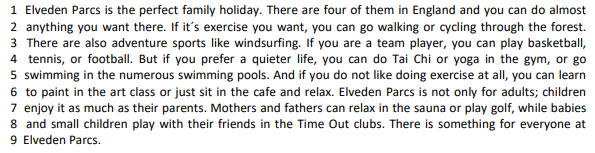
The pronoun “them” (line 1) refers to:
Ano: 2025
Banca:
IMPARH
Órgão:
Prefeitura de Fortaleza - CE
Prova:
IMPARH - 2025 - Prefeitura de Fortaleza - CE - Professor Substituto - Língua Inglesa |
Q3598088
Inglês
Texto associado
A PERFECT FAMILY HOLIDAY
The interrogative form of the sentence “There is something
for everyone at Elveden Parcs” (lines 8-9) is:
Ano: 2025
Banca:
AMEOSC
Órgão:
Prefeitura de Santa Helena - SC
Prova:
AMEOSC - 2025 - Prefeitura de Santa Helena - SC - Professor com Licenciatura Plena em Língua Portuguesa e Estrangeira (Inglês) - Edital nº 6 |
Q3591155
Inglês
Texto associado
O texto seguinte servirá de base para responder às
questões de 1 a 5.
Population history of the Southern Caucasus
Max Planck Institute for Evolutionary Anthropology—An
international team of researchers from Germany,
Georgia, Armenia, and Norway has analyzed ancient
DNA from 230 individuals across 50 archaeological sites
from Georgia and Armenia. Within the framework of the
Max Planck-Harvard Research Center for the
Archaeoscience of the Ancient Mediterranean,
co-directed by Johannes Krause, Director at the Max
Planck Institute for Evolutionary Anthropology in Leipzig,
and Philipp Stockhammer, Professor at Ludwig
Maximilians University of Munich, this study reconstructs
the genetic interactions of populations in the Southern
Caucasus over time and down to the level of individual
mobility.
Mostly constant ancestry with traces of Bronze Age
migrations
Spanning from the Early Bronze Age (circa 3500 BCE) to
after the Migration Period (circa 500 CE), the research
shows that people in the Southern Caucasus retained a
mostly constant ancestry profile. "The persistence of a
deeply rooted local gene pool through several shifts in
material culture is exceptional", says population
geneticist Harald Ringbauer, whose research team at the
Max Planck Institute for Evolutionary Anthropology led
this study, "This stands out compared to other regions
across Western Eurasia, where many changes were
linked to substantial movement of people."
While there was overall genetic continuity, the research
also found evidence of migration from neighboring
regions. During the later phases of the Bronze Age, in
particular, a portion of the area's genetic makeup traces
back to people from Anatolia and the Eurasian steppe
pastoralists—reflecting cultural exchange, technological
innovation, burial practices, and the expansion of
economic systems, such as mobile pastoralism.
Following this period, the population size in the area
increased, and genetic signatures of mixing were often
more transient or confined to singular mobile individuals.
Cranial deformation: introduced by migration, then turned
into a local tradition
One of the study's most striking findings concerns early
Medieval individuals from the Iberian Kingdom, located in
present-day eastern Georgia, who had intentionally
deformed skulls. This cultural practice was long thought
to be tied to Central Eurasian Steppe populations. "We
identified numerous individuals with deformed skulls who
were genetically Central Asian, and we even found direct
genealogical links to the Avars and Huns " says lead
author and geneticist Eirini Skourtanioti from the Max
Planck Institute for Evolutionary Anthropology and
Ludwig Maximilians University Munich. "However, our
analyses revealed that most of these individuals were
locals, not migrants. This is a compelling example of the
cultural adoption of a practice that was likely
disseminated in the area by nomadic groups."
Liana Bitadze, head of the Anthropological Research
Laboratory at Tbilisi State University in Georgia and a
co-author of the study, corroborates the significance of
this finding: "Previously, we addressed this question
through comparative morphometric analyses. Now,
ancient DNA analysis has created a completely new line
of evidence, helping us to reach more definitive
answers."
A melting pot of diverse ancestries
The study also highlights how urban centers and early
Christian sites in eastern Georgia became melting pots of
people beginning in Late Antiquity. This further
emphasizes the long-standing role of the Caucasus as a
dynamic cultural and genetic frontier.
"Historical sources mention how the Caucasus Mountains
served both as a barrier and a corridor for migration
during Late Antiquity. Our study shows that increased
individual mobility was a key feature of the emerging
urban centers in the region", says Xiaowen Jia, co-lead
author and PhD researcher at Ludwig Maximilians
University Munich.
This research sets a new standard for understanding the
population histories of regions that have long been
overlooked by archaeogenetics.
https://popular-archaeology.com/article/population-history-of-the-southe
rn-caucasus/
Rewrite the sentence "Most of these individuals were
locals, not migrants" using the modal verb must to
express a strong deduction about their origin, keeping the
meaning. Which option is correct?
Ano: 2025
Banca:
AMEOSC
Órgão:
Prefeitura de Santa Helena - SC
Prova:
AMEOSC - 2025 - Prefeitura de Santa Helena - SC - Professor com Licenciatura Plena em Língua Portuguesa e Estrangeira (Inglês) - Edital nº 6 |
Q3591154
Inglês
Texto associado
O texto seguinte servirá de base para responder às
questões de 1 a 5.
Population history of the Southern Caucasus
Max Planck Institute for Evolutionary Anthropology—An
international team of researchers from Germany,
Georgia, Armenia, and Norway has analyzed ancient
DNA from 230 individuals across 50 archaeological sites
from Georgia and Armenia. Within the framework of the
Max Planck-Harvard Research Center for the
Archaeoscience of the Ancient Mediterranean,
co-directed by Johannes Krause, Director at the Max
Planck Institute for Evolutionary Anthropology in Leipzig,
and Philipp Stockhammer, Professor at Ludwig
Maximilians University of Munich, this study reconstructs
the genetic interactions of populations in the Southern
Caucasus over time and down to the level of individual
mobility.
Mostly constant ancestry with traces of Bronze Age
migrations
Spanning from the Early Bronze Age (circa 3500 BCE) to
after the Migration Period (circa 500 CE), the research
shows that people in the Southern Caucasus retained a
mostly constant ancestry profile. "The persistence of a
deeply rooted local gene pool through several shifts in
material culture is exceptional", says population
geneticist Harald Ringbauer, whose research team at the
Max Planck Institute for Evolutionary Anthropology led
this study, "This stands out compared to other regions
across Western Eurasia, where many changes were
linked to substantial movement of people."
While there was overall genetic continuity, the research
also found evidence of migration from neighboring
regions. During the later phases of the Bronze Age, in
particular, a portion of the area's genetic makeup traces
back to people from Anatolia and the Eurasian steppe
pastoralists—reflecting cultural exchange, technological
innovation, burial practices, and the expansion of
economic systems, such as mobile pastoralism.
Following this period, the population size in the area
increased, and genetic signatures of mixing were often
more transient or confined to singular mobile individuals.
Cranial deformation: introduced by migration, then turned
into a local tradition
One of the study's most striking findings concerns early
Medieval individuals from the Iberian Kingdom, located in
present-day eastern Georgia, who had intentionally
deformed skulls. This cultural practice was long thought
to be tied to Central Eurasian Steppe populations. "We
identified numerous individuals with deformed skulls who
were genetically Central Asian, and we even found direct
genealogical links to the Avars and Huns " says lead
author and geneticist Eirini Skourtanioti from the Max
Planck Institute for Evolutionary Anthropology and
Ludwig Maximilians University Munich. "However, our
analyses revealed that most of these individuals were
locals, not migrants. This is a compelling example of the
cultural adoption of a practice that was likely
disseminated in the area by nomadic groups."
Liana Bitadze, head of the Anthropological Research
Laboratory at Tbilisi State University in Georgia and a
co-author of the study, corroborates the significance of
this finding: "Previously, we addressed this question
through comparative morphometric analyses. Now,
ancient DNA analysis has created a completely new line
of evidence, helping us to reach more definitive
answers."
A melting pot of diverse ancestries
The study also highlights how urban centers and early
Christian sites in eastern Georgia became melting pots of
people beginning in Late Antiquity. This further
emphasizes the long-standing role of the Caucasus as a
dynamic cultural and genetic frontier.
"Historical sources mention how the Caucasus Mountains
served both as a barrier and a corridor for migration
during Late Antiquity. Our study shows that increased
individual mobility was a key feature of the emerging
urban centers in the region", says Xiaowen Jia, co-lead
author and PhD researcher at Ludwig Maximilians
University Munich.
This research sets a new standard for understanding the
population histories of regions that have long been
overlooked by archaeogenetics.
https://popular-archaeology.com/article/population-history-of-the-southe
rn-caucasus/
Consider the following statements about the text:
I. The study's findings challenge previous beliefs about cranial deformation, showing that it was adopted locally rather than exclusively brought by Central Eurasian migrants.
II. Evidence of migration from Anatolia and Eurasian steppe pastoralists during the Bronze Age is linked in the text to technological and cultural exchanges.
III. The Caucasus Mountains are described solely as a barrier to human movement throughout history.
Which are correct according to the text?
I. The study's findings challenge previous beliefs about cranial deformation, showing that it was adopted locally rather than exclusively brought by Central Eurasian migrants.
II. Evidence of migration from Anatolia and Eurasian steppe pastoralists during the Bronze Age is linked in the text to technological and cultural exchanges.
III. The Caucasus Mountains are described solely as a barrier to human movement throughout history.
Which are correct according to the text?
Ano: 2025
Banca:
AMEOSC
Órgão:
Prefeitura de Santa Helena - SC
Prova:
AMEOSC - 2025 - Prefeitura de Santa Helena - SC - Professor com Licenciatura Plena em Língua Portuguesa e Estrangeira (Inglês) - Edital nº 6 |
Q3591153
Inglês
Texto associado
O texto seguinte servirá de base para responder às
questões de 1 a 5.
Population history of the Southern Caucasus
Max Planck Institute for Evolutionary Anthropology—An
international team of researchers from Germany,
Georgia, Armenia, and Norway has analyzed ancient
DNA from 230 individuals across 50 archaeological sites
from Georgia and Armenia. Within the framework of the
Max Planck-Harvard Research Center for the
Archaeoscience of the Ancient Mediterranean,
co-directed by Johannes Krause, Director at the Max
Planck Institute for Evolutionary Anthropology in Leipzig,
and Philipp Stockhammer, Professor at Ludwig
Maximilians University of Munich, this study reconstructs
the genetic interactions of populations in the Southern
Caucasus over time and down to the level of individual
mobility.
Mostly constant ancestry with traces of Bronze Age
migrations
Spanning from the Early Bronze Age (circa 3500 BCE) to
after the Migration Period (circa 500 CE), the research
shows that people in the Southern Caucasus retained a
mostly constant ancestry profile. "The persistence of a
deeply rooted local gene pool through several shifts in
material culture is exceptional", says population
geneticist Harald Ringbauer, whose research team at the
Max Planck Institute for Evolutionary Anthropology led
this study, "This stands out compared to other regions
across Western Eurasia, where many changes were
linked to substantial movement of people."
While there was overall genetic continuity, the research
also found evidence of migration from neighboring
regions. During the later phases of the Bronze Age, in
particular, a portion of the area's genetic makeup traces
back to people from Anatolia and the Eurasian steppe
pastoralists—reflecting cultural exchange, technological
innovation, burial practices, and the expansion of
economic systems, such as mobile pastoralism.
Following this period, the population size in the area
increased, and genetic signatures of mixing were often
more transient or confined to singular mobile individuals.
Cranial deformation: introduced by migration, then turned
into a local tradition
One of the study's most striking findings concerns early
Medieval individuals from the Iberian Kingdom, located in
present-day eastern Georgia, who had intentionally
deformed skulls. This cultural practice was long thought
to be tied to Central Eurasian Steppe populations. "We
identified numerous individuals with deformed skulls who
were genetically Central Asian, and we even found direct
genealogical links to the Avars and Huns " says lead
author and geneticist Eirini Skourtanioti from the Max
Planck Institute for Evolutionary Anthropology and
Ludwig Maximilians University Munich. "However, our
analyses revealed that most of these individuals were
locals, not migrants. This is a compelling example of the
cultural adoption of a practice that was likely
disseminated in the area by nomadic groups."
Liana Bitadze, head of the Anthropological Research
Laboratory at Tbilisi State University in Georgia and a
co-author of the study, corroborates the significance of
this finding: "Previously, we addressed this question
through comparative morphometric analyses. Now,
ancient DNA analysis has created a completely new line
of evidence, helping us to reach more definitive
answers."
A melting pot of diverse ancestries
The study also highlights how urban centers and early
Christian sites in eastern Georgia became melting pots of
people beginning in Late Antiquity. This further
emphasizes the long-standing role of the Caucasus as a
dynamic cultural and genetic frontier.
"Historical sources mention how the Caucasus Mountains
served both as a barrier and a corridor for migration
during Late Antiquity. Our study shows that increased
individual mobility was a key feature of the emerging
urban centers in the region", says Xiaowen Jia, co-lead
author and PhD researcher at Ludwig Maximilians
University Munich.
This research sets a new standard for understanding the
population histories of regions that have long been
overlooked by archaeogenetics.
https://popular-archaeology.com/article/population-history-of-the-southe
rn-caucasus/
Based on the text, judge the following statements:
1.(__)The research covered a time span from circa 3500 BCE to circa 500 CE.
2.(__)The increase in population size during the later Bronze Age was entirely due to migration from Central Asia.
3.(__)Individual mobility in Late Antiquity contributed to the diversity found in emerging urban centers in eastern Georgia.
The correct sequence is:
1.(__)The research covered a time span from circa 3500 BCE to circa 500 CE.
2.(__)The increase in population size during the later Bronze Age was entirely due to migration from Central Asia.
3.(__)Individual mobility in Late Antiquity contributed to the diversity found in emerging urban centers in eastern Georgia.
The correct sequence is:
Ano: 2025
Banca:
AMEOSC
Órgão:
Prefeitura de Santa Helena - SC
Prova:
AMEOSC - 2025 - Prefeitura de Santa Helena - SC - Professor com Licenciatura Plena em Língua Portuguesa e Estrangeira (Inglês) - Edital nº 6 |
Q3591152
Inglês
Texto associado
O texto seguinte servirá de base para responder às
questões de 1 a 5.
Population history of the Southern Caucasus
Max Planck Institute for Evolutionary Anthropology—An
international team of researchers from Germany,
Georgia, Armenia, and Norway has analyzed ancient
DNA from 230 individuals across 50 archaeological sites
from Georgia and Armenia. Within the framework of the
Max Planck-Harvard Research Center for the
Archaeoscience of the Ancient Mediterranean,
co-directed by Johannes Krause, Director at the Max
Planck Institute for Evolutionary Anthropology in Leipzig,
and Philipp Stockhammer, Professor at Ludwig
Maximilians University of Munich, this study reconstructs
the genetic interactions of populations in the Southern
Caucasus over time and down to the level of individual
mobility.
Mostly constant ancestry with traces of Bronze Age
migrations
Spanning from the Early Bronze Age (circa 3500 BCE) to
after the Migration Period (circa 500 CE), the research
shows that people in the Southern Caucasus retained a
mostly constant ancestry profile. "The persistence of a
deeply rooted local gene pool through several shifts in
material culture is exceptional", says population
geneticist Harald Ringbauer, whose research team at the
Max Planck Institute for Evolutionary Anthropology led
this study, "This stands out compared to other regions
across Western Eurasia, where many changes were
linked to substantial movement of people."
While there was overall genetic continuity, the research
also found evidence of migration from neighboring
regions. During the later phases of the Bronze Age, in
particular, a portion of the area's genetic makeup traces
back to people from Anatolia and the Eurasian steppe
pastoralists—reflecting cultural exchange, technological
innovation, burial practices, and the expansion of
economic systems, such as mobile pastoralism.
Following this period, the population size in the area
increased, and genetic signatures of mixing were often
more transient or confined to singular mobile individuals.
Cranial deformation: introduced by migration, then turned
into a local tradition
One of the study's most striking findings concerns early
Medieval individuals from the Iberian Kingdom, located in
present-day eastern Georgia, who had intentionally
deformed skulls. This cultural practice was long thought
to be tied to Central Eurasian Steppe populations. "We
identified numerous individuals with deformed skulls who
were genetically Central Asian, and we even found direct
genealogical links to the Avars and Huns " says lead
author and geneticist Eirini Skourtanioti from the Max
Planck Institute for Evolutionary Anthropology and
Ludwig Maximilians University Munich. "However, our
analyses revealed that most of these individuals were
locals, not migrants. This is a compelling example of the
cultural adoption of a practice that was likely
disseminated in the area by nomadic groups."
Liana Bitadze, head of the Anthropological Research
Laboratory at Tbilisi State University in Georgia and a
co-author of the study, corroborates the significance of
this finding: "Previously, we addressed this question
through comparative morphometric analyses. Now,
ancient DNA analysis has created a completely new line
of evidence, helping us to reach more definitive
answers."
A melting pot of diverse ancestries
The study also highlights how urban centers and early
Christian sites in eastern Georgia became melting pots of
people beginning in Late Antiquity. This further
emphasizes the long-standing role of the Caucasus as a
dynamic cultural and genetic frontier.
"Historical sources mention how the Caucasus Mountains
served both as a barrier and a corridor for migration
during Late Antiquity. Our study shows that increased
individual mobility was a key feature of the emerging
urban centers in the region", says Xiaowen Jia, co-lead
author and PhD researcher at Ludwig Maximilians
University Munich.
This research sets a new standard for understanding the
population histories of regions that have long been
overlooked by archaeogenetics.
https://popular-archaeology.com/article/population-history-of-the-southe
rn-caucasus/
Read the sentence: "Urban centers and early Christian
sites in eastern Georgia became melting pots of people
beginning in Late Antiquity." A Portuguese-speaking
learner might wrongly assume that "melting pot" means
"pote derretendo" (literal). Which interpretation reflects
the correct figurative meaning in this context?
Ano: 2025
Banca:
AMEOSC
Órgão:
Prefeitura de Santa Helena - SC
Prova:
AMEOSC - 2025 - Prefeitura de Santa Helena - SC - Professor com Licenciatura Plena em Língua Portuguesa e Estrangeira (Inglês) - Edital nº 6 |
Q3591151
Inglês
Texto associado
O texto seguinte servirá de base para responder às
questões de 1 a 5.
Population history of the Southern Caucasus
Max Planck Institute for Evolutionary Anthropology—An
international team of researchers from Germany,
Georgia, Armenia, and Norway has analyzed ancient
DNA from 230 individuals across 50 archaeological sites
from Georgia and Armenia. Within the framework of the
Max Planck-Harvard Research Center for the
Archaeoscience of the Ancient Mediterranean,
co-directed by Johannes Krause, Director at the Max
Planck Institute for Evolutionary Anthropology in Leipzig,
and Philipp Stockhammer, Professor at Ludwig
Maximilians University of Munich, this study reconstructs
the genetic interactions of populations in the Southern
Caucasus over time and down to the level of individual
mobility.
Mostly constant ancestry with traces of Bronze Age
migrations
Spanning from the Early Bronze Age (circa 3500 BCE) to
after the Migration Period (circa 500 CE), the research
shows that people in the Southern Caucasus retained a
mostly constant ancestry profile. "The persistence of a
deeply rooted local gene pool through several shifts in
material culture is exceptional", says population
geneticist Harald Ringbauer, whose research team at the
Max Planck Institute for Evolutionary Anthropology led
this study, "This stands out compared to other regions
across Western Eurasia, where many changes were
linked to substantial movement of people."
While there was overall genetic continuity, the research
also found evidence of migration from neighboring
regions. During the later phases of the Bronze Age, in
particular, a portion of the area's genetic makeup traces
back to people from Anatolia and the Eurasian steppe
pastoralists—reflecting cultural exchange, technological
innovation, burial practices, and the expansion of
economic systems, such as mobile pastoralism.
Following this period, the population size in the area
increased, and genetic signatures of mixing were often
more transient or confined to singular mobile individuals.
Cranial deformation: introduced by migration, then turned
into a local tradition
One of the study's most striking findings concerns early
Medieval individuals from the Iberian Kingdom, located in
present-day eastern Georgia, who had intentionally
deformed skulls. This cultural practice was long thought
to be tied to Central Eurasian Steppe populations. "We
identified numerous individuals with deformed skulls who
were genetically Central Asian, and we even found direct
genealogical links to the Avars and Huns " says lead
author and geneticist Eirini Skourtanioti from the Max
Planck Institute for Evolutionary Anthropology and
Ludwig Maximilians University Munich. "However, our
analyses revealed that most of these individuals were
locals, not migrants. This is a compelling example of the
cultural adoption of a practice that was likely
disseminated in the area by nomadic groups."
Liana Bitadze, head of the Anthropological Research
Laboratory at Tbilisi State University in Georgia and a
co-author of the study, corroborates the significance of
this finding: "Previously, we addressed this question
through comparative morphometric analyses. Now,
ancient DNA analysis has created a completely new line
of evidence, helping us to reach more definitive
answers."
A melting pot of diverse ancestries
The study also highlights how urban centers and early
Christian sites in eastern Georgia became melting pots of
people beginning in Late Antiquity. This further
emphasizes the long-standing role of the Caucasus as a
dynamic cultural and genetic frontier.
"Historical sources mention how the Caucasus Mountains
served both as a barrier and a corridor for migration
during Late Antiquity. Our study shows that increased
individual mobility was a key feature of the emerging
urban centers in the region", says Xiaowen Jia, co-lead
author and PhD researcher at Ludwig Maximilians
University Munich.
This research sets a new standard for understanding the
population histories of regions that have long been
overlooked by archaeogenetics.
https://popular-archaeology.com/article/population-history-of-the-southe
rn-caucasus/
Read the sentence from the text:
"This stands out compared to other regions across
Western Eurasia, where many changes were linked to
substantial movement of people."
Match each highlighted word to its correct grammatical
category:
COLUMN 1
I. This
II. other
III. where
IV. many
V. substantial
COLUMN 2
1.Relative adverb
2.Adjective
3.Quantifier adjective
4.Demonstrative pronoun
5.Attributive adjective
The correct matching is:
COLUMN 1
I. This
II. other
III. where
IV. many
V. substantial
COLUMN 2
1.Relative adverb
2.Adjective
3.Quantifier adjective
4.Demonstrative pronoun
5.Attributive adjective
The correct matching is:
Ano: 2025
Banca:
Instituto Consulplan
Órgão:
Prefeitura de Vermelho Novo - MG
Prova:
Instituto Consulplan - 2025 - Prefeitura de Vermelho Novo - MG - Professor de Inglês |
Q3587387
Inglês
Read the following line from the song “If I Were a Boy” by Beyoncé:
If I were a boy
Even just for a day
I'd roll out of bed in the morning
And throw on what I wanted then go
Drink beer with the guys
And chase after girls
I'd kick it with who I wanted
And I'd never get confronted for it
'Cause they'd stick up for me
According to English grammar rules, the use of “were” instead of “was” in this sentence is explained by:
If I were a boy
Even just for a day
I'd roll out of bed in the morning
And throw on what I wanted then go
Drink beer with the guys
And chase after girls
I'd kick it with who I wanted
And I'd never get confronted for it
'Cause they'd stick up for me
According to English grammar rules, the use of “were” instead of “was” in this sentence is explained by:
Ano: 2025
Banca:
Instituto Consulplan
Órgão:
Prefeitura de Vermelho Novo - MG
Prova:
Instituto Consulplan - 2025 - Prefeitura de Vermelho Novo - MG - Professor de Inglês |
Q3587386
Inglês
Observe the humorous image below, which plays with the idea of the forms of modal verbs in English:

(Available on: https://www.reddit.com/r/memes/. Accessed on: may 2025.)
The image presents “might” and “mould” as possible forms of “may”. Considering grammatical accuracy and the use of humor in language learning, the alternative that best explains the linguistic joke presented is:
Ano: 2025
Banca:
Instituto Consulplan
Órgão:
Prefeitura de Vermelho Novo - MG
Prova:
Instituto Consulplan - 2025 - Prefeitura de Vermelho Novo - MG - Professor de Inglês |
Q3587385
Inglês
Look at the event poster below:

(Available on: https://www.theo2.co.uk/events/. Accessed on: may 2025.)
The most appropriate reading strategy to locate specific information such as the event's date and venue is:

 Conheça nossos planos