Questões de Concurso
Sobre ensino da língua estrangeira inglesa em inglês
Foram encontradas 2.182 questões


The economist. science & technology. Feb 20th 2020
edition. Internet:
I By asking her pupils to guess the overall sense of the text just from its title, she would be promoting the use of the technique known as skimming.
II Exercises based on the skimming technique would demand her pupils to have a high level of vocabulary.
III If she asks the students to find out the name of the university in which Dr Barret works, they would be making a prediction.
Choose the correct option.
Text 1
Multiliteracies
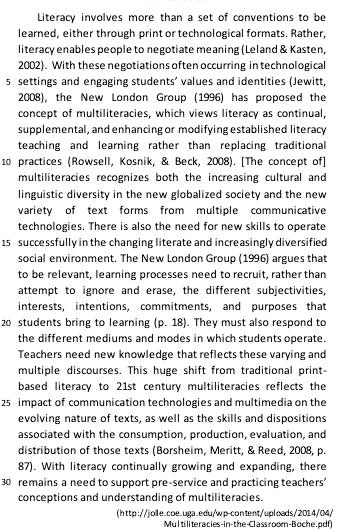
Match the strategies offered below to the different teaching perspectives.
1. Multiliteracies posture
2. The Audio Lingual method
3. The Grammar-Translation method
4. Communicative Language teaching
( ) Presenting target-language reading passages and answering questions that follow.
( ) Discussing cultural diversity through different means such as written texts and blogs.
( ) Repeating patterns until students are able to form new habits in the target language.
( ) Offering students authentic materials that may function as triggers for classroom interactions.
Mark the option which indicates the correct matching, from top to bottom.
No ensino da língua estrangeira, na abordagem comunicativa, é dado ênfase às quatro competências: Listening, Speaking, Reading, Writing (habilidade de ouvir, falar, ler e escrever).
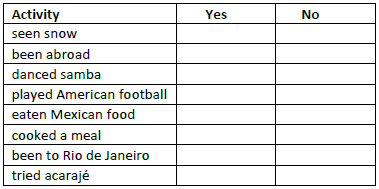
Analise a atividade abaixo e assinale a alternativa que apresente as habilidades que estão sendo enfocadas no seguinte exercício:
Exercise: Find someone who.... Walk around the class and talk to your friends. Ask them questions in order to find out who has already had these experiences. Take note of your answers. Use this: Have you ever……………………………………….?
Questions 37 and 38 refer to the text below
Listening challenges for English language learners
There are many difficulties an individual may face in understanding a talk, lecture or conversation in a second language (and sometimes even in their first language). The speaker, the situation and the listener can all be the cause of these difficulties.
Contributing factors include the speaker talking quickly, background noise, a lack of visual clues (such as on the telephone), the listener’s limited vocabulary, a lack of knowledge of the topic, and an inability to distinguish individual sounds.
While the challenges posed by the speaker or the situation may be out of the listener’s hands, there are a few skills or 'strategies' that English learners can use to help them along
.
Choose the alternative with the CORRECT order of procedures for learners to improve their listening skills.
According to Brown (2007), the two most valuable reading strategies for English learners are:
Brazilian Portuguese learners of English tend to mispronounce and misperceive ‘final s’ in plural forms (nouns) and third person singular forms (in the present simple tense) as well as ‘final ed’ in simple past forms of regular verbs. Another common difficulty is choosing between “a” or “an”. In fact, there are simple phonological rules that can help learners overcome such difficulties. Mark (T) for the true statements and (F) for the false ones.
( ) The words moved, laughed, played, and rained have the same final sound.
( ) The words moved, laughed, hated, and shaked have two syllables.
( ) Considering the use of the indefinite article (a, an), it is correct to say: a car, a house, a dog, a one-eyed man, a university, an umbrella, and, an apple.
( ) The words cats, umbrellas, candles, and birds have the same final sound.
( ) The words books, chiefs, tops, and fakes have the same final sound.
Mark the alternative which contains the CORRECT sequence from the first to the last propositions.
Differences between Brazilian Portuguese and English can result in difficulties in oral comprehension and production due to transfer. These difficulties can result in intelligibility and comprehensibility problems that can be overcome when teachers understand why and how the difficulties happen. Mark the alternative in which only common phonological processes that trigger mispronunciations produced by Brazilians when speaking English are mentioned.
The use of authentic materials in the classroom can be beneficial to the learner because of the real language exposure supporting a more creative approach to teaching, the possibility of practicing skimming and scanning, the encouragement to reading for pleasure, among others. Nevertheless, using authentic materials in ESP classes can also have some disadvantages, such as:
English learning in Brazil
Statutory and the National Curricular Guidelines make the teaching of a ......................................... language at elementary and high school ................................... . However, teachers and experts acknowledge that English teaching - both public and private - is unable to provide students with a usable level of English. They identify similar reasons to those that cause other problems in basic education: the lack of language teaching equipment and over-filled classrooms.
There are also fundamental problems with the amount of time set aside for teaching English and it is hard to find adequately qualified teachers. In these conditions English teaching is reduced to the basic rules of grammar, reading short texts and learning to pass multiple choice exams for university admittance. Even government officials admit that English teaching in basic education has many shortcomings. The National Curricular Guidelines (which outline the curriculum for each subject) are well articulated, but cannot be applied fully in practice. Officials have pointed out that there are no language labs in schools as there is little funding available for them.
They feel that this limits oral communication, a problem that many educators have argued is exacerbated by the large number of students in the classroom. Government representatives and teachers alike have bemoaned the poor quality of language teachers working in basic language education. They argue that a bachelor degree in literature coupled with a teaching license does not prepare a language teacher for the reality of the classroom and to effectively teach the language. There is a widely held belief that these teachers are unlikely to have actually had the means to visit English speaking countries and lack the communication practice required to develop the command of a language. Experts have argued that it would be helpful to send teachers to travel to English speaking countries.
The shortcomings of language teaching in Brazil have resulted in a shortage of professionals who can speak English well. That limits contact between professionals, clients and suppliers and restricts international business opportunities. This affects the whole country - if Brazil is to function fully in the global arena it will need professionals better equipped with English.
https://www.britishcouncil.org.br
There are some Methods of teaching English that are more important than others.
Choose the alternative that contains the correct answer.
English learning in Brazil
Statutory and the National Curricular Guidelines make the teaching of a ......................................... language at elementary and high school ................................... . However, teachers and experts acknowledge that English teaching - both public and private - is unable to provide students with a usable level of English. They identify similar reasons to those that cause other problems in basic education: the lack of language teaching equipment and over-filled classrooms.
There are also fundamental problems with the amount of time set aside for teaching English and it is hard to find adequately qualified teachers. In these conditions English teaching is reduced to the basic rules of grammar, reading short texts and learning to pass multiple choice exams for university admittance. Even government officials admit that English teaching in basic education has many shortcomings. The National Curricular Guidelines (which outline the curriculum for each subject) are well articulated, but cannot be applied fully in practice. Officials have pointed out that there are no language labs in schools as there is little funding available for them.
They feel that this limits oral communication, a problem that many educators have argued is exacerbated by the large number of students in the classroom. Government representatives and teachers alike have bemoaned the poor quality of language teachers working in basic language education. They argue that a bachelor degree in literature coupled with a teaching license does not prepare a language teacher for the reality of the classroom and to effectively teach the language. There is a widely held belief that these teachers are unlikely to have actually had the means to visit English speaking countries and lack the communication practice required to develop the command of a language. Experts have argued that it would be helpful to send teachers to travel to English speaking countries.
The shortcomings of language teaching in Brazil have resulted in a shortage of professionals who can speak English well. That limits contact between professionals, clients and suppliers and restricts international business opportunities. This affects the whole country - if Brazil is to function fully in the global arena it will need professionals better equipped with English.
https://www.britishcouncil.org.br
When it comes to English language skills, the most frequent activity is:
English learning in Brazil
Statutory and the National Curricular Guidelines make the teaching of a ......................................... language at elementary and high school ................................... . However, teachers and experts acknowledge that English teaching - both public and private - is unable to provide students with a usable level of English. They identify similar reasons to those that cause other problems in basic education: the lack of language teaching equipment and over-filled classrooms.
There are also fundamental problems with the amount of time set aside for teaching English and it is hard to find adequately qualified teachers. In these conditions English teaching is reduced to the basic rules of grammar, reading short texts and learning to pass multiple choice exams for university admittance. Even government officials admit that English teaching in basic education has many shortcomings. The National Curricular Guidelines (which outline the curriculum for each subject) are well articulated, but cannot be applied fully in practice. Officials have pointed out that there are no language labs in schools as there is little funding available for them.
They feel that this limits oral communication, a problem that many educators have argued is exacerbated by the large number of students in the classroom. Government representatives and teachers alike have bemoaned the poor quality of language teachers working in basic language education. They argue that a bachelor degree in literature coupled with a teaching license does not prepare a language teacher for the reality of the classroom and to effectively teach the language. There is a widely held belief that these teachers are unlikely to have actually had the means to visit English speaking countries and lack the communication practice required to develop the command of a language. Experts have argued that it would be helpful to send teachers to travel to English speaking countries.
The shortcomings of language teaching in Brazil have resulted in a shortage of professionals who can speak English well. That limits contact between professionals, clients and suppliers and restricts international business opportunities. This affects the whole country - if Brazil is to function fully in the global arena it will need professionals better equipped with English.
https://www.britishcouncil.org.br
Among the most recognized and commonly used approaches and methods for teaching a second or foreign language, there are some that are more popular.
Choose the alternative which contains the correct ones.
Consider the following idioms and their meanings. If the idiom and its meaning are equivalent mark T (true) in the parenthesis, if they are not, mark F (false).
( ) Hang in there = Don’t give up.
( ) Easy does it = Slow down.
( ) It´s not rocket science = Tell something briefly.
( ) That’s the last straw = My patience has run out.
( ) You can say that again = That’s true.
I agree. Mark the alternative that presents the correct sequence, from top to bottom.

 Conheça nossos planos