Questões de Concurso
Sobre ensino da língua estrangeira inglesa em inglês
Foram encontradas 2.182 questões


I. Identificar similaridades e diferenças entre a língua inglesa e a língua materna/outras línguas, articulando-as a aspectos sociais, culturais e identitários, em uma relação intrínseca entre língua, cultura e identidade. II. Conhecer diferentes patrimônios culturais, materiais e imateriais, difundidos na língua inglesa, com vistas ao exercício da fruição e da ampliação de perspectivas no contato com diferentes manifestações artístico-culturais. III. Utilizar novas tecnologias, com novas linguagens e modos de interação, para pesquisar, selecionar, compartilhar, posicionar-se e produzir sentidos em práticas de letramento na língua inglesa, de forma ética, crítica e responsável. IV. Identificar o lugar de si e o do outro em um mundo plurilíngue e multicultural, refletindo, criticamente, sobre como a aprendizagem da língua inglesa contribui para a inserção dos sujeitos no mundo globalizado, inclusive no que concerne ao mundo do trabalho. V. Comunicar-se na língua inglesa, por meio do uso variado de linguagens em mídias impressas ou digitais, reconhecendo-a como ferramenta de acesso ao conhecimento, de ampliação das perspectivas e de possibilidades para a compreensão dos valores e interesses de outras culturas e para o exercício do protagonismo social.
Assinale a alternativa CORRETA:
CORONAVIRUS
Coronavirus is a newly discovered virus. It causes a disease called Covid-19. In some parts of the world, it has made lots ............ people sick. Corona is a Latin for crown, because ............. the microscope, these viruses look like a crown .............. spikes ending ............... little blobs.
A lot of symptoms are similar to the flu. You may have dry and itchy cough, fever, lots of sneezing and even hard to breathe. Most of people who has gotten sick with this coronavirus have had a mild case. It means you will not feel the disease. But, for people who are much older or who already have health problems are more likely to get sicker with coronavirus.
If anyone gets sick and feels like they may have coronavirus, they can immediately call their doctors and get help. If there is something we are not sure about the information, confused or worried about, don’t be afraid to ask someone we trust.
Here are some things you can do to protect yourself, family and friends from getting sick: 1) wash your hands often using soap and water. 2) Sneeze into your elbows. It is believed that coronavirus spread through little liquid from our lungs. If you sneeze into your elbows, you can prevent germs for going far into the air. 3) Avoid touching your face. Don’t pick your nose. Don’t touch your mouth. Don’t rub your eyes. They are the places where the virus enter our bodies.
Remember that this kind of virus can affect anybody. It
doesn’t matter where you come from or what country
you are from. Don’t forget, there are a lot of helpers
out there who are working to protect us from the virus.
We can take a part by keeping our health and stay at
home to stop the virus spread to others.
CORONAVIRUS
Coronavirus is a newly discovered virus. It causes a disease called Covid-19. In some parts of the world, it has made lots ............ people sick. Corona is a Latin for crown, because ............. the microscope, these viruses look like a crown .............. spikes ending ............... little blobs.
A lot of symptoms are similar to the flu. You may have dry and itchy cough, fever, lots of sneezing and even hard to breathe. Most of people who has gotten sick with this coronavirus have had a mild case. It means you will not feel the disease. But, for people who are much older or who already have health problems are more likely to get sicker with coronavirus.
If anyone gets sick and feels like they may have coronavirus, they can immediately call their doctors and get help. If there is something we are not sure about the information, confused or worried about, don’t be afraid to ask someone we trust.
Here are some things you can do to protect yourself, family and friends from getting sick: 1) wash your hands often using soap and water. 2) Sneeze into your elbows. It is believed that coronavirus spread through little liquid from our lungs. If you sneeze into your elbows, you can prevent germs for going far into the air. 3) Avoid touching your face. Don’t pick your nose. Don’t touch your mouth. Don’t rub your eyes. They are the places where the virus enter our bodies.
Remember that this kind of virus can affect anybody. It
doesn’t matter where you come from or what country
you are from. Don’t forget, there are a lot of helpers
out there who are working to protect us from the virus.
We can take a part by keeping our health and stay at
home to stop the virus spread to others.
The Grammatical Approach is one of the several methods of teaching English to students who are learning the language for the first time.
Choose the alternative that is correct about the Grammatical Approach.
O texto, acima, se refere a qual dos métodos de ensino de língua estrangeira?
Match the teacher’s purposes for using students’ first language:
I- Asking students to show they know what to do for homework = used for checking understanding
II- Giving individual written feedback to a weak student = used for explaining procedures
III- Telling a large group of teenagers the rules of a game = used for motivating
IV- Encouraging elementary students to try new ways of learning = used for motivating
Check the correct answer:
Match the examples of teacher’s classroom language with their functions:
Function
A- checking understanding
B- emphasising word stress
C- drilling
D- nominating
E- monitoring
F- eliciting
G- organizing pairwork
Teacher’s classroom language
( ) Listen, I like playing football, repeat everyone, I like playing football.
( ) Maria – collect the books, please.
( ) Tell me three adjectives beginning with the letter “C”.
( ) Just listen to how I say it – poTAtoes.
( ) Okay, discuss it with your partner now, please.
( ) I’m really full, I’ve just eaten a big lunch. Am I hungry now?
( ) Let’s have a look. Yes, that’s great. Now try the next one.
The correct sequence is:
SEQUENCE OF COURSEBOOK ACTIVITIES:
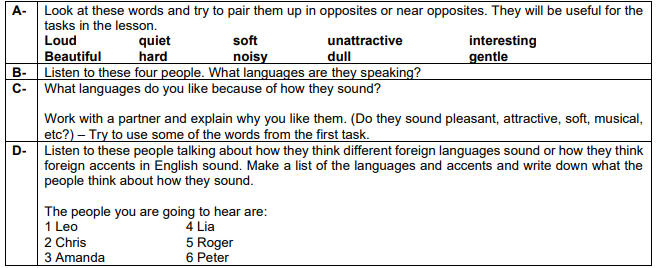

Uses of coursebook materials:
( ) Involves speaking practice ( ) practices note-taking skills ( ) pre-teaches vocabulary ( ) develops listening for detail ( ) personalizes the topic ( ) brainstorms ideas about the topic ( ) introduces the theme of the lesson ( ) provides language needed to do the activities
The correct sequence is:
I- Learning is improved through increased motivation and the study of natural language seen in context. When learners are interested in a topic they are motivated to acquire language to communicate. II- Language is seen in real-life situations in which students can acquire the language. This is natural language development which builds on other forms of learning. III- Fluency is more important than accuracy and errors are a natural part of language learning. Learners develop fluency in English by using English to communicate for a variety of purposes. IV- CLIL is based on language acquisition focusing severely on learning grammar and sentence structure.
Choose the alternative with the correct answer:
I- According to ECA (Statute of Children and Adolescent) “It is the duty of the public authorities only, to ensure, with absolute priority, the effective rights relating to life, health, food, education, sport, leisure, professionalization, culture, dignity, respect, freedom and family and community coexistence.” II- The completion of the latest version of the BNCC determines the obligation to teach English language starting in the first grade of elementary school. III- According to the BNCC, teaching English means reviewing the relationships between language, territory and culture, as English speakers are no longer found only in countries where this is the official language. IV- The BNCC understands the learning of English in a perspective of an education that is linguistic, conscious and critical, in which the pedagogical and political dimensions are intrinsically linked.
Choose the alternative with the correct answer:
TABELA 1 I. Atividades destinadas a levar os alunos a pensar sobre o texto, emitir suas reações e avaliar, criticamente, as ideias do autor.
II. Ativar o pré-conhecimento do aluno em relação à organização textual.
III. São importantes as estratégias de integração de uma informação a outra, o estabelecimento dos elos coesivos e a utilização de estratégias de inferência.
TABELA 2 A. Pré-leitura
B. Leitura
C. Pós-leitura.
Relacione as duas tabelas acima e assinale a alternativa que contém a sequência correta, respectivamente:

 Conheça nossos planos