Questões de Concurso
Sobre ensino da língua estrangeira inglesa em inglês
Foram encontradas 2.182 questões


RICHARDS, Jack C. Theories of Teaching in Language Teaching. In: RICHARDS, J. C. & RENANDYA, W. A. Methodology in Language Teaching: An Anthology of Current Practice. Cambridge: Cambridge University Press, 2002, p. 21.
Which of the following characteristics is concerned with an effective teaching?

Gil Ragsdale. Recipes for success in language learning.
Internet: <www.elgazette.com>
O texto relata uma experiência de aprendizagem de inglês e francês por meio da troca de receitas entre refugiados em um campo de refugiados de Calais. A respeito das ideias e informações do texto precedente e de seus aspectos linguísticos, julgue o item que se segue.
The cooking recipes are authentic materials that allow, among
other things, the work with word pronunciation in classroom.
Considerando a BNCCpara o ensino fundamental de língua inglesa, julgue o item seguinte.
Considerando-se a expectativa de produção oral (eixo
oralidade) para o 6.º ano do ensino fundamental, uma
habilidade prevista na BNCC é a de analisar posicionamentos
defendidos e refutados em textos orais sobre temas de interesse
social e coletivo.
Considerando a BNCCpara o ensino fundamental de língua inglesa, julgue o item seguinte.
Uma das competências específicas de língua inglesa para o
ensino fundamental, descrita na BNCC, envolve a identificação
de semelhanças e diferenças entre a língua inglesa e a língua
materna, a serem articuladas a aspectos sociais, culturais e
identitários.
Considerando a BNCCpara o ensino fundamental de língua inglesa, julgue o item seguinte.
O tratamento dado ao inglês na BNCC prioriza
seu status de língua franca, o que significa vincular esse idioma
à noção de pertencimento a territórios de países hegemônicos.

Internet:<www.canteach.ca>
A partir do texto 7A1-I e das diretrizes da BNCC para língua inglesa, julgue o item a seguir.
Caso uma turma de ensino fundamental decidisse utilizar a
fábula para uma atividade de recriação dramática, o professor
de língua inglesa deveria adverti-los de que a pronúncia
deveria ser isenta de sotaques brasileiros, além de corrigi-los
com rigor quanto a esse aspecto.
Internet:<www.canteach.ca>
A partir do texto 7A1-I e das diretrizes da BNCC para língua inglesa, julgue o item a seguir.
A utilização do texto em sala de aula permite o conhecimento
e a discussão sobre tradições culturais africanas, intermediada
pela língua inglesa.
Internet:<www.canteach.ca>
A partir do texto 7A1-I e das diretrizes da BNCC para língua inglesa, julgue o item a seguir.
Devido à ocorrência da frase ‘Kwasuka sukela....’, que não está
em língua inglesa, o texto é inadequado para o uso em sala de
aula, por conta da potencial confusão que pode causar para os
aprendizes da língua inglesa.
Internet:<www.canteach.ca>
A partir do texto 7A1-I e das diretrizes da BNCC para língua inglesa, julgue o item a seguir.
Empregando-se a estratégia de skimming, é possível, a partir de
certas marcas do texto, concluir que se trata de uma fábula
sobre um felino, denominado cheetah em inglês.
How monks helped invent sign language
For millennia people with hearing impairments encountered marginalization because it was believed that language could only be learned by hearing the spoken word. Ancient Greek philosopher Aristotle, for example, asserted that “Men that are deaf are in all cases also dumb.” Under Roman law people who were born deaf were denied the right to sign a will as they were “presumed to understand nothing; because it is not possible that they have been able to learn to read or write.”
Pushback against such ideas began in the 16th-century, with the creation of the first formal sign language for the hearing impaired, by Pedro Ponce de León, a Spanish Benedictine monk. His idea to use sign language was not a completely new one. Native Americans used hand gestures to communicate with other tribes and to facilitate trade with Europeans. Benedictine monks had used them to convey messages during their daily periods of silence. Inspired by the latter practice, Ponce de León adapted the gestures used in his monastery to create a method for teaching the deaf to communicate, paving the way for systems now used all over the world.
Building on Ponce de León’s work, another Spanish cleric and linguist, Juan Pablo Bonet, proposed that deaf people learn to pronounce words and progressively construct meaningful phrases. Bonet’s approach combined oralism – using sounds to communicate – with sign language. The system had its challenges, especially when learning the words for abstract terms, or intangible forms such as conjunctions like “for,” “nor,” or “yet.”
In 1755 the French Catholic priest Charles-Michel de l’Épée established a more comprehensive method for educating the deaf, which culminated in the founding of the first public school for deaf children, in Paris. Students came to the institute from all over France, bringing signs they had used to communicate with at home. Insistent that sign language needed to be a complete language, his system was complex enough to express prepositions, conjunctions, and other grammatical elements.
Épée’s standardized sign language quickly spread across Europe and to the United States. In 1814 Thomas Gallaudet went to France to learn Épée’s language system. Three years later, Gallaudet established the American School for the Deaf in his hometown in Connecticut. Students from across the United States attended, and they brought signs they used to communicate with at home.American Sign Language became a combination of these signs and those from French Sign Language.
Thanks to the development of formal sign languages, people with hearing impairment can access spoken language in all its variety. The world’s many modern signing systems have different rules for pronunciation, word order, and grammar. New visual languages can even express regional accents to reflect the complexity and richness of local speech.
(Ines Anton Rayas. www.nationalgeographic.com. 28.05.2019. Adaptado)

Considerando o fragmento do texto 3 “Ao mesmo tempo, a ênfase posta pelo autor na qualidade das
ferramentas de tradução automática parece, por enquanto, excessiva” e “De todo modo, é duvidoso
que esse tipo de recurso elimine a necessidade humana de comunicação imediata que conduz à eleição
mais ou menos espontânea de uma língua franca” (linhas 13-18), de acordo com os Parâmetros
Curriculares Nacional da Língua Estrangeira, é correto afirmar que
“A prática secular no Brasil privilegia o estudo da língua pela língua, muita forma gramatical que se
enfeixa num colar de conhecimentos desaplicados, que se vão de nossa memória sem aviso prévio”
(ALMEIDA FILHO, 2003). Sobre o ensino da língua inglesa, nesse contexto, é correto afirmar que
Analise a figura 5.
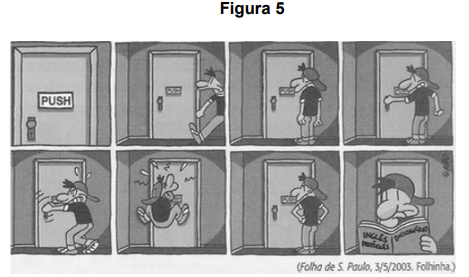
A tirinha apresentada na figura 5 revela o não cumprimento do direito educacional à aprendizagem de
língua estrangeira, concomitantemente à língua materna, previsto nos Parâmetros Curriculares
Nacionais da Língua Estrangeira, portanto fere ao pressuposto básico
In order for collection of sentences and utterances to succed effectively, the discourse needs to be organised or conducted in such a way that it will be successful. In written English this calls for both coherence and cohesion. For a text to be coherent, it needs to be in the right order. (…)
No matter how coherent a text is, however, it will not work unless it has internal cohesion. The elements in that text must cohere or stick to each other successfully to help us navigate our way around the stretch of discourse. One way of achieving this is through lexical cohesion, and a way of ensuring lexical cohesion is through the repetition of words and phrases. (…) We can also use interrelated words and meanings to bind a text together (…)
Another similar cohesive technique is that of substitution, using a phrase to refer to something we have already written. (…) Writers also use linkers such as and, also, moreover (…)
These features are also present in spoken language, which also shows many examples of ellipsis (where words from a written-grammar version of an utterance are left out without compromising the meaning of what is said). (…)
(Harmer, J. The practice of English language teaching. 2007. Adapted)
There is a danger in paying too much attention to learners’ errors. While errors indeed reveal a system at work, the classroom language teacher can become so preoccupied ________ noticing errors that the correct utterances in the second language go unnoticed. In our observation and analysis of errors – for all that they do reveal about the learner – we must beware of placing too much attention on errors and not lose sight of the value of positive reinforcement of clearly expressed language that is a product of the learner’s progress of development. While the diminishing of errors is an important criterion ______ increasing language proficiency, the ultimate goal of second language learning is the attainment of communicative fluency.
Another inadequacy in error analysis is an overemphasis on production data. Language is speaking and listening, writing and reading. The comprehension of language is as important as production. It so happens that production lends itself to analysis and thus becomes the prey of researchers, __________ comprehension data is equally important in developing an understanding of the process of SLA.
(Brown, D. H. Principles of language learning and teaching. 2000. Adapted)
Read the two cartoons and answer questions.

Classes which are arranged in a circle make quite a strong statement about what the teacher and the students believe in. With all the people in the room sitting in a circle, there is a far greater feeling of equality than when the teacher stays out at the front. This may not be quite so true of the horseshoe shape, where the teacher is often located in a commanding position, but, even here, the rigidity that comes with orderly rows, for example, is lessened.
With the horseshoe and circle seating, the classroom is a more intimate place and the potential for students to share feelings and information through talking, eye contact or expressive body movements (eyebrow-raising, shouldershrugging, etc.) is far greater than when they are sitting in rows.
(Harmer, J. The practice of English language teaching. 2007)
Classes which are arranged in a circle make quite a strong statement about what the teacher and the students believe in. With all the people in the room sitting in a circle, there is a far greater feeling of equality than when the teacher stays out at the front. This may not be quite so true of the horseshoe shape, where the teacher is often located in a commanding position, but, even here, the rigidity that comes with orderly rows, for example, is lessened.
With the horseshoe and circle seating, the classroom is a more intimate place and the potential for students to share feelings and information through talking, eye contact or expressive body movements (eyebrow-raising, shouldershrugging, etc.) is far greater than when they are sitting in rows.
(Harmer, J. The practice of English language teaching. 2007)
Study the sentence ‘We asked Mrs. Cooper for her advise’. What type of mistake does it contain?
Choose the word that rhymes with NOW.

 Conheça nossos planos