Questões de Concurso
Sobre ensino da língua estrangeira inglesa em inglês
Foram encontradas 2.182 questões


Choose the alternative that contains the correct missing words:
1. Beginners need to be exposure to comprehensible and useful words and phrases and, later develop insights into grammar.
2. People who travel or work in foreign languages environments start learning the new language by grammar rules.
3. Communicative tasks that are based on reading and listening texts or video extracts are ways to design natural reading and listening strategies.
4. Exposure and use a foreign language are not enough to the acquisition the target language, otherwise, learner’s confidence will never grow and many of them will leave school.
Choose the alternative which presents the correct sentences
TEXT:
What's the best way to learn receptive skills?
Miranda Hamilton
July 26, 2021
We often think of speaking and writing as the most challenging of the four language skills but what about the receptive skills? With reading, learners have time to think, but listening in another language presents a very different set of challenges for the learner. How often have we heard learners complain ‘it’s too fast, teacher!’? So how can you help?
Some guides are designed to help teachers understand the subskills of listening, with activities, tips and strategies to help you develop your learners’ listening skills as they prepare for their exams.
Here are just a few of the ideas from the guides for you to try with your learners. They will work at all levels.
How many words?
This micro listening is a great activity to try towards the end of your listening lesson, when learners have already heard the recording, so they know the speakers’ voices and the topic.
• Select a short phrase, of around 10 words, from the listening you have just completed. Set up the audio so you are ready to press ‘Play’.
• Tell the learners to listen and count the number of words they hear. You will need to play the audio several times. Pairs discuss. Take a range of answers from the class, but don’t tell them the answer just yet.
• Write the phrase on the board and count the number of words with the class. Who was the closest?
• Now ask them to listen and read the phrase at the same time. This time they have to decide which words they hear most clearly, in other words, you want them to notice the stressed words. Ask why they think they heard these words most clearly. Explain that stressed words carry the key information.
This micro listening activity helps raise learners’ awareness of sounds, helping them notice the stressed words and preparing them to listen for key information.
Support every learner
In mixed-ability classes, put a few simple strategies in place so the whole class can listen to the same recording, and take part in the same activity. This means that no learner feels lost or left behind.
• Make the gap-fill or sentence-completion task more achievable and supply the first letter of the missing word. Alternatively supply the first and the final letter and indicate how many letters the missing word has.
• Provide an additional layer of support for weaker learners by giving them the audio script. They can read the script as they listen and use it to help them find the correct answers.
Prepare to listen, prepare to understand
Don’t be in too much of a hurry to hand out the listening task and press ‘Play’. Time spent in class before listening means learners are better prepared to understand.
• Before you listen, have a class discussion around the topic of the listening. This gives learners the opportunity not only to practice their speaking, but also to practice listening to one another. A good discussion will make them think about the main ideas they might hear when they listen. • Useful vocabulary always comes out of a class discussion, creating a very natural way to pre-teach vocabulary before they listen. Useful language linked to a discussion is easier to learn because learners have a context, which makes it easier to remember than pre-teaching vocabulary from a wordlist.
• Take your time to discuss the task and check understanding. Encourage the class to reflect on their discussion and predict the answers. Remember to write their predictions on the board. Did they guess correctly? It doesn’t matter if they did or not, what matters is that they are prepared and ready to listen to see if they were right.
Feeling prepared to listen means learners feel confident and ready to understand, both in the classroom and in their exam.
Adapted from: https://www.cambridgeenglish.org/blog/whats-the-best-way-tolearn-receptive-skills
Answer questions according to TEXT.
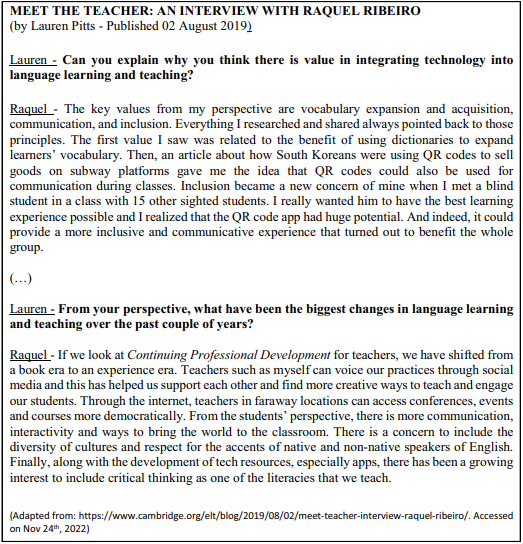
Answer questions according to TEXT.
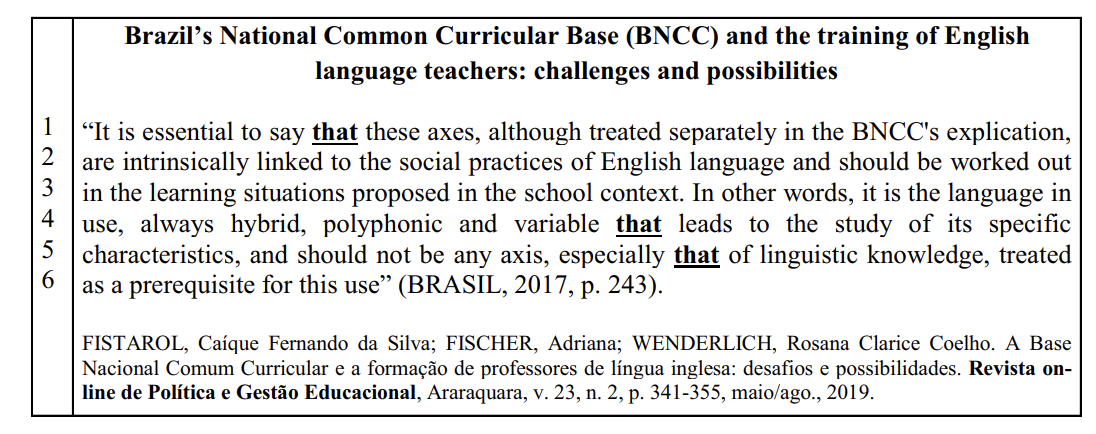
Available from: <https://www.redalyc.org/journal/6377/637766241008/html/>. Accessed on: Nov 22 , 2022 nd
Complete the sentences with on, in or at:
Brazilian Independence Day is ____ September 7. _____ Easter, I am going to visit my relatives in the countryside.
I will see you ____ Tuesday morning.
_____ the 60s, there were many great rock bands.
I usually have lunch ____ midday.
The correct sequence is:
1.(__) Formal literacy in English occurs when students watch subtitled movies, have fun with online games, subtitled or not, and dialogue with colleagues of other nationalities, for example.
2.(__) The teacher, having teaching objectives defined year by year, in an idea of route formative and complexification of the object of study, will use the organizing framework of concepts to plan, exploring the different axes and objects of knowledge, aiming at qualification and progressiveness of learning objectives and development.
3.(__)Studying languages allows the subject to understand how different cultures are organized, customs and the social daily life of the other, as well as assists in the media interaction in which both the student and teacher are social and historically situated.
The correct sequence is:
I.The language must not be fragmented, mainly because such fragmentation does not occur within the scope of effective language use practices.
II.It is up to the teacher to explain to the students that the languages must be respected, as they belong to the certain territories and cultures.
III.Language skills can be explored contextually among the different literacy practices, both reception and production.
The following is(are) correct proposition(s):
Choose the sentences below as true or false:
1.(__)The Currículo da Educação Básica do Sistema Municipal de Ensino de Blumenau (2021) has different organizations in language teaching, and the Bilingual Education is instituted from the first year of elementary school in an integrated way with the other curricular components.
2.(__) Throughout the classes, grammar should not be "disrespected", since it is the basis of all English language knowledge.
3.(__)The planning of the English Language teacher presupposes thinking about your starting point and your of arrival in the processes of teaching and learning.
The correct sequence is:
Julgue as sentenças abaixo como VERDADEIRAS ou FALSAS:
1.(__)Letramento em inglês envolve a habilidade de compreender textos autênticos, desde artigos acadêmicos e literatura até notícias e mídia digital. Professores podem adotar estratégias que incentivem a leitura crítica, como análise de contexto, interpretação simbólica e questionamento reflexivo.
2.(__)Aulas de língua inglesa devem focar na produção de diversos tipos de textos, desde ensaios argumentativos até criativos, estimulando a criatividade e o pensamento crítico. Escrever bem em inglês não apenas demonstra proficiência no idioma, mas também ajuda os alunos a estruturarem suas ideias de maneira organizada e coerente.
3.(__)Em um mundo cada vez mais digital, o letramento em inglês se estende ao domínio das habilidades digitais. Isso inclui a capacidade de compreender e criar textos em formatos digitais, como vídeos, podcasts, blogs e redes sociais.
A sequência CORRETA é:
( ) O Método Audiolingual baseia-se na teoria estruturalista da língua e na corrente behaviorista de aprendizado.
( ) O Método Suggestopedia foca nos elementos psicológicos e emocionais dos estudantes, na organização do ambiente da aprendizagem e, principalmente, na autoridade do professor.
( ) O Método Comunicativo, também conhecido como sociocultural, tem o objetivo de desenvolver a competência cognitiva por meio do pensamento.
( ) No Método Indireto, a língua materna serve de intermediária entre a língua-alvo e os alunos na construção dos sentidos de produções orais.
Assinale a alternativa que indica a sequência correta, de cima para baixo.
1. A Língua Inglesa na BNCC propõe o desenvolvimento de habilidades e competências importantes para acessar saberes linguísticos necessários para o engajamento e a participação em um mundo cada vez mais globalizado, contribuindo para o exercício da cidadania.
2. O professor, proposto pela BNCC, terá uma atitude acolhedora e legítima nas diversas formas de expressão da língua. Considera o uso correto do idioma em oposição ao uso adequado para atingir propósitos comunicativos.
3. São considerados eixos do componente Língua Inglesa na BNCC: oralidade, leitura, escrita, conhecimento linguístico e dimensão intercultural.
4. A Língua Inglesa na BNCC é concebida como língua franca, pautada em seu papel como ferramenta de comunicação. O novo status de língua franca implica deslocar a língua de um modelo ideal de falante para um modelo mais real, considerando suas diferenças culturais e as variações linguísticas.
Assinale a alternativa que indica todas as afirmativas corretas.
A) Communicative Approach
B) Audiolingual Approach
C) Grammar-Based Approach
D) Lexical Approach
E) Direct Approach
1 - Emphasis on learning grammatical patterns.
2 - Focus on vocabulary and collocations acquisition.
3 - Promotion of interaction and oral communication.
4 - Repetition and memorization of dialogues.
5 - Exclusive use of English in the classroom.
Correct Association:

 Conheça nossos planos