Questões de Concurso
Sobre ensino da língua estrangeira inglesa em inglês
Foram encontradas 2.182 questões


Assinale a opção que melhor sintetiza a relação entre língua, cultura e sociedade apresentada no fragmento de texto precedente.
I tem como principal função auxiliar o desenvolvimento contínuo dos alunos.
II é projetada para fornecer reconhecimento aos melhores alunos de cada turma, permitindo-lhes comprovarem suas áreas de destaque por meio de um certificado.
III destina-se a classificar os alunos em níveis de proficiência, fornecer notas finais e comparar seu desempenho com o de outros alunos.
IV é uma ferramenta valiosa para orientar o processo de aprendizado, identificar áreas que precisam de melhoria e promover o crescimento contínuo dos estudantes.
Assinale a opção correta.
Denys Cuche. A noção de cultura nas ciências sociais. 2.ª ed. Bauru: EUDSC, 2002 (com adaptações).
Considerando as ideias do fragmento de texto precedente e o impacto das relações entre língua, cultura e sociedade sobre o ensino do inglês, assinale a opção correta.
( ) Predicting é uma estratégia usada a partir de palavras chaves, títulos e subtítulos, do que você já tem conhecimento prévio sobre o assunto, onde você levanta hipóteses e prevê o assunto do texto.
( ) Scanning é o ato de fazer uma leitura rápida do texto para retirar os conceitos e as ideias principais, em outras palavras, você faz uma exploração geral do texto sem se deter a um ponto específico. Neste momento você deve buscar a ideia geral do texto.
( ) Lighting envolve dar uma lida rápida, mas devese usar essa estratégia quando o objetivo é encontrar algo específico no texto, isto é, quando se sabe exatamente o que está procurando.
( ) Guessing é quando você deixa a tradução de palavra por palavra de lado, e tenta entender algumas palavras pelo sentido da frase, sem ter de buscar as mesmas no dicionário.
I. No Método Comunicativo, o foco está na repetição e na prática auditiva, sendo que o aprendizado é baseado em padrões e estruturas linguísticas.
II. No Método Direto, as aulas são ministradas totalmente em inglês e o objetivo é ensinar o idioma da mesma forma como se aprende a língua materna, sem tradução.
III. No Método Silent Way, o professor fala minimamente, encorajando os alunos a descobrirem as regras e estruturas por si mesmos.
Está(ão) correta(s) a(s) seguinte(s) proposição(ões).
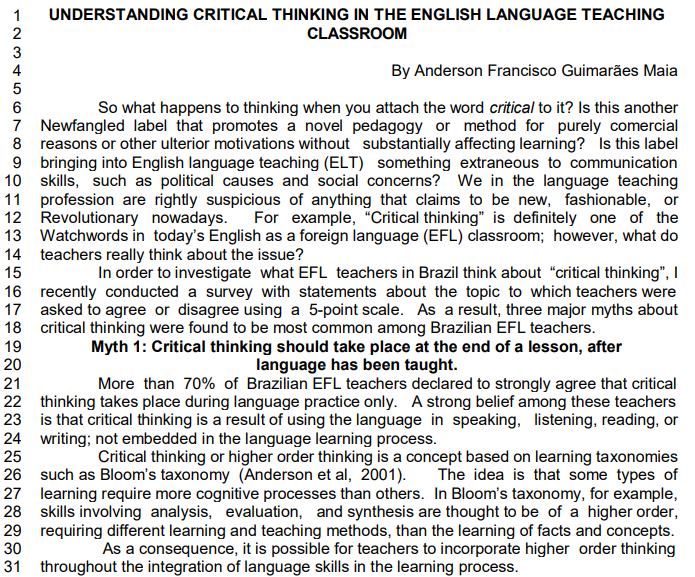
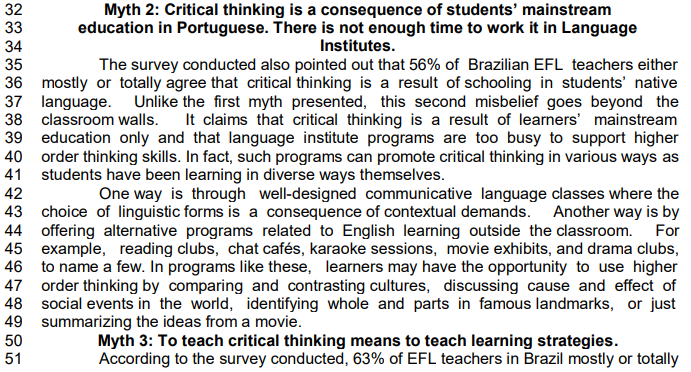
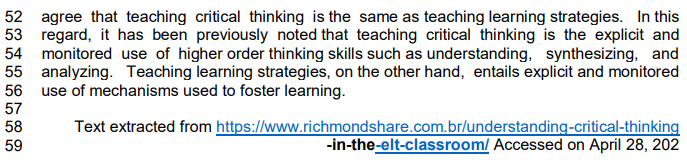
Considerando que “o conhecimento da Língua Inglesa se configura como instrumento de expansão dos horizontes de interação social e de acesso a culturas em escala global, já que o idioma é, atualmente, reconhecido mundialmente como um importante meio de transmissão de conhecimentos”, como definido pelo Currículo em Movimento do Novo Ensino Médio do Distrito Federal, julgue o item a seguir.
Leia o texto para responder à questão.
Assessment is perhaps one of the least understood areas of language teaching and learning. Students may see tests as a threat to their competence because they are afraid they will not perform well. Teachers often do not like to construct tests and are not altogether satisfied with the results when they do.
A more constructive view of language testing exists when (a) testing is undertood as an opportunity for interaction between teacher and student; (b) students are judged on the basis of the knowledge they have; (c) the criteria for success on the test are clear to students; (d) students receive a grade for their performance on a set of tests representing different testing methods (not just one!); (e) the tests are intended to help students improve their skills; (f) the results are discussed.
The seminal efforts by Canalle e Swain (1980) to operationalize Hymes’ (1972) communicative competence have provided a relevant set of criteria for describing tests. Tests should be seen as tapping one or more of the four components making up the construct of communicative competence: grammatical, discourse, sociolinguistic and strategic competence.
(Andrew D.Cohen. Second language Assessment. IN: Marianne
Cerce-Murcia(ed). Teaching English as a second or foreign language.
Boston, Massachusstes: Heinle&Heinle. 2nd edition. 2001. Adaptado)
Leia o texto para responder à questão.
Assessment is perhaps one of the least understood areas of language teaching and learning. Students may see tests as a threat to their competence because they are afraid they will not perform well. Teachers often do not like to construct tests and are not altogether satisfied with the results when they do.
A more constructive view of language testing exists when (a) testing is undertood as an opportunity for interaction between teacher and student; (b) students are judged on the basis of the knowledge they have; (c) the criteria for success on the test are clear to students; (d) students receive a grade for their performance on a set of tests representing different testing methods (not just one!); (e) the tests are intended to help students improve their skills; (f) the results are discussed.
The seminal efforts by Canalle e Swain (1980) to operationalize Hymes’ (1972) communicative competence have provided a relevant set of criteria for describing tests. Tests should be seen as tapping one or more of the four components making up the construct of communicative competence: grammatical, discourse, sociolinguistic and strategic competence.
(Andrew D.Cohen. Second language Assessment. IN: Marianne
Cerce-Murcia(ed). Teaching English as a second or foreign language.
Boston, Massachusstes: Heinle&Heinle. 2nd edition. 2001. Adaptado)

 Conheça nossos planos