Questões de Concurso
Sobre ensino da língua estrangeira inglesa em inglês
Foram encontradas 2.182 questões


Ano: 2025
Banca:
AMEOSC
Órgão:
Prefeitura de Itapiranga - SC
Prova:
AMEOSC - 2025 - Prefeitura de Itapiranga - SC - Professor de Língua Estrangeira (Inglês) |
Q3771340
Inglês
In the teaching of pronunciation in English as a Lingua
Franca (ELF), the pedagogical focus shifts in relation to
the native-speaker model. Analyze the following
statements:
I.The main goal of pronunciation teaching from an ELF perspective is intelligibility, that is, the speaker's ability to be understood by other speakers (native or non-native).
II.The ELF approach values the diversity of accents, as long as communication is not hindered, and does not aim at imitating a specific accent (e.g., British or American) as a target.
III.Pronunciation teaching in ELF should focus on both segmental (sounds) and suprasegmental (rhythm, intonation, stress) features that are crucial for mutual understanding.
The correct statements are:
I.The main goal of pronunciation teaching from an ELF perspective is intelligibility, that is, the speaker's ability to be understood by other speakers (native or non-native).
II.The ELF approach values the diversity of accents, as long as communication is not hindered, and does not aim at imitating a specific accent (e.g., British or American) as a target.
III.Pronunciation teaching in ELF should focus on both segmental (sounds) and suprasegmental (rhythm, intonation, stress) features that are crucial for mutual understanding.
The correct statements are:
Ano: 2025
Banca:
AMEOSC
Órgão:
Prefeitura de Itapiranga - SC
Prova:
AMEOSC - 2025 - Prefeitura de Itapiranga - SC - Professor de Língua Estrangeira (Inglês) |
Q3771339
Inglês
In English teaching, the development of the four skills
(listening, speaking, reading, writing) should be worked
on in an integrated way, reflecting real language use.
Which activity best exemplifies this integration?
Ano: 2025
Banca:
FEPESE
Órgão:
Prefeitura de Concórdia - SC
Prova:
FEPESE - 2025 - Prefeitura de Concórdia - SC - Professor de Língua Inglesa - Edital nº 4 |
Q3770620
Inglês
Analyze the sentences below about the four language skills.
1. In writing, coherence and cohesion are essential to make a text clear and connected.
2. In listening, it’s enough to hear the sounds without interpreting them.
3. Pair work and group discussions are effective ways to develop speaking skills.
4. In reading comprehension, understanding vocabulary is more important than understanding structure.
Choose the alternative which contains the correct affirmatives.
1. In writing, coherence and cohesion are essential to make a text clear and connected.
2. In listening, it’s enough to hear the sounds without interpreting them.
3. Pair work and group discussions are effective ways to develop speaking skills.
4. In reading comprehension, understanding vocabulary is more important than understanding structure.
Choose the alternative which contains the correct affirmatives.
Ano: 2025
Banca:
FEPESE
Órgão:
Prefeitura de Concórdia - SC
Prova:
FEPESE - 2025 - Prefeitura de Concórdia - SC - Professor de Língua Inglesa - Edital nº 4 |
Q3770617
Inglês
Os gêneros textuais em língua inglesa são fundamentais para o desenvolvimento da leitura, escrita e
compreensão textual.
Eles variam de acordo com o contexto e a função, incluindo categorias como:
 (novel, short story, myth,
fairy tale),
(novel, short story, myth,
fairy tale),
(article, editorial, essay),
(recipe, manual) e
informativos (news, advertisement, email).
Assinale a alternativa que completa corretamente as lacunas do texto.
Eles variam de acordo com o contexto e a função, incluindo categorias como:
(novel, short story, myth,
fairy tale),
(article, editorial, essay),
(recipe, manual) e
informativos (news, advertisement, email).
Assinale a alternativa que completa corretamente as lacunas do texto.
Ano: 2025
Banca:
FEPESE
Órgão:
Prefeitura de Cunha Porã - SC
Prova:
FEPESE - 2025 - Prefeitura de Cunha Porã - SC - Professor de Inglês |
Q3768710
Inglês
Reading Strategies help students by improving
comprehension, active engagement, and retention of
information.
Decide if the following affirmatives about Reading Strategies are true ( T ) or false ( F ).
( ) Pre-reading: students predict the content from title, images, or layout.
( ) Identifying key words can help you understand the main ideas.
( ) Extensive reading involves reading long texts for pleasure or general understanding.
( ) Skimming and scanning are examples of intensive reading.
Choose the alternative which presents the correct sequence, from top to bottom:
Decide if the following affirmatives about Reading Strategies are true ( T ) or false ( F ).
( ) Pre-reading: students predict the content from title, images, or layout.
( ) Identifying key words can help you understand the main ideas.
( ) Extensive reading involves reading long texts for pleasure or general understanding.
( ) Skimming and scanning are examples of intensive reading.
Choose the alternative which presents the correct sequence, from top to bottom:
Ano: 2025
Banca:
UECE-CEV
Órgão:
Prefeitura de Tauá - CE
Prova:
UECE-CEV - 2025 - Prefeitura de Tauá - CE - Professor de Educação Básica Nível II - Língua Inglesa |
Q3768157
Inglês
Texto associado
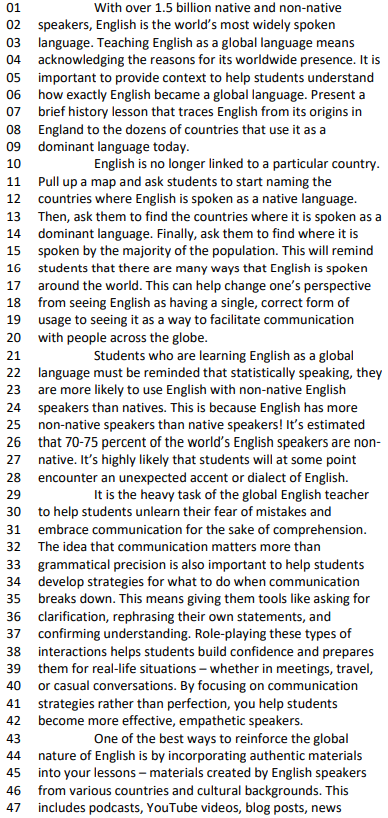
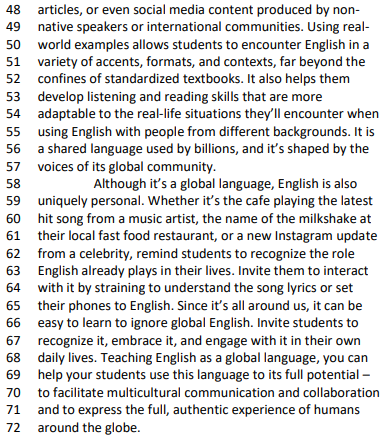
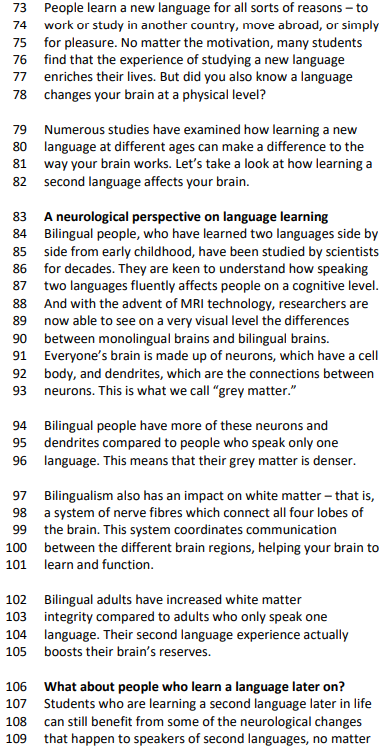
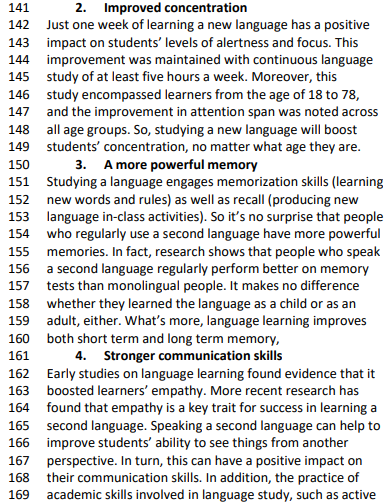
T E X T 1
Teaching English as a Global Language
Adapted from: https://bridge.edu/tefl/March 21, 2025
T E X T 2
How learning a new language changes your brain
Adapted from: https://www.cambridge.org/elt/blog/2022/04/29.
According to the text, the teaching of English as a global
language should focus mostly on
Ano: 2025
Banca:
UECE-CEV
Órgão:
Prefeitura de Tauá - CE
Prova:
UECE-CEV - 2025 - Prefeitura de Tauá - CE - Professor de Educação Básica Nível II - Língua Inglesa |
Q3768156
Inglês
Texto associado
T E X T 1
Teaching English as a Global Language
Adapted from: https://bridge.edu/tefl/March 21, 2025
T E X T 2
How learning a new language changes your brain
Adapted from: https://www.cambridge.org/elt/blog/2022/04/29.
As to the use of materials in Global English lessons, the text
suggests that one excellent idea is to bring authentic materials to
the classrooms mentioning, for example, YouTube videos and social
media content. Such materials should be produced by
Ano: 2025
Banca:
Avança SP
Órgão:
Prefeitura de Araçariguama - SP
Prova:
Avança SP - 2025 - Prefeitura de Araçariguama - SP - PEB II - Língua Estrangeira (Inglês) |
Q3764982
Inglês
The Communicative Approach emphasizes
meaningful communication and interaction in the
language classroom. Which of the following
activities is not consistent with the principles of
the Communicative Approach?
Ano: 2025
Banca:
Instituto Access
Órgão:
Prefeitura de Navegantes - SC
Prova:
Instituto Access - 2025 - Prefeitura de Navegantes - SC - Professor de Inglês |
Q3764859
Inglês
Considering general knowledge of English Language
Teaching (ELT) methodologies, analyze the assertions
below:
I.The Grammar-Translation Method (GTM) focuses on reading and writing, often neglecting oral communication, and uses the native language as a medium of instruction.
II.The Direct Method prohibits the use of the mother tongue but relies heavily on translation exercises to ensure comprehension of abstract concepts.
III.Total Physical Response (TPR) is based on the coordination of speech and action, attempting to teach language through physical (motor) activity.
Mark the option that presents only the correct statements.
I.The Grammar-Translation Method (GTM) focuses on reading and writing, often neglecting oral communication, and uses the native language as a medium of instruction.
II.The Direct Method prohibits the use of the mother tongue but relies heavily on translation exercises to ensure comprehension of abstract concepts.
III.Total Physical Response (TPR) is based on the coordination of speech and action, attempting to teach language through physical (motor) activity.
Mark the option that presents only the correct statements.
Ano: 2025
Banca:
Instituto Access
Órgão:
Prefeitura de Navegantes - SC
Prova:
Instituto Access - 2025 - Prefeitura de Navegantes - SC - Professor de Inglês |
Q3764856
Inglês
Regarding the teaching of reading strategies (Scanning
vs. Skimming), judge the following statements as True (T)
or False (F).
(__)A teacher asks students to look for a specific date and name in a text. This practice develops Scanning.
(__)A teacher asks students to read the title and first paragraph to get the gist of the text. This practice develops Skimming.
(__)Skimming requires reading every word intensively to understand the detailed meaning.
(__)Scanning is a top-down strategy that focuses on the general organization of the text.
Mark the alternative that shows the correct sequence, from top to bottom.
(__)A teacher asks students to look for a specific date and name in a text. This practice develops Scanning.
(__)A teacher asks students to read the title and first paragraph to get the gist of the text. This practice develops Skimming.
(__)Skimming requires reading every word intensively to understand the detailed meaning.
(__)Scanning is a top-down strategy that focuses on the general organization of the text.
Mark the alternative that shows the correct sequence, from top to bottom.
Ano: 2025
Banca:
Instituto Access
Órgão:
Prefeitura de Navegantes - SC
Prova:
Instituto Access - 2025 - Prefeitura de Navegantes - SC - Professor de Inglês |
Q3764853
Inglês
Communicative Competence, as proposed by Hymes
and later developed by Canale and Swain, goes beyond
grammatical correctness. Select the option that correctly
defines 'Sociolinguistic Competence' within this
framework.
Ano: 2025
Banca:
Instituto Access
Órgão:
Prefeitura de Navegantes - SC
Prova:
Instituto Access - 2025 - Prefeitura de Navegantes - SC - Professor de Inglês |
Q3764851
Inglês
When teaching the genre 'Business Email', specific
pragmatic features are emphasized. Select the
alternative that best describes a characteristic of formal
business emails.
Ano: 2025
Banca:
Instituto Access
Órgão:
Prefeitura de Navegantes - SC
Prova:
Instituto Access - 2025 - Prefeitura de Navegantes - SC - Professor de Inglês |
Q3764846
Inglês
Content and Language Integrated Learning (CLIL) is an
approach that has gained prominence. Analyze the
assertions below:
I.CLIL involves teaching a curricular subject (like Science or History) through the medium of a foreign language.
II.The '4Cs' framework of CLIL stands for Content, Communication, Cognition, and Culture.
III.In CLIL, the focus is exclusively on the subject matter, with no attention paid to language form or grammar.
Mark the option that presents only the correct statements.
I.CLIL involves teaching a curricular subject (like Science or History) through the medium of a foreign language.
II.The '4Cs' framework of CLIL stands for Content, Communication, Cognition, and Culture.
III.In CLIL, the focus is exclusively on the subject matter, with no attention paid to language form or grammar.
Mark the option that presents only the correct statements.
Ano: 2025
Banca:
Instituto Access
Órgão:
Prefeitura de Navegantes - SC
Prova:
Instituto Access - 2025 - Prefeitura de Navegantes - SC - Professor de Inglês |
Q3764845
Inglês
In the context of teaching English as a Lingua Franca
(ELF), the concept of 'Intercultural Communicative
Competence' (ICC) is essential. Analyze the assertions
below regarding Byram's model of ICC:
I.'Savoir être' refers to the attitude of openness and curiosity towards other cultures and a willingness to suspend disbelief about other cultures.
II.'Savoirs' refers strictly to the knowledge of the grammar rules of the target language essential for accurate communication.
III.'Savoir apprendrefaire' involves the skills of discovery and interaction, the ability to acquire new knowledge of a culture and cultural practices.
Mark the option that presents only the correct statements.
I.'Savoir être' refers to the attitude of openness and curiosity towards other cultures and a willingness to suspend disbelief about other cultures.
II.'Savoirs' refers strictly to the knowledge of the grammar rules of the target language essential for accurate communication.
III.'Savoir apprendrefaire' involves the skills of discovery and interaction, the ability to acquire new knowledge of a culture and cultural practices.
Mark the option that presents only the correct statements.
Ano: 2025
Banca:
Instituto Access
Órgão:
Prefeitura de Navegantes - SC
Prova:
Instituto Access - 2025 - Prefeitura de Navegantes - SC - Professor de Inglês |
Q3764842
Inglês
Stephen Krashen's Monitor Model is pivotal in Second
Language Acquisition theory. Regarding its five
hypotheses, analyze the assertions below:
I.The Acquisition-Learning Hypothesis states that acquisition is a subconscious process, while learning is a conscious process resulting in 'knowing about' the language.
II.The Input Hypothesis suggests that learners progress when they receive 'comprehensible input' that is slightly above their current level (i+1).
III.The Affective Filter Hypothesis claims that high motivation, self-confidence, and low anxiety act as a filter that facilitates language acquisition.
Mark the option that presents only the correct statements.
I.The Acquisition-Learning Hypothesis states that acquisition is a subconscious process, while learning is a conscious process resulting in 'knowing about' the language.
II.The Input Hypothesis suggests that learners progress when they receive 'comprehensible input' that is slightly above their current level (i+1).
III.The Affective Filter Hypothesis claims that high motivation, self-confidence, and low anxiety act as a filter that facilitates language acquisition.
Mark the option that presents only the correct statements.
Ano: 2025
Banca:
Quadrix
Órgão:
SEDF
Prova:
Quadrix - 2025 - SEDF - Professor de Educação Básica: Lem/Inglês |
Q3763535
Inglês
Texto associado
Formative assessment in the context of English language
teaching is a dynamic and interactive process that prioritizes
the continuous monitoring of learners’ linguistic, cognitive,
and socio‑emotional development (Black & Wiliam, 1998).
Its primary purpose is not merely to quantify achievement,
but to scaffold learning through diagnostic feedback,
reflective practices, and metacognitive engagement. In
basic education, formative assessment encourages learners
to co‑construct meaning, identify strengths and areas for
improvement, and develop autonomous strategies for
language use. Effective implementation requires teachers
to integrate multimodal resources, collaborative tasks, and
culturally authentic materials, ensuring that assessment
aligns with communicative competence, intercultural
awareness, and ethical dimensions of learning. By
positioning assessment as a tool for empowerment rather
than control, educators foster critical thinking, learner
agency, and a deeper engagement with both linguistic
structures and social practices of the target language.
BLACK, P., & WILIAM, D. (1998). Assessment and classroom learning.
Assessment in Education: Principles, Policy & Practice, 5(1), p. 7–74.
About the text and based on advanced perspectives on
formative assessment in English language teaching in basic
education, judge the following items.
When implemented correctly, formative assessment
positions learners as passive recipients of feedback
rather than active participants in their learning.
Ano: 2025
Banca:
Quadrix
Órgão:
SEDF
Prova:
Quadrix - 2025 - SEDF - Professor de Educação Básica: Lem/Inglês |
Q3763534
Inglês
Texto associado
Formative assessment in the context of English language
teaching is a dynamic and interactive process that prioritizes
the continuous monitoring of learners’ linguistic, cognitive,
and socio‑emotional development (Black & Wiliam, 1998).
Its primary purpose is not merely to quantify achievement,
but to scaffold learning through diagnostic feedback,
reflective practices, and metacognitive engagement. In
basic education, formative assessment encourages learners
to co‑construct meaning, identify strengths and areas for
improvement, and develop autonomous strategies for
language use. Effective implementation requires teachers
to integrate multimodal resources, collaborative tasks, and
culturally authentic materials, ensuring that assessment
aligns with communicative competence, intercultural
awareness, and ethical dimensions of learning. By
positioning assessment as a tool for empowerment rather
than control, educators foster critical thinking, learner
agency, and a deeper engagement with both linguistic
structures and social practices of the target language.
BLACK, P., & WILIAM, D. (1998). Assessment and classroom learning.
Assessment in Education: Principles, Policy & Practice, 5(1), p. 7–74.
About the text and based on advanced perspectives on
formative assessment in English language teaching in basic
education, judge the following items.
Formative assessment is designed to align with
communicative competence, intercultural awareness,
and ethical dimensions of learning.
Ano: 2025
Banca:
Quadrix
Órgão:
SEDF
Prova:
Quadrix - 2025 - SEDF - Professor de Educação Básica: Lem/Inglês |
Q3763532
Inglês
Texto associado
Formative assessment in the context of English language
teaching is a dynamic and interactive process that prioritizes
the continuous monitoring of learners’ linguistic, cognitive,
and socio‑emotional development (Black & Wiliam, 1998).
Its primary purpose is not merely to quantify achievement,
but to scaffold learning through diagnostic feedback,
reflective practices, and metacognitive engagement. In
basic education, formative assessment encourages learners
to co‑construct meaning, identify strengths and areas for
improvement, and develop autonomous strategies for
language use. Effective implementation requires teachers
to integrate multimodal resources, collaborative tasks, and
culturally authentic materials, ensuring that assessment
aligns with communicative competence, intercultural
awareness, and ethical dimensions of learning. By
positioning assessment as a tool for empowerment rather
than control, educators foster critical thinking, learner
agency, and a deeper engagement with both linguistic
structures and social practices of the target language.
BLACK, P., & WILIAM, D. (1998). Assessment and classroom learning.
Assessment in Education: Principles, Policy & Practice, 5(1), p. 7–74.
About the text and based on advanced perspectives on
formative assessment in English language teaching in basic
education, judge the following items.
Learners are encouraged to co‑construct meaning,
identify strengths and weaknesses, and develop
autonomous strategies.
Ano: 2025
Banca:
Quadrix
Órgão:
SEDF
Prova:
Quadrix - 2025 - SEDF - Professor de Educação Básica: Lem/Inglês |
Q3763531
Inglês
Texto associado
Formative assessment in the context of English language
teaching is a dynamic and interactive process that prioritizes
the continuous monitoring of learners’ linguistic, cognitive,
and socio‑emotional development (Black & Wiliam, 1998).
Its primary purpose is not merely to quantify achievement,
but to scaffold learning through diagnostic feedback,
reflective practices, and metacognitive engagement. In
basic education, formative assessment encourages learners
to co‑construct meaning, identify strengths and areas for
improvement, and develop autonomous strategies for
language use. Effective implementation requires teachers
to integrate multimodal resources, collaborative tasks, and
culturally authentic materials, ensuring that assessment
aligns with communicative competence, intercultural
awareness, and ethical dimensions of learning. By
positioning assessment as a tool for empowerment rather
than control, educators foster critical thinking, learner
agency, and a deeper engagement with both linguistic
structures and social practices of the target language.
BLACK, P., & WILIAM, D. (1998). Assessment and classroom learning.
Assessment in Education: Principles, Policy & Practice, 5(1), p. 7–74.
About the text and based on advanced perspectives on
formative assessment in English language teaching in basic
education, judge the following items.
Formative assessment aims primarily to quantify
students’ achievement and rank them according
to performance.
Ano: 2025
Banca:
Quadrix
Órgão:
SEDF
Prova:
Quadrix - 2025 - SEDF - Professor de Educação Básica: Lem/Inglês |
Q3763530
Inglês
Texto associado
Based on the pedagogical guidelines for organizing the 3rd
cycle of elementary education, judge the following items.
Teachers must balance methodological rigor with
flexibility, inclusivity, and ethical engagement,
preparing students for globalized participation.

 Conheça nossos planos