🎯 Saiba o que estudar

Avançado com Treinador a partir de R$ 0,76/dia

Questões de Concurso Sobre discurso direto e indireto | reported speech em inglês

Questões Discursivas

Foram encontradas 182 questões

Q3837328 Inglês
When converting sentences from Direct to Indirect Speech, specific shifts occur not only in tenses but also in the mood of the verb, particularly with imperatives. Select the alternative that correctly transforms the sentence: "The doctor said to the patient, 'Don't stop taking the medicine unless you feel dizzy.'" into Indirect Speech.
Alternativas
Q3818250 Inglês
All the sentences below are examples of reported speech, except: 
Alternativas
Q4092464 Inglês
For question, choose the best option to fill in the blanks CORRECTLY.
“He told me that I wasn’t _____ for this role.”
Alternativas
Q3985247 Inglês

Rewrite the sentence. Use the Reported Questions.


➢ Rita asked Kenny, “how old are you?”. 

Alternativas
Q3985245 Inglês

Change the following sentence from Direct Speech into Reported Speech.


➢ The secretary told me, “I’m sorry, but Mr. Brown has just left the office.”
Alternativas
Q3902511 Inglês
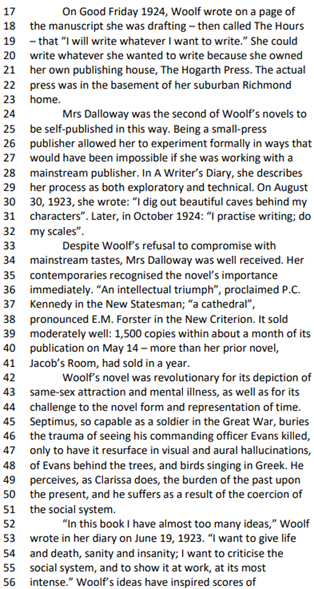
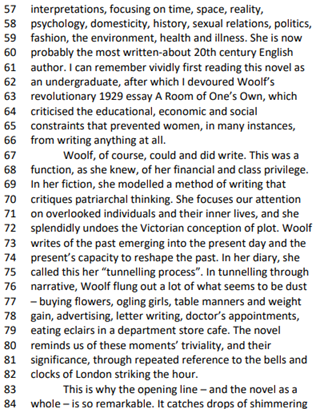
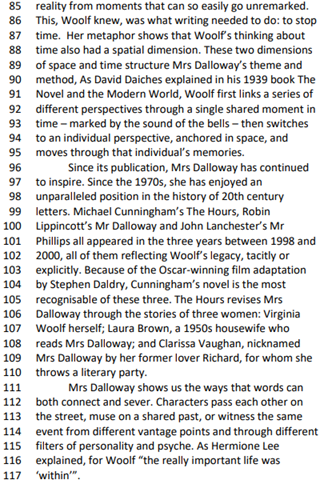
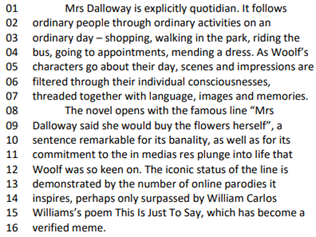
Seize the day – Virginia Woolf’s Mrs Dalloway at 100


Q1_20.png (316×237)
Q1_20_2.png (314×589)
Q1_20_3.png (316×409)
Q1_20_4.png (320×484)


Adapted from: https://theconversation/jan.30.2025
The sentences “Mrs Dalloway said she would buy the flowers herself.” and ‘“An intellectual triumph”, proclaimed P.C. Kennedy in the New Statesman’ are, respectively, examples of
Alternativas
Q3893487 Inglês
 O Discurso Indireto (*Reported Speech* ou *Indirect Speech*) é a estrutura usada para relatar o que outra pessoa disse, sem citar suas palavras exatas. Esse processo geralmente envolve mudanças nos tempos verbais (chamado *backshift*), nos pronomes e nos advérbios de tempo e lugar, para adequar a fala relatada ao novo contexto temporal e espacial do narrador.

Acerca das regras de transformação do discurso direto para o indireto, marque V, para as afirmativas verdadeiras, e F, para as falsas:

(__)Ao relatar uma fala, o *Simple Present* do discurso direto ("I *work* here") geralmente muda para o *Simple Past* no indireto ("He said he *worked* there").
(__)O *Simple Past* do discurso direto ("I *saw* the movie") geralmente muda para o *Past Perfect* no indireto ("She said she *had seen* the movie").
(__)Advérbios de tempo e lugar também mudam para refletir a perspectiva do narrador, como "now" mudando para "then" e "here" mudando para "there".
(__)Não é necessário fazer qualquer alteração no tempo verbal se o verbo principal de relato (*reporting verb*) estiver no presente (e.g., "She *says*...").

Após análise, assinale a alternativa que apresenta a sequência correta dos itens acima, de cima para baixo:
Alternativas
Q3855966 Inglês

Choose the alternative that correctly transforms the direct speech into reported speech.


Direct speech:


"I will start the project tomorrow," he said.

Alternativas
Q3824597 Inglês
There are four distinct techniques to convey or narrate what was said by someone to a third party: direct speech, reported speech, free direct speech and free reported speech.

I.Free direct speech is characterized by conveying the original message, but not the speaker's exact words.
II.He said their house had been for sale for six months is an example of reported speech.
III.Free reported speech is used in narratives to convey the thoughts or words of a character, through the narrator's voice.
IV.Reported speech presents with introductory verbs such as to say, to ask or to tell , and with quotation marks.
V.Direct speech can require a shift in verb tenses, pronouns and adverbs.
Alternativas
Q3824372 Inglês
Concerning reported speech, analyze the statements.

I. When the reporting verb is in the present, backshift is optional in neutral contexts.
II. Yesterday commonly becomes the previous day in indirect reports.
III. Must for obligation is normally reported as had to under backshift in neutral contexts.
IV. Would generally stays would in reported conditionals.
V. Universal truths often remain in the present even after a past reporting verb.

Which statements are CORRECT?
Alternativas
Q3820889 Inglês

Mother Goose and Grimm cartoon, by Mike Peters

The question: Can you solve our energy crisis? , made by Ralph, the dog character is given in the direct speech. Choose the alternative with its appropriate conversion into the reported speech:
Alternativas
Q3813939 Inglês
There are different ways to present speech in written texts. These include direct speech, reported (indirect) speech, free direct speech, and free indirect speech. Understanding how each one works can help readers and teachers recognize narrative styles and voices.
Read the following statements and choose the correct statement:
Alternativas
Q3813280 Inglês

Laszlo Krasznahorkai Is Awarded Nobel Prize in Literature


    Laszlo Krasznahorkai, a Hungarian novelist known for his dystopian themes and relentless prose, with winding sentences that can run on for pages, was awarded the Nobel Prize in Literature on Thursday. The Swedish Academy, which organizes the prize, said at a news conference that Krasznahorkai had received the award “for his compelling and visionary oeuvre that, in the midst of apocalyptic terror, reaffirms the power of art.”


   Krasznahorkai (pronounced CRAS-now-hoar-kay), 71, has been a perennial favorite for the Nobel. Hailed as a “master of the apocalypse” by Susan Sontag, Krasznahorkai has long been revered by fellow writers for his idiosyncratic style and bleak narratives that can often be slyly humorous.


   He’s also written half a dozen screenplays in collaboration with the Hungarian movie director Bela Tarr, who has adapted several of his novels for the screen. Tarr filmed “The Melancholy of Resistance,” which is among Krasznahorkai’s best-known works, as “Werckmeister Harmonies,” in 2000. The novel, filled with vast sentences, concerns events in a small Hungarian town after a circus arrives with a huge stuffed whale in tow.


   Krasznahorkai told The New York Times in 2014 that he had tried to develop an absolutely original style, adding, “I wanted to be free to stray far from my literary ancestors, and not make some new version of Kafka or Dostoyevsky or Faulkner.”


  Steve Sem-Sandberg, a member of the committee that awarded the prize, praised Krasznahorkai’s “powerful, musically inspired epic style” at the news conference announcing the Nobel. “It is Krasznahorkai’s artistic gaze, which is entirely free of illusion and which sees through the fragility of the social order, combined with his unwavering belief in the power of art that has motivated the academy to award the prize,” Sem-Sandberg added.


   A spokeswoman for Krasznahorkai’s German publisher said in an email on Thursday that the author was not conducting any interviews, although earlier in the day he briefly spoke to Swedish radio: “I’m very happy, thank you,” he said, adding, “I don’t know what’s coming in the future.”


   Krasznahorkai was born in Gyula, a small town about 120 miles from Budapest, in 1954. His family’s Jewish roots were kept a secret — his grandfather changed the family name from Korin to Krasznahorkai to assimilate — and Krasznahorkai didn’t know about his Jewish heritage until his father told him when he was 11.


   He was a musical prodigy, and worked as a professional musician for several years in his youth, playing piano in a jazz band and singing in a rock group. His father was a lawyer, and his mother worked in the social welfare ministry. Inspired by Kafka, an author he revered, he planned to study law and was fascinated by criminal psychology, but ended up studying Hungarian language and literature.


   After school, Krasznahorkai undertook military service but, he has said in interviews, deserted the army after being punished for insubordination. He then took on odd jobs — including working as a miner and as a night watchman for 300 cows, a post that allowed him to read work by Dostoyevsky and Malcolm Lowry’s “Under the Volcano,” a book he called his “bible.”


   When he began writing, his aim was to complete one book, then pursue a career in music. At the time he published his first short story, artists and writers were subject to censorship under Hungary’s Communist regime, and he was taken in for questioning by the police, who interrogated him about his anti-Communist views and took away his passport.


   Krasznahorkai was undeterred. In 1985, he published his subversive debut novel, “Satantango,” about life in a poor, crumbling hamlet, which was a literary sensation in Hungary. “Nobody, myself included, could understand how it was possible to publish ‘Satantango’ because it’s anything but an unproblematic novel for the Communist system,” he said in a 2018 Paris Review interview.


  “He doesn’t deal with grand politics, he’s dealing with the experiences of people who live within societies that are decaying and falling apart,” said the poet George Szirtes, who translated “Satantango” and several other works by Krasznahorkai. Tarr filmed an adaptation, which lasts for over seven hours, in 1994. In an interview on Thursday he recalled reading the book in one night and asking if he could turn it into a movie, only to find the author annoyed to be woken up during Easter holidays. The novel was filled with “these poor people, these miserable people,” Tarr said, but Krasznahorkai gave them a rare “dignity.”


   Szirtes said that Krasznahorkai never expected his books — filled with endless clauses and sub-clauses — to catch on with a wide international audience. “The books can look daunting in some ways, simply because there is no break in them,” Szirtes said. In recent decades, Krasznahorkai has received a stream of accolades outside his home country. In 2015, he won the Man Booker International Prize, which at the time was awarded for an author’s entire body of work rather than a specific novel.


   In the United States, New Directions has published a dozen of his books in translation, and more are forthcoming, including “Zsömle Is Gone,” a satire about an elderly retired electrician living in the countryside who believes he’s a descendant of Hungarian royalty. Barbara Epler, the publisher of New Directions, said one of the most striking things about Krasznahorkai’s work is his ability to weave unexpected humor into bleak stories. “What’s amazing is its anti-gravitational element — all this darkness and within it, an escalating, incredibly deadpan hilarity,” she said.


   The Nobel Prize is literature’s major honor, and typically the capstone to a writer’s career. Past recipients have included the authors Saul Bellow and Toni Morrison, the playwright Harold Pinter and, in 2016, Bob Dylan. Krasznahorkai had featured among bookmakers’ favorites to win the prize for many years. He is the second Hungarian to receive the literature Nobel after Imre Kertész, a novelist and Holocaust survivor, in 2002.


   While Krasznahorkai’s work has often been praised for its political overtones, he has rejected the idea that he’s writing political allegories. “I never want to write some political novels,” he told The New York Times in 2014. “My resistance against the Communist regime was not political. It was against a society.”


   Krasznahorkai isn’t comfortable being cast as a social or political prognosticator. He has said he’s never felt at ease discussing his work, and doesn’t see himself as “part of literary life.” “Writing, for me, is a totally private act,” he told The Paris Review. “I’m ashamed to speak about my literature — it’s the same as if you were to ask me about my most private secrets.”


Adapted from: https://www.nytimes.com/2025/10/09/


The sentence “Krasznahorkai told The New York Times in 2014 that he had tried to develop an absolutely original style, adding, ‘I wanted to be free to stray far from my literary ancestors, and not make some new version of Kafka or Dostoyevsky or Faulkner.’” presents in its sequence, respectively,
Alternativas
Q3811217 Inglês

Match the items in Column B to the corresponding concepts in Column A regarding sentence relationships and forms of speech representation:


Column A: concepts


1.Direct speech


2.Reported speech


3.Discourse markers


Column B: descriptions


(__)Words used to organize ideas in a text, signaling contrast, consequence, addition, or sequence.


(__)A structure in which the speaker's exact words are reproduced without grammatical changes.


(__)A structure that requires changes in pronouns, verb tenses, and time expressions when reporting someone's speech.


Choose the alternative that presents the correct association between the columns:

Alternativas
Q3790628 Inglês
Em narrativas contemporâneas, a fusão entre voz narrativa e consciência da personagem, sem marcas explícitas de citação, caracteriza: 
Alternativas
Q3773726 Inglês

Read the text below and answer question


Plan to test Liberian schoolchildren for drugs blocked

October 17th, 2025

By Moses Kollie Garzeawu

Monrovia, Liberia, Africa


Liberia's Education Ministry has blocked controversial plans to introduce mandatory drug testing in all of the country's schools.


Speaking to local media, the interim head of the Liberia Drug Enforcement Agency (LDEA), Fitzgerald Biago, said school testing would help address the growing problem of drug abuse.


The announcement sparked a mixed response. Some thought it would help tackle the scourge of drugs, while others saw it as an invasion of privacy, or feared it would cost too much.


Last year, President Joseph Boakai declared drug and substance abuse a national emergency and a recent EU-backed report estimated that one in five young Liberians take drugs.


However, the Education Ministry said it was not aware of any plans to test students and added that such a decision needed to be based on concrete evidence and properly thought through.


Assistant minister in charge of students Sona Toure-Sesay told the BBC that this kind of plan required proper research. "Let's assume we are made aware of the proposed initiatives by the LDEA, it will require us to conduct research and review case studies from other countries where this has been successful," she said.  


Toure-Sesay also noted that testing could affect students. "What happens to students who test positive? What are the social services in place for them? Some of them might be bullied even after returning, and it may affect their overall educational performances."


She added that a multi-sectoral committee on drug and substance abuse had been set up, headed by the Health Ministry. Along with strengthening health clubs in schools, she said that this would help to reduce the prevalence of drugs among students.


President Boakai dismissed the leadership of the LDEA in August this year, and recently appointed Biago, a former senior police officer, as interim head of the agency.


Taken from:

https://www.bbc.com/news/articles/c0mxz3x1lr7o  

The principal said to the students: “Don’t bring drugs to school”.


Choose the alternative that expresses the above sentence in reported speech: 

Alternativas
Q3771576 Inglês
Choose the option that best reports the statement below, adjusting tense, pronouns, time references and the relative clause.
Direct speech: The chair said to the board, “We can’t approve the draft that the consultant, whose portfolio I admire, emailed yesterday unless she sends us the missing data now.”
Alternativas
Q3764991 Inglês

Q30.png (650×209)


Mark the alternative that transforms Calvin’s sentence into reported speech:


“As soon as I save a little more money, I’ll buy a ticket.”

Alternativas
Q3764860 Inglês
Change the following sentence into Reported Speech: 'I will finish the report tomorrow,' said John. Judge the following statements as True (T) or False (F).
(__)John said that he would finish the report the following day.
(__)John said that he will finish the report tomorrow.
(__)John told that he would finish the report the next day.
(__)John said that he would finish the report tomorrow.

Mark the alternative that shows the correct sequence, from top to bottom.
Alternativas
Q3758292 Inglês
The English passive highlights affected participants or information structure shifts (topic continuity), not merely agent deletion. In indirect speech, tense and deixis may shift under backshifting conventions, yet factivity and universal truths resist change. Subordination via complement, relative, and adverbial clauses provides cohesion; that-deletion depends on register and processing ease (cf. Huddleston & Pullum). Select the correct statement. 
Alternativas
Respostas
41: D
42: B
43: D
44: B
45: B
46: A
47: D
48: C
49: B
50: E
51: C
52: D
53: C
54: D
55: B
56: A
57: A
58: A
59: B
60: D