Questões de Concurso
Sobre discurso direto e indireto | reported speech em inglês
Foram encontradas 195 questões


Ao relatar posteriormente esse episódio em uma narrativa situada integralmente no passado, empregando a sequência convencional de tempos do discurso indireto e realizando as alterações referenciais necessárias, a professora deveria registrar:
"I may send the revised material tomorrow, but I haven't finished checking it yet."
On Wednesday, another teacher reports what was said.
Which sentence accurately reports the original statement from the later temporal perspective?
Which reported version is CORRECTLY constructed?
"The scale and precision of these constructions are simply astonishing."
Suppose a writer reports his statement later, using conventional reported-speech backshift and maintaining the original meaning.
Which sentence is appropriately formed?
Original statement:
"I didn't start Sync Labs due to concerns about the labor market."
Which sentence appropriately reports the statement?
The principal said, “We are implementing the new assessment framework today.”
Sarah said, “I am studying English because I want to travel.” Considering the appropriate transformation into reported speech, which alternative is correct?
Para responder à questão, leia o texto abaixo.
How Will You Get from How Things Are to How Things "Should" Be?
A lot of people get fixated on things that they think "should" happen, but fail to address substantial obstacles in the way. I may even agree with them about what I think "should" happen. But that doesn't mean that it's going to happen. If you're thinking that there is also a danger in being overly cautious or waiting to work out the perfect plan, you're right. That can become a form of procrastination. Acting on an imperfect plan is usually better than waiting until you've worked out every last detail. But at least have some kind of plan that doesn't require a miracle to happen.
The plan that works will also probably not be the plan you started with. You will have to update the plan as you proceed and the situation evolves.
A good model for this process is John Boyd's OODA decision making loop. OODA stands for Observe, Orient, Decide, Act. Actions produce responses that provide new information. New information requires reorientation and new decisions will have to be made that lead to new actions, and the loop repeats.
No big changes happened because a bunch of people sat around complaining about how things "should be."
That's like saying "l should be a millionaire." You could be, but you're going to need some kind of plan to get there that realistically acknowledges the obstacles in your way.
Many of the problems we face today took years to create.
We have inherited a big mess. A lot of things happened that "should not" have happened. Mistakes were made.
But that's life. It's going to throw all kinds of things at you that are sub-optimal. Things you didn't "deserve" or ask for. Cleaning up messes you didn't create is as normal as dealing with bad weather.
Some messes only require a dustpan.
But if you want to clean up a really big mess, you're going to need a plan.
Fonte: https://mrjackdonovan.substack.com/p/the-flow-chart
Leia o texto a seguir para responder à questão:
In the Star Trek universe, the audience occasionally gets a glimpse inside schools on the planet Vulcan. Young children stand alone in “capsules” surrounded by 360-degree digital screens. Adults walk around but do not talk to the students. Instead, each child interacts only with a sophisticated artificial intelligence (AI). Although this is not the reality in today’s classrooms on Earth, there are people for whom a vision of personalized learning conducted by artificial intelligence has considerable appeal.
Individualized learning has its place. But decades of educational research also demonstrate that learning is essentially a social endeavor. Classrooms that privilege personalized AI chatbots overlook that fact.
Generative AI is quickly coming to classrooms. If decades ago educators worldwide promoted the benefits of “One Laptop per Child”, today we may be approaching the model “one chatbot per child.” What does educational research tell us about what this model could mean for children’s learning and well-being?
During much of the 20th century, learning was understood as mainly as a matter of individual cognition. A misconception, if compared to today’s comprehension of what learning involves. Scientists now understand that apparently individual processes – such as building new knowledge – are actually social interactions with the world around us. In classrooms, this suggests that opportunities for daily personal interaction can strongly support brain health and academic learning.
Therefore, it is important to understand generative AI’s real-life impact on students.
For example: How does it feel to learn from a chatbot, day after day? How will long-term use of AI affect children’s mental health? How does AI use affect children’s relationships with each other and with their teachers? What kinds of relationships might children form with the chatbots themselves? More broadly, we could also ask: What do we, as a society, actually want children to learn?
Good teaching and learning blends social and individual processes. I see the beneficial application of any new technology in the classroom – AI or otherwise – as a way to build upon the social fabric of human learning. My concern about personalized AI tutors is how they might displace already infrequent opportunities for social interaction, further isolating children in classrooms.
(Niral Shah. www.converstion.com, 15.12.2025. Adaptado)
The five direct questions in the fifth paragraph have been rewritten as indirect questions.
The only correct pair of sentences is found in alternative:
Observe as tirinhas da série Peanuts, de Charles Schulz:
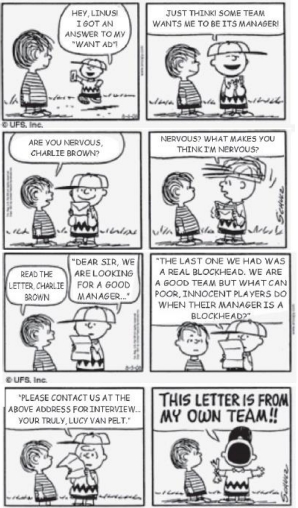
A carta enviada por Lucy van Pelt a um anúncio de jornal apresenta uma crítica irônica à liderança de Charlie Brown. No início da leitura da carta, lê-se o seguinte trecho em discurso direto:
“Dear Sir, we are looking for a good manager... The last one we had was a real blockhead.”
Assinale a alternativa que apresenta a reescrita desse trecho em discurso indireto, mantendo a fidelidade ao texto original e aplicando rigorosamente as regras de concordância e sequência temporal da norma-padrão da língua inglesa.
The tulips are too excitable, it is winter here. Look how white everything is, how quiet, how snowed-in. I am learning peacefulness, lying by myself quietly As the light lies on these white walls, this bed, these hands. I am nobody; I have nothing to do with explosions. I have given my name and my day-clothes up to the nurses And my history to the anaesthetist and my body to surgeons. PLATH, Sylvia. Tulips. In: PLATH, Sylvia. Collected Poems. Edited by Ted Hughes. New York: Harper & Row, 1981. p. 160–162.
Assinale a alternativa que apresenta a transposição correta para o reported speech da afirmação "I have given my name and my day-clothes up to the nurses."
"I am working on a new project."
I. Cleft sentences may foreground specific constituents for discourse emphasis;
II. Direct speech representation frequently preserves original utterance structure;
III. Active voice systematically suppresses the semantic role of the agent;
IV. Negation scope may vary according to syntactic positioning in clauses;
V. Conditional structures exclusively express hypothetical future situations.
Choose the correct alternative:
Column 01 ( )"l have completed the assignment," the student said.
( )The manager explained that the meeting had been postponed.
( )'We are preparing the researchers stated. annual report,” the
( )The athlete mentioned that he would participate in the competition.
( )"My sister visited us last weekend," Laura told her friends.
Column 02 l.Indirect Speech
II.Direct Speech
Choose the alternative with the correct sequence.

 Conheça nossos planos