Questões de Concurso
Sobre discurso direto e indireto | reported speech em inglês
Foram encontradas 195 questões


Consider the sentence below:
"Active methodologies promote interaction", said the teacher.
Now, choose the alternative below that correctly restates it into reported speech:
Question must be answered based on the following text.
This passage from “The Sign of the Four” by Arthur Conan Doyle, captures Holmes’ logical approach to deduction and showcases his analytical abilities.
"When you have eliminated the impossible, whatever remains, however improbable, must be the truth", said Sherlock Holmes.
Available at: https://standardebooks.org/ebooks/arthur-conan-doyle/the-sign-of-the-four/text/single-page#chapter-6
Question must be answered based on the following text.
In this passage from Alice’s Adventure in Wonderland, by Lewis Carrol, Alice meets the Cheshire Cat and asks for directions.
"Would you tell me, please, which way I ought to go from here?" Alice asked.
"That depends a good deal on where you want to get to”, said the Cat.
"I don’t much care where—" said Alice.
"Then it doesn’t matter which way you go", said the Cat.
—so long as I get somewhere", Alice added as an explanation.
"Oh, you’re sure to do that," said the Cat, "if you only walk long enough".
Available at: https://standardebooks.org/ebooks/lewis-carroll/alices-adventures-in-wonderland/johntenniel/text/single-page#chapter-6
Leia a tirinha a seguir para responder à próxima questão.
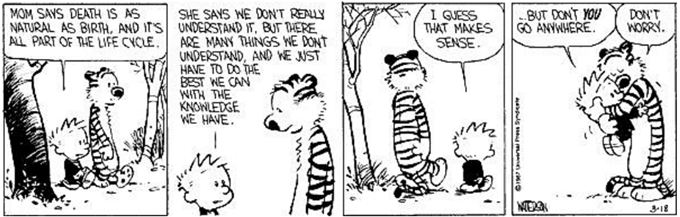
https://screenrant.com/most-heartwarming-calvin-and-hobbes-comics/
Leia a tirinha a seguir para responder à próxima questão.
https://screenrant.com/most-heartwarming-calvin-and-hobbes-comics/
After calling an emergency meeting to happen in the situation room, Mr. President _________________ the ministers that the state of affairs might become critical.

Which option maintains the correct tense consistency if rephrased?
Text 7A2-II
In October 1971, a gentleman called Frieder Nake published a note entitled, There Should Be No Computer Art, which I quote here. “Soon after the advent of computers, it became clear that there was a great potential application for them in the area of artistic creation”, he began. “Before 1960, amazing, large, expensive, digital computers helped to produce poetic text and music. Analog computers, or only oscilloscopes, generated drawings of sets of mathematical curves and representations of oscillations. It was not before the first exhibitions of computer produced pictures were held in 1965 that a greater public took notice of this threat, as some said, progress, as some thought. I was involved in this development from its beginning.
I think that the way the art scene reacted to the new creations is interesting, pleasing, and stupid. I stated in 1970 that I was no longer going to take part in exhibitions. I find it easy to admit that computer art did not contribute to the advancement of art if we compare the computer products to all existing works of art. In other words, the repertoire of results of aesthetic behavior has not been changed by the use of computers. This point of view, namely, that of art history, is shared and held against computer art by many art critics. There is no doubt in my mind”, Frieder Nake said, “that interesting new methods have been found in the last decade which can be of some significance for the creative artist”.
As you might imagine, this was a bit of a controversial take. Here was a man who had for part of the previous decade been an insider, an advocate for the use of algorithmic and generative processes to create art. However, he was now seeing things from another perspective. I’ll just finish with another piece from what he posted in that article: “Questions like ‘is a computer creative’, or ‘is a computer an artist’, or the like, should not be considered serious questions, period. In the light of what we are facing at the end of the 20th century, those irrelevant questions do not matter”.
Where is the Art? A History in Technology.
Internet: <https://www.infoq.com> (adapted).
Each of the following options presents a different version of the last sentence of the second paragraph of text 7A2-II. Choose the option in which not only are the correctness and the original meaning of the fragment maintained, but also is the reported indirect speech used correctly.
Text 1 – How children learn languages
Questions 31 to 39
How long does it take to learn a language?
Leia a tirinha a seguir:

(https://www.semanticscholar.org)
A reporting verb is used according to rules of grammar in sentence:
"I will call you tomorrow," she said.
I.In reported speech, the reporting verb can change from present tense to past tense when the reported statement is about a past event.
II.When reporting statements, modal verbs such as 'can' change to their past equivalents, such as 'could', to reflect the shift from direct to reported speech.
III.Reported speech often entails backshifting, where verb tenses shift back one tense in indirect speech compared to the original direct speech.
It is correct what is stated in:
Text 2
(Part II) Students’ skills
But graduation rates, while important, speak little to the quality of education received. The OECD’s Programme for International Student Assessment (PISA) reviews the extent to which students near the end of their compulsory education (usually around age 15) have acquired some of the knowledge and skills that are essential for full participation in modern societies, particularly in reading, mathematics and science.
In 2018, PISA tested students from 79 countries, including OECD countries, Brazil, the Russian Federation and South Africa. The students were tested on their reading ability, their skills in maths and level in sciences. Research shows that these skills are more reliable predictors of economic and social well-being than the number of years spent in school or in post -formal education. The average student in the OECD area scored 488. On average in the OECD, girls scored 491 compared with 485 for boys.
Estonia is the highest-performing OECD country, with average PISA scores of 526, followed by Japan and Korea with 520 points. The lowest performing OECD country, Colombia, has an average score of 406. This means that the gap between the highest and lowest performing OECD countries is 120 points.
The best-performing school systems manage to provide highquality education to all students. In Canada, Estonia, Finland and Ireland for example, students tend to perform well regardless of their social background. In Israel and Luxembourg however, the gap between the students with the lowest socio-economic background and the students with the highest socio-economic background reaches more than 120 points, suggesting students’ socio-economic background tends to have an impact on their results. On average across OECD countries, there is a widening 89-point difference in PISA scores between the students with the highest and lowest socio-economic background.
https://www.oecdbetterlifeindex.org/topics/education/
Associate the direct statements with their respective indirect statements.
DIRECT
1 - No, I’m sorry. I haven’t the time.
2 - Could I go to see that film with you?
3 - Be careful if you go walking in the hills alone.
4 - You can be sure I’ll be at the station to meet you.
5 - Why don’t we spend the day walking in the country hills?
INDIRECT
( ) She promised to be at the station to meet him.
( ) She refused to help as she didn´t have the time.
( ) She was warned about walking in the hills alone.
( ) She asked if she could go to see the film with him.
( ) She suggested they spent the day walking in the country hills.
The correct sequence of this association is:

 Conheça nossos planos