Questões Militares Sobre não definido
Foram encontradas 573 questões


Examine a figura abaixo.
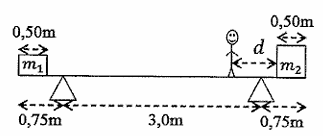
Um pedreiro de peso P=1,0×10³ N está fazendo reparos em um muro. Ele utiliza como andaime uma tábua de massa m e comprimento L (massa uniformemente distribuída) apoiada simetricamente sobre dois cavaletes idênticos. Para que ele tenha mais espaço para se deslocar sobre a tábua, decide colocar um balde contendo água (de massa total m1) em uma das extremidades da tábua e um outro balde contendo argamassa (de massa total m2) na outra extremidade, conforme indicado na figura acima. Sendo as seções retas dos baldes (vistos de cima) quadradas, de lado a, considere que as massas de água e de argamassa estão uniformemente distribuídas nos baldes e que o centro de gravidade do homem está sobre a sua mediana vertical, e assinale a opção que apresenta a distância mínima d, em metros, que o pedreiro deve manter do balde contendo argamassa para que a tábua esteja em equilíbrio.
Dados: g = 10 m/s2; L = 4,5 m; a = 0,5 m; m1 = 3,0 kg; m2 = 49kg e mT = 6,0 kg.
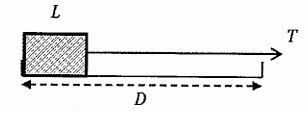
A figura mostra uma caixa de comprimento L, sendo arrastada em um espaço confinado de largura D por meio de um cabo, na horizontal, cuja tensão tem módulo igual a T. A caixa possui massa m e o coeficiente de atrito cinético entre a caixa e o solo é igual a μc. Assinale a alternativa que corresponde ao intervalo de tempo Δt que o cabo deve atuar (contado a partir do instante em que, partindo do repouso, adquire velocidade v>0) para que ela percorra a distância ΔS=D−L sem colidir com os limites do espaço confinado, de modo que a caixa encerre o deslocamento ΔS com velocidade nula, evitando danos ao conteúdo do seu interior. Desconsidere a resistência do ar.
Mark the option that completes the question below correctly.
______ different kinds of trees grow in the Amazon?
In 2013, Field Museum ecologist Nigel Pitman and fellow scientists estimated that there are 16,000 different trees growing in the Amazon. But confirming that guess meant actually counting all of the known species.
(Adapted from: https://www.fieldmuseum.org/blog)
Which option completes the paragraph below correctly?
“Everyone ______ in a good mood when they ______ their drive to Canterville Chase. It ______ a beautiful July evening, and they ______ the pine trees as they ______.”
(Adapted from: WILDE, Oscar. The Canterville Ghost:
The graphic novel. Boston: Heinle, 2011. p.15)
Which option completes the text correctly?
Lord Canterville: Mr. Otis, the law of ______ country states that ______ jewels belong to ______ family. Take ______. ______ are ______.
(Adapted from: WILDE, Oscar. The Canterville Ghost:
The graphic novel. Boston: Heinle, 2011. p.113)
Complete the gaps in the dialogue with a, an or the. Then, choose the option with the correct sequence. A dash (-) indicates that no article is used.
Tom is selling his sail boat. He advertised it and Jim phoned him to ask for information.
TOM: Hi!
JIM: How long have you had it for?
TOM: I've had it for three years. It's not ______ old sail boat. It's in ______ great condition! And it has ______ lot of equipment installed.
JIM: Why do you want to sell it?
TOM: Well, this is ______ first sail boat I've had in my life and now I need ______ different one. It's quite fast but it's not ______ fastest sail boat in ______ world.
JIM: Oh, I see. Where did you buy it?
TOM: I bought it at ______ Boats For All. Would you like to make ______ appointment to see it?
JIM: Sure!
Look at the chart below.
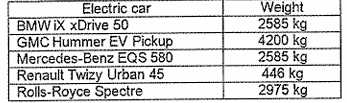
(Adapted from: https://www.myevreview.com)
According to the chart, it is correct to say that:
Mark the option that completes the dialogue below correctly.
John: Peter, don't close the door.
Peter: What did you say?
John: I ______ the door.
Read the sentence below.
The Government has clarified that there is no obligation for event operators to cancel or postpone shows and sporting events during the national mourning period, including the day of the state funeral.
(https://accessaa.co.uk)
Which option replaces the underlined verb correctly, without changing the meaning of the sentence?
TEXT II
Read the text below and answer question.
Welcome to the ‘plastisphere’: the synthetic
ecosystem evolving at sea
[1] Plastic bottles dominate waste in the ocean, with an estimated 1m of them reaching the sea every minute. The biggest culprit is polyethylene terephthalate (Pet) bottles.
[2] Last month, a study found two bacteria capable of breaking down Pet - or, as the headlines put it, “eating plastic”. Known as Thioclava sp. BHET1 and Bacillus sp. BHET2, the bacteria were isolated in a laboratory - but they were discovered in the ocean.
[3] The bacteria are the latest example of new organisms that appear to be growing in a unique environment: the vast amounts of plastic at sea.
[4] Like the atmosphere, magnetosphere and hydrosphere, the plastisphere is a region. But it is also an ecosystem, like the Siberian steppe or coral reefs - a plasticised marine environment. The best-known concentration of seaborne plastic waste is the Great Pacific garbage patch, a sort of plastic soup spread over an area roughly twice the size of France, but plastic is everywhere.
[5] First described in a 2013 study to refer to a collective of plastic-colonising organisms, including bacteria and fungi, the term has since expanded. It now loosely encompasses larger organisms, from crabs to jellyfish, which float across oceans on marine plastics. The term was coined by Linda Amaral-Zettler, a marine microbiologist at the Royal Netherlands Institute for Sea Research.
[6] Although the term may be recent, the phenomenon is not. “The plastisphere has been around for as long as plastic has existed,” Amaral-Zettler says.
[7] What is new is our understanding of just how complex an ecosystem the world of plastic can be. In the plastisphere there are organisms that photosynthesise; there are predators and prey, symbionts and parasites, allowing for “a full range of interactions possible, as in other ecosystems”, says Amaral-Zettler.
[8] Another unique feature of the plastisphere is that humans invented it. Every other ecosystem has evolved over millions of years. The meaning of that is not yet clear. Wright believes “it’s more an issue of scale” because unlike most naturally occurring materials, plastic is highly durable and persistent, allowing the growth and spread of attached organisms over a massive area.
[9] There are also concerns about plastic-colonising organisms that can travel around the world. Amaral-Zettler’s 2013 study discovered Vibrio, a type of bacteria known to contain several species of pathogens, including some associated with gastroenteritis.
[10] For the scientists, the plastisphere’s presence is a less obvious concern than its potential health dangers. Most plastic ends up in landfill, but nearly a third of it ends up in the sea. The majority sinks, but a lot does not, becoming a home for all sorts of microbes that might not otherwise have a home.
[11] “At the moment that’s still very much an active area of research,” Wright says. There are two main fields of investigation: potential pathogens in the plastisphere, and the potential for some microbes to biodegrade hydrocarbons, such as the plastic-eaters identified last month.
[12] Those are not unique to the ocean. In 2016, scientists in Japan discovered Ideonella sakaiensis, a species of bacteria at a rubbish tip that had evolved an enzyme that enabled it to eat plastic.
[13] But another study in the same year found that, compared with bacteria in the surrounding water, those in the plastisphere possessed an enriched collection of genes, suggesting that they had adapted for a “surface-attached lifestyle”.
[14] Could the plastisphere evolve in such a way that bacteria would essentially eat it, or at least help us identify ways to break down our plastic waste? “I’d definitely agree [that] microbes on plastics are going to be the key place to look in the fight against plastic,” says Wright.
(Adapted from: https://www.theguardian.com)
TEXT II
Read the text below and answer question.
Welcome to the ‘plastisphere’: the synthetic
ecosystem evolving at sea
[1] Plastic bottles dominate waste in the ocean, with an estimated 1m of them reaching the sea every minute. The biggest culprit is polyethylene terephthalate (Pet) bottles.
[2] Last month, a study found two bacteria capable of breaking down Pet - or, as the headlines put it, “eating plastic”. Known as Thioclava sp. BHET1 and Bacillus sp. BHET2, the bacteria were isolated in a laboratory - but they were discovered in the ocean.
[3] The bacteria are the latest example of new organisms that appear to be growing in a unique environment: the vast amounts of plastic at sea.
[4] Like the atmosphere, magnetosphere and hydrosphere, the plastisphere is a region. But it is also an ecosystem, like the Siberian steppe or coral reefs - a plasticised marine environment. The best-known concentration of seaborne plastic waste is the Great Pacific garbage patch, a sort of plastic soup spread over an area roughly twice the size of France, but plastic is everywhere.
[5] First described in a 2013 study to refer to a collective of plastic-colonising organisms, including bacteria and fungi, the term has since expanded. It now loosely encompasses larger organisms, from crabs to jellyfish, which float across oceans on marine plastics. The term was coined by Linda Amaral-Zettler, a marine microbiologist at the Royal Netherlands Institute for Sea Research.
[6] Although the term may be recent, the phenomenon is not. “The plastisphere has been around for as long as plastic has existed,” Amaral-Zettler says.
[7] What is new is our understanding of just how complex an ecosystem the world of plastic can be. In the plastisphere there are organisms that photosynthesise; there are predators and prey, symbionts and parasites, allowing for “a full range of interactions possible, as in other ecosystems”, says Amaral-Zettler.
[8] Another unique feature of the plastisphere is that humans invented it. Every other ecosystem has evolved over millions of years. The meaning of that is not yet clear. Wright believes “it’s more an issue of scale” because unlike most naturally occurring materials, plastic is highly durable and persistent, allowing the growth and spread of attached organisms over a massive area.
[9] There are also concerns about plastic-colonising organisms that can travel around the world. Amaral-Zettler’s 2013 study discovered Vibrio, a type of bacteria known to contain several species of pathogens, including some associated with gastroenteritis.
[10] For the scientists, the plastisphere’s presence is a less obvious concern than its potential health dangers. Most plastic ends up in landfill, but nearly a third of it ends up in the sea. The majority sinks, but a lot does not, becoming a home for all sorts of microbes that might not otherwise have a home.
[11] “At the moment that’s still very much an active area of research,” Wright says. There are two main fields of investigation: potential pathogens in the plastisphere, and the potential for some microbes to biodegrade hydrocarbons, such as the plastic-eaters identified last month.
[12] Those are not unique to the ocean. In 2016, scientists in Japan discovered Ideonella sakaiensis, a species of bacteria at a rubbish tip that had evolved an enzyme that enabled it to eat plastic.
[13] But another study in the same year found that, compared with bacteria in the surrounding water, those in the plastisphere possessed an enriched collection of genes, suggesting that they had adapted for a “surface-attached lifestyle”.
[14] Could the plastisphere evolve in such a way that bacteria would essentially eat it, or at least help us identify ways to break down our plastic waste? “I’d definitely agree [that] microbes on plastics are going to be the key place to look in the fight against plastic,” says Wright.
(Adapted from: https://www.theguardian.com)
Decide if the statements below are true (T) or false (F) according to the text. Then, choose the option that contains the right sequence.
( ) The plastisphere is one more ecosystem in our world and it is similar to all other ecosystems that exist.
( ) The atmosphere, the magnetosphere and the hydrosphere gave origin to the plastisphere.
( ) In addition to bacteria and fungi, some animals can travel to many countries on marine plastics.
( ) The bacteria in the plastisphere can be characterized as a group of bacteria that have not become adapted to living on the surface.
( ) Wright believes that we can combat plastic pollution if we do research on microbes that eat or decompose plastic waste.
TEXT I
Read the text below and answer the question.
Robo-penguin: how artificial birds are relaying the
secrets of ocean currents
[1] If it looks like a penguin and swims like a penguin - but it's actually a robot - then it must be the latest advance in marine sensory equipment.
[2] The Quadron is an autonomous underwater vehicle (AUV): a 3D-printed self-propelled machine designed to mimic a penguin in order to measure the properties of oceanic eddies.
[3] It was developed by Burkard Baschek while head of Germany's Institute of Coastal Ocean Dynamics at the Helmholtz Centre Hereon after he watched more than $20,000 of his equipment sink to the bottom of the Pacific Ocean.
[4] Eddies are small ocean currents that other research methods have struggled to capture. They influence all the animals and plants in the seas as well as the Earth's climate, driving roughly 50% of all phytoplankton production. The base of the marine food chain, phytoplankton and other marine plants such as kelp and algal plankton also produce up to 70% of atmospheric oxygen.
[5] Despite their significance, eddies are poorly understood within the scientific community because they are small; some are just 10 metres across, and they have an average lifespan of 12 hours, posing a huge challenge for ocean observations. Few detailed measurements even exist.
[6] Baschek first developed a device with about 20 sensors attached to a rope, to be towed behind a ship to measure key oceanographic variables in the eddies - such as temperature, salinity, pressure, chlorophyll and oxygen. But the rope would catch on rocks, fishing nets or containers - sending all the data to the seabed.
[7] “The only way to avoid such underwater dangers was to develop a device which can do these measurements without being tied to a rope,” says Baschek.
[8] The solution came from Rudolf Bannasch and his team at the Berlin-based company EvoLogics, which specialises in bionics based on natural evolution. Bannasch knew exactly what Baschek needed: a penguin.
[9] “Penguins provide a shape with optimal aerodynamic characteristics,” says Bannasch. His studies in wireless underwater navigation and communication systems suggest that penguins are 20% to 30% more aerodynamic than anything designed in a laboratory, ideal for the high-speed measurements Baschek sought.
[10] In April, the first Quadron prototype - the name derives from “quadro”, after the four propellers that move the AUV, and “penguin” - had its maiden voyage in a lake near Berlin. It has a maximum speed of eight knots (9.2 mph) and uses the same sensors that used to be towed on a rope. The Quadron, however, can float freely through the water, avoiding obstructions, to depths of 150 metres.
[11] One element in the study of eddies that has worried scientists is that they need to be measured in multiple locations simultaneously. Bannasch and his colleagues are working to create two more artificial penguins that would swim in unison and communicate with each other.
[12] “We developed the first singing underwater modems so that the Quadrons will be able to send and receive chirping signals similar to those of dolphins,” says Bannasch.
[13] As for losing them to the bottom of the ocean, the artificial penguins have a final trick that also mimics their real-life counterparts: if the electronics fail and the sensors go dark, they float.
(Adapted from: https://www.theguardian.com)
According to the text:
TEXT I
Read the text below and answer the question.
Robo-penguin: how artificial birds are relaying the
secrets of ocean currents
[1] If it looks like a penguin and swims like a penguin - but it's actually a robot - then it must be the latest advance in marine sensory equipment.
[2] The Quadron is an autonomous underwater vehicle (AUV): a 3D-printed self-propelled machine designed to mimic a penguin in order to measure the properties of oceanic eddies.
[3] It was developed by Burkard Baschek while head of Germany's Institute of Coastal Ocean Dynamics at the Helmholtz Centre Hereon after he watched more than $20,000 of his equipment sink to the bottom of the Pacific Ocean.
[4] Eddies are small ocean currents that other research methods have struggled to capture. They influence all the animals and plants in the seas as well as the Earth's climate, driving roughly 50% of all phytoplankton production. The base of the marine food chain, phytoplankton and other marine plants such as kelp and algal plankton also produce up to 70% of atmospheric oxygen.
[5] Despite their significance, eddies are poorly understood within the scientific community because they are small; some are just 10 metres across, and they have an average lifespan of 12 hours, posing a huge challenge for ocean observations. Few detailed measurements even exist.
[6] Baschek first developed a device with about 20 sensors attached to a rope, to be towed behind a ship to measure key oceanographic variables in the eddies - such as temperature, salinity, pressure, chlorophyll and oxygen. But the rope would catch on rocks, fishing nets or containers - sending all the data to the seabed.
[7] “The only way to avoid such underwater dangers was to develop a device which can do these measurements without being tied to a rope,” says Baschek.
[8] The solution came from Rudolf Bannasch and his team at the Berlin-based company EvoLogics, which specialises in bionics based on natural evolution. Bannasch knew exactly what Baschek needed: a penguin.
[9] “Penguins provide a shape with optimal aerodynamic characteristics,” says Bannasch. His studies in wireless underwater navigation and communication systems suggest that penguins are 20% to 30% more aerodynamic than anything designed in a laboratory, ideal for the high-speed measurements Baschek sought.
[10] In April, the first Quadron prototype - the name derives from “quadro”, after the four propellers that move the AUV, and “penguin” - had its maiden voyage in a lake near Berlin. It has a maximum speed of eight knots (9.2 mph) and uses the same sensors that used to be towed on a rope. The Quadron, however, can float freely through the water, avoiding obstructions, to depths of 150 metres.
[11] One element in the study of eddies that has worried scientists is that they need to be measured in multiple locations simultaneously. Bannasch and his colleagues are working to create two more artificial penguins that would swim in unison and communicate with each other.
[12] “We developed the first singing underwater modems so that the Quadrons will be able to send and receive chirping signals similar to those of dolphins,” says Bannasch.
[13] As for losing them to the bottom of the ocean, the artificial penguins have a final trick that also mimics their real-life counterparts: if the electronics fail and the sensors go dark, they float.
(Adapted from: https://www.theguardian.com)
TEXT I
Read the text below and answer the question.
Robo-penguin: how artificial birds are relaying the
secrets of ocean currents
[1] If it looks like a penguin and swims like a penguin - but it's actually a robot - then it must be the latest advance in marine sensory equipment.
[2] The Quadron is an autonomous underwater vehicle (AUV): a 3D-printed self-propelled machine designed to mimic a penguin in order to measure the properties of oceanic eddies.
[3] It was developed by Burkard Baschek while head of Germany's Institute of Coastal Ocean Dynamics at the Helmholtz Centre Hereon after he watched more than $20,000 of his equipment sink to the bottom of the Pacific Ocean.
[4] Eddies are small ocean currents that other research methods have struggled to capture. They influence all the animals and plants in the seas as well as the Earth's climate, driving roughly 50% of all phytoplankton production. The base of the marine food chain, phytoplankton and other marine plants such as kelp and algal plankton also produce up to 70% of atmospheric oxygen.
[5] Despite their significance, eddies are poorly understood within the scientific community because they are small; some are just 10 metres across, and they have an average lifespan of 12 hours, posing a huge challenge for ocean observations. Few detailed measurements even exist.
[6] Baschek first developed a device with about 20 sensors attached to a rope, to be towed behind a ship to measure key oceanographic variables in the eddies - such as temperature, salinity, pressure, chlorophyll and oxygen. But the rope would catch on rocks, fishing nets or containers - sending all the data to the seabed.
[7] “The only way to avoid such underwater dangers was to develop a device which can do these measurements without being tied to a rope,” says Baschek.
[8] The solution came from Rudolf Bannasch and his team at the Berlin-based company EvoLogics, which specialises in bionics based on natural evolution. Bannasch knew exactly what Baschek needed: a penguin.
[9] “Penguins provide a shape with optimal aerodynamic characteristics,” says Bannasch. His studies in wireless underwater navigation and communication systems suggest that penguins are 20% to 30% more aerodynamic than anything designed in a laboratory, ideal for the high-speed measurements Baschek sought.
[10] In April, the first Quadron prototype - the name derives from “quadro”, after the four propellers that move the AUV, and “penguin” - had its maiden voyage in a lake near Berlin. It has a maximum speed of eight knots (9.2 mph) and uses the same sensors that used to be towed on a rope. The Quadron, however, can float freely through the water, avoiding obstructions, to depths of 150 metres.
[11] One element in the study of eddies that has worried scientists is that they need to be measured in multiple locations simultaneously. Bannasch and his colleagues are working to create two more artificial penguins that would swim in unison and communicate with each other.
[12] “We developed the first singing underwater modems so that the Quadrons will be able to send and receive chirping signals similar to those of dolphins,” says Bannasch.
[13] As for losing them to the bottom of the ocean, the artificial penguins have a final trick that also mimics their real-life counterparts: if the electronics fail and the sensors go dark, they float.
(Adapted from: https://www.theguardian.com)
TEXT I
Read the text below and answer the question.
Robo-penguin: how artificial birds are relaying the
secrets of ocean currents
[1] If it looks like a penguin and swims like a penguin - but it's actually a robot - then it must be the latest advance in marine sensory equipment.
[2] The Quadron is an autonomous underwater vehicle (AUV): a 3D-printed self-propelled machine designed to mimic a penguin in order to measure the properties of oceanic eddies.
[3] It was developed by Burkard Baschek while head of Germany's Institute of Coastal Ocean Dynamics at the Helmholtz Centre Hereon after he watched more than $20,000 of his equipment sink to the bottom of the Pacific Ocean.
[4] Eddies are small ocean currents that other research methods have struggled to capture. They influence all the animals and plants in the seas as well as the Earth's climate, driving roughly 50% of all phytoplankton production. The base of the marine food chain, phytoplankton and other marine plants such as kelp and algal plankton also produce up to 70% of atmospheric oxygen.
[5] Despite their significance, eddies are poorly understood within the scientific community because they are small; some are just 10 metres across, and they have an average lifespan of 12 hours, posing a huge challenge for ocean observations. Few detailed measurements even exist.
[6] Baschek first developed a device with about 20 sensors attached to a rope, to be towed behind a ship to measure key oceanographic variables in the eddies - such as temperature, salinity, pressure, chlorophyll and oxygen. But the rope would catch on rocks, fishing nets or containers - sending all the data to the seabed.
[7] “The only way to avoid such underwater dangers was to develop a device which can do these measurements without being tied to a rope,” says Baschek.
[8] The solution came from Rudolf Bannasch and his team at the Berlin-based company EvoLogics, which specialises in bionics based on natural evolution. Bannasch knew exactly what Baschek needed: a penguin.
[9] “Penguins provide a shape with optimal aerodynamic characteristics,” says Bannasch. His studies in wireless underwater navigation and communication systems suggest that penguins are 20% to 30% more aerodynamic than anything designed in a laboratory, ideal for the high-speed measurements Baschek sought.
[10] In April, the first Quadron prototype - the name derives from “quadro”, after the four propellers that move the AUV, and “penguin” - had its maiden voyage in a lake near Berlin. It has a maximum speed of eight knots (9.2 mph) and uses the same sensors that used to be towed on a rope. The Quadron, however, can float freely through the water, avoiding obstructions, to depths of 150 metres.
[11] One element in the study of eddies that has worried scientists is that they need to be measured in multiple locations simultaneously. Bannasch and his colleagues are working to create two more artificial penguins that would swim in unison and communicate with each other.
[12] “We developed the first singing underwater modems so that the Quadrons will be able to send and receive chirping signals similar to those of dolphins,” says Bannasch.
[13] As for losing them to the bottom of the ocean, the artificial penguins have a final trick that also mimics their real-life counterparts: if the electronics fail and the sensors go dark, they float.
(Adapted from: https://www.theguardian.com)

 Conheça nossos planos