Questões Militares Sobre inglês
Foram encontradas 4.500 questões


Ano: 2026
Banca:
VUNESP
Órgão:
EsFCEx
Prova:
VUNESP - 2026 - EsFCEx - Oficial - Especialidade: Magistério em Inglês |
Q4189441
Inglês
Texto associado
Leia os textos a seguir para responder à questão:
Do certain people actually have a “knack” for learning
foreign languages? Anecdotal evidence would suggest that
some people are indeed able to learn languages faster and
more efficiently than others. One way of looking at such
aptitude is the identification of characteristics of successful
language learners. Risk-taking behavior, memory efficiency,
intelligent guessing, willingness to communicate, low anxiety,
and ambiguity tolerance are but a few of the many variables
that have been cited
(Brown, H.D., Principles of Language Learning and Teaching, 2014. Adaptado)
Historically, research on language aptitude has been a
roller-coaster ride. John Carroll’s (Carroll & Sapon, 1959)
pioneering work on aptitude, embodied in the Modern
Language Aptitude Test (MLAT), began the quest. The
MLAT asserted the predictability of number learning, sound
discrimination, pattern discernment, and memorization
for future success in a foreign language. This test, and
some others, were used for some time in such contexts
as Peace Corps volunteer training programs and military
communications courses to help predict successful language
learners.
(Brown, H.D., Principles of Language Learning and Teaching, 2014. Adaptado)
To rewrite the opening question in the text “Do some
people actually have a ‘knack’ for learning foreign
languages?” in indirect speech, select the option that
correctly completes the main sentence “We want to
know
Ano: 2026
Banca:
VUNESP
Órgão:
EsFCEx
Prova:
VUNESP - 2026 - EsFCEx - Oficial - Especialidade: Magistério em Inglês |
Q4189439
Inglês
Texto associado
Leia o texto a seguir para responder à questão:
According to Savignon and Sysoyev (2005), “cultures
are never static” (p. 36). Certainly, there are aspects
of culture that do not change or change at a slower rate,
such as values, norms, and historical heritage (Savignon &
Sysoyev, 2005), but teachers need “to recognize the limits
of this static nature and keep in mind that culture, as well as
language, is constantly changing, it is in flux (Lange, 1999).
The dynamic nature of culture brings a number of challenges
and concerns for teachers trying to choose relevant teaching
materials and activities (Savignon & Sysoyev, 2005). While
culture is often depicted as static in textbooks, the digital
media, authentic products and texts provide a more dynamic
environment.
Foreign language instructors are beginning to incorporate
more movies in the FL classroom as “an accessible
window” (Bueno, 2009, p. 319) to the target culture through
“combined effects of images, sounds, camera, plots and
dialogue” (Stephens, 2001, p. 2). The teachers’ major task
is to bring both language and culture into students’ social
reality (Lange, 1999), in order to make sure that they do not
possess incomplete or outdated knowledge about the target
language and its culture.
(Dema, O., Mueller, A. J., Teaching culture in the 21st century
language classroom, 2012. Adaptado)
The verb in the fragment “While culture is often depicted
as static in textbooks” (paragraph 2) is in the passive
voice. However, not all English verbs – or verb tenses –
can take a passive. The alternative in which the sentence
can be correctly rewritten in the passive voice is:
Ano: 2026
Banca:
VUNESP
Órgão:
EsFCEx
Prova:
VUNESP - 2026 - EsFCEx - Oficial - Especialidade: Magistério em Inglês |
Q4189437
Inglês
Texto associado
Leia o texto a seguir para responder à questão:
According to Savignon and Sysoyev (2005), “cultures
are never static” (p. 36). Certainly, there are aspects
of culture that do not change or change at a slower rate,
such as values, norms, and historical heritage (Savignon &
Sysoyev, 2005), but teachers need “to recognize the limits
of this static nature and keep in mind that culture, as well as
language, is constantly changing, it is in flux (Lange, 1999).
The dynamic nature of culture brings a number of challenges
and concerns for teachers trying to choose relevant teaching
materials and activities (Savignon & Sysoyev, 2005). While
culture is often depicted as static in textbooks, the digital
media, authentic products and texts provide a more dynamic
environment.
Foreign language instructors are beginning to incorporate
more movies in the FL classroom as “an accessible
window” (Bueno, 2009, p. 319) to the target culture through
“combined effects of images, sounds, camera, plots and
dialogue” (Stephens, 2001, p. 2). The teachers’ major task
is to bring both language and culture into students’ social
reality (Lange, 1999), in order to make sure that they do not
possess incomplete or outdated knowledge about the target
language and its culture.
(Dema, O., Mueller, A. J., Teaching culture in the 21st century
language classroom, 2012. Adaptado)
According to the first paragraph,
Ano: 2026
Banca:
VUNESP
Órgão:
EsFCEx
Prova:
VUNESP - 2026 - EsFCEx - Oficial - Especialidade: Magistério em Inglês |
Q4189436
Inglês
Texto associado
Leia o texto a seguir para responder à questão:
Knowledge of a language enables you to combine sounds
to form words, words to form phrases, and phrases to form
sentences. You cannot buy a dictionary or phrase book of
any language with all the sentences of the language. No
dictionary can list all the possible sentences, because the
number of sentences in a language is infinite. Knowing a
language means being able to produce and understand new
sentences never spoken before. This is the creative aspect
of language. Not every speaker can create great literature, but
everybody who knows a language can create and understand
new sentences.
This creative aspect of language is quite easy to illustrate.
If for every sentence in the language a longer sentence can
be formed, then there is no limit to the number of sentences.
If you know English, you have the knowledge to add any
number of adjectives as modifiers to a noun and to form
sentences with indefinite numbers of clauses.
All human languages permit their speakers to increase the
length and complexity of sentences in these ways; creativity is
a universal property of human language.
Our knowledge of language not only allows us to
produce and understand an infinite number of well-formed
(even if silly and illogical) sentences, but also permits us
to distinguish well-formed (grammatical) sentences from
ill-formed (ungrammatical) sentences – or non-sentences.
(Fromkin, Rodman and Hyams, An Introduction to Language, 2013. Adaptado)
A teacher is discussing aspects of knowledge of the
language and creativity, and also introduces the
concept of sentences (grammatically well-formed) and
non-sentences (grammatically ill-formed) discussed by
Fromkin, Rodman and Hyams. Students are asked to
get in groups and discuss the 5 following sentences
to decide which one, among them, can be considered
a non-sentence according to the authors’ view.
Based on this context, select the option that presents
a non-sentence.
Ano: 2026
Banca:
VUNESP
Órgão:
EsFCEx
Prova:
VUNESP - 2026 - EsFCEx - Oficial - Especialidade: Magistério em Inglês |
Q4189435
Inglês
Texto associado
Leia o texto a seguir para responder à questão:
Knowledge of a language enables you to combine sounds
to form words, words to form phrases, and phrases to form
sentences. You cannot buy a dictionary or phrase book of
any language with all the sentences of the language. No
dictionary can list all the possible sentences, because the
number of sentences in a language is infinite. Knowing a
language means being able to produce and understand new
sentences never spoken before. This is the creative aspect
of language. Not every speaker can create great literature, but
everybody who knows a language can create and understand
new sentences.
This creative aspect of language is quite easy to illustrate.
If for every sentence in the language a longer sentence can
be formed, then there is no limit to the number of sentences.
If you know English, you have the knowledge to add any
number of adjectives as modifiers to a noun and to form
sentences with indefinite numbers of clauses.
All human languages permit their speakers to increase the
length and complexity of sentences in these ways; creativity is
a universal property of human language.
Our knowledge of language not only allows us to
produce and understand an infinite number of well-formed
(even if silly and illogical) sentences, but also permits us
to distinguish well-formed (grammatical) sentences from
ill-formed (ungrammatical) sentences – or non-sentences.
(Fromkin, Rodman and Hyams, An Introduction to Language, 2013. Adaptado)
The sentence in the fourth paragraph displays one
correct use of paired conjunctions.
The alternative in which the paired conjunctions help form a grammatically correct sentence is:
The alternative in which the paired conjunctions help form a grammatically correct sentence is:
Ano: 2026
Banca:
VUNESP
Órgão:
EsFCEx
Prova:
VUNESP - 2026 - EsFCEx - Oficial - Especialidade: Magistério em Inglês |
Q4189434
Inglês
Texto associado
Leia o texto a seguir para responder à questão:
Knowledge of a language enables you to combine sounds
to form words, words to form phrases, and phrases to form
sentences. You cannot buy a dictionary or phrase book of
any language with all the sentences of the language. No
dictionary can list all the possible sentences, because the
number of sentences in a language is infinite. Knowing a
language means being able to produce and understand new
sentences never spoken before. This is the creative aspect
of language. Not every speaker can create great literature, but
everybody who knows a language can create and understand
new sentences.
This creative aspect of language is quite easy to illustrate.
If for every sentence in the language a longer sentence can
be formed, then there is no limit to the number of sentences.
If you know English, you have the knowledge to add any
number of adjectives as modifiers to a noun and to form
sentences with indefinite numbers of clauses.
All human languages permit their speakers to increase the
length and complexity of sentences in these ways; creativity is
a universal property of human language.
Our knowledge of language not only allows us to
produce and understand an infinite number of well-formed
(even if silly and illogical) sentences, but also permits us
to distinguish well-formed (grammatical) sentences from
ill-formed (ungrammatical) sentences – or non-sentences.
(Fromkin, Rodman and Hyams, An Introduction to Language, 2013. Adaptado)
O conectivo que pode ser usado para relacionar as
duas sentenças do terceiro parágrafo sem corromper o
significado é
Ano: 2026
Banca:
VUNESP
Órgão:
EsFCEx
Prova:
VUNESP - 2026 - EsFCEx - Oficial - Especialidade: Magistério em Inglês |
Q4189433
Inglês
Texto associado
Leia o texto a seguir para responder à questão:
Knowledge of a language enables you to combine sounds
to form words, words to form phrases, and phrases to form
sentences. You cannot buy a dictionary or phrase book of
any language with all the sentences of the language. No
dictionary can list all the possible sentences, because the
number of sentences in a language is infinite. Knowing a
language means being able to produce and understand new
sentences never spoken before. This is the creative aspect
of language. Not every speaker can create great literature, but
everybody who knows a language can create and understand
new sentences.
This creative aspect of language is quite easy to illustrate.
If for every sentence in the language a longer sentence can
be formed, then there is no limit to the number of sentences.
If you know English, you have the knowledge to add any
number of adjectives as modifiers to a noun and to form
sentences with indefinite numbers of clauses.
All human languages permit their speakers to increase the
length and complexity of sentences in these ways; creativity is
a universal property of human language.
Our knowledge of language not only allows us to
produce and understand an infinite number of well-formed
(even if silly and illogical) sentences, but also permits us
to distinguish well-formed (grammatical) sentences from
ill-formed (ungrammatical) sentences – or non-sentences.
(Fromkin, Rodman and Hyams, An Introduction to Language, 2013. Adaptado)
No final do primeiro parágrafo, o trecho “everybody who
knows a language” contém um pronome relativo que não
pode ser suprimido sem prejuízo da gramaticalidade da
frase. Da mesma forma, não pode ser omitido o pronome
relativo em:
Ano: 2026
Banca:
VUNESP
Órgão:
EsFCEx
Prova:
VUNESP - 2026 - EsFCEx - Oficial - Especialidade: Magistério em Inglês |
Q4189432
Inglês
Texto associado
Leia o texto a seguir para responder à questão:
Knowledge of a language enables you to combine sounds
to form words, words to form phrases, and phrases to form
sentences. You cannot buy a dictionary or phrase book of
any language with all the sentences of the language. No
dictionary can list all the possible sentences, because the
number of sentences in a language is infinite. Knowing a
language means being able to produce and understand new
sentences never spoken before. This is the creative aspect
of language. Not every speaker can create great literature, but
everybody who knows a language can create and understand
new sentences.
This creative aspect of language is quite easy to illustrate.
If for every sentence in the language a longer sentence can
be formed, then there is no limit to the number of sentences.
If you know English, you have the knowledge to add any
number of adjectives as modifiers to a noun and to form
sentences with indefinite numbers of clauses.
All human languages permit their speakers to increase the
length and complexity of sentences in these ways; creativity is
a universal property of human language.
Our knowledge of language not only allows us to
produce and understand an infinite number of well-formed
(even if silly and illogical) sentences, but also permits us
to distinguish well-formed (grammatical) sentences from
ill-formed (ungrammatical) sentences – or non-sentences.
(Fromkin, Rodman and Hyams, An Introduction to Language, 2013. Adaptado)
No trecho do primeiro parágrafo “Knowledge of a
language enables you to”, a palavra destacada é formada
pela adição do prefixo en- à raiz “able”. A alternativa em
que o prefixo en- desempenha o mesmo papel que em
“enable” é:
Ano: 2026
Banca:
VUNESP
Órgão:
EsFCEx
Prova:
VUNESP - 2026 - EsFCEx - Oficial - Especialidade: Magistério em Inglês |
Q4189431
Inglês
Texto associado
Leia o texto a seguir para responder à questão:
Knowledge of a language enables you to combine sounds
to form words, words to form phrases, and phrases to form
sentences. You cannot buy a dictionary or phrase book of
any language with all the sentences of the language. No
dictionary can list all the possible sentences, because the
number of sentences in a language is infinite. Knowing a
language means being able to produce and understand new
sentences never spoken before. This is the creative aspect
of language. Not every speaker can create great literature, but
everybody who knows a language can create and understand
new sentences.
This creative aspect of language is quite easy to illustrate.
If for every sentence in the language a longer sentence can
be formed, then there is no limit to the number of sentences.
If you know English, you have the knowledge to add any
number of adjectives as modifiers to a noun and to form
sentences with indefinite numbers of clauses.
All human languages permit their speakers to increase the
length and complexity of sentences in these ways; creativity is
a universal property of human language.
Our knowledge of language not only allows us to
produce and understand an infinite number of well-formed
(even if silly and illogical) sentences, but also permits us
to distinguish well-formed (grammatical) sentences from
ill-formed (ungrammatical) sentences – or non-sentences.
(Fromkin, Rodman and Hyams, An Introduction to Language, 2013. Adaptado)
According to the first paragraph, the creative aspect of
language allows the user to
Ano: 2026
Banca:
Marinha
Órgão:
MARINHA
Prova:
Marinha - 2026 - MARINHA - Exame de Proficiência para a Categoria de Moço de Convés (MOC) |
Q4161472
Inglês
Na rotina de passadiço e manobra de uma embarcação, os comandos e ordens de leme em
inglês devem ser seguidos de forma precisa. Se o oficial de quarto desejar que o timoneiro
reduza a guinada do navio o mais rápido possível, a ordem padrão dada é:
Ano: 2026
Banca:
Marinha
Órgão:
MARINHA
Prova:
Marinha - 2026 - MARINHA - Exame de Proficiência para as Categorias de Marinheiro Auxiliar de Convés/Marinheiro Auxiliar de Máquinas (MAC/MAM) |
Q4157289
Inglês
A palavra que é repetida três vezes seguida do nome da embarcação, posição e ocorrência e é usada em casos de emergência, como por exemplo, um perigo de naufrágio é:
Ano: 2026
Banca:
Marinha
Órgão:
MARINHA
Prova:
Marinha - 2026 - MARINHA - Exame de Proficiência para as Categorias de Cozinheiro, Taifeiro e Auxiliar de Saúde |
Q4157246
Inglês
Durante o fundeio em área próxima ao canal de acesso, a embarcação começa a perder posição porque o ferro não está sustentando adequadamente. Ao mesmo tempo, a estação de tráfego informa que a embarcação passou a interferir na passagem de outras embarcações e determina que o ferro seja suspenso. Considerando o vocabulário técnico marítimo em inglês, qual sequência de frases representa melhor essa situação operacional?
Ano: 2026
Banca:
Marinha
Órgão:
MARINHA
Prova:
Marinha - 2026 - MARINHA - Exame de Proficiência para as Categorias de Cozinheiro, Taifeiro e Auxiliar de Saúde |
Q4157244
Inglês
Durante uma manobra em área restrita, o oficial de quarto percebe que a embarcação já completou a alteração de rumo desejada. Em seguida, transmite ao timoneiro a ordem: “Steady as she goes.” Considerando o uso técnico dessa ordem em inglês marítimo, o timoneiro deve compreender que precisa:
Ano: 2026
Banca:
Marinha
Órgão:
MARINHA
Prova:
Marinha - 2026 - MARINHA - Exame de Proficiência para as Categorias de Cozinheiro, Taifeiro e Auxiliar de Saúde |
Q4157243
Inglês
Durante uma manobra em porto, um rebocador aproxima-se para auxiliar a embarcação. O oficial transmite a ordem: “Send heaving lines to the tugs.” Considerando o contexto da assistência de rebocadores, a ação esperada da tripulação é:
Ano: 2026
Banca:
Marinha
Órgão:
MARINHA
Prova:
Marinha - 2026 - MARINHA - Exame de Proficiência para as Categorias de Cozinheiro, Taifeiro e Auxiliar de Saúde |
Q4157242
Inglês
Durante uma operação simples de apoio a bordo, a tripulação precisa escolher um cabo leve, capaz de permanecer na superfície da água, adequado para uso em resgate ou em amarrações curtas. No vocabulário técnico marítimo em inglês, o material mais compatível com essa finalidade é:
Ano: 2026
Banca:
CESPE / CEBRASPE
Órgão:
PM-DF
Prova:
CESPE / CEBRASPE - 2026 - PM-DF - Oficial Policial Militar - 2º Tenente |
Q4126930
Inglês
Texto associado
Text CG1A7
The United Kingdom (UK) government is developing a
“murder prediction” programme which it hopes can use personal
data of those known to the authorities to identify the people most
likely to become killers. Researchers are alleged to be using
algorithms to analyse the information of thousands of people,
including victims of crime, as they try to identify those at greatest
risk of committing serious violent offences.
The Ministry of Justice (MoJ) says the scheme will “review
offender characteristics that increase the risk of committing
homicide” and “explore alternative and innovative data science
techniques to risk assessment of homicide”. The project would
“provide evidence towards improving risk assessment of serious
crime and ultimately contribute to protecting the public via better
analysis”, a spokesperson added.
The MoJ hopes the project will help boost public safety, but
campaigners have called it “chilling and dystopian”.
Sofia Lyall, a researcher for Statewatch, the pressure group that
discovered the existence of the project, said: “Time and again, research
shows that algorithmic systems for ‘predicting’ crime are inherently
flawed. This latest model […] will reinforce and magnify the structural
discrimination underpinning the criminal legal system.”
“Like other systems of its kind, it will code in bias towards
racialised and low-income communities. Building an automated
tool to profile people as violent criminals is deeply wrong, and
using such sensitive data on mental health, addiction and disability
is highly intrusive and alarming,” added Lyall.
Internet: <https://www.theguardian.com/uk-news> (adapted).
Choose the option that presents the two verbs that best express the
meaning of ‘profile’, in ‘Building an automated tool to profile
people as violent criminals’ (last paragraph of text CG1A7).
Ano: 2026
Banca:
CESPE / CEBRASPE
Órgão:
PM-DF
Prova:
CESPE / CEBRASPE - 2026 - PM-DF - Oficial Policial Militar - 2º Tenente |
Q4126929
Inglês
Texto associado
Text CG1A7
The United Kingdom (UK) government is developing a
“murder prediction” programme which it hopes can use personal
data of those known to the authorities to identify the people most
likely to become killers. Researchers are alleged to be using
algorithms to analyse the information of thousands of people,
including victims of crime, as they try to identify those at greatest
risk of committing serious violent offences.
The Ministry of Justice (MoJ) says the scheme will “review
offender characteristics that increase the risk of committing
homicide” and “explore alternative and innovative data science
techniques to risk assessment of homicide”. The project would
“provide evidence towards improving risk assessment of serious
crime and ultimately contribute to protecting the public via better
analysis”, a spokesperson added.
The MoJ hopes the project will help boost public safety, but
campaigners have called it “chilling and dystopian”.
Sofia Lyall, a researcher for Statewatch, the pressure group that
discovered the existence of the project, said: “Time and again, research
shows that algorithmic systems for ‘predicting’ crime are inherently
flawed. This latest model […] will reinforce and magnify the structural
discrimination underpinning the criminal legal system.”
“Like other systems of its kind, it will code in bias towards
racialised and low-income communities. Building an automated
tool to profile people as violent criminals is deeply wrong, and
using such sensitive data on mental health, addiction and disability
is highly intrusive and alarming,” added Lyall.
Internet: <https://www.theguardian.com/uk-news> (adapted).
When text CG1A7 states that “The MoJ hopes the project will help
boost public safety” (third paragraph), it means the Ministry of
Justice is expressing
Ano: 2026
Banca:
CESPE / CEBRASPE
Órgão:
PM-DF
Prova:
CESPE / CEBRASPE - 2026 - PM-DF - Oficial Policial Militar - 2º Tenente |
Q4126928
Inglês
Texto associado
Text CG1A7
The United Kingdom (UK) government is developing a
“murder prediction” programme which it hopes can use personal
data of those known to the authorities to identify the people most
likely to become killers. Researchers are alleged to be using
algorithms to analyse the information of thousands of people,
including victims of crime, as they try to identify those at greatest
risk of committing serious violent offences.
The Ministry of Justice (MoJ) says the scheme will “review
offender characteristics that increase the risk of committing
homicide” and “explore alternative and innovative data science
techniques to risk assessment of homicide”. The project would
“provide evidence towards improving risk assessment of serious
crime and ultimately contribute to protecting the public via better
analysis”, a spokesperson added.
The MoJ hopes the project will help boost public safety, but
campaigners have called it “chilling and dystopian”.
Sofia Lyall, a researcher for Statewatch, the pressure group that
discovered the existence of the project, said: “Time and again, research
shows that algorithmic systems for ‘predicting’ crime are inherently
flawed. This latest model […] will reinforce and magnify the structural
discrimination underpinning the criminal legal system.”
“Like other systems of its kind, it will code in bias towards
racialised and low-income communities. Building an automated
tool to profile people as violent criminals is deeply wrong, and
using such sensitive data on mental health, addiction and disability
is highly intrusive and alarming,” added Lyall.
Internet: <https://www.theguardian.com/uk-news> (adapted).
Based on the information provided in text CG1A7 about the
“‘murder prediction’ programme”, judge the following items.
I The programme has been in use in the United Kingdom for at least a couple of years.
II According to advocates of the programme in the UK government, one of its goals is to improve how the risk of serious crimes is assessed.
III Opponents of the programme argue that it will increase the structural discrimination on which the UK criminal legal system is based.
Choose the correct option.
I The programme has been in use in the United Kingdom for at least a couple of years.
II According to advocates of the programme in the UK government, one of its goals is to improve how the risk of serious crimes is assessed.
III Opponents of the programme argue that it will increase the structural discrimination on which the UK criminal legal system is based.
Choose the correct option.
Ano: 2026
Banca:
CESPE / CEBRASPE
Órgão:
PM-DF
Prova:
CESPE / CEBRASPE - 2026 - PM-DF - Oficial Policial Militar - 2º Tenente |
Q4126927
Inglês
Texto associado
Text CG1A7
The United Kingdom (UK) government is developing a
“murder prediction” programme which it hopes can use personal
data of those known to the authorities to identify the people most
likely to become killers. Researchers are alleged to be using
algorithms to analyse the information of thousands of people,
including victims of crime, as they try to identify those at greatest
risk of committing serious violent offences.
The Ministry of Justice (MoJ) says the scheme will “review
offender characteristics that increase the risk of committing
homicide” and “explore alternative and innovative data science
techniques to risk assessment of homicide”. The project would
“provide evidence towards improving risk assessment of serious
crime and ultimately contribute to protecting the public via better
analysis”, a spokesperson added.
The MoJ hopes the project will help boost public safety, but
campaigners have called it “chilling and dystopian”.
Sofia Lyall, a researcher for Statewatch, the pressure group that
discovered the existence of the project, said: “Time and again, research
shows that algorithmic systems for ‘predicting’ crime are inherently
flawed. This latest model […] will reinforce and magnify the structural
discrimination underpinning the criminal legal system.”
“Like other systems of its kind, it will code in bias towards
racialised and low-income communities. Building an automated
tool to profile people as violent criminals is deeply wrong, and
using such sensitive data on mental health, addiction and disability
is highly intrusive and alarming,” added Lyall.
Internet: <https://www.theguardian.com/uk-news> (adapted).
In the fragment “The MoJ hopes the project will help boost public
safety, but campaigners have called it ‘chilling and dystopian’.”
(third paragraph of text CG1A7), it can be correctly concluded that
the pronoun “it” refers to
Q3872471
Inglês
Texto associado
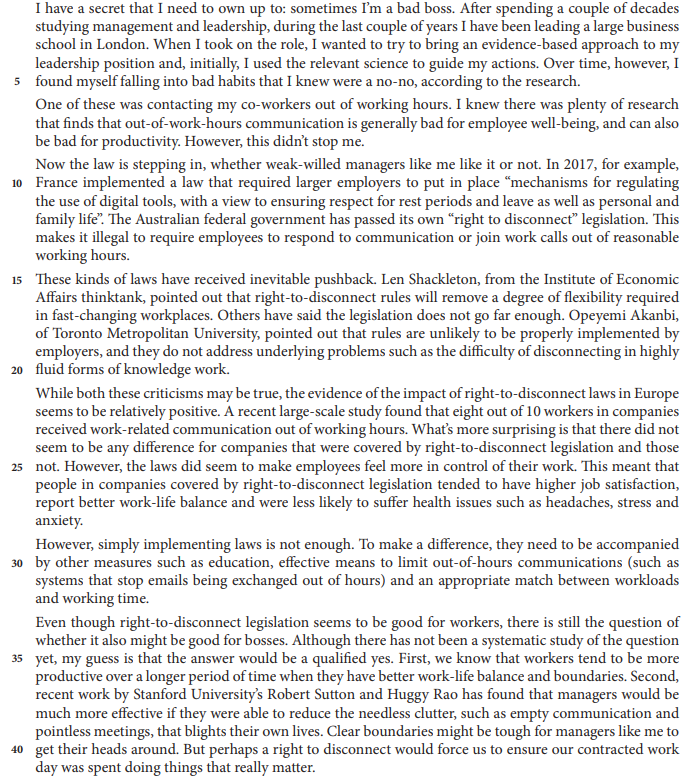
I’M A BOSS – PLEASE, BAN ME FROM OUT-OF-HOURS
EMAILS AND CALLS, AND SAVE ME FROM MYSELF
ANDRÉ SPICER
Adaptado de theguardian.com, 17/02/2024.
According to the last sentence of the article, the right to disconnect would bring the following
benefit:

 Conheça nossos planos