Selecionar segmento
Estude com questões de diferentes segmentos
Atenção: Isso limpará todos os campos já preenchidos no filtro!
Foram encontradas 31.045 questões
Resolva questões gratuitamente!
Junte-se a mais de 4 milhões de concurseiros!


Ano: 2026
Banca:
FUNDATEC
Órgão:
Prefeitura de Pontão - RS
Provas:
FUNDATEC - 2026 - Prefeitura de Pontão - RS - Professor de Artes
|
FUNDATEC - 2026 - Prefeitura de Pontão - RS - Professor de Ciências |
FUNDATEC - 2026 - Prefeitura de Pontão - RS - Professor de Educação Física |
FUNDATEC - 2026 - Prefeitura de Pontão - RS - Professor de Educação Infantil |
FUNDATEC - 2026 - Prefeitura de Pontão - RS - Professor de Geografia |
FUNDATEC - 2026 - Prefeitura de Pontão - RS - Professor de História |
FUNDATEC - 2026 - Prefeitura de Pontão - RS - Professor de Inglês |
FUNDATEC - 2026 - Prefeitura de Pontão - RS - Professor de Matemática |
FUNDATEC - 2026 - Prefeitura de Pontão - RS - Professor de Português |
FUNDATEC - 2026 - Prefeitura de Pontão - RS - Professor de Séries Iniciais |
Q4037678
Português
Texto associado
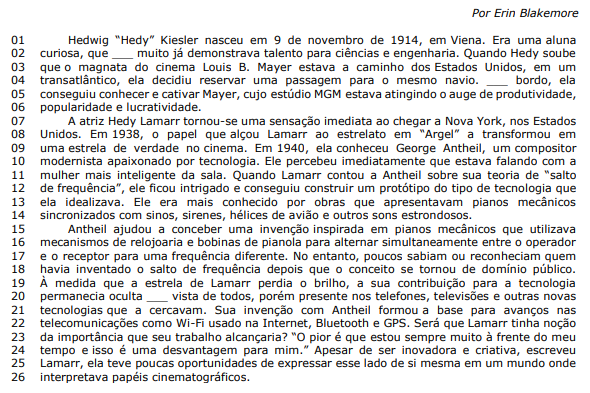
A incrível história de Hedy Lamarr, a estrela de Hollywood que ajudou a inventar o Wi-Fi e
o Bluetooth
(Disponível em: nationalgeographicbrasil.com/historia/2026/02/a-incrivel-historia-de-hedy-lamarr-a-estrela-dehollywood-que-ajudou-a-inventar-o-wi-fi-e-o-bluethooh – texto adaptado especialmente para esta prova).
Assinale a alternativa que apresenta a melhor síntese sobre a trajetória de Hedy
Lamarr apresentada no texto.
Ano: 2026
Banca:
FUNDATEC
Órgão:
Prefeitura de Pontão - RS
Provas:
FUNDATEC - 2026 - Prefeitura de Pontão - RS - Professor de Artes
|
FUNDATEC - 2026 - Prefeitura de Pontão - RS - Professor de Ciências |
FUNDATEC - 2026 - Prefeitura de Pontão - RS - Professor de Educação Física |
FUNDATEC - 2026 - Prefeitura de Pontão - RS - Professor de Educação Infantil |
FUNDATEC - 2026 - Prefeitura de Pontão - RS - Professor de Geografia |
FUNDATEC - 2026 - Prefeitura de Pontão - RS - Professor de História |
FUNDATEC - 2026 - Prefeitura de Pontão - RS - Professor de Inglês |
FUNDATEC - 2026 - Prefeitura de Pontão - RS - Professor de Matemática |
FUNDATEC - 2026 - Prefeitura de Pontão - RS - Professor de Português |
FUNDATEC - 2026 - Prefeitura de Pontão - RS - Professor de Séries Iniciais |
Q4037677
Português
Texto associado
A incrível história de Hedy Lamarr, a estrela de Hollywood que ajudou a inventar o Wi-Fi e
o Bluetooth
(Disponível em: nationalgeographicbrasil.com/historia/2026/02/a-incrivel-historia-de-hedy-lamarr-a-estrela-dehollywood-que-ajudou-a-inventar-o-wi-fi-e-o-bluethooh – texto adaptado especialmente para esta prova).
De acordo com o texto, sobre a atriz Hedy Lamarr, assinale a alternativa INCORRETA.
Ano: 2026
Banca:
FUNDATEC
Órgão:
Prefeitura de Bom Jesus - RS
Prova:
FUNDATEC - 2026 - Prefeitura de Bom Jesus - RS - Professor de Língua Inglesa |
Q4031855
Inglês
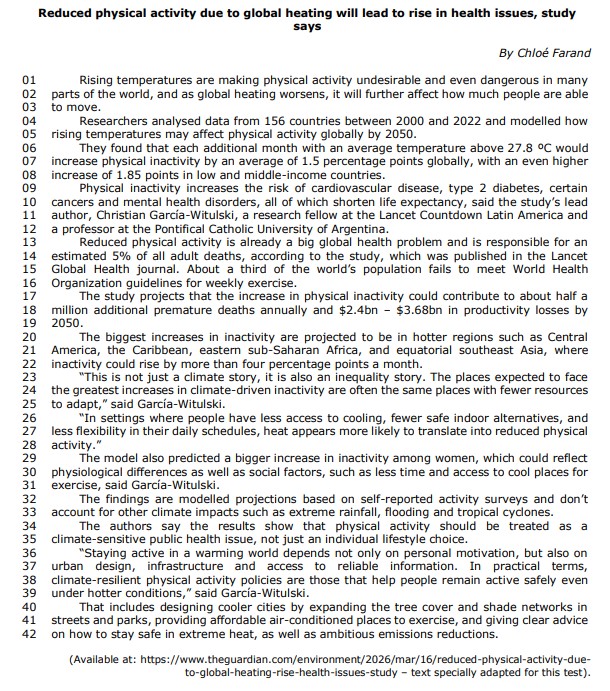
In the sentence “Physical inactivity increases the risk of cardiovascular disease [...]
all of which shorten life expectancy” (l. 09-10) the relative pronoun in bold “which” refers to:
Ano: 2026
Banca:
FUNDATEC
Órgão:
Prefeitura de Bom Jesus - RS
Prova:
FUNDATEC - 2026 - Prefeitura de Bom Jesus - RS - Professor de Língua Inglesa |
Q4031854
Inglês
In the sentence “[...] with an even higher increase of 1.85 points in low and
middle-income countries” (l. 07-08), what degree of adjective is “higher”?
Ano: 2026
Banca:
FUNDATEC
Órgão:
Prefeitura de Bom Jesus - RS
Prova:
FUNDATEC - 2026 - Prefeitura de Bom Jesus - RS - Professor de Língua Inglesa |
Q4031853
Inglês
The pronoun in bold “they” in the sentence “They found that each additional month [...]” (l. 06) refers to:
Ano: 2026
Banca:
FUNDATEC
Órgão:
Prefeitura de Bom Jesus - RS
Prova:
FUNDATEC - 2026 - Prefeitura de Bom Jesus - RS - Professor de Língua Inglesa |
Q4031852
Inglês
Which of the following words is a synonym for “undesirable” (l. 01)?
Ano: 2026
Banca:
FUNDATEC
Órgão:
Prefeitura de Bom Jesus - RS
Prova:
FUNDATEC - 2026 - Prefeitura de Bom Jesus - RS - Professor de Língua Inglesa |
Q4031851
Inglês
Analyse the following sentence based on the text's ideas:
“If global heating continues to worsen, physical inactivity __________ even more common”.
Mark the alternative that correctly fills in the blank in the sentence above.
Ano: 2026
Banca:
FUNDATEC
Órgão:
Prefeitura de Bom Jesus - RS
Prova:
FUNDATEC - 2026 - Prefeitura de Bom Jesus - RS - Professor de Língua Inglesa |
Q4031850
Inglês
In the sentence “Researchers analysed data from 156 countries”, what tense is the
verb in bold “analysed” in?
Ano: 2026
Banca:
FUNDATEC
Órgão:
Prefeitura de Bom Jesus - RS
Prova:
FUNDATEC - 2026 - Prefeitura de Bom Jesus - RS - Professor de Língua Inglesa |
Q4031849
Inglês
According to the study, staying active in a warming world depends NOT only on
personal motivation BUT also on:
Ano: 2026
Banca:
FUNDATEC
Órgão:
Prefeitura de Bom Jesus - RS
Prova:
FUNDATEC - 2026 - Prefeitura de Bom Jesus - RS - Professor de Língua Inglesa |
Q4031848
Inglês
According to the text, which of the following is NOT a practical policy for helping
people remain active safely in hotter conditions?
Ano: 2026
Banca:
FUNDATEC
Órgão:
Prefeitura de Bom Jesus - RS
Prova:
FUNDATEC - 2026 - Prefeitura de Bom Jesus - RS - Professor de Língua Inglesa |
Q4031847
Inglês
The text states that the increase in physical inactivity is not only a climate issue but
also an inequality issue because
Ano: 2026
Banca:
FUNDATEC
Órgão:
Prefeitura de Bom Jesus - RS
Prova:
FUNDATEC - 2026 - Prefeitura de Bom Jesus - RS - Professor de Língua Inglesa |
Q4031846
Inglês
According to the text, what is the main consequence of rising global temperatures
for human health?
Ano: 2026
Banca:
FUNDATEC
Órgão:
Prefeitura de Bom Jesus - RS
Provas:
FUNDATEC - 2026 - Prefeitura de Bom Jesus - RS - Professor de Ciências
|
FUNDATEC - 2026 - Prefeitura de Bom Jesus - RS - Professor de Educação Física |
FUNDATEC - 2026 - Prefeitura de Bom Jesus - RS - Professor de Geografia |
FUNDATEC - 2026 - Prefeitura de Bom Jesus - RS - Professor de História |
FUNDATEC - 2026 - Prefeitura de Bom Jesus - RS - Professor de Língua Inglesa |
FUNDATEC - 2026 - Prefeitura de Bom Jesus - RS - Professor de Língua Portuguesa |
FUNDATEC - 2026 - Prefeitura de Bom Jesus - RS - Professor de Matemática |
FUNDATEC - 2026 - Prefeitura de Bom Jesus - RS - Professor de Sala AEE |
FUNDATEC - 2026 - Prefeitura de Bom Jesus - RS - Psicopedagogo |
Q4030605
Pedagogia
Uma escola pública decide implementar um laboratório maker (fablab), mas o utiliza
apenas para que os alunos sigam instruções rígidas e reproduzam modelos previamente definidos,
sem espaço para criação ou resolução de problemas. A equipe gestora afirma que já está alinhada à
Educação 5.0. Considerando essa situação, assinale a alternativa mais correta.
Ano: 2026
Banca:
FUNDATEC
Órgão:
Prefeitura de Bom Jesus - RS
Provas:
FUNDATEC - 2026 - Prefeitura de Bom Jesus - RS - Professor de Ciências
|
FUNDATEC - 2026 - Prefeitura de Bom Jesus - RS - Professor de Educação Física |
FUNDATEC - 2026 - Prefeitura de Bom Jesus - RS - Professor de Geografia |
FUNDATEC - 2026 - Prefeitura de Bom Jesus - RS - Professor de História |
FUNDATEC - 2026 - Prefeitura de Bom Jesus - RS - Professor de Língua Inglesa |
FUNDATEC - 2026 - Prefeitura de Bom Jesus - RS - Professor de Língua Portuguesa |
FUNDATEC - 2026 - Prefeitura de Bom Jesus - RS - Professor de Matemática |
FUNDATEC - 2026 - Prefeitura de Bom Jesus - RS - Professor de Sala AEE |
FUNDATEC - 2026 - Prefeitura de Bom Jesus - RS - Psicopedagogo |
Q4030604
Pedagogia
A partir da concepção de Experiência de Aprendizagem Mediada (EAM), proposta por
Feuerstein, assinale a alternativa que melhor expressa a distinção entre aprendizagem mediada e
aprendizagem direta.
Ano: 2026
Banca:
FUNDATEC
Órgão:
Prefeitura de Bom Jesus - RS
Provas:
FUNDATEC - 2026 - Prefeitura de Bom Jesus - RS - Professor de Ciências
|
FUNDATEC - 2026 - Prefeitura de Bom Jesus - RS - Professor de Educação Física |
FUNDATEC - 2026 - Prefeitura de Bom Jesus - RS - Professor de Geografia |
FUNDATEC - 2026 - Prefeitura de Bom Jesus - RS - Professor de História |
FUNDATEC - 2026 - Prefeitura de Bom Jesus - RS - Professor de Língua Inglesa |
FUNDATEC - 2026 - Prefeitura de Bom Jesus - RS - Professor de Língua Portuguesa |
FUNDATEC - 2026 - Prefeitura de Bom Jesus - RS - Professor de Matemática |
FUNDATEC - 2026 - Prefeitura de Bom Jesus - RS - Professor de Sala AEE |
FUNDATEC - 2026 - Prefeitura de Bom Jesus - RS - Psicopedagogo |
Q4030603
Pedagogia
No campo educacional, os modelos de ensino híbrido podem assumir trajetórias
sustentadas ou disruptivas. Considerando essa distinção, assinale a alternativa correta.
Ano: 2026
Banca:
FUNDATEC
Órgão:
Prefeitura de Bom Jesus - RS
Provas:
FUNDATEC - 2026 - Prefeitura de Bom Jesus - RS - Professor de Ciências
|
FUNDATEC - 2026 - Prefeitura de Bom Jesus - RS - Professor de Educação Física |
FUNDATEC - 2026 - Prefeitura de Bom Jesus - RS - Professor de Geografia |
FUNDATEC - 2026 - Prefeitura de Bom Jesus - RS - Professor de História |
FUNDATEC - 2026 - Prefeitura de Bom Jesus - RS - Professor de Língua Inglesa |
FUNDATEC - 2026 - Prefeitura de Bom Jesus - RS - Professor de Língua Portuguesa |
FUNDATEC - 2026 - Prefeitura de Bom Jesus - RS - Professor de Matemática |
FUNDATEC - 2026 - Prefeitura de Bom Jesus - RS - Professor de Sala AEE |
FUNDATEC - 2026 - Prefeitura de Bom Jesus - RS - Psicopedagogo |
Q4030602
Pedagogia
Uma professora observa que alunos de diferentes origens culturais apresentam
dificuldades de interação e, com frequência, surgem situações de preconceito em sala. Considerando
esse contexto, qual prática pedagógica melhor enfrenta essa problemática?
Ano: 2026
Banca:
FUNDATEC
Órgão:
Prefeitura de Bom Jesus - RS
Provas:
FUNDATEC - 2026 - Prefeitura de Bom Jesus - RS - Professor de Ciências
|
FUNDATEC - 2026 - Prefeitura de Bom Jesus - RS - Professor de Educação Física |
FUNDATEC - 2026 - Prefeitura de Bom Jesus - RS - Professor de Geografia |
FUNDATEC - 2026 - Prefeitura de Bom Jesus - RS - Professor de História |
FUNDATEC - 2026 - Prefeitura de Bom Jesus - RS - Professor de Língua Inglesa |
FUNDATEC - 2026 - Prefeitura de Bom Jesus - RS - Professor de Língua Portuguesa |
FUNDATEC - 2026 - Prefeitura de Bom Jesus - RS - Professor de Matemática |
FUNDATEC - 2026 - Prefeitura de Bom Jesus - RS - Professor de Sala AEE |
FUNDATEC - 2026 - Prefeitura de Bom Jesus - RS - Psicopedagogo |
Q4030601
Pedagogia
A compreensão da didática ultrapassa a noção tradicional de método de ensino. Nesse
sentido, assinale a alternativa que melhor expressa essa ampliação conceitual no âmbito da formação
docente.
Ano: 2026
Banca:
FUNDATEC
Órgão:
Prefeitura de Bom Jesus - RS
Provas:
FUNDATEC - 2026 - Prefeitura de Bom Jesus - RS - Professor de Ciências
|
FUNDATEC - 2026 - Prefeitura de Bom Jesus - RS - Professor de Educação Física |
FUNDATEC - 2026 - Prefeitura de Bom Jesus - RS - Professor de Geografia |
FUNDATEC - 2026 - Prefeitura de Bom Jesus - RS - Professor de História |
FUNDATEC - 2026 - Prefeitura de Bom Jesus - RS - Professor de Língua Inglesa |
FUNDATEC - 2026 - Prefeitura de Bom Jesus - RS - Professor de Língua Portuguesa |
FUNDATEC - 2026 - Prefeitura de Bom Jesus - RS - Professor de Matemática |
FUNDATEC - 2026 - Prefeitura de Bom Jesus - RS - Professor de Sala AEE |
FUNDATEC - 2026 - Prefeitura de Bom Jesus - RS - Psicopedagogo |
Q4030600
Pedagogia
Uma professora da rede municipal de Bom Jesus concluiu curso de pós-graduação na
área de educação, com carga horária compatível e relação com sua área de atuação. Após obter o
certificado, protocolou requerimento junto ao órgão competente solicitando sua mudança de faixa na
carreira. Considerando o Plano de Carreira do Magistério, a administração deverá:
Ano: 2026
Banca:
FUNDATEC
Órgão:
Prefeitura de Bom Jesus - RS
Provas:
FUNDATEC - 2026 - Prefeitura de Bom Jesus - RS - Professor de Ciências
|
FUNDATEC - 2026 - Prefeitura de Bom Jesus - RS - Professor de Educação Física |
FUNDATEC - 2026 - Prefeitura de Bom Jesus - RS - Professor de Geografia |
FUNDATEC - 2026 - Prefeitura de Bom Jesus - RS - Professor de História |
FUNDATEC - 2026 - Prefeitura de Bom Jesus - RS - Professor de Língua Inglesa |
FUNDATEC - 2026 - Prefeitura de Bom Jesus - RS - Professor de Língua Portuguesa |
FUNDATEC - 2026 - Prefeitura de Bom Jesus - RS - Professor de Matemática |
FUNDATEC - 2026 - Prefeitura de Bom Jesus - RS - Professor de Sala AEE |
FUNDATEC - 2026 - Prefeitura de Bom Jesus - RS - Psicopedagogo |
Q4030599
Pedagogia
Um psicopedagogo institucional acompanha uma turma de pré-escola e identifica que
a equipe pedagógica utiliza instrumentos avaliativos com registros classificatórios (como “atingiu/não
atingiu os objetivos”), vinculando tais registros à possibilidade de retenção pedagógica para crianças
garantir melhores condições de aprendizagem futura. Considerando a LDBEN, assinale a alternativa
que expressa a orientação mais adequada do psicopedagogo.
consideradas “imaturas” para o Ensino Fundamental. A equipe justifica a prática como forma de
Ano: 2026
Banca:
FUNDATEC
Órgão:
Prefeitura de Bom Jesus - RS
Provas:
FUNDATEC - 2026 - Prefeitura de Bom Jesus - RS - Professor de Ciências
|
FUNDATEC - 2026 - Prefeitura de Bom Jesus - RS - Professor de Educação Física |
FUNDATEC - 2026 - Prefeitura de Bom Jesus - RS - Professor de Geografia |
FUNDATEC - 2026 - Prefeitura de Bom Jesus - RS - Professor de História |
FUNDATEC - 2026 - Prefeitura de Bom Jesus - RS - Professor de Língua Inglesa |
FUNDATEC - 2026 - Prefeitura de Bom Jesus - RS - Professor de Língua Portuguesa |
FUNDATEC - 2026 - Prefeitura de Bom Jesus - RS - Professor de Matemática |
FUNDATEC - 2026 - Prefeitura de Bom Jesus - RS - Professor de Sala AEE |
FUNDATEC - 2026 - Prefeitura de Bom Jesus - RS - Psicopedagogo |
Q4030598
Pedagogia
Uma rede de ensino decide investir na implementação de diretrizes, estruturando
sua política na aquisição sistemática de livros didáticos e paradidáticos sobre história e cultura
afro-brasileira e africana, acompanhada da recomendação de uso desses materiais pelos
docentes. No entanto, não há previsão de formação continuada, incentivo à pesquisa ou
articulação com outras instâncias institucionais. À luz das Diretrizes Curriculares Nacionais para a
Educação das Relações Étnico-Raciais, essa política é:

 Conheça nossos planos