Foram encontradas 31.359 questões

Resolva questões gratuitamente!

Junte-se a mais de 4 milhões de concurseiros!

Q4367325 Inglês
Roman mosaic and villa complex found in Rutland farmer's field


(1º§) The mosaic, found in Rutland, has been described as the first example of its kind in the UK. It was discovered by the landowner's son and investigated by archaeologists from the University of Leicester. Historic England described the mosaic as "one of the most remarkable and significant... ever found in Britain".

(2º§) The mosaic and surrounding villa complex have now been protected as a Scheduled Monument by the Department for Digital, Culture, Media and Sport (DCMS) on the advice of Historic England. The complex is thought to have been occupied by a wealthy individual from the late Roman period.

(3º§) Jim Irvine, son of landowner Brian Naylor, made the initial discovery after spotting "unusual pottery" on a walk during the 2020 lockdown, and contacted the archaeological team at Leicestershire County Council. He said: "My family have been farming this land for 50 or 60 years. "During lockdown last year, I noticed some pottery on the ground which didn't look like any pottery I'd seen before. "We came down here with a spade and I dug a shallow trench and I was in exactly the right place. "To see something that has been undisturbed for 1700 years or so has been amazing. "The thing that has been keeping me interested is what's the state of the next thing to come out of the site because it's all been amazing so far." Historic England funded urgent excavation work at the site by the University of Leicester.

(4º§) The mosaic, which forms the floor of what was thought to be a dining or entertaining area of the villa, measures 11m x 7m (36ft x 23ft). Mosaics were regularly used in private and public buildings across the Roman Empire, and often featured famous figures from mythology. However, the Rutland mosaic is thought to be unique in the UK as it features Achilles and his battle with Hector at the conclusion of the Trojan War.

Analysis - By Phil Mackie, BBC Midlands correspondent at the scene

(5º§) I know where the villa was found but I'm not allowed to give away too many details. It's because they don't want anyone coming along and trying to carry out their own investigations and disturbing the site.

(6º§) For now, the mosaic has been covered back up. It's been well protected for more than a millennium and a half beneath a 2ft (0.6m) layer of soil, and it won't come to any further harm now it's back underground. Jim Irvine really hopes that people will be able to come to visit in situ one day but decisions about its long-term future haven't been made yet. The site is so big that only a tiny part of the complex has been excavated. There are likely to be more discoveries in the digging seasons to come.

(7º§) Investigations have revealed the large villa is surrounded by barns, circular structures and possibly a bath house. The complex is likely to have been occupied by someone with a knowledge of classical literature, between the 3rd and 4th Century AD. John Thomas, deputy director of the University of Leicester Archaeological Services and project manager on the excavations, said: "This is certainly the most exciting Roman mosaic discovery in the UK in the last century. "It gives us fresh perspectives on the attitudes of people at the time, their links to classical literature, and it also tells us an enormous amount about the individual who commissioned this piece. "This is someone with a knowledge of the classics, who had the money to commission a piece of such detail, and it's the very first depiction of these stories that we've ever found in Britain."

(8º§) Duncan Wilson, chief executive of Historic England, added: "To have uncovered such a rare mosaic of this size, as well as a surrounding villa, is remarkable. "Discoveries like this are so important in helping us piece together our shared history. By protecting this site we are able to continue learning from it, and look forward to what future excavations may teach us about the people who lived there over 1,500 years ago." The site is on private land and not accessible to the public but discussions are ongoing with Rutland County Council to set up an off-site display of the villa complex and its finds, Historic England said. Further excavations are planned on the site in 2022. Mr Irvine said the field will no longer be used for farming so the area can be protected.


(adapted) https://www.bbc.com/news/uk-england-leicestershire-59391650
According to the text, judge the sentences below as TRUE or FALSE:

1.(__)Discoveries like the Rutland village mosaics are very important in helping us to piece together our shared history.
2.(__)Mosaics were regularly used in public and private buildings throughout the Roman Empire.
3.(__)After archaeological research, the field of Rutland will be cultivated again.


The CORRECT sequence is:
Alternativas
Q4367324 Inglês
Roman mosaic and villa complex found in Rutland farmer's field


(1º§) The mosaic, found in Rutland, has been described as the first example of its kind in the UK. It was discovered by the landowner's son and investigated by archaeologists from the University of Leicester. Historic England described the mosaic as "one of the most remarkable and significant... ever found in Britain".

(2º§) The mosaic and surrounding villa complex have now been protected as a Scheduled Monument by the Department for Digital, Culture, Media and Sport (DCMS) on the advice of Historic England. The complex is thought to have been occupied by a wealthy individual from the late Roman period.

(3º§) Jim Irvine, son of landowner Brian Naylor, made the initial discovery after spotting "unusual pottery" on a walk during the 2020 lockdown, and contacted the archaeological team at Leicestershire County Council. He said: "My family have been farming this land for 50 or 60 years. "During lockdown last year, I noticed some pottery on the ground which didn't look like any pottery I'd seen before. "We came down here with a spade and I dug a shallow trench and I was in exactly the right place. "To see something that has been undisturbed for 1700 years or so has been amazing. "The thing that has been keeping me interested is what's the state of the next thing to come out of the site because it's all been amazing so far." Historic England funded urgent excavation work at the site by the University of Leicester.

(4º§) The mosaic, which forms the floor of what was thought to be a dining or entertaining area of the villa, measures 11m x 7m (36ft x 23ft). Mosaics were regularly used in private and public buildings across the Roman Empire, and often featured famous figures from mythology. However, the Rutland mosaic is thought to be unique in the UK as it features Achilles and his battle with Hector at the conclusion of the Trojan War.

Analysis - By Phil Mackie, BBC Midlands correspondent at the scene

(5º§) I know where the villa was found but I'm not allowed to give away too many details. It's because they don't want anyone coming along and trying to carry out their own investigations and disturbing the site.

(6º§) For now, the mosaic has been covered back up. It's been well protected for more than a millennium and a half beneath a 2ft (0.6m) layer of soil, and it won't come to any further harm now it's back underground. Jim Irvine really hopes that people will be able to come to visit in situ one day but decisions about its long-term future haven't been made yet. The site is so big that only a tiny part of the complex has been excavated. There are likely to be more discoveries in the digging seasons to come.

(7º§) Investigations have revealed the large villa is surrounded by barns, circular structures and possibly a bath house. The complex is likely to have been occupied by someone with a knowledge of classical literature, between the 3rd and 4th Century AD. John Thomas, deputy director of the University of Leicester Archaeological Services and project manager on the excavations, said: "This is certainly the most exciting Roman mosaic discovery in the UK in the last century. "It gives us fresh perspectives on the attitudes of people at the time, their links to classical literature, and it also tells us an enormous amount about the individual who commissioned this piece. "This is someone with a knowledge of the classics, who had the money to commission a piece of such detail, and it's the very first depiction of these stories that we've ever found in Britain."

(8º§) Duncan Wilson, chief executive of Historic England, added: "To have uncovered such a rare mosaic of this size, as well as a surrounding villa, is remarkable. "Discoveries like this are so important in helping us piece together our shared history. By protecting this site we are able to continue learning from it, and look forward to what future excavations may teach us about the people who lived there over 1,500 years ago." The site is on private land and not accessible to the public but discussions are ongoing with Rutland County Council to set up an off-site display of the villa complex and its finds, Historic England said. Further excavations are planned on the site in 2022. Mr Irvine said the field will no longer be used for farming so the area can be protected.


(adapted) https://www.bbc.com/news/uk-england-leicestershire-59391650

"It gives us fresh perspectives on the attitudes of people at the time." (7º§)

In which verbal tense the excerpt above be categorized?

Alternativas
Q4367323 Inglês
Roman mosaic and villa complex found in Rutland farmer's field


(1º§) The mosaic, found in Rutland, has been described as the first example of its kind in the UK. It was discovered by the landowner's son and investigated by archaeologists from the University of Leicester. Historic England described the mosaic as "one of the most remarkable and significant... ever found in Britain".

(2º§) The mosaic and surrounding villa complex have now been protected as a Scheduled Monument by the Department for Digital, Culture, Media and Sport (DCMS) on the advice of Historic England. The complex is thought to have been occupied by a wealthy individual from the late Roman period.

(3º§) Jim Irvine, son of landowner Brian Naylor, made the initial discovery after spotting "unusual pottery" on a walk during the 2020 lockdown, and contacted the archaeological team at Leicestershire County Council. He said: "My family have been farming this land for 50 or 60 years. "During lockdown last year, I noticed some pottery on the ground which didn't look like any pottery I'd seen before. "We came down here with a spade and I dug a shallow trench and I was in exactly the right place. "To see something that has been undisturbed for 1700 years or so has been amazing. "The thing that has been keeping me interested is what's the state of the next thing to come out of the site because it's all been amazing so far." Historic England funded urgent excavation work at the site by the University of Leicester.

(4º§) The mosaic, which forms the floor of what was thought to be a dining or entertaining area of the villa, measures 11m x 7m (36ft x 23ft). Mosaics were regularly used in private and public buildings across the Roman Empire, and often featured famous figures from mythology. However, the Rutland mosaic is thought to be unique in the UK as it features Achilles and his battle with Hector at the conclusion of the Trojan War.

Analysis - By Phil Mackie, BBC Midlands correspondent at the scene

(5º§) I know where the villa was found but I'm not allowed to give away too many details. It's because they don't want anyone coming along and trying to carry out their own investigations and disturbing the site.

(6º§) For now, the mosaic has been covered back up. It's been well protected for more than a millennium and a half beneath a 2ft (0.6m) layer of soil, and it won't come to any further harm now it's back underground. Jim Irvine really hopes that people will be able to come to visit in situ one day but decisions about its long-term future haven't been made yet. The site is so big that only a tiny part of the complex has been excavated. There are likely to be more discoveries in the digging seasons to come.

(7º§) Investigations have revealed the large villa is surrounded by barns, circular structures and possibly a bath house. The complex is likely to have been occupied by someone with a knowledge of classical literature, between the 3rd and 4th Century AD. John Thomas, deputy director of the University of Leicester Archaeological Services and project manager on the excavations, said: "This is certainly the most exciting Roman mosaic discovery in the UK in the last century. "It gives us fresh perspectives on the attitudes of people at the time, their links to classical literature, and it also tells us an enormous amount about the individual who commissioned this piece. "This is someone with a knowledge of the classics, who had the money to commission a piece of such detail, and it's the very first depiction of these stories that we've ever found in Britain."

(8º§) Duncan Wilson, chief executive of Historic England, added: "To have uncovered such a rare mosaic of this size, as well as a surrounding villa, is remarkable. "Discoveries like this are so important in helping us piece together our shared history. By protecting this site we are able to continue learning from it, and look forward to what future excavations may teach us about the people who lived there over 1,500 years ago." The site is on private land and not accessible to the public but discussions are ongoing with Rutland County Council to set up an off-site display of the villa complex and its finds, Historic England said. Further excavations are planned on the site in 2022. Mr Irvine said the field will no longer be used for farming so the area can be protected.


(adapted) https://www.bbc.com/news/uk-england-leicestershire-59391650
According to the text, one of the researchers' hypotheses is that the area was occupied by:
Alternativas
Q4367322 Inglês
Roman mosaic and villa complex found in Rutland farmer's field


(1º§) The mosaic, found in Rutland, has been described as the first example of its kind in the UK. It was discovered by the landowner's son and investigated by archaeologists from the University of Leicester. Historic England described the mosaic as "one of the most remarkable and significant... ever found in Britain".

(2º§) The mosaic and surrounding villa complex have now been protected as a Scheduled Monument by the Department for Digital, Culture, Media and Sport (DCMS) on the advice of Historic England. The complex is thought to have been occupied by a wealthy individual from the late Roman period.

(3º§) Jim Irvine, son of landowner Brian Naylor, made the initial discovery after spotting "unusual pottery" on a walk during the 2020 lockdown, and contacted the archaeological team at Leicestershire County Council. He said: "My family have been farming this land for 50 or 60 years. "During lockdown last year, I noticed some pottery on the ground which didn't look like any pottery I'd seen before. "We came down here with a spade and I dug a shallow trench and I was in exactly the right place. "To see something that has been undisturbed for 1700 years or so has been amazing. "The thing that has been keeping me interested is what's the state of the next thing to come out of the site because it's all been amazing so far." Historic England funded urgent excavation work at the site by the University of Leicester.

(4º§) The mosaic, which forms the floor of what was thought to be a dining or entertaining area of the villa, measures 11m x 7m (36ft x 23ft). Mosaics were regularly used in private and public buildings across the Roman Empire, and often featured famous figures from mythology. However, the Rutland mosaic is thought to be unique in the UK as it features Achilles and his battle with Hector at the conclusion of the Trojan War.

Analysis - By Phil Mackie, BBC Midlands correspondent at the scene

(5º§) I know where the villa was found but I'm not allowed to give away too many details. It's because they don't want anyone coming along and trying to carry out their own investigations and disturbing the site.

(6º§) For now, the mosaic has been covered back up. It's been well protected for more than a millennium and a half beneath a 2ft (0.6m) layer of soil, and it won't come to any further harm now it's back underground. Jim Irvine really hopes that people will be able to come to visit in situ one day but decisions about its long-term future haven't been made yet. The site is so big that only a tiny part of the complex has been excavated. There are likely to be more discoveries in the digging seasons to come.

(7º§) Investigations have revealed the large villa is surrounded by barns, circular structures and possibly a bath house. The complex is likely to have been occupied by someone with a knowledge of classical literature, between the 3rd and 4th Century AD. John Thomas, deputy director of the University of Leicester Archaeological Services and project manager on the excavations, said: "This is certainly the most exciting Roman mosaic discovery in the UK in the last century. "It gives us fresh perspectives on the attitudes of people at the time, their links to classical literature, and it also tells us an enormous amount about the individual who commissioned this piece. "This is someone with a knowledge of the classics, who had the money to commission a piece of such detail, and it's the very first depiction of these stories that we've ever found in Britain."

(8º§) Duncan Wilson, chief executive of Historic England, added: "To have uncovered such a rare mosaic of this size, as well as a surrounding villa, is remarkable. "Discoveries like this are so important in helping us piece together our shared history. By protecting this site we are able to continue learning from it, and look forward to what future excavations may teach us about the people who lived there over 1,500 years ago." The site is on private land and not accessible to the public but discussions are ongoing with Rutland County Council to set up an off-site display of the villa complex and its finds, Historic England said. Further excavations are planned on the site in 2022. Mr Irvine said the field will no longer be used for farming so the area can be protected.


(adapted) https://www.bbc.com/news/uk-england-leicestershire-59391650
Consider the following assertives:

I.The place where the mosaic is located is open to the public for visitation.
II.The place where the mosaic was found has already been completely excavated by archaeologists and many pieces have been removed.
III.The mosaic raises clues about people's connection with classical literature during the period of the Roman Empire.

Which one(s) is(are) CORRECT? 
Alternativas
Q4367321 Inglês
Roman mosaic and villa complex found in Rutland farmer's field


(1º§) The mosaic, found in Rutland, has been described as the first example of its kind in the UK. It was discovered by the landowner's son and investigated by archaeologists from the University of Leicester. Historic England described the mosaic as "one of the most remarkable and significant... ever found in Britain".

(2º§) The mosaic and surrounding villa complex have now been protected as a Scheduled Monument by the Department for Digital, Culture, Media and Sport (DCMS) on the advice of Historic England. The complex is thought to have been occupied by a wealthy individual from the late Roman period.

(3º§) Jim Irvine, son of landowner Brian Naylor, made the initial discovery after spotting "unusual pottery" on a walk during the 2020 lockdown, and contacted the archaeological team at Leicestershire County Council. He said: "My family have been farming this land for 50 or 60 years. "During lockdown last year, I noticed some pottery on the ground which didn't look like any pottery I'd seen before. "We came down here with a spade and I dug a shallow trench and I was in exactly the right place. "To see something that has been undisturbed for 1700 years or so has been amazing. "The thing that has been keeping me interested is what's the state of the next thing to come out of the site because it's all been amazing so far." Historic England funded urgent excavation work at the site by the University of Leicester.

(4º§) The mosaic, which forms the floor of what was thought to be a dining or entertaining area of the villa, measures 11m x 7m (36ft x 23ft). Mosaics were regularly used in private and public buildings across the Roman Empire, and often featured famous figures from mythology. However, the Rutland mosaic is thought to be unique in the UK as it features Achilles and his battle with Hector at the conclusion of the Trojan War.

Analysis - By Phil Mackie, BBC Midlands correspondent at the scene

(5º§) I know where the villa was found but I'm not allowed to give away too many details. It's because they don't want anyone coming along and trying to carry out their own investigations and disturbing the site.

(6º§) For now, the mosaic has been covered back up. It's been well protected for more than a millennium and a half beneath a 2ft (0.6m) layer of soil, and it won't come to any further harm now it's back underground. Jim Irvine really hopes that people will be able to come to visit in situ one day but decisions about its long-term future haven't been made yet. The site is so big that only a tiny part of the complex has been excavated. There are likely to be more discoveries in the digging seasons to come.

(7º§) Investigations have revealed the large villa is surrounded by barns, circular structures and possibly a bath house. The complex is likely to have been occupied by someone with a knowledge of classical literature, between the 3rd and 4th Century AD. John Thomas, deputy director of the University of Leicester Archaeological Services and project manager on the excavations, said: "This is certainly the most exciting Roman mosaic discovery in the UK in the last century. "It gives us fresh perspectives on the attitudes of people at the time, their links to classical literature, and it also tells us an enormous amount about the individual who commissioned this piece. "This is someone with a knowledge of the classics, who had the money to commission a piece of such detail, and it's the very first depiction of these stories that we've ever found in Britain."

(8º§) Duncan Wilson, chief executive of Historic England, added: "To have uncovered such a rare mosaic of this size, as well as a surrounding villa, is remarkable. "Discoveries like this are so important in helping us piece together our shared history. By protecting this site we are able to continue learning from it, and look forward to what future excavations may teach us about the people who lived there over 1,500 years ago." The site is on private land and not accessible to the public but discussions are ongoing with Rutland County Council to set up an off-site display of the villa complex and its finds, Historic England said. Further excavations are planned on the site in 2022. Mr Irvine said the field will no longer be used for farming so the area can be protected.


(adapted) https://www.bbc.com/news/uk-england-leicestershire-59391650
Considering the context, the words "depiction" (7º§), "pottery" (3º§) and "set up" (8º§) can be translated respectively as:
Alternativas
Q4367320 Inglês
Roman mosaic and villa complex found in Rutland farmer's field


(1º§) The mosaic, found in Rutland, has been described as the first example of its kind in the UK. It was discovered by the landowner's son and investigated by archaeologists from the University of Leicester. Historic England described the mosaic as "one of the most remarkable and significant... ever found in Britain".

(2º§) The mosaic and surrounding villa complex have now been protected as a Scheduled Monument by the Department for Digital, Culture, Media and Sport (DCMS) on the advice of Historic England. The complex is thought to have been occupied by a wealthy individual from the late Roman period.

(3º§) Jim Irvine, son of landowner Brian Naylor, made the initial discovery after spotting "unusual pottery" on a walk during the 2020 lockdown, and contacted the archaeological team at Leicestershire County Council. He said: "My family have been farming this land for 50 or 60 years. "During lockdown last year, I noticed some pottery on the ground which didn't look like any pottery I'd seen before. "We came down here with a spade and I dug a shallow trench and I was in exactly the right place. "To see something that has been undisturbed for 1700 years or so has been amazing. "The thing that has been keeping me interested is what's the state of the next thing to come out of the site because it's all been amazing so far." Historic England funded urgent excavation work at the site by the University of Leicester.

(4º§) The mosaic, which forms the floor of what was thought to be a dining or entertaining area of the villa, measures 11m x 7m (36ft x 23ft). Mosaics were regularly used in private and public buildings across the Roman Empire, and often featured famous figures from mythology. However, the Rutland mosaic is thought to be unique in the UK as it features Achilles and his battle with Hector at the conclusion of the Trojan War.

Analysis - By Phil Mackie, BBC Midlands correspondent at the scene

(5º§) I know where the villa was found but I'm not allowed to give away too many details. It's because they don't want anyone coming along and trying to carry out their own investigations and disturbing the site.

(6º§) For now, the mosaic has been covered back up. It's been well protected for more than a millennium and a half beneath a 2ft (0.6m) layer of soil, and it won't come to any further harm now it's back underground. Jim Irvine really hopes that people will be able to come to visit in situ one day but decisions about its long-term future haven't been made yet. The site is so big that only a tiny part of the complex has been excavated. There are likely to be more discoveries in the digging seasons to come.

(7º§) Investigations have revealed the large villa is surrounded by barns, circular structures and possibly a bath house. The complex is likely to have been occupied by someone with a knowledge of classical literature, between the 3rd and 4th Century AD. John Thomas, deputy director of the University of Leicester Archaeological Services and project manager on the excavations, said: "This is certainly the most exciting Roman mosaic discovery in the UK in the last century. "It gives us fresh perspectives on the attitudes of people at the time, their links to classical literature, and it also tells us an enormous amount about the individual who commissioned this piece. "This is someone with a knowledge of the classics, who had the money to commission a piece of such detail, and it's the very first depiction of these stories that we've ever found in Britain."

(8º§) Duncan Wilson, chief executive of Historic England, added: "To have uncovered such a rare mosaic of this size, as well as a surrounding villa, is remarkable. "Discoveries like this are so important in helping us piece together our shared history. By protecting this site we are able to continue learning from it, and look forward to what future excavations may teach us about the people who lived there over 1,500 years ago." The site is on private land and not accessible to the public but discussions are ongoing with Rutland County Council to set up an off-site display of the villa complex and its finds, Historic England said. Further excavations are planned on the site in 2022. Mr Irvine said the field will no longer be used for farming so the area can be protected.


(adapted) https://www.bbc.com/news/uk-england-leicestershire-59391650
According to the text, who discovered the mosaic?
Alternativas
Q4367319 Inglês
Roman mosaic and villa complex found in Rutland farmer's field


(1º§) The mosaic, found in Rutland, has been described as the first example of its kind in the UK. It was discovered by the landowner's son and investigated by archaeologists from the University of Leicester. Historic England described the mosaic as "one of the most remarkable and significant... ever found in Britain".

(2º§) The mosaic and surrounding villa complex have now been protected as a Scheduled Monument by the Department for Digital, Culture, Media and Sport (DCMS) on the advice of Historic England. The complex is thought to have been occupied by a wealthy individual from the late Roman period.

(3º§) Jim Irvine, son of landowner Brian Naylor, made the initial discovery after spotting "unusual pottery" on a walk during the 2020 lockdown, and contacted the archaeological team at Leicestershire County Council. He said: "My family have been farming this land for 50 or 60 years. "During lockdown last year, I noticed some pottery on the ground which didn't look like any pottery I'd seen before. "We came down here with a spade and I dug a shallow trench and I was in exactly the right place. "To see something that has been undisturbed for 1700 years or so has been amazing. "The thing that has been keeping me interested is what's the state of the next thing to come out of the site because it's all been amazing so far." Historic England funded urgent excavation work at the site by the University of Leicester.

(4º§) The mosaic, which forms the floor of what was thought to be a dining or entertaining area of the villa, measures 11m x 7m (36ft x 23ft). Mosaics were regularly used in private and public buildings across the Roman Empire, and often featured famous figures from mythology. However, the Rutland mosaic is thought to be unique in the UK as it features Achilles and his battle with Hector at the conclusion of the Trojan War.

Analysis - By Phil Mackie, BBC Midlands correspondent at the scene

(5º§) I know where the villa was found but I'm not allowed to give away too many details. It's because they don't want anyone coming along and trying to carry out their own investigations and disturbing the site.

(6º§) For now, the mosaic has been covered back up. It's been well protected for more than a millennium and a half beneath a 2ft (0.6m) layer of soil, and it won't come to any further harm now it's back underground. Jim Irvine really hopes that people will be able to come to visit in situ one day but decisions about its long-term future haven't been made yet. The site is so big that only a tiny part of the complex has been excavated. There are likely to be more discoveries in the digging seasons to come.

(7º§) Investigations have revealed the large villa is surrounded by barns, circular structures and possibly a bath house. The complex is likely to have been occupied by someone with a knowledge of classical literature, between the 3rd and 4th Century AD. John Thomas, deputy director of the University of Leicester Archaeological Services and project manager on the excavations, said: "This is certainly the most exciting Roman mosaic discovery in the UK in the last century. "It gives us fresh perspectives on the attitudes of people at the time, their links to classical literature, and it also tells us an enormous amount about the individual who commissioned this piece. "This is someone with a knowledge of the classics, who had the money to commission a piece of such detail, and it's the very first depiction of these stories that we've ever found in Britain."

(8º§) Duncan Wilson, chief executive of Historic England, added: "To have uncovered such a rare mosaic of this size, as well as a surrounding villa, is remarkable. "Discoveries like this are so important in helping us piece together our shared history. By protecting this site we are able to continue learning from it, and look forward to what future excavations may teach us about the people who lived there over 1,500 years ago." The site is on private land and not accessible to the public but discussions are ongoing with Rutland County Council to set up an off-site display of the villa complex and its finds, Historic England said. Further excavations are planned on the site in 2022. Mr Irvine said the field will no longer be used for farming so the area can be protected.


(adapted) https://www.bbc.com/news/uk-england-leicestershire-59391650
In which paragraph we find information about the future  of excavations in Rutland village?
Alternativas
Q4323938 Inglês

Instruction: answer question based on the following text.


4 easy ways to make your holidays more eco-friendly
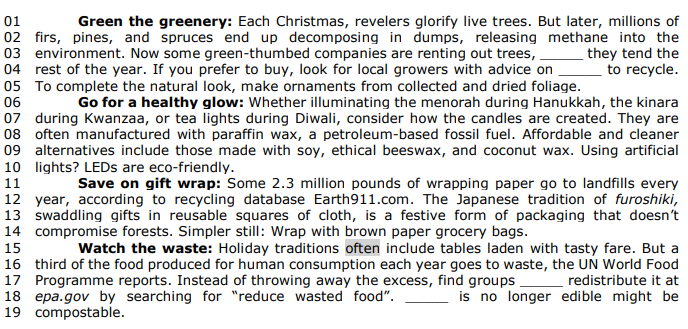


(Available at: https://www.nationalgeographic.com/environment/article/4-easy-ways-to-make-your-holidaysmore-eco-friendly – text especially adapted for this test).

All options below could replace the highlighted word “often” (l. 15) with no significative changes in meaning, EXCEPT for:
Alternativas
Q4323937 Inglês

Instruction: answer question based on the following text.


4 easy ways to make your holidays more eco-friendly


(Available at: https://www.nationalgeographic.com/environment/article/4-easy-ways-to-make-your-holidaysmore-eco-friendly – text especially adapted for this test).

Not considering accents, there are some common pronunciation rules in standard English. The final “s” in plural nouns, for example, sounds like /z/ in “trees” (l. 01), like /iz/ in “spruces” (l. 02), and like /s/ “dumps” (l. 02). In which alternative the nouns follow the same pronunciation rules, in the same order as in the example?
Alternativas
Q4323936 Inglês

Instruction: answer question based on the following text.


4 easy ways to make your holidays more eco-friendly


(Available at: https://www.nationalgeographic.com/environment/article/4-easy-ways-to-make-your-holidaysmore-eco-friendly – text especially adapted for this test).

Find below the option that shows the correct answers to fill out, in order, the blanks in paragraphs 1 and 4.
Alternativas
Q4323935 Inglês

Instruction: answer question based on the following text.


4 easy ways to make your holidays more eco-friendly


(Available at: https://www.nationalgeographic.com/environment/article/4-easy-ways-to-make-your-holidaysmore-eco-friendly – text especially adapted for this test).

What is the author’s main suggestion in the “Go for a healthy glow” topic?
Alternativas
Q4323934 Inglês

Instruction: answer question based on the following text.


4 easy ways to make your holidays more eco-friendly


(Available at: https://www.nationalgeographic.com/environment/article/4-easy-ways-to-make-your-holidaysmore-eco-friendly – text especially adapted for this test).

Which of the topics below is NOT mentioned in the article?
Alternativas
Q4323933 Pedagogia
Cipriano Luckesi (2010) afirma que o ato de avaliar deve ser definido como: 
Alternativas
Q4323932 Pedagogia
Segundo Hoffmann (2014), em uma concepção mediadora, a prática avaliativa se efetiva através:
Alternativas
Q4323931 Pedagogia
Luckesi (2010) faz um alerta de que vivemos sob o que ele denomina “pedagogia do exame” e que essa prática traz como consequências psicológicas para os educandos o desenvolvimento:

I. De personalidades submissas.
II. Da autocensura.
III. Da criticidade e da criatividade.

Quais estão corretas?
Alternativas
Q4323930 Pedagogia
A aprendizagem baseada em competências também é denominada aprendizagem por meio de:
Alternativas
Q4323929 Pedagogia
De acordo com Bacich & Moran (2018), analise as assertivas abaixo sobre a sala de aula invertida:

I. O aluno estuda previamente, e a aula torna-se o lugar de aprendizagem ativa, em que há perguntas, discussões e atividades práticas.
II. O professor transmite informação ao aluno, que, após a aula, deve estudar o material abordado e realizar alguma atividade de avaliação para mostrar que esse material foi assimilado.
III. O professor trabalha as dificuldades dos alunos e verifica as questões mais problemáticas que devem ser trabalhadas em sala de aula.

Quais estão corretas?
Alternativas
Q4323928 Pedagogia
A respeito da estratégia rotação por estações, analise as assertivas abaixo:

I. Possibilita o aprendizado em grupo.
II. É uma estratégia de ensino híbrido.
III. O foco da aprendizagem é o professor.

Quais estão corretas?
Alternativas
Q4323927 Pedagogia
Sobre a importância do planejamento escolar, Libâneo (2013) afirma que:

I. O planejamento é um processo de racionalização, organização e coordenação da ação docente, articulando a atividade escolar e a problemática do contexto social.
II. O planejamento é uma atividade de reflexão acerca de nossas opções e ações; se não pensarmos detidamente sobre o rumo que devemos dar ao nosso trabalho, ficaremos entregues aos rumos estabelecidos pelos interesses dominantes na sociedade.
III. A ação de planejar é atividade consciente de previsão das ações docentes, fundamentadas em opções político-pedagógicas, e tendo como referência permanente as situações didáticas concretas.

Quais estão corretas? 
Alternativas
Q4323926 Pedagogia
As metodologias ativas estão alicerçadas na:

I. Memorização e reprodução do conhecimento.
II. Autonomia e no protagonismo do aluno.
III. Aprendizagem colaborativa e na interdisciplinaridade.

Quais estão corretas?

Alternativas
Respostas
17201: B
17202: E
17203: A
17204: B
17205: E
17206: B
17207: C
17208: E
17209: C
17210: A
17211: D
17212: B
17213: A
17214: A
17215: B
17216: D
17217: C
17218: B
17219: E
17220: D