Questões de Concurso
Para professor - inglês
Foram encontradas 30.790 questões
Resolva questões gratuitamente!
Junte-se a mais de 4 milhões de concurseiros!
TEXT 1
Why is music good for the brain?
October 7, 2020
By Andrew E. Budson, MD, Editorial Advisory Board Member, Harvard Health Publishing

1. Can music really affect your well-being, learning, cognitive function, quality of life, and even happiness? Hand in a recent survey on music and brain health conducted by AARP revealed some interesting findings about the impact of music on cognitive and emotional well-being: music listeners had higher scores for mental well-being and slightly reduced levels of anxiety and depression compared to people overall.
2. Of survey respondents who currently go to musical performances, 69% rated their brain health as “excellent” or “very good,” compared to 58% for those who went in the past and 52% for those who never attended. Of those who reported often being exposed to music as a child, 68% rated their ability to learn new things as “excellent” or “very good,” compared to 50% of those who were not exposed to music.
3. Active musical engagement, including those over age 50, was associated with higher rates of happiness and good cognitive function. Adults with no early music exposure but who currently engage in some music appreciation show above average mental well-being scores. Those are pretty impressive results, to be sure. However, this 20-minute online survey has some limitations. For one, it included 3,185 US adults ages 18 and older; that is a small number if you are extrapolating to 328 million people across the country. For another, it is really a survey of people’s opinions. For example, although people might report their brain health as “excellent,” there was no objective measure of brain health such as an MRI scan, or even a test to measure their cognition.
4. Lastly, even if the ratings were true, the findings are only correlations. They do not prove that, for example, it was the exposure to music as a child that led to one’s improved ability to learn new things. It may be equally likely that those children brought up in more affluent households were both more likely to be exposed to music and to be given a good education that led to their being able to easily learn new things later in life.
5. Music has been shown to activate some of the broadest and most diverse networks of the brain. Of course, music activates the auditory cortex in the temporal lobes close to your ears, but that’s just the beginning. The parts of the brain involved in emotion are not only activated during emotional music, they are also synchronized. Music also activates a variety of memory regions. And, interestingly, music activates the motor system. In fact, it has been theorized that it is the activation of the brain’s motor system that allows us to pick out the beat of the music even before we start tapping our foot to it!
6. Okay, get along! so music activates just about all of the brain. Why is that so important? Well, have you ever heard the expression, “If you don’t use it, you’ll lose it”? It turns out this is actually true in the brain. Brain pathways — and even whole networks — are strengthened when they are used and are weakened when they are not used. The reason is that the brain is efficient; it isn’t going to bother keeping a brain pathway strong when it hasn’t been used in many years. The brain will use the neurons in that pathway for something else. These types of changes should be intuitively obvious to you — that’s why it is harder to speak that foreign language if you haven’t used it in 20 years; many of the old pathways have degraded and the neurons are being used for other purposes.
BUDSON, Andrew E. Why is music good for the brain? Harvard Health Publishing, 7 out. 2020. Disponível em:
Acoording the Communicative Language Teaching (CLT):
I. The communicative approach is based on the idea that learning language successfully comes through having to communicate real meaning.
II. The movement and approach known as Communicative Language Teaching (CLT) is a good example of how a paradigm shift in language teaching reflects these two sources of change.
III. Practising question forms by asking learners to find out personal information about their colleagues is an example of the communicative approach, as it involves meaningful communication.
The correct staments are:
TEXT 1
Why is music good for the brain?
October 7, 2020
By Andrew E. Budson, MD, Editorial Advisory Board Member, Harvard Health Publishing

1. Can music really affect your well-being, learning, cognitive function, quality of life, and even happiness? Hand in a recent survey on music and brain health conducted by AARP revealed some interesting findings about the impact of music on cognitive and emotional well-being: music listeners had higher scores for mental well-being and slightly reduced levels of anxiety and depression compared to people overall.
2. Of survey respondents who currently go to musical performances, 69% rated their brain health as “excellent” or “very good,” compared to 58% for those who went in the past and 52% for those who never attended. Of those who reported often being exposed to music as a child, 68% rated their ability to learn new things as “excellent” or “very good,” compared to 50% of those who were not exposed to music.
3. Active musical engagement, including those over age 50, was associated with higher rates of happiness and good cognitive function. Adults with no early music exposure but who currently engage in some music appreciation show above average mental well-being scores. Those are pretty impressive results, to be sure. However, this 20-minute online survey has some limitations. For one, it included 3,185 US adults ages 18 and older; that is a small number if you are extrapolating to 328 million people across the country. For another, it is really a survey of people’s opinions. For example, although people might report their brain health as “excellent,” there was no objective measure of brain health such as an MRI scan, or even a test to measure their cognition.
4. Lastly, even if the ratings were true, the findings are only correlations. They do not prove that, for example, it was the exposure to music as a child that led to one’s improved ability to learn new things. It may be equally likely that those children brought up in more affluent households were both more likely to be exposed to music and to be given a good education that led to their being able to easily learn new things later in life.
5. Music has been shown to activate some of the broadest and most diverse networks of the brain. Of course, music activates the auditory cortex in the temporal lobes close to your ears, but that’s just the beginning. The parts of the brain involved in emotion are not only activated during emotional music, they are also synchronized. Music also activates a variety of memory regions. And, interestingly, music activates the motor system. In fact, it has been theorized that it is the activation of the brain’s motor system that allows us to pick out the beat of the music even before we start tapping our foot to it!
6. Okay, get along! so music activates just about all of the brain. Why is that so important? Well, have you ever heard the expression, “If you don’t use it, you’ll lose it”? It turns out this is actually true in the brain. Brain pathways — and even whole networks — are strengthened when they are used and are weakened when they are not used. The reason is that the brain is efficient; it isn’t going to bother keeping a brain pathway strong when it hasn’t been used in many years. The brain will use the neurons in that pathway for something else. These types of changes should be intuitively obvious to you — that’s why it is harder to speak that foreign language if you haven’t used it in 20 years; many of the old pathways have degraded and the neurons are being used for other purposes.
BUDSON, Andrew E. Why is music good for the brain? Harvard Health Publishing, 7 out. 2020. Disponível em:
TEXT 1
Why is music good for the brain?
October 7, 2020
By Andrew E. Budson, MD, Editorial Advisory Board Member, Harvard Health Publishing

1. Can music really affect your well-being, learning, cognitive function, quality of life, and even happiness? Hand in a recent survey on music and brain health conducted by AARP revealed some interesting findings about the impact of music on cognitive and emotional well-being: music listeners had higher scores for mental well-being and slightly reduced levels of anxiety and depression compared to people overall.
2. Of survey respondents who currently go to musical performances, 69% rated their brain health as “excellent” or “very good,” compared to 58% for those who went in the past and 52% for those who never attended. Of those who reported often being exposed to music as a child, 68% rated their ability to learn new things as “excellent” or “very good,” compared to 50% of those who were not exposed to music.
3. Active musical engagement, including those over age 50, was associated with higher rates of happiness and good cognitive function. Adults with no early music exposure but who currently engage in some music appreciation show above average mental well-being scores. Those are pretty impressive results, to be sure. However, this 20-minute online survey has some limitations. For one, it included 3,185 US adults ages 18 and older; that is a small number if you are extrapolating to 328 million people across the country. For another, it is really a survey of people’s opinions. For example, although people might report their brain health as “excellent,” there was no objective measure of brain health such as an MRI scan, or even a test to measure their cognition.
4. Lastly, even if the ratings were true, the findings are only correlations. They do not prove that, for example, it was the exposure to music as a child that led to one’s improved ability to learn new things. It may be equally likely that those children brought up in more affluent households were both more likely to be exposed to music and to be given a good education that led to their being able to easily learn new things later in life.
5. Music has been shown to activate some of the broadest and most diverse networks of the brain. Of course, music activates the auditory cortex in the temporal lobes close to your ears, but that’s just the beginning. The parts of the brain involved in emotion are not only activated during emotional music, they are also synchronized. Music also activates a variety of memory regions. And, interestingly, music activates the motor system. In fact, it has been theorized that it is the activation of the brain’s motor system that allows us to pick out the beat of the music even before we start tapping our foot to it!
6. Okay, get along! so music activates just about all of the brain. Why is that so important? Well, have you ever heard the expression, “If you don’t use it, you’ll lose it”? It turns out this is actually true in the brain. Brain pathways — and even whole networks — are strengthened when they are used and are weakened when they are not used. The reason is that the brain is efficient; it isn’t going to bother keeping a brain pathway strong when it hasn’t been used in many years. The brain will use the neurons in that pathway for something else. These types of changes should be intuitively obvious to you — that’s why it is harder to speak that foreign language if you haven’t used it in 20 years; many of the old pathways have degraded and the neurons are being used for other purposes.
BUDSON, Andrew E. Why is music good for the brain? Harvard Health Publishing, 7 out. 2020. Disponível em:
TEXT 1
Why is music good for the brain?
October 7, 2020
By Andrew E. Budson, MD, Editorial Advisory Board Member, Harvard Health Publishing

1. Can music really affect your well-being, learning, cognitive function, quality of life, and even happiness? Hand in a recent survey on music and brain health conducted by AARP revealed some interesting findings about the impact of music on cognitive and emotional well-being: music listeners had higher scores for mental well-being and slightly reduced levels of anxiety and depression compared to people overall.
2. Of survey respondents who currently go to musical performances, 69% rated their brain health as “excellent” or “very good,” compared to 58% for those who went in the past and 52% for those who never attended. Of those who reported often being exposed to music as a child, 68% rated their ability to learn new things as “excellent” or “very good,” compared to 50% of those who were not exposed to music.
3. Active musical engagement, including those over age 50, was associated with higher rates of happiness and good cognitive function. Adults with no early music exposure but who currently engage in some music appreciation show above average mental well-being scores. Those are pretty impressive results, to be sure. However, this 20-minute online survey has some limitations. For one, it included 3,185 US adults ages 18 and older; that is a small number if you are extrapolating to 328 million people across the country. For another, it is really a survey of people’s opinions. For example, although people might report their brain health as “excellent,” there was no objective measure of brain health such as an MRI scan, or even a test to measure their cognition.
4. Lastly, even if the ratings were true, the findings are only correlations. They do not prove that, for example, it was the exposure to music as a child that led to one’s improved ability to learn new things. It may be equally likely that those children brought up in more affluent households were both more likely to be exposed to music and to be given a good education that led to their being able to easily learn new things later in life.
5. Music has been shown to activate some of the broadest and most diverse networks of the brain. Of course, music activates the auditory cortex in the temporal lobes close to your ears, but that’s just the beginning. The parts of the brain involved in emotion are not only activated during emotional music, they are also synchronized. Music also activates a variety of memory regions. And, interestingly, music activates the motor system. In fact, it has been theorized that it is the activation of the brain’s motor system that allows us to pick out the beat of the music even before we start tapping our foot to it!
6. Okay, get along! so music activates just about all of the brain. Why is that so important? Well, have you ever heard the expression, “If you don’t use it, you’ll lose it”? It turns out this is actually true in the brain. Brain pathways — and even whole networks — are strengthened when they are used and are weakened when they are not used. The reason is that the brain is efficient; it isn’t going to bother keeping a brain pathway strong when it hasn’t been used in many years. The brain will use the neurons in that pathway for something else. These types of changes should be intuitively obvious to you — that’s why it is harder to speak that foreign language if you haven’t used it in 20 years; many of the old pathways have degraded and the neurons are being used for other purposes.
BUDSON, Andrew E. Why is music good for the brain? Harvard Health Publishing, 7 out. 2020. Disponível em:
TEXT 1
Why is music good for the brain?
October 7, 2020
By Andrew E. Budson, MD, Editorial Advisory Board Member, Harvard Health Publishing

1. Can music really affect your well-being, learning, cognitive function, quality of life, and even happiness? Hand in a recent survey on music and brain health conducted by AARP revealed some interesting findings about the impact of music on cognitive and emotional well-being: music listeners had higher scores for mental well-being and slightly reduced levels of anxiety and depression compared to people overall.
2. Of survey respondents who currently go to musical performances, 69% rated their brain health as “excellent” or “very good,” compared to 58% for those who went in the past and 52% for those who never attended. Of those who reported often being exposed to music as a child, 68% rated their ability to learn new things as “excellent” or “very good,” compared to 50% of those who were not exposed to music.
3. Active musical engagement, including those over age 50, was associated with higher rates of happiness and good cognitive function. Adults with no early music exposure but who currently engage in some music appreciation show above average mental well-being scores. Those are pretty impressive results, to be sure. However, this 20-minute online survey has some limitations. For one, it included 3,185 US adults ages 18 and older; that is a small number if you are extrapolating to 328 million people across the country. For another, it is really a survey of people’s opinions. For example, although people might report their brain health as “excellent,” there was no objective measure of brain health such as an MRI scan, or even a test to measure their cognition.
4. Lastly, even if the ratings were true, the findings are only correlations. They do not prove that, for example, it was the exposure to music as a child that led to one’s improved ability to learn new things. It may be equally likely that those children brought up in more affluent households were both more likely to be exposed to music and to be given a good education that led to their being able to easily learn new things later in life.
5. Music has been shown to activate some of the broadest and most diverse networks of the brain. Of course, music activates the auditory cortex in the temporal lobes close to your ears, but that’s just the beginning. The parts of the brain involved in emotion are not only activated during emotional music, they are also synchronized. Music also activates a variety of memory regions. And, interestingly, music activates the motor system. In fact, it has been theorized that it is the activation of the brain’s motor system that allows us to pick out the beat of the music even before we start tapping our foot to it!
6. Okay, get along! so music activates just about all of the brain. Why is that so important? Well, have you ever heard the expression, “If you don’t use it, you’ll lose it”? It turns out this is actually true in the brain. Brain pathways — and even whole networks — are strengthened when they are used and are weakened when they are not used. The reason is that the brain is efficient; it isn’t going to bother keeping a brain pathway strong when it hasn’t been used in many years. The brain will use the neurons in that pathway for something else. These types of changes should be intuitively obvious to you — that’s why it is harder to speak that foreign language if you haven’t used it in 20 years; many of the old pathways have degraded and the neurons are being used for other purposes.
BUDSON, Andrew E. Why is music good for the brain? Harvard Health Publishing, 7 out. 2020. Disponível em:
TEXT 1
Why is music good for the brain?
October 7, 2020
By Andrew E. Budson, MD, Editorial Advisory Board Member, Harvard Health Publishing

1. Can music really affect your well-being, learning, cognitive function, quality of life, and even happiness? Hand in a recent survey on music and brain health conducted by AARP revealed some interesting findings about the impact of music on cognitive and emotional well-being: music listeners had higher scores for mental well-being and slightly reduced levels of anxiety and depression compared to people overall.
2. Of survey respondents who currently go to musical performances, 69% rated their brain health as “excellent” or “very good,” compared to 58% for those who went in the past and 52% for those who never attended. Of those who reported often being exposed to music as a child, 68% rated their ability to learn new things as “excellent” or “very good,” compared to 50% of those who were not exposed to music.
3. Active musical engagement, including those over age 50, was associated with higher rates of happiness and good cognitive function. Adults with no early music exposure but who currently engage in some music appreciation show above average mental well-being scores. Those are pretty impressive results, to be sure. However, this 20-minute online survey has some limitations. For one, it included 3,185 US adults ages 18 and older; that is a small number if you are extrapolating to 328 million people across the country. For another, it is really a survey of people’s opinions. For example, although people might report their brain health as “excellent,” there was no objective measure of brain health such as an MRI scan, or even a test to measure their cognition.
4. Lastly, even if the ratings were true, the findings are only correlations. They do not prove that, for example, it was the exposure to music as a child that led to one’s improved ability to learn new things. It may be equally likely that those children brought up in more affluent households were both more likely to be exposed to music and to be given a good education that led to their being able to easily learn new things later in life.
5. Music has been shown to activate some of the broadest and most diverse networks of the brain. Of course, music activates the auditory cortex in the temporal lobes close to your ears, but that’s just the beginning. The parts of the brain involved in emotion are not only activated during emotional music, they are also synchronized. Music also activates a variety of memory regions. And, interestingly, music activates the motor system. In fact, it has been theorized that it is the activation of the brain’s motor system that allows us to pick out the beat of the music even before we start tapping our foot to it!
6. Okay, get along! so music activates just about all of the brain. Why is that so important? Well, have you ever heard the expression, “If you don’t use it, you’ll lose it”? It turns out this is actually true in the brain. Brain pathways — and even whole networks — are strengthened when they are used and are weakened when they are not used. The reason is that the brain is efficient; it isn’t going to bother keeping a brain pathway strong when it hasn’t been used in many years. The brain will use the neurons in that pathway for something else. These types of changes should be intuitively obvious to you — that’s why it is harder to speak that foreign language if you haven’t used it in 20 years; many of the old pathways have degraded and the neurons are being used for other purposes.
BUDSON, Andrew E. Why is music good for the brain? Harvard Health Publishing, 7 out. 2020. Disponível em:
TEXT 1
Why is music good for the brain?
October 7, 2020
By Andrew E. Budson, MD, Editorial Advisory Board Member, Harvard Health Publishing

1. Can music really affect your well-being, learning, cognitive function, quality of life, and even happiness? Hand in a recent survey on music and brain health conducted by AARP revealed some interesting findings about the impact of music on cognitive and emotional well-being: music listeners had higher scores for mental well-being and slightly reduced levels of anxiety and depression compared to people overall.
2. Of survey respondents who currently go to musical performances, 69% rated their brain health as “excellent” or “very good,” compared to 58% for those who went in the past and 52% for those who never attended. Of those who reported often being exposed to music as a child, 68% rated their ability to learn new things as “excellent” or “very good,” compared to 50% of those who were not exposed to music.
3. Active musical engagement, including those over age 50, was associated with higher rates of happiness and good cognitive function. Adults with no early music exposure but who currently engage in some music appreciation show above average mental well-being scores. Those are pretty impressive results, to be sure. However, this 20-minute online survey has some limitations. For one, it included 3,185 US adults ages 18 and older; that is a small number if you are extrapolating to 328 million people across the country. For another, it is really a survey of people’s opinions. For example, although people might report their brain health as “excellent,” there was no objective measure of brain health such as an MRI scan, or even a test to measure their cognition.
4. Lastly, even if the ratings were true, the findings are only correlations. They do not prove that, for example, it was the exposure to music as a child that led to one’s improved ability to learn new things. It may be equally likely that those children brought up in more affluent households were both more likely to be exposed to music and to be given a good education that led to their being able to easily learn new things later in life.
5. Music has been shown to activate some of the broadest and most diverse networks of the brain. Of course, music activates the auditory cortex in the temporal lobes close to your ears, but that’s just the beginning. The parts of the brain involved in emotion are not only activated during emotional music, they are also synchronized. Music also activates a variety of memory regions. And, interestingly, music activates the motor system. In fact, it has been theorized that it is the activation of the brain’s motor system that allows us to pick out the beat of the music even before we start tapping our foot to it!
6. Okay, get along! so music activates just about all of the brain. Why is that so important? Well, have you ever heard the expression, “If you don’t use it, you’ll lose it”? It turns out this is actually true in the brain. Brain pathways — and even whole networks — are strengthened when they are used and are weakened when they are not used. The reason is that the brain is efficient; it isn’t going to bother keeping a brain pathway strong when it hasn’t been used in many years. The brain will use the neurons in that pathway for something else. These types of changes should be intuitively obvious to you — that’s why it is harder to speak that foreign language if you haven’t used it in 20 years; many of the old pathways have degraded and the neurons are being used for other purposes.
BUDSON, Andrew E. Why is music good for the brain? Harvard Health Publishing, 7 out. 2020. Disponível em:
TEXT 1
Why is music good for the brain?
October 7, 2020
By Andrew E. Budson, MD, Editorial Advisory Board Member, Harvard Health Publishing

1. Can music really affect your well-being, learning, cognitive function, quality of life, and even happiness? Hand in a recent survey on music and brain health conducted by AARP revealed some interesting findings about the impact of music on cognitive and emotional well-being: music listeners had higher scores for mental well-being and slightly reduced levels of anxiety and depression compared to people overall.
2. Of survey respondents who currently go to musical performances, 69% rated their brain health as “excellent” or “very good,” compared to 58% for those who went in the past and 52% for those who never attended. Of those who reported often being exposed to music as a child, 68% rated their ability to learn new things as “excellent” or “very good,” compared to 50% of those who were not exposed to music.
3. Active musical engagement, including those over age 50, was associated with higher rates of happiness and good cognitive function. Adults with no early music exposure but who currently engage in some music appreciation show above average mental well-being scores. Those are pretty impressive results, to be sure. However, this 20-minute online survey has some limitations. For one, it included 3,185 US adults ages 18 and older; that is a small number if you are extrapolating to 328 million people across the country. For another, it is really a survey of people’s opinions. For example, although people might report their brain health as “excellent,” there was no objective measure of brain health such as an MRI scan, or even a test to measure their cognition.
4. Lastly, even if the ratings were true, the findings are only correlations. They do not prove that, for example, it was the exposure to music as a child that led to one’s improved ability to learn new things. It may be equally likely that those children brought up in more affluent households were both more likely to be exposed to music and to be given a good education that led to their being able to easily learn new things later in life.
5. Music has been shown to activate some of the broadest and most diverse networks of the brain. Of course, music activates the auditory cortex in the temporal lobes close to your ears, but that’s just the beginning. The parts of the brain involved in emotion are not only activated during emotional music, they are also synchronized. Music also activates a variety of memory regions. And, interestingly, music activates the motor system. In fact, it has been theorized that it is the activation of the brain’s motor system that allows us to pick out the beat of the music even before we start tapping our foot to it!
6. Okay, get along! so music activates just about all of the brain. Why is that so important? Well, have you ever heard the expression, “If you don’t use it, you’ll lose it”? It turns out this is actually true in the brain. Brain pathways — and even whole networks — are strengthened when they are used and are weakened when they are not used. The reason is that the brain is efficient; it isn’t going to bother keeping a brain pathway strong when it hasn’t been used in many years. The brain will use the neurons in that pathway for something else. These types of changes should be intuitively obvious to you — that’s why it is harder to speak that foreign language if you haven’t used it in 20 years; many of the old pathways have degraded and the neurons are being used for other purposes.
BUDSON, Andrew E. Why is music good for the brain? Harvard Health Publishing, 7 out. 2020. Disponível em:
TEXT 1
Why is music good for the brain?
October 7, 2020
By Andrew E. Budson, MD, Editorial Advisory Board Member, Harvard Health Publishing

1. Can music really affect your well-being, learning, cognitive function, quality of life, and even happiness? Hand in a recent survey on music and brain health conducted by AARP revealed some interesting findings about the impact of music on cognitive and emotional well-being: music listeners had higher scores for mental well-being and slightly reduced levels of anxiety and depression compared to people overall.
2. Of survey respondents who currently go to musical performances, 69% rated their brain health as “excellent” or “very good,” compared to 58% for those who went in the past and 52% for those who never attended. Of those who reported often being exposed to music as a child, 68% rated their ability to learn new things as “excellent” or “very good,” compared to 50% of those who were not exposed to music.
3. Active musical engagement, including those over age 50, was associated with higher rates of happiness and good cognitive function. Adults with no early music exposure but who currently engage in some music appreciation show above average mental well-being scores. Those are pretty impressive results, to be sure. However, this 20-minute online survey has some limitations. For one, it included 3,185 US adults ages 18 and older; that is a small number if you are extrapolating to 328 million people across the country. For another, it is really a survey of people’s opinions. For example, although people might report their brain health as “excellent,” there was no objective measure of brain health such as an MRI scan, or even a test to measure their cognition.
4. Lastly, even if the ratings were true, the findings are only correlations. They do not prove that, for example, it was the exposure to music as a child that led to one’s improved ability to learn new things. It may be equally likely that those children brought up in more affluent households were both more likely to be exposed to music and to be given a good education that led to their being able to easily learn new things later in life.
5. Music has been shown to activate some of the broadest and most diverse networks of the brain. Of course, music activates the auditory cortex in the temporal lobes close to your ears, but that’s just the beginning. The parts of the brain involved in emotion are not only activated during emotional music, they are also synchronized. Music also activates a variety of memory regions. And, interestingly, music activates the motor system. In fact, it has been theorized that it is the activation of the brain’s motor system that allows us to pick out the beat of the music even before we start tapping our foot to it!
6. Okay, get along! so music activates just about all of the brain. Why is that so important? Well, have you ever heard the expression, “If you don’t use it, you’ll lose it”? It turns out this is actually true in the brain. Brain pathways — and even whole networks — are strengthened when they are used and are weakened when they are not used. The reason is that the brain is efficient; it isn’t going to bother keeping a brain pathway strong when it hasn’t been used in many years. The brain will use the neurons in that pathway for something else. These types of changes should be intuitively obvious to you — that’s why it is harder to speak that foreign language if you haven’t used it in 20 years; many of the old pathways have degraded and the neurons are being used for other purposes.
BUDSON, Andrew E. Why is music good for the brain? Harvard Health Publishing, 7 out. 2020. Disponível em:
TEXT 1
Why is music good for the brain?
October 7, 2020
By Andrew E. Budson, MD, Editorial Advisory Board Member, Harvard Health Publishing

1. Can music really affect your well-being, learning, cognitive function, quality of life, and even happiness? Hand in a recent survey on music and brain health conducted by AARP revealed some interesting findings about the impact of music on cognitive and emotional well-being: music listeners had higher scores for mental well-being and slightly reduced levels of anxiety and depression compared to people overall.
2. Of survey respondents who currently go to musical performances, 69% rated their brain health as “excellent” or “very good,” compared to 58% for those who went in the past and 52% for those who never attended. Of those who reported often being exposed to music as a child, 68% rated their ability to learn new things as “excellent” or “very good,” compared to 50% of those who were not exposed to music.
3. Active musical engagement, including those over age 50, was associated with higher rates of happiness and good cognitive function. Adults with no early music exposure but who currently engage in some music appreciation show above average mental well-being scores. Those are pretty impressive results, to be sure. However, this 20-minute online survey has some limitations. For one, it included 3,185 US adults ages 18 and older; that is a small number if you are extrapolating to 328 million people across the country. For another, it is really a survey of people’s opinions. For example, although people might report their brain health as “excellent,” there was no objective measure of brain health such as an MRI scan, or even a test to measure their cognition.
4. Lastly, even if the ratings were true, the findings are only correlations. They do not prove that, for example, it was the exposure to music as a child that led to one’s improved ability to learn new things. It may be equally likely that those children brought up in more affluent households were both more likely to be exposed to music and to be given a good education that led to their being able to easily learn new things later in life.
5. Music has been shown to activate some of the broadest and most diverse networks of the brain. Of course, music activates the auditory cortex in the temporal lobes close to your ears, but that’s just the beginning. The parts of the brain involved in emotion are not only activated during emotional music, they are also synchronized. Music also activates a variety of memory regions. And, interestingly, music activates the motor system. In fact, it has been theorized that it is the activation of the brain’s motor system that allows us to pick out the beat of the music even before we start tapping our foot to it!
6. Okay, get along! so music activates just about all of the brain. Why is that so important? Well, have you ever heard the expression, “If you don’t use it, you’ll lose it”? It turns out this is actually true in the brain. Brain pathways — and even whole networks — are strengthened when they are used and are weakened when they are not used. The reason is that the brain is efficient; it isn’t going to bother keeping a brain pathway strong when it hasn’t been used in many years. The brain will use the neurons in that pathway for something else. These types of changes should be intuitively obvious to you — that’s why it is harder to speak that foreign language if you haven’t used it in 20 years; many of the old pathways have degraded and the neurons are being used for other purposes.
BUDSON, Andrew E. Why is music good for the brain? Harvard Health Publishing, 7 out. 2020. Disponível em:
Atenção! Leia o texto a seguir para responder à questão.
The research paper published in ‘Humanities & Social Sciences Communications’ — an open-access journal, distributed by Springer Nature — examines the impact of AI on “loss in decisionmaking and privacy concerns among university students in Pakistan and China”.
The rise of AI has also exposed students and teachers to a number of challenges, particularly data hacking and systemic and racial biases. “Many people are now concerned with the ethical attributes of AI systems and believe that the security issue must be considered in AI system development,” the researchers claimed. In order to mitigate safety concerns, the paper said there was a need to “continuously re-evaluate and re-design” security practices. However, academia is poorly equipped to deal this issue due to a shortage of funding and technical staff. “No one can run from the threat of AI concerning cybersecurity, it behaves like a double-edged sword.”
As per the research, AI has the potential to revolutionise the education sector but with certain drawbacks. In order to effectively harness this technology, the paper called for steps to ensure AI does not cause at least “severe ethical concerns”, and technology backed by secure algorithms to ensure data security and minimisation of AI’s bias. It also recommended measures to curtail overreliance on AI to address “laziness” and cognitive deficiency.
ABBAS, Zaki. AI making students lazy, impairing cognition: study. Disponível em: https://www.dawn.com/news/1759121/ai-making-students-lazy-impairingcognition-study. Acesso em: 12 jul. 2024. Adaptado.
Considere o seguinte trecho do texto apresentado anteriormente: “In order to effectively harness this technology, the paper called for steps to ensure AI does not cause at least “severe ethical concerns”, and technology backed by secure algorithms to ensure data security and minimisation of AI’s bias”.
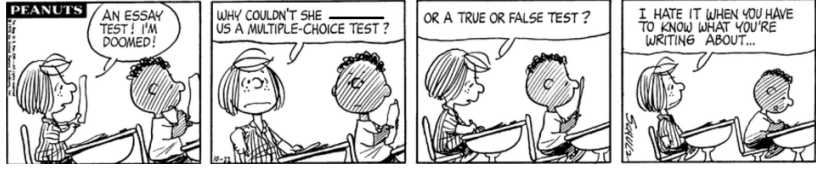
Ao relacionar as informações trazidas pelo texto e a fala do homem no cartoon, pode-se inferir corretamente que
Atenção! Leia o texto a seguir para responder à questão.
The research paper published in ‘Humanities & Social Sciences Communications’ — an open-access journal, distributed by Springer Nature — examines the impact of AI on “loss in decisionmaking and privacy concerns among university students in Pakistan and China”.
The rise of AI has also exposed students and teachers to a number of challenges, particularly data hacking and systemic and racial biases. “Many people are now concerned with the ethical attributes of AI systems and believe that the security issue must be considered in AI system development,” the researchers claimed. In order to mitigate safety concerns, the paper said there was a need to “continuously re-evaluate and re-design” security practices. However, academia is poorly equipped to deal this issue due to a shortage of funding and technical staff. “No one can run from the threat of AI concerning cybersecurity, it behaves like a double-edged sword.”
As per the research, AI has the potential to revolutionise the education sector but with certain drawbacks. In order to effectively harness this technology, the paper called for steps to ensure AI does not cause at least “severe ethical concerns”, and technology backed by secure algorithms to ensure data security and minimisation of AI’s bias. It also recommended measures to curtail overreliance on AI to address “laziness” and cognitive deficiency.
ABBAS, Zaki. AI making students lazy, impairing cognition: study. Disponível em: https://www.dawn.com/news/1759121/ai-making-students-lazy-impairingcognition-study. Acesso em: 12 jul. 2024. Adaptado.
Atenção! Leia o texto a seguir para responder à questão.
The research paper published in ‘Humanities & Social Sciences Communications’ — an open-access journal, distributed by Springer Nature — examines the impact of AI on “loss in decisionmaking and privacy concerns among university students in Pakistan and China”.
The rise of AI has also exposed students and teachers to a number of challenges, particularly data hacking and systemic and racial biases. “Many people are now concerned with the ethical attributes of AI systems and believe that the security issue must be considered in AI system development,” the researchers claimed. In order to mitigate safety concerns, the paper said there was a need to “continuously re-evaluate and re-design” security practices. However, academia is poorly equipped to deal this issue due to a shortage of funding and technical staff. “No one can run from the threat of AI concerning cybersecurity, it behaves like a double-edged sword.”
As per the research, AI has the potential to revolutionise the education sector but with certain drawbacks. In order to effectively harness this technology, the paper called for steps to ensure AI does not cause at least “severe ethical concerns”, and technology backed by secure algorithms to ensure data security and minimisation of AI’s bias. It also recommended measures to curtail overreliance on AI to address “laziness” and cognitive deficiency.
ABBAS, Zaki. AI making students lazy, impairing cognition: study. Disponível em: https://www.dawn.com/news/1759121/ai-making-students-lazy-impairingcognition-study. Acesso em: 12 jul. 2024. Adaptado.
Em uma atividade de sala, a professora pediu aos alunos que marcassem em suas agendas seus planos para a semana seguinte. Em seguida, eles deveriam sentar-se com um colega e simular um diálogo. Para realizar a atividade, ela escreveu na lousa o seguinte diálogo, a partir do qual os alunos deveriam usar corretamente um repertório linguístico aprendido para preencher a lacuna.
Aluno A: What __________ (do) on Monday/Tuesday/Wednesday…?
Aluno B: I ____________ (play soccer/go dancing/do my homework…) on Monday/Tuesday/Wednesday…
Para que os alunos sejam bem-sucedidos nessa atividade, é preciso que eles saibam usar corretamente qual tempo verbal?
Learning Portuguese-English cognates is a great way to build vocabulary fast! It’s basically using what you already know to get a jump-start.
Cognates are simply words that are very similar in both languages, usually due to a common root.
Below, you can explore some of the typical spelling patterns for English → Portuguese cognates, with examples for each one. Remember that these patterns do not apply every time. But they are a convenient way to help you notice more cognates as you continue to learn English!
Observe os padrões de sufixo abaixo e complete as lacunas indicadas.
ph → f
Ex: telephone → telefone
tion → -ção
Ex: nation → nação
ty → ____________
Ex: society → ____________
fy → ____________
Ex: identify → ____________
(...)
Practice Portuguese. Portuguese-English Cognates. Practice Portuguese, 2024. Disponível em: https://www.practiceportuguese.com/learning-notes/portugueseenglish-cognates/. Acesso em: 12 jul. 2024. Adaptado.
Em sequência, os termos que completam corretamente essas lacunas são:
A Well Respected Man
The Kinks
'Cause he gets up in the morning
And he goes to work at nine
And he comes back home at five-thirty
Gets the same train every time
'Cause his world is built 'round punctuality
It never fails
And he's oh, so good
And he's oh, so fine
And he's oh, so healthy
In his body and his mind
(…)
And his mother goes to meetings
While his father pulls the maid
And she stirs the tea with councilors
While discussing foreign trade
And she passes looks, as well as bills
At every suave young man (…)
DAVIES, Ray. A well respected man. Disponível em: https://lyrics.lyricfind.com/lyrics/the-kinks-a-well-respected-man. Acesso em: 12 jul. 2024. Adaptado.
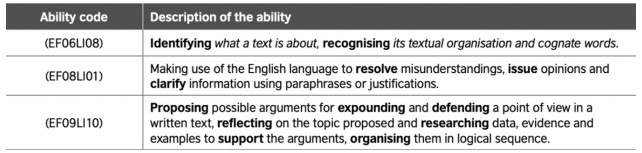
Letras de música podem ser ótimos recursos para desenvolver uma habilidade exigida pelo currículo escolar. A letra de “A well respected man” poderia ser mais bem usada para trabalhar qual habilidade dos estudantes?
WATTERSON, Bill. Calvin and Hobbes. Disponível em: https://www.gocomics.com/calvinandhobbes/2024/08/10. Acesso em: 12 ago. 2024.
Sobre os recursos linguísticos usados no quadrinho, avalie se as afirmações abaixo são verdadeiras (V) ou falsas (F).
I. Nos trechos “The world should’ve been designed” e “The world centainly could’ve used”, o uso de ‘should’ve been’ e ‘could’ve used’ indica haver possibilidade de que as ações sugeridas por Calvin aconteçam no futuro.
II. No trecho ‘so everyone didn’t have to eat each other to survive’ o termo ‘so’ poderia ser substituído por ‘de modo que’.
III. ‘To begin with’ é uma expressão idiomática que equivale em português, no contexto, a “antes de mais nada”.
As afirmações são, respectivamente,
Finding and identifying problems helps students practice detecting problems. Problem identification is found to be more important for reviewer learning, perhaps because reviewers are involved in more highly cognitive demanding activities when identifying problems. Interestingly, it is easier to see problems in documents/objects produced by ____________ than in ____________ documents because learners often “see” what they meant to produce and not what they actually produced. Thus, ____________ may be an easier context in which to practice skills related to repairing errors because errors are more easily detected
SCHUNN, Christian D. The Learning Science of Multi - Peer Feedback for EFL Students. Disponível em: https://www.lrdc.pitt.edu/schunn/papers/The%20Learning%20Sci_for_EFL_Student s_Schunn_Wu_2019.pdf. Acesso em: 12 jul. 2024. Adaptado.
Em sequência, as palavras que completam corretamente essas lacunas são:
Atenção! Leia o texto a seguir para responder à próxima questão.
The Two Goats
Two Goats, frisking gayly on the rocky steeps of a mountain valley, chanced to meet, one on each side of a deep chasm through which poured a mighty mountain torrent. The trunk of a fallen tree formed the only means of crossing the chasm, and on this not even two squirrels could have passed each other in safety. The narrow path would have made the bravest tremble. Not so our Goats. Their pride would not permit either to stand aside for the other.
One set her foot on the log. The other did likewise. In the middle they met horn to horn. Neither would give way, and so they both fell, to be swept away by the roaring torrent below.
Library of Congress. The Aesop for children. Library of Congress, 2024. Disponível em: https://read.gov/aesop/013.html. Acesso em: 12 jul. 2024.
Atenção! Leia o texto a seguir para responder à próxima questão.
The Two Goats
Two Goats, frisking gayly on the rocky steeps of a mountain valley, chanced to meet, one on each side of a deep chasm through which poured a mighty mountain torrent. The trunk of a fallen tree formed the only means of crossing the chasm, and on this not even two squirrels could have passed each other in safety. The narrow path would have made the bravest tremble. Not so our Goats. Their pride would not permit either to stand aside for the other.
One set her foot on the log. The other did likewise. In the middle they met horn to horn. Neither would give way, and so they both fell, to be swept away by the roaring torrent below.
Library of Congress. The Aesop for children. Library of Congress, 2024. Disponível em: https://read.gov/aesop/013.html. Acesso em: 12 jul. 2024.