Questões de Concurso
Sobre inglês
Foram encontradas 25.448 questões
Resolva questões gratuitamente!
Junte-se a mais de 4 milhões de concurseiros!


Ano: 2026
Banca:
IF-MT
Órgão:
IF-MT
Prova:
IF-MT - 2026 - IF-MT - Professor EBTT - Área: Português/Inglês |
Q3870571
Inglês
The Curricular Guidelines for High School - MT (2012, p.90) approach some effects of global expansion of English
language teaching around the world. According to them, the expansion of English in the world and its relationship
with other languages was not something innocent. It is solidly rooted in the colonial period of the British Empire
and in ideological arguments related to language teaching in the world to promote capitalist interests.
Mato Grosso. Secretaria de Estado de Educação. Orientações Curriculares: Área de Linguagens: Educação Básica. Cuiabá: Gráfica Print, 2012
From those considerations, it is CORRECT to say that:
Mato Grosso. Secretaria de Estado de Educação. Orientações Curriculares: Área de Linguagens: Educação Básica. Cuiabá: Gráfica Print, 2012
From those considerations, it is CORRECT to say that:
Ano: 2026
Banca:
IF-MT
Órgão:
IF-MT
Prova:
IF-MT - 2026 - IF-MT - Professor EBTT - Área: Português/Inglês |
Q3870569
Inglês
The Curricular Guidelines for High School (2006, p.87) propose new aims for Foreign Languages teaching.
BRASIL. Ministério da Educação: Secretaria de Educação Básica. Orientações Curriculares para o Ensino Médio: Linguagens, códigos e suas tecnologias. Brasília, 2006, p.87.
Choose the item(s) that point(s) those new aims.
I. To revisit the reflection on the educational role of foreign language teaching in High School and emphasize its importance.
II. To reaffirm the relevance of the notion of citizenship and discuss the practice of this concept in foreign language teaching.
III. To discuss the problem of exclusion in education in the face of "globalizing" values and the feeling of inclusion often associated with knowledge of foreign languages.
IV. To introduce theories on language (literacies, multiliteracies, multimodality, hypertext).
V. To provide suggestions for the practice of foreign language teaching through new technologies.
Choose the CORRECT alternative.
BRASIL. Ministério da Educação: Secretaria de Educação Básica. Orientações Curriculares para o Ensino Médio: Linguagens, códigos e suas tecnologias. Brasília, 2006, p.87.
Choose the item(s) that point(s) those new aims.
I. To revisit the reflection on the educational role of foreign language teaching in High School and emphasize its importance.
II. To reaffirm the relevance of the notion of citizenship and discuss the practice of this concept in foreign language teaching.
III. To discuss the problem of exclusion in education in the face of "globalizing" values and the feeling of inclusion often associated with knowledge of foreign languages.
IV. To introduce theories on language (literacies, multiliteracies, multimodality, hypertext).
V. To provide suggestions for the practice of foreign language teaching through new technologies.
Choose the CORRECT alternative.
Ano: 2026
Banca:
IF-MT
Órgão:
IF-MT
Prova:
IF-MT - 2026 - IF-MT - Professor EBTT - Área: Português/Inglês |
Q3870568
Inglês
PCNs (2000, p.28) bring some competencies and skills to be developed in Modern Foreign Languages and
make some reflection about what to teach.
BRASIL. Ministério da Educação: Secretaria de Educação Básica. Parâmetros Curriculares Nacionais (Ensino Médio). Parte II - Linguagens, Códigos e suas Tecnologias. 2000.
Choose the INCORRECT sentence about the discussion presented in PCNs (2000) about foreign language teaching.
BRASIL. Ministério da Educação: Secretaria de Educação Básica. Parâmetros Curriculares Nacionais (Ensino Médio). Parte II - Linguagens, Códigos e suas Tecnologias. 2000.
Choose the INCORRECT sentence about the discussion presented in PCNs (2000) about foreign language teaching.
Ano: 2026
Banca:
IF-MT
Órgão:
IF-MT
Prova:
IF-MT - 2026 - IF-MT - Professor EBTT - Área: Português/Inglês |
Q3870567
Inglês
"The multiliteracies approach in English Language Teaching in 21st Century Paradigm is a learning that has
long been echoed in the world of education. However, there are still some people who are opaque about
those multiliteracies. The teaching paradigm with a multiliteracies approach in this paper is defined as a
strategic concept of English Language teaching that is not only limited to teaching language skills (listening,
speaking, writing, and reading), but rather more complex in the practice of cultural and social accuracy.
Thus, learning leads to cognitive, affective, and psychomotor enrichment through a variety of learning
content that is integrated with social and cultural understanding of learners." (Siyaswati, 2019, p.1)
SIYASWATI. Multiliteracies Approach in English Language Teaching Paradigm in 21st Century. Advances in Social Science, Education and Humanities Research. Volume 434. Pages 90 - 96. Disponível em: https://www.atlantis-press.com/proceedings/iconelt-19/125939251. Acesso em: 03 mai. 2025.
After reading Siyaswati´s definition of multiliteracies, judge the items as (T) TRUE or (F) FALSE about the role of multiliteracies in English Language Teaching (ELT).
( ) The multiliteracies pedagogy in ELT is inclusive, as it makes provision for learners with different learning styles and abilities as well as learners who struggle with conventional literacy skills.
( ) ELT pedagogy based on multiliteracies moves English language learning beyond just the acquisition of language skills, and supports the development of critical literacy.
( ) Multiliteracies try to integrate technologies (e.g., new literacies; digital m edia) in the classroom and are characterized by four pedagogical practices (situated practice, overt instruction, critical framing, and transformed practice), and cultural and social practices.
( ) ELT pedagogy based on multiliteracies considers language is still taught as a set of productive (speaking and writing) and receptive (listening and reading) skills.
Choose the CORRECT sequence.
SIYASWATI. Multiliteracies Approach in English Language Teaching Paradigm in 21st Century. Advances in Social Science, Education and Humanities Research. Volume 434. Pages 90 - 96. Disponível em: https://www.atlantis-press.com/proceedings/iconelt-19/125939251. Acesso em: 03 mai. 2025.
After reading Siyaswati´s definition of multiliteracies, judge the items as (T) TRUE or (F) FALSE about the role of multiliteracies in English Language Teaching (ELT).
( ) The multiliteracies pedagogy in ELT is inclusive, as it makes provision for learners with different learning styles and abilities as well as learners who struggle with conventional literacy skills.
( ) ELT pedagogy based on multiliteracies moves English language learning beyond just the acquisition of language skills, and supports the development of critical literacy.
( ) Multiliteracies try to integrate technologies (e.g., new literacies; digital m edia) in the classroom and are characterized by four pedagogical practices (situated practice, overt instruction, critical framing, and transformed practice), and cultural and social practices.
( ) ELT pedagogy based on multiliteracies considers language is still taught as a set of productive (speaking and writing) and receptive (listening and reading) skills.
Choose the CORRECT sequence.
Ano: 2026
Banca:
IF-MT
Órgão:
IF-MT
Prova:
IF-MT - 2026 - IF-MT - Professor EBTT - Área: Português/Inglês |
Q3870566
Inglês
"Grammar describes how we combine, organize and change words and parts of words to make meaning.
We use rules for this description." (Spratt; Pulverness; Williams, 2005, p.5).
SPRATT, M.; PULVERNESS A.; WILLIAMS, M. The TKT – Teaching Knowledge Test Course. Cambridge University Press: Cambridge, 2005.
Based on the concept of grammar, choose the INCORRECT sentence.
SPRATT, M.; PULVERNESS A.; WILLIAMS, M. The TKT – Teaching Knowledge Test Course. Cambridge University Press: Cambridge, 2005.
Based on the concept of grammar, choose the INCORRECT sentence.
Ano: 2026
Banca:
IF-MT
Órgão:
IF-MT
Prova:
IF-MT - 2026 - IF-MT - Professor EBTT - Área: Português/Inglês |
Q3870565
Inglês
Interests in learning strategies began with the publication of papers collectively known as the "good language
learner" studies (Cohen; Weaver, 1998). Since then, hundreds of studies have been generated that look at
different aspects of learning strategies and their roles in language learning. In an effort to make sense of
the huge database and numerous research findings in this area, Oxford (1990, as cited in Cohen; Weaver,
1998) differentiates learning strategies into four categories: cognitive, metacognitive, affective and social
(Oxford, 2002, p.121).
Oxford. L.Language Learning Strategies in a Nutshell: Update and ESL Suggestions.In: RICHARDS, J. C. & RENANDYA. W.A. Methodology in Language Teaching: an Anthology of Current Practice. Cambridge: Cambridge University Press 2002. Chapter 11 - pages 121 -132.
Identify the learning strategies as exposed by Oxford (2002) by matching each definition to the CORRECT category.
1. Cognitive
2. Metacognitive
3. Affective
4. Social
( ) This strategy deals with the planning, monitoring, and evaluation of language learning activities. For example, students may develop a plan for monitoring their progress by constantly comparing their current level of proficiency with the course goals outlined in the curriculum.
( ) This strategy involves the identification, retention, and retrieval of language elements. For example, students may use memory-enhancing strategies (e.g., the keyword method) to help them remember new words.
( ) This strategy refers to actions learners take to interact with users of the language. For example, students may deliberately seek out opportunities to use the target language with native speakers of the language.
( ) This strategy serves to regulate emotions, attitudes, and motivation. For example, students may read linguistically simplified books to develop a positive attitude toward reading materials.
Choose the CORRECT sequence.
Oxford. L.Language Learning Strategies in a Nutshell: Update and ESL Suggestions.In: RICHARDS, J. C. & RENANDYA. W.A. Methodology in Language Teaching: an Anthology of Current Practice. Cambridge: Cambridge University Press 2002. Chapter 11 - pages 121 -132.
Identify the learning strategies as exposed by Oxford (2002) by matching each definition to the CORRECT category.
1. Cognitive
2. Metacognitive
3. Affective
4. Social
( ) This strategy deals with the planning, monitoring, and evaluation of language learning activities. For example, students may develop a plan for monitoring their progress by constantly comparing their current level of proficiency with the course goals outlined in the curriculum.
( ) This strategy involves the identification, retention, and retrieval of language elements. For example, students may use memory-enhancing strategies (e.g., the keyword method) to help them remember new words.
( ) This strategy refers to actions learners take to interact with users of the language. For example, students may deliberately seek out opportunities to use the target language with native speakers of the language.
( ) This strategy serves to regulate emotions, attitudes, and motivation. For example, students may read linguistically simplified books to develop a positive attitude toward reading materials.
Choose the CORRECT sequence.
Ano: 2026
Banca:
IF-MT
Órgão:
IF-MT
Prova:
IF-MT - 2026 - IF-MT - Professor EBTT - Área: Português/Inglês |
Q3870564
Inglês
"Teachers may wonder "which way they ought to go" before they enter a classroom. This usually means
that teachers need to plan what they want to do in their classrooms. So, lesson planning involves decisions
about the pedagogical dimensions of the lesson. But another important aspect of a lesson concerns the
management of learners during the lesson. This includes eliciting students´ attention, maintaining their
engagement in the lesson, and organizing them into pairs or groups." (Farrell, 2002, p.30)
FARRELL, T. S. C. Lesson Planning In: RICHARDS, J. C. & RENANDYA. W.A. Methodology in Language Teaching: an Anthology of Current Practice. Cambridge: Cambridge University Press 2002. Chapter 3 - pages 30-39.
After reading about the importance of lesson planning, match the CORRECT information to the number in the following Lesson Plan.
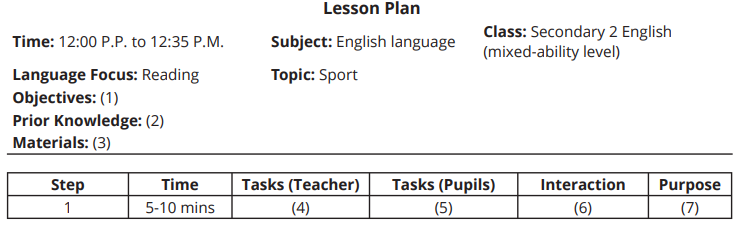
( ) 1. Reading materials - article from a book on sports 2. Television 3. Whiteboard
( ) To teach the students how to skim for main idea of the passage - identify key words.
( ) Students have learned how to locate information by reading and finding the main sentence of each paragraph.
( )
( )
( ) Arouse interest. Activate schema for sport
( )
Choose the CORRECT sequence.
FARRELL, T. S. C. Lesson Planning In: RICHARDS, J. C. & RENANDYA. W.A. Methodology in Language Teaching: an Anthology of Current Practice. Cambridge: Cambridge University Press 2002. Chapter 3 - pages 30-39.
After reading about the importance of lesson planning, match the CORRECT information to the number in the following Lesson Plan.
( ) 1. Reading materials - article from a book on sports 2. Television 3. Whiteboard
( ) To teach the students how to skim for main idea of the passage - identify key words.
( ) Students have learned how to locate information by reading and finding the main sentence of each paragraph.
( )
( )
( ) Arouse interest. Activate schema for sport
( )
Choose the CORRECT sequence.
Ano: 2026
Banca:
IF-MT
Órgão:
IF-MT
Prova:
IF-MT - 2026 - IF-MT - Professor EBTT - Área: Português/Inglês |
Q3870562
Inglês
Concerning the history of teaching English as a foreign language, in the 70s, teachers faced another approach to
teaching. Language was not seen as a set of sentences anymore, but as a set of communicative events.
PIAZZA, Paulo Thiago. The historical development of english as a foreign language teaching in brazilian schools: methods and legal documents. Revista Contribuciones a Las Ciencias Sociales, São José dos Pinhais, v.17, n.6, p. 01-23, 2024. Disponível em: https://ojs.revistacontribuciones.com/ojs/index.php/clcs. Acesso em: 10 mai. 2025.
Judge the items as ( T ) TRUE or ( F ) FALSE according to the Communicative Approach.
( ) Instead of organizing the syllabus based on grammar topics (simple past, simple present, if clauses, etc.), the organization is focused on developing students´ communicative competence.
( ) Classes based on Communicative Language Teaching (CLT) tend to be more teacher-centered, with a greater emphasis on teacher-student interactions and situations where the language must be used by students for communicative purposes.
( ) Errors are viewed as part of development, and most of the time are not corrected immediately. ( ) The role of the teacher in CLT is to promote situations where students need to communicate in their mother tongue.
( ) Students must be exposed to authentic materials, that is, language as it is actually used in daily routines in the real world.
Choose the CORRECT sequence.
PIAZZA, Paulo Thiago. The historical development of english as a foreign language teaching in brazilian schools: methods and legal documents. Revista Contribuciones a Las Ciencias Sociales, São José dos Pinhais, v.17, n.6, p. 01-23, 2024. Disponível em: https://ojs.revistacontribuciones.com/ojs/index.php/clcs. Acesso em: 10 mai. 2025.
Judge the items as ( T ) TRUE or ( F ) FALSE according to the Communicative Approach.
( ) Instead of organizing the syllabus based on grammar topics (simple past, simple present, if clauses, etc.), the organization is focused on developing students´ communicative competence.
( ) Classes based on Communicative Language Teaching (CLT) tend to be more teacher-centered, with a greater emphasis on teacher-student interactions and situations where the language must be used by students for communicative purposes.
( ) Errors are viewed as part of development, and most of the time are not corrected immediately. ( ) The role of the teacher in CLT is to promote situations where students need to communicate in their mother tongue.
( ) Students must be exposed to authentic materials, that is, language as it is actually used in daily routines in the real world.
Choose the CORRECT sequence.
Ano: 2026
Banca:
IF-MT
Órgão:
IF-MT
Prova:
IF-MT - 2026 - IF-MT - Professor EBTT - Área: Português/Inglês |
Q3870561
Inglês
"Teaching is characterized by many factors, such as teachers´ beliefs, preferences, personalities, and one of
the factors that mostly influences teaching is the method, which holds systematic procedures prescribed to
the teacher based on linguistic theory or legal documents." (Piazza, 2024, p.3)
PIAZZA, Paulo Thiago. The historical development of english as a foreign language teaching in brazilian schools: methods and legal documents. Revista Contribuciones a Las Ciencias Sociales, São José dos Pinhais, v.17, n.6, p. 01-23, 2024. Disponível em: https://ojs.revistacontribuciones.com/ojs/index.php/clcs. Acesso em: 10 mai. 2025.
According to Larsen-Freeman and Anderson (2011, p.38 apud PIAZZA, 2024, p. 5), in a class based on the GrammarTranslation method, the "fundamental purpose of learning a language is to be able to read literature written in the target language".
Choose the item that IS NOT applied to the Grammar-Translation method.
PIAZZA, Paulo Thiago. The historical development of english as a foreign language teaching in brazilian schools: methods and legal documents. Revista Contribuciones a Las Ciencias Sociales, São José dos Pinhais, v.17, n.6, p. 01-23, 2024. Disponível em: https://ojs.revistacontribuciones.com/ojs/index.php/clcs. Acesso em: 10 mai. 2025.
According to Larsen-Freeman and Anderson (2011, p.38 apud PIAZZA, 2024, p. 5), in a class based on the GrammarTranslation method, the "fundamental purpose of learning a language is to be able to read literature written in the target language".
Choose the item that IS NOT applied to the Grammar-Translation method.
Ano: 2026
Banca:
Avança SP
Órgão:
Prefeitura de Vinhedo - SP
Prova:
Avança SP - 2026 - Prefeitura de Vinhedo - SP - Professor de Educação Básica II - Inglês |
Q3869510
Inglês
In which word is the -ed ending pronounced as /ɪd/?
Ano: 2026
Banca:
Avança SP
Órgão:
Prefeitura de Vinhedo - SP
Prova:
Avança SP - 2026 - Prefeitura de Vinhedo - SP - Professor de Educação Básica II - Inglês |
Q3869509
Inglês

Read the comic strip and choose the option that correctly explains the meaning of the expression “gravy boat” as used in the dialogue.
Ano: 2026
Banca:
Avança SP
Órgão:
Prefeitura de Vinhedo - SP
Prova:
Avança SP - 2026 - Prefeitura de Vinhedo - SP - Professor de Educação Básica II - Inglês |
Q3869508
Inglês
In English, the placement of the stress mark ( ˈ ) indicates the stressed syllable of a word. In many twosyllable words, stress on the first syllable often signals a noun, while stress on the second syllable
commonly signals a verb. Which pair correctly matches pronunciation → word class?
Ano: 2026
Banca:
Avança SP
Órgão:
Prefeitura de Vinhedo - SP
Prova:
Avança SP - 2026 - Prefeitura de Vinhedo - SP - Professor de Educação Básica II - Inglês |
Q3869507
Inglês

In the sentence “I used to make original snowmen, but it was time-consuming hard work,” the expression used to indicates:
Ano: 2026
Banca:
Avança SP
Órgão:
Prefeitura de Vinhedo - SP
Prova:
Avança SP - 2026 - Prefeitura de Vinhedo - SP - Professor de Educação Básica II - Inglês |
Q3869506
Inglês
In which word does the letter “c” correspond to
the phoneme /s/?
Ano: 2026
Banca:
Avança SP
Órgão:
Prefeitura de Vinhedo - SP
Prova:
Avança SP - 2026 - Prefeitura de Vinhedo - SP - Professor de Educação Básica II - Inglês |
Q3869505
Inglês
Choose the option that correctly completes the
following blanks:
The conference will take place ___ March 15th, starting ___ 9 a.m. and ending ___ the afternoon.
The conference will take place ___ March 15th, starting ___ 9 a.m. and ending ___ the afternoon.
Ano: 2026
Banca:
Avança SP
Órgão:
Prefeitura de Vinhedo - SP
Prova:
Avança SP - 2026 - Prefeitura de Vinhedo - SP - Professor de Educação Básica II - Inglês |
Q3869504
Inglês
Choose the option that correctly completes the
following blanks.
A coffee shop is a place _____ people usually go to relax or work, and a teacher is someone _____ helps students learn new skills.
A coffee shop is a place _____ people usually go to relax or work, and a teacher is someone _____ helps students learn new skills.
Ano: 2026
Banca:
Avança SP
Órgão:
Prefeitura de Vinhedo - SP
Prova:
Avança SP - 2026 - Prefeitura de Vinhedo - SP - Professor de Educação Básica II - Inglês |
Q3869503
Inglês
From the options below, all verbs have an
irregular past tense, except one. Identify it.
Ano: 2026
Banca:
Avança SP
Órgão:
Prefeitura de Vinhedo - SP
Prova:
Avança SP - 2026 - Prefeitura de Vinhedo - SP - Professor de Educação Básica II - Inglês |
Q3869502
Inglês
Choose the option that correctly completes the sentence.
If I ___ you, I would accept the offer.
Ano: 2026
Banca:
Avança SP
Órgão:
Prefeitura de Vinhedo - SP
Prova:
Avança SP - 2026 - Prefeitura de Vinhedo - SP - Professor de Educação Básica II - Inglês |
Q3869501
Inglês
From the options below, all pairs correctly present an adjective and its comparative form, except one. Identify it.
Ano: 2026
Banca:
Avança SP
Órgão:
Prefeitura de Vinhedo - SP
Prova:
Avança SP - 2026 - Prefeitura de Vinhedo - SP - Professor de Educação Básica II - Inglês |
Q3869500
Inglês
From the options below, all pairs correctly
present an adjective and its superlative form,
except one. Identify it.

 Conheça nossos planos