Questões de Concurso
Sobre inglês
Foram encontradas 25.448 questões
Resolva questões gratuitamente!
Junte-se a mais de 4 milhões de concurseiros!


For question, consider the following text.
South Korea’s President Yoon Suk Yeol _____1 investigated _____ 2 to declare martial law. Prosecutors accuse him _____3 insurrection.
Former Defense Minister Kim Yong-hyun, who resigned, is barred from _____4 the country.
Yoon’s impeachment is being debated. While his party, the People Power Party (PPP), opposes it, some members voted _____5 his martial law order. Party leader Han Dong-hun called Yoon’s actions unconstitutional but warned that impeachment could create chaos. If impeached, the Prime Minister would lead _____ 6 elections in 60 days.
Amid the controversy, Yoon accepted Defense Minister Kim’s resignation and nominated Choi Byung-hyuk as his replacement. Several _____ 7 ministers plan to resign. Yoon’s martial law lasted only hours after lawmakers in an emergency vote repealed it, even blocking troops from entering parliament.
Source: <https://www.newsinlevels.com/products/southkorea-political-crisis-level-3/>
For question, consider the following text.
South Korea’s President Yoon Suk Yeol _____1 investigated _____ 2 to declare martial law. Prosecutors accuse him _____3 insurrection.
Former Defense Minister Kim Yong-hyun, who resigned, is barred from _____4 the country.
Yoon’s impeachment is being debated. While his party, the People Power Party (PPP), opposes it, some members voted _____5 his martial law order. Party leader Han Dong-hun called Yoon’s actions unconstitutional but warned that impeachment could create chaos. If impeached, the Prime Minister would lead _____ 6 elections in 60 days.
Amid the controversy, Yoon accepted Defense Minister Kim’s resignation and nominated Choi Byung-hyuk as his replacement. Several _____ 7 ministers plan to resign. Yoon’s martial law lasted only hours after lawmakers in an emergency vote repealed it, even blocking troops from entering parliament.
Source: <https://www.newsinlevels.com/products/southkorea-political-crisis-level-3/>
For question, consider the following text.
South Korea’s President Yoon Suk Yeol _____1 investigated _____ 2 to declare martial law. Prosecutors accuse him _____3 insurrection.
Former Defense Minister Kim Yong-hyun, who resigned, is barred from _____4 the country.
Yoon’s impeachment is being debated. While his party, the People Power Party (PPP), opposes it, some members voted _____5 his martial law order. Party leader Han Dong-hun called Yoon’s actions unconstitutional but warned that impeachment could create chaos. If impeached, the Prime Minister would lead _____ 6 elections in 60 days.
Amid the controversy, Yoon accepted Defense Minister Kim’s resignation and nominated Choi Byung-hyuk as his replacement. Several _____ 7 ministers plan to resign. Yoon’s martial law lasted only hours after lawmakers in an emergency vote repealed it, even blocking troops from entering parliament.
Source: <https://www.newsinlevels.com/products/southkorea-political-crisis-level-3/>
Resumos relacionados
Advérbios e conjunções em inglês para concursos públicos
O estudo de advérbios e conjunções na língua inglesa é fundamental para quem deseja se destacar em provas de concursos públicos. Esses elementos desempenham papéis essenciais na construção de frases, influenciando diretamente o sentido e a coesão textual, habilidades bastante exigidas nas questões de interpretação e compreensão de textos em inglês.
Artigos (Articles) em inglês: uso em concursos públicos
Artigos (Articles) são palavras essenciais na gramática da língua inglesa, usadas para indicar se um substantivo está sendo mencionado de forma específica ou geral. Eles desempenham papel fundamental em provas de concursos, pois ajudam na compreensão e interpretação dos textos, além de serem frequentemente cobrados em questões envolvendo uso correto de estruturas gramaticais.
Text II
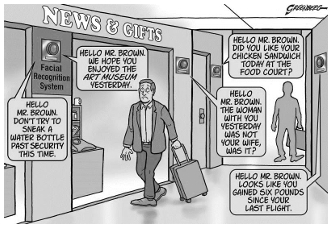
From: https://www.cartoonmovement.com/cartoon/facial-recognition-0
Text I
Understanding bias in facial recognition technologies
Over the past couple of years, the growing debate around automated facial recognition has reached a boiling point. As developers have continued to swiftly expand the scope of these kinds of technologies into an almost unbounded range of applications, an increasingly strident chorus of critical voices has sounded concerns about the injurious effects of the proliferation of such systems on impacted individuals and communities. Critics argue that the irresponsible design and use of facial detection and recognition technologies (FDRTs) threaten to violate civil liberties, infringe on basic human rights and further entrench structural racism and systemic marginalisation. In addition, they argue that the gradual creep of face surveillance infrastructures into every domain of lived experience may eventually eradicate the modern democratic forms of life that have long provided cherished means to individual flourishing, social solidarity and human self-creation.
Defenders, by contrast, emphasise the gains in public safety, security and efficiency that digitally streamlined capacities for facial identification, identity verification and trait characterisation may bring. These proponents point to potential real-world benefits like the added security of facial recognition enhanced border control, the increased efficacy of missing children or criminal suspect searches that are driven by the application of brute force facial analysis to largescale databases and the many added conveniences of facial verification in the business of everyday life.
Whatever side of the debate on which one lands, it would appear that FDRTs are here to stay.
Adapted from: understanding_bias_in_facial_recognition_technology.pdf
Text I
Understanding bias in facial recognition technologies
Over the past couple of years, the growing debate around automated facial recognition has reached a boiling point. As developers have continued to swiftly expand the scope of these kinds of technologies into an almost unbounded range of applications, an increasingly strident chorus of critical voices has sounded concerns about the injurious effects of the proliferation of such systems on impacted individuals and communities. Critics argue that the irresponsible design and use of facial detection and recognition technologies (FDRTs) threaten to violate civil liberties, infringe on basic human rights and further entrench structural racism and systemic marginalisation. In addition, they argue that the gradual creep of face surveillance infrastructures into every domain of lived experience may eventually eradicate the modern democratic forms of life that have long provided cherished means to individual flourishing, social solidarity and human self-creation.
Defenders, by contrast, emphasise the gains in public safety, security and efficiency that digitally streamlined capacities for facial identification, identity verification and trait characterisation may bring. These proponents point to potential real-world benefits like the added security of facial recognition enhanced border control, the increased efficacy of missing children or criminal suspect searches that are driven by the application of brute force facial analysis to largescale databases and the many added conveniences of facial verification in the business of everyday life.
Whatever side of the debate on which one lands, it would appear that FDRTs are here to stay.
Adapted from: understanding_bias_in_facial_recognition_technology.pdf
Text I
Understanding bias in facial recognition technologies
Over the past couple of years, the growing debate around automated facial recognition has reached a boiling point. As developers have continued to swiftly expand the scope of these kinds of technologies into an almost unbounded range of applications, an increasingly strident chorus of critical voices has sounded concerns about the injurious effects of the proliferation of such systems on impacted individuals and communities. Critics argue that the irresponsible design and use of facial detection and recognition technologies (FDRTs) threaten to violate civil liberties, infringe on basic human rights and further entrench structural racism and systemic marginalisation. In addition, they argue that the gradual creep of face surveillance infrastructures into every domain of lived experience may eventually eradicate the modern democratic forms of life that have long provided cherished means to individual flourishing, social solidarity and human self-creation.
Defenders, by contrast, emphasise the gains in public safety, security and efficiency that digitally streamlined capacities for facial identification, identity verification and trait characterisation may bring. These proponents point to potential real-world benefits like the added security of facial recognition enhanced border control, the increased efficacy of missing children or criminal suspect searches that are driven by the application of brute force facial analysis to largescale databases and the many added conveniences of facial verification in the business of everyday life.
Whatever side of the debate on which one lands, it would appear that FDRTs are here to stay.
Adapted from: understanding_bias_in_facial_recognition_technology.pdf
"The past is consumed in the present and the present is living only because it brings forth the future."
This statement reflects a central feature of Modernist narrative technique by illustrating:
"Poetry is the spontaneous overflow of powerful feelings: it takes its origin from emotion recollected in tranquility: the emotion is contemplated till, by a species of reaction, the tranquility gradually disappears, and an emotion, kindred to that which was before the subject of contemplation, is gradually produced, and does itself actually exist in the mind."
Based on this statement, Wordsworth's conception of poetry emphasizes:
"Between my finger and my thumb
The squat pen rests.
I'll dig with it."
The metaphor of "digging" in this poem primarily conveys:
"Far from a nuisance, Troy's waste is an archaeologist's treasure trove."
The expression "treasure trove" in this sentence most likely refers to:
I. The author employs a multidisciplinary analytical approach to waste archaeology, examining quantitative ratios of bones to pottery, ash concentration levels, and the spatial distribution of artifacts such as storage jars and grinding stones to identify functional areas within the ancient city, thereby transforming seemingly chaotic refuse deposits into structured maps of daily activities including food preparation, craft production, and storage practices.
II. The text demonstrates that exotic imported materials such as carnelian and lapis lazuli found within Troy's refuse layers serve exclusively as indicators of aesthetic preferences and artistic tastes of Bronze Age inhabitants, having no significant implications for understanding trade networks, economic development, or the city's integration into broader regional exchange systems during its transformation from agrarian settlement to regional centre.
III. The archaeological evidence presented suggests that Troy's mid-second millennium BC revival, characterized by refined ceramics, luxury imports, and increased social complexity, represents the same settlement phase that Homer later immortalized in the Iliad, where Greek warriors confronted massive accumulated debris mounds while attempting to reach the palaces during the legendary Trojan War.
The following statement(s) is/are CORRECT:
"Waste is the diary no one meant to write, yet it records the intimate rhythms of daily life with unfiltered clarity."
In this context, the word "unfiltered" most nearly means:
(__) The text argues that waste management in Bronze Age Troy was chaotic and disorganized, reflecting the inhabitants' lack of concern for hygiene and sanitation, which contrasts sharply with modern systematic waste disposal practices that emerged only in contemporary urban civilizations.
(__) According to the author's archaeological analysis, the 15 meters of accumulated debris and nine major building phases visible at Troy reveal deliberate spatial organization of waste disposal, where the location and composition of refuse deposits provide insights into social status, community boundaries, and the evolution of economic activities over nearly 2,000 years.
(__) The text suggests that Troy experienced continuous linear growth throughout the Bronze Age, with no periods of decline or economic contraction, as evidenced by increasingly elaborate architecture, expanding trade networks, and progressively sophisticated waste management systems maintained consistently across all archaeological layers.
The CORRECT sequence is:
"Far from a nuisance, Troy's waste is an archaeologist's treasure trove. Over nearly 2,000 years, Troy ended up with 15 meters of built-up debris. Archaeologists can see nine major building phases in it, each made up of hundreds of thin layers, which formed as people lived their everyday lives."
An English teacher preparing reading comprehension activities for intermediate Brazilian students analyzes this passage to identify vocabulary and conceptual challenges. Regarding lexical comprehension, idiomatic expressions, and the relationship between linguistic form and archaeological content, which pedagogical analysis is accurate?
I. The sentence "Where people chose to dump, or not to dump, speaks volumes about status, social roles, and community boundaries" contains a concessive type (free relative clause) functioning as the direct object of the verb "speaks," where "where" introduces a clause with an implicit antecedent referring back to "volumes," and this construction is identical to adverbial clauses of place which modify verbs rather than function as noun phrase equivalents.
II. The complex sentence "Having spent more than 16 summers excavating and analysing the bronze age layers of Troy, I've learned to read the city's history this waste" demonstrates a non-finite participial clause ("Having spent...") functioning as an adverbial of reason or temporal background, with the perfect aspect "having spent" indicating that the action of the participle preceded the main clause verb "learned," though the sentence contains a grammatical error with missing preposition "from" or "in" before "this waste."
III. The structure "What appears chaotic turns out to be a carefully structured map" exemplifies a pseudo-cleft (wh-cleft) sentence construction that foregrounds information by moving it to subject position, creating emphasis on "what appears chaotic" while the predicate provides the surprising revelation, and this syntactic pattern is commonly employed in academic writing to manage information flow and create rhetorical impact.
The following statement(s) is/are CORRECT:

 Conheça nossos planos