Questões de Concurso
Sobre análise do discurso em linguística
Foram encontradas 287 questões


O círculo de Bakhtin compreende o enunciado como memória discursiva, isto é, todo enunciado é uma resposta a algo já dito, orientado a um público em um dado contexto social (FARACO, 2009). Na psicologia do corpo social, os atos humanos são construídos por cadeias ininterruptas dos enunciados como, por exemplo, as conversas de corredor, as trocas de opinião nas diferentes reuniões sociais e as trocas puramente fortuitas (BAKHTIN, 2011).
CAMPOS, Paula Angélica da Silva. O gênero do discurso no ensinoaprendizagem: em direção a uma abordagem desestabilizadora e sóciohistórica da linguagem. Entretextos, Londrina, v. 18, n. 2, p. 51–76, 2018. Disponível em: https://ojs.uel.br/revistas/uel/index.php/entretextos/article/view/31994. Acesso em: 29 nov. 2025.
A compreensão do enunciado como memória discursiva e como ato sempre orientado a um contexto social deve ser levado em consideração nas aulas de língua portuguesa para que se desloque a abordagem normativa tradicional para uma prática de ensino funcional e reflexiva. Nessa perspectiva, qual é a principal implicação metodológica para o ensino de língua que contemple a dimensão social e discursiva da linguagem?
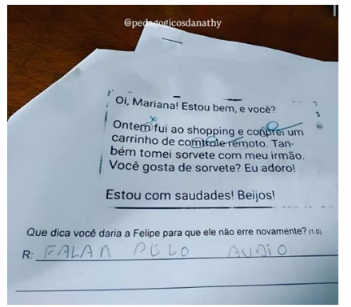
Fonte:https://www.instagram.com/p/DQl2PxigMro/?igsh=MW91aWcz ZHhrdXNybQ==. Acesso em 8/05/2026.
Sobre a escrita da expressão “Falar pelo audio”, produzida por um estudante em contexto de comunicação informal, assinale a alternativa correta.

I. O enunciado mobiliza uma implicatura conversacional ao sugerir, por meio da estrutura disjuntiva "ou", que as duas opções não são necessariamente excludentes. O leitor atento infere que o programa BBB pode ser simultaneamente entretenimento e instrumento de autorreflexão.
II. A palavra "laboratório", empregada em sentido conotativo, produz efeito de ressignificação do objeto discursivo: desloca o BBB do campo do entretenimento trivial para o da observação sistemática do comportamento humano, dependendo do repertório sociocultural do leitor para ser interpretada dessa forma.
III. O significado do enunciado é integralmente determinado pela sua estrutura linguística explícita, independentemente do contexto de circulação, do suporte midiático ou dos conhecimentos prévios compartilhados entre emissor e receptor.
IV. A escolha do gênero pergunta retórica é uma estratégia enunciativa que posiciona o leitor como agente da construção de sentido, produzindo efeito de engajamento e de interpelação direta.
V. O contexto de publicação em um perfil jornalístico do Instagram (boletimbrio) integra o processo de significação: a plataforma, o público-alvo presumido e o caráter editorial da postagem orientam a interpretação do enunciado para além do que está literalmente escrito.
Após análise, conclui-se que estão corretas:
Leia o texto a seguir

Disponível em: https://www.iguatamaagora.com.br/noticia/828/metaacolhercampanha-de-prevencao-ao-feminicidio. Acesso em: 30 nov. 2025.
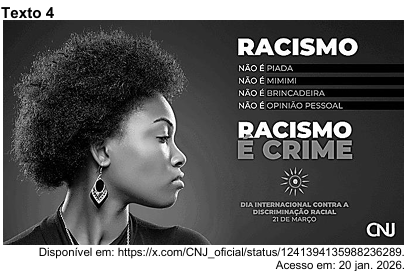
De acordo com as concepções de Marcuschi sobre textualidade, o trecho evidencia que:
Para responder à questão, leia o texto abaixo.
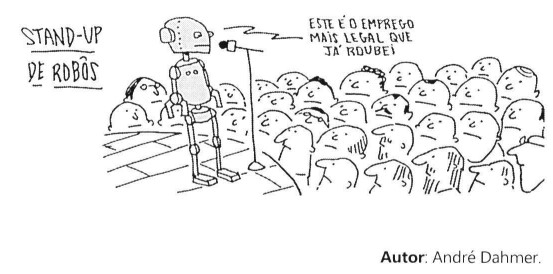
Na fala do personagem principal - Este ó o emprego mais legal que já roubei -, o emprego do verbo roubei carrega um pressuposto semântico implícito na discussão contemporânea sobre o mercado de trabalho.
Esse termo sinaliza:
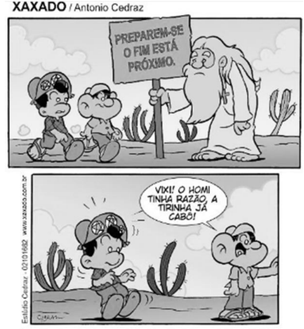
https://blogdoxandro.blogspot.com/2013/08/tiras-n4929-turma-do-xaxadoantonio.html
A fala do personagem no segundo quadrinho apresenta marcas linguísticas que se afastam da norma-padrão.
Considerando o contexto da tirinha, essas marcas
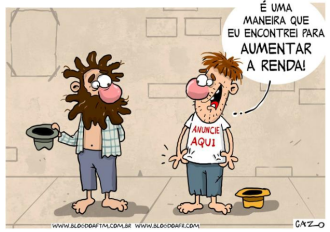
CAZO. Negócios e oportunidades. Disponível em
<https://blogdoaftm.com.br/charge-negocios-eoportunidades-4/>.
O elemento "aqui", presente no enunciado "Anuncie aqui", utilizado na charge acima, estabelece referência:
Assinale a alternativa que preenche, correta e respectivamente, as lacunas do trecho acima.
De acordo com Orlandi (2012), a Análise do Discurso estuda como os sentidos são produzidos na linguagem, considerando a relação entre sujeito, história e ideologia. Nesse contexto, analise as assertivas abaixo, assinalando V, se verdadeiras, ou F, se falsas.
( ) O objeto discursivo não é dado de forma imediata, sendo construído pelo analista por meio da transformação do discurso empírico em um objeto teórico.
( ) A descrição ocorre após a análise do objeto ter sido realizada até seu esgotamento.
( ) A paráfrase e a metáfora são elementos que permitem certo grau de operacionalização dos conceitos.
( ) O discurso resulta da articulação entre o real, marcado pela descontinuidade, incompletude e contradição, e o imaginário, caracterizado pela unidade, coerência e aparência de sentido estável.
A ordem correta de preenchimento dos parênteses, de cima para baixo, é:
De acordo com o texto e com a perspectiva teórica apresentada, assinale a alternativa CORRETA.
TEXTOS I E II PARA A QUESTÃO
TEXTO I
Uma revolução sem gramática
Professor honorário de linguística da Universidade do País de Gales, David Crystal é uma das maiores autoridades em linguagem. Autor de A Revolução da Linguagem, falou à VEJA, em 2007, sobre os impactos da internet no uso da língua e sobre o desaparecimento de línguas no mundo.
A internet está mudando o caráter das línguas?
Em cinquenta ou cem anos, todas as línguas que usam a internet serão diferentes. Surge o netspeak, ou comunicação mediada pelo computador. Ainda é cedo para prever a extensão dessa mudança, pois transformações linguísticas levam tempo. A distância entre Chaucer e Shakespeare, separados por duzentos anos, ilustra isso. O e-mail é recente. Há novidades gráficas e no uso de emoticons, mas não uma nova gramática. Poucas palavras foram incorporadas ao inglês por causa da internet, sem alterar seu caráter.
A informalidade é uma característica do netspeak?
Sim, por enquanto. O fenômeno começou com os nerds da internet, que viam a rede como alternativa à comunicação formal. Ignoravam pontuação e ortografia. Com a popularização da internet, essa informalidade se espalhou, especialmente nos e-mails. Hoje, com usuários mais velhos, a comunicação tende a se tornar novamente mais formal.
Por que tantas línguas estão desaparecendo?
O principal motivo é a assimilação cultural causada pela globalização. Línguas majoritárias suprimem idiomas menores. Não apenas o inglês, mas também chinês, russo, hindi e suahili ameaçam línguas de pequenas comunidades. A preservação depende de políticas regionais que valorizem a diversidade.
O que se perde quando uma língua morre?
Perde-se uma forma única de ver o mundo. Cada língua expressa uma visão própria, ligada à história, ao ambiente e ao modo de pensar de uma comunidade. A linguagem é o meio fundamental de comunicar essa experiência humana.
O inglês ameaça o português?
Não. Todas as línguas incorporam palavras estrangeiras. O inglês tomou empréstimos de mais de 350 línguas, o que ampliou sua expressividade. Palavras estrangeiras não substituem as existentes, coexistem com elas. Assim, a língua evolui e se enriquece.
MARINHO, Janice Helena Chaves; DACONTI, Geruza Corrêa; CUNHA, Gustavo Ximenes. O texto e sua tipologia: fundamentos e aplicações. Belo Horizonte: Faculdade de Letras da UFMG, 2012, p. 42–44. Adaptado.
TEXTO II

Disponível em: https://blogdoaftm.com.br/charge-geracao-internet/ . Acesso em: 05 fev. 2026.
HALLIDAY, M.A.K.; HASAN, R. Cohesion in English. London: Longman, 1976.

 Conheça nossos planos