Questões de Concurso
Sobre análise do discurso em linguística
Foram encontradas 286 questões


Coluna 1
1. Proposta.
2. Tese.
3. Argumentos pró-tese, ou persuasão.
4. Argumentos contrários à tese, ou concessão.
Coluna 2
( ) Proposição cuja veracidade o autor procura demonstrar; é a asserção para a qual se orienta argumentativamente todo o texto, sendo a conclusão da qual se pretende persuadir o leitor.
( ) Condição sine qua non para que haja argumentação, é sempre independente em relação ao texto produzido. Quanto ao seu enunciador, este pode ser um indivíduo, ou seja, um cidadão comum ou uma figura pública, ou então uma coletividade, representada nas fórmulas do tipo “dizem que”, “sabe-se que” etc. Por via de regra, esse enunciador não é o autor do texto.
( ) É um recurso argumentativo que pode ser representado pelo esquema “A mas B”, que pode ser traduzido como “você deve tirar de A uma conclusão r, mas não o faça porque B, tão verdadeiro quanto A, sugere a conclusão não-r”.
( ) Proposições destinadas a defender uma ideia; são formulados com base nas crenças partilhadas pelos participantes do jogo argumentativo para dar legitimidade ao discurso e aumentar a credibilidade do autor. Visam também persuadir o leitor da posição tomada pelo autor.
A ordem correta de preenchimento dos parênteses, de cima para baixo, é:
I. Na perspectiva bakhtiniana, a linguagem constitui um fenômeno social, histórico e ideológico, produzido nas interações entre os sujeitos, razão pela qual a compreensão de um enunciado depende das relações dialógicas estabelecidas em determinado contexto.
PORQUE
II. Para Bakhtin, todo enunciado é construído em diálogo com outros enunciados, incorporando diferentes vozes sociais, o que fundamenta conceitos como dialogismo e polifonia.
Acerca das assertivas, pode-se afirmar que:
Observe a tirinha a seguir.
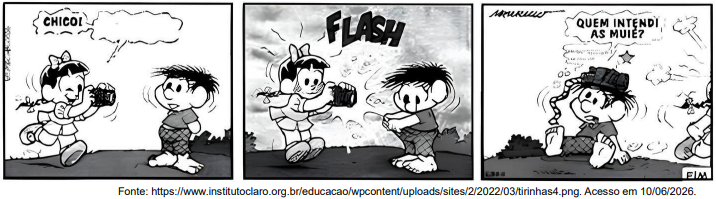
Na tirinha, após ser chamado por Rosinha, Chico Bento direciona o olhar para a câmera. Em seguida, um enunciado não verbalizado é sugerido pelo contexto, e Chico passa a olhar para dentro do próprio calção. Considerando os mecanismos de produção de sentido, é correto afirmar que o humor decorre principalmente:
Observe a imagem a seguir para responder à questão.

( ) Estão presentes em toda realização comunicativa humana. ( ) Entende-se como “estilo” as escolhas linguísticas que falantes fazem para dizer o que desejam dizer, como escolhas lexicais ou de estrutura frasal. ( ) Não são determinados pelas esferas discursivas, pois as escolhas não vêm da necessidade de adaptação dos falantes/escritores.
Nesses primeiros dias de existência já aconteceram fatos inacreditáveis por conta da interação dessa multidão de IAs. Chame-os de “comportamentos emergentes”. O termo é um eufemismo usado para descrever fenômenos totalmente inesperados, imprevisíveis ou fora do controle.
Analise as asserções que seguem acerca dos elementos de textualidade.
I- Enquanto a coesão é considerada um critério cotextual, a situacionalidade é considerada um critério contextual.
II- Acoesão é critério determinante para que um aglomerado de palavras seja considerado um texto.
III- A coesão não é critério necessário e nem suficiente para a textualidade, ou seja, a sua presença não garante a textualidade e a sua ausência não a impede.
IV- Os critérios de textualidade incluem a aceitabilidade, a metatextualidade e a intertextualidade.
É CORRETO o que se afirma apenas em:
Assinale a alternativa correta.
A devolução impossível: a epopeia do “só mais um procedimento”
Eu entrei na loja com uma sacola e um sonho pequeno: devolver um produto. Nem queria briga, nem queria drama. Queria paz, estorno e vida seguindo. O produto, um fone “premium”, tinha decidido morrer no terceiro dia. Não foi uma morte trágica. Foi uma morte burocrática. Ele simplesmente parou, como quem bate ponto e some.
Na minha cabeça, a lógica era infantil e perfeita: comprei, não funcionou, devolvo. Na vida real, a lógica vem com rodapé.
A atendente sorriu com a energia de quem já recebeu cem “casos simples” antes do almoço.
— Boa tarde. Em que posso ajudar?
— Quero devolver. Está com defeito.
Ela pegou o fone como se fosse uma prova em tribunal e, sem olhar para mim, perguntou:
— Tem nota?
A nota, claro. O documento sagrado. Eu tirei do bolso com a reverência de quem apresenta identidade.
Ela leu, digitou, clicou e disse a frase que inaugura toda epopeia:
— Então... pela nossa política, a troca é com a assistência.
Eu ouvi “nossa política” e senti que havia entrado numa constituição paralela, com artigos invisíveis e sanções emocionais.
— Mas eu quero devolver.
— Devolver é só em até sete dias e desde que esteja sem uso.
— Eu usei três dias. Para descobrir que não funciona. Ela sorriu de novo. O sorriso tinha a delicadeza de um carimbo.
— Entendo. Mas o sistema entende diferente.
Quando alguém diz que o sistema entende, você percebe que está discutindo com uma entidade abstrata. E entidades abstratas não têm culpa, não têm rosto e não erram. No máximo, “apresentam instabilidade”.
Eu tentei ser razoável. Fiz a pergunta que sempre parece inocente até virar armadilha:
— E qual é o procedimento?
Ela apontou para um papel. O papel tinha um QR code e uma promessa: “Rápido e fácil”.
— Você abre um chamado.
— Eu abro agora?
— Você abre pelo site.
— E depois?
— Depois aguarda.
— Aguarda quanto?
Ela respirou como quem consulta uma norma não escrita.
— Até quinze dias úteis.
Quinze dias úteis. Tempo suficiente para o fone ressuscitar por remorso ou para eu me acostumar ao silêncio.
Eu tentei outra rota.
— Não dá para resolver aqui?
— Só com laudo.
Laudo. A palavra “laudo” é mágica: ela transforma um fone em paciente e eu em parte interessada. Em dois segundos, eu não era mais cliente. Eu era “demandante”.
— E se o laudo disser que é defeito?
— Se for defeito, a assistência avalia.
— E se não for defeito?
— Se não for defeito, pode haver cobrança.
Cobrança. Outra palavra mágica. Ela faz o problema parecer culpa sua, mesmo quando o fone morreu sozinho, quietinho, sem plateia.
Eu senti vontade de dizer “isso é um absurdo”. Mas percebi que o absurdo não funciona contra um procedimento. O procedimento sempre ganha por cansaço. Ele não precisa estar certo. Ele só precisa continuar existindo.
A atendente, vendo minha cara, tentou uma gentileza:
— Posso ajudar você a abrir o chamado no seu celular.
Eu abri o site. Ele pediu login. Eu não lembrava. Pediu e-mail. Pediu senha. Pediu confirmar no e-mail. O e-mail demorou. O Wi-Fi da loja era filosófico: existia, mas questionava a própria existência.
Quando finalmente consegui, o formulário perguntou:
“Descreva o defeito em até 200 caracteres.” Eu pensei em escrever: “O defeito é acreditar em slogans.” Mas escrevi algo técnico, porque a vida exige seriedade em momentos ridículos.
Enviei.
A atendente olhou e disse:
— Pronto. Agora é só aguardar.
— E o que eu faço com o fone?
— Você guarda. Não pode usar.
Eu guardei o fone na sacola e tive uma iluminação amarga: a devolução impossível não é um evento. É um método. Uma forma elegante de adiar o óbvio até ele virar desistência.
Saí da loja com um número de protocolo e uma sensação estranha. Eu não tinha resolvido nada, mas tinha participado de um ritual. E, no mundo moderno, às vezes é isso que chamam de atendimento: você não sai com solução. Você sai com processo.
Fonte: Banca Examinadora
Texto 01 para a questão:
"O mundo é formado por um conjunto de lugares e de redes. O que é rede para uns é lugar para outros. O que é lugar para uns é rede para outros. Mas o que é lugar para todos é o espaço da vida, o espaço do cotidiano, o espaço da reprodução da vida. A globalização atual, no entanto, é perversa, porque ela se funda na tirania do dinheiro e na tirania da informação. Ela é uma globalização como fábula, pois nos faz crer em um mundo que não existe, e como perversidade, pois o mundo que ela constrói é o mundo da desigualdade, da pobreza, da fome, do desemprego, da violência."
Fonte: SANTOS, Milton. Por uma outra globalização: do pensamento único à consciência universal. 4. ed. Rio de Janeiro: Record, 2000.
“A matéria do poema é a língua, e a poesia lida com a língua com grande liberdade. Mas qualquer um que já se pôs a escrever sabe que a língua não se dobra facilmente, que não somos só nós que fazemos a língua dizer, ela também nos força a dizer. Roland Barthes cita o linguista Roman Jakobson para dizer que um idioma se define menos pelo que ele permite dizer, do que pelo que ele obriga a dizer.”
(Disponível em: https://www.em.com.br/app/noticia/pensar/2021/06/25/intema_pensar.1280263/ana-martins-marques-poema-tem-a-ver-com-o-atrito-entre-as-palavras.shtml - Acesso em 28 fev. 2026.)
Sobre o processo argumentativo do trecho citado, é correto afirmar que:
Leia o texto III e responda à questão.
Texto III
Mensagem de primavera
De cima desta janela da rua República do Peru, a observadora de tardes e manhãs reparou que a primavera não era uma ficção do calendário deste nosso tempo sem tempo, estagnado e apenas travestido em estações pelos figurinos. As amendoeiras de minha rua mostraram o inverno ainda mesmo quando o sol rompia por Copacabana e banhistas sem conta atulhavam a praia.
Envelheceram amarelentas, tornaram-se quase esqueléticas e negras. E, agora, a chuva maciça que cai, enquanto escrevo, mostra uma festa de folhas novas, vivas, bulindo sob a porção de água e brilhando acima dos guarda-chuvas e sombrinhas. A natureza de nossa rua fez a primavera em que tantas pessoas não acreditam, neste Rio de verde cansativo. Se a Primavera habita as minhas árvores tão pensadas, da rua República do Peru, por onde andará ela no coração das mulheres?
Creio já ter descoberto. Vi, justamente agora, passar uma mocinha límpida e lavada de gotas de chuva, que abria sorriso muito lento e doce. Ela acabava - estava claro - de ver o namorado e atravessava a rua com um clarão de quente alegria. Mais além, um pouco lerda, a mulher grávida encobre a face pelas folhas da amendoeira copada. Só seu corpo se desenha numa curva farta, desvendando difícil os pés gordinhos. A mulher carrega pela rua alguém tão importante quanto esta estação despercebida - a primavera que só alguns pressentem.
Mais adiante, a jovem que voltou do almoço retoma o lugar no balcão e, antes de entrar na loja, eleva a mãozinha ajeitando o cabelo umedecido, como um pássaro esticando uma asa. Que tem esta moça no gesto tão gentil a oferecer de primavera? Visivelmente, ela está enfrentando o seu dia com uma disposição amanhecente: ela tem planos, a mocinha.
É a pausa antes do fim do ano, a pausa da primavera. Muitas coisas vão acontecer na vida das criaturas. As mulheres sabem que há mudanças próximas em suas existências. Umas casarão, outras enfrentarão um trabalho novo com disposição nova; mãos ágeis terão no colo pequenos pedaços que significarão a cobertura de novas vidas. Como se as mulheres também criassem folhas e que elas, só elas, fossem parte desta primavera recusada de todos nós.
A minha mensagem vai para o íntimo das mulheres; para o sorriso da moça que viu o namorado, o caminhar da mulher que espera o filho, o gesto da criatura que levanta o rosto para um outro dia, numa outra primavera que começa. Eu estou com elas. Estou com o novo dia, com as folhas novas, com os seres amanhecentes e os abençoo em comunhão de fé.
(Seleta de Dinah Silveira de Queiroz. Apresentação e notas de Bella Josef. Rio de Janeiro, José Olympio, INL, 1974, pp. 25-26.)
Relacione os conceitos apresentados na Coluna 1 às definições da Coluna 2.
COLUNA 1 1.Dialogismo 2.Polifonia 3.Discurso 4.Enunciado 5.Enunciação
COLUNA 2 (__)Processo de produção da linguagem vinculado às condições concretas em que ocorre a interação verbal.
(__)Materialização linguística produzida em situação comunicativa específica e marcada pela relação entre interlocutores.
(__)Relação de interação entre diferentes vozes sociais presentes na construção dos sentidos.
(__)Construção discursiva posicionamentos históricos, presentes na linguagem. vinculada aos sociais e ideológicos.
(__)Convivência de múltiplas vozes e perspectivas discursivas em uma mesma construção textual.
Assinale a alternativa correta, “de cima para baixo”.
Assinale a alternativa correta quanto aos tipos de discurso.
De acordo com as concepções de língua e linguagem conforme os estudos de Bakhtin, assinale a alternativa correta.
Assinale a alternativa que preenche, correta e respectivamente as lacunas do trecho acima.

 Conheça nossos planos