Questões de Concurso
Sobre vocabulário | vocabulary em inglês
Foram encontradas 3.149 questões


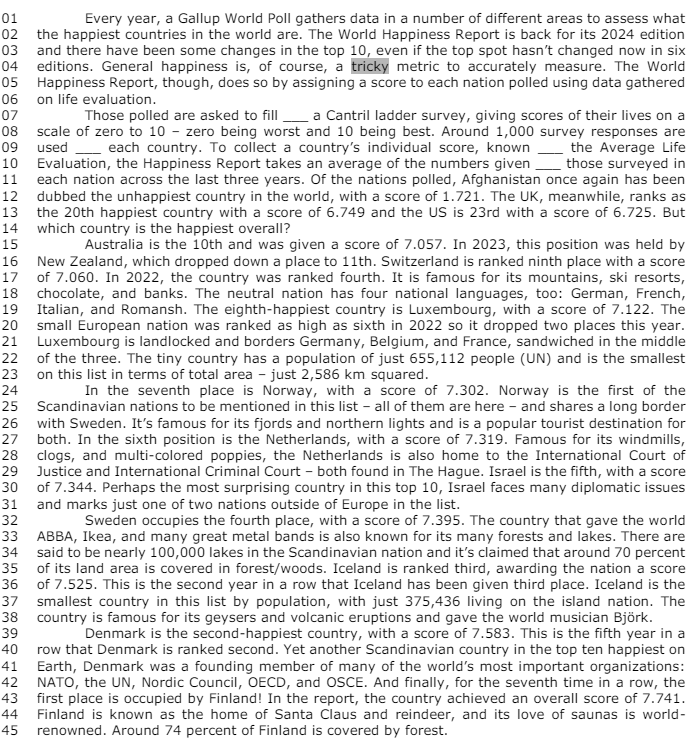
About cognate words and false cognates, as well as pedagogic trends, judge the item that follow.
The words experiences and report are two examples of
cognates in English and Portuguese.
Internet:<www.learnenglishteens.britishcouncil.org>
According to the text and general English knowledge answer the item.
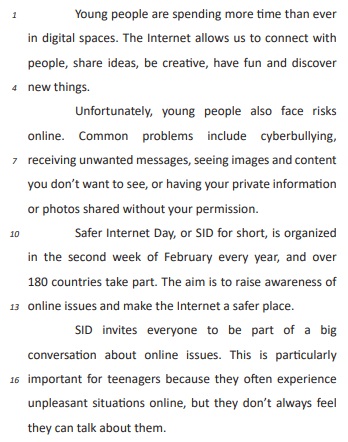
The period “The aim is to raise awareness of online
issues and make the Internet a safer place” (lines 12
and 13) can be correctly rewritten as The goal is to
raise consciousness of online problems and make
internet a safer place.
Read Text I and answer the fourteen questions that follow it
Text I The “literacy turn” in education: reexamining
what it means to be literate
In response to the phenomena of mass migration and the emergence of digital communications media that defined the last decade of the 20th century, the New London Group (NLG) called for a broader view of literacy and literacy teaching in its 1996 manifesto, A Pedagogy of Multiliteracies: Designing Social Futures. The group argued that literacy pedagogy in education must (1) reflect the increasing cultural and linguistic diversity of the contemporary globalized world, and (2) account for the new kinds of texts and textual engagement that have emerged in the wake of new information and multimedia technologies. In order to better capture the plurality of discourses, languages, and media, they proposed the term ‘multiliteracies’.
Within the NLG’s pedagogy of multiliteracies, language and
other modes of communication are viewed as dynamic resources
for meaning making that undergo constant changes in the
dynamics of language use as learners attempt to achieve their
own purposes. Within this broader view of literacy and literacy
teaching, learners are no longer “users as decoders of language”
but rather “designers of meaning.” Meaning is not viewed as
something that resides in texts; rather, deriving meaning is
considered an active and dynamic process in which learners
combine and creatively apply both linguistic and other semiotic
resources (e.g., visual, gesture, sound, etc.) with an awareness of
“the sets of conventions connected with semiotic activity [...] in a
given social space” (NLG, 1996, p. 74).
Grounded within the view that learning develops in social,
cultural, and material contexts as a result of collaborative
interactions, NLG argued that instantiating literacy-based
teaching in classrooms calls on the complex integration and
interaction of four pedagogical components that are neither
hierarchical nor linear and can at times overlap: situated practice,
overt instruction, critical framing, and transformed practice. […]
Although the NLG’s pedagogy of multiliteracies was
conceived as a “statement of general principle” (1996, p. 89) for
schools, the group’s call for educators to recognize the diversity
and social situatedness of literacy has had a lasting impact on
foreign language (FL) teaching and learning. The reception of the
group’s work along with that of other scholars from critical
pedagogy appeared at a time when the field was becoming less
solidly anchored in theories of L2 acquisition and more interested
in the social practice of FL education itself. In the section that
follows, we describe the current state of FL literacy studies as it
has developed in recent years, before finally turning to some very
recent emerging trends that we are likely to see develop going
forward.
(Adapted from: https://www.colorado.edu/center/altec/sites/default/files/ attachedfiles/moving_toward_multiliteracies_in_foreign_language_teaching.pdf)
Text CB1A7
Whenever a global economic transformation takes place, a single city usually drives it forward. Ghent, in modern-day Belgium, was at the core of the burgeoning global wool trade in the 13th century. The first initial public offering took place in Amsterdam in 1602. London was the financial centre of the first wave of globalisation during the 19th century. Today the city is San Francisco.
California’s commercial capital has no serious rival in generative artificial intelligence (AI), a breakthrough technology that has caused a bull market in American stocks and which, many economists hope, will power a global productivity surge. Almost all big AI start-up companies are based in the Bay Area, which comprises the city of San Francisco and Silicon Valley (largely based in Santa Clara county, to the south). OpenAI is there, of course; so are Anthropic, Databricks and Scale AI. Tech giants, including Meta and Microsoft, are also spending big on AI in San Francisco. According to Brookings Metro, a think tank, last year San Francisco accounted for close to a tenth of generative AI job postings in America, more than any other city of the country. New York, with four times as many residents, was second.
Internet: <www.economist.com> (adapted).
I have 12 years old. - I goed to school yesterday. - I am with a headache. - She work in the morning.
Corrected – worked – seemed – studied
Sheep –ship – Cheap – Chip
English teachers often ask students to look at a text to find out things. With this purpose, Teacher Marianne Sousa developed the following task to her 8th grade students:

Considerando a tarefa da Professora Marianne, qual foi o aspecto enfocado por ela no texto? A
Text 1 for question

Disponível em: https://www.mirror.co.uk/news/real-life-stories/a-cup-of-tea-solves-everything-505302. Acesso em jan. 2024. Texto adaptado.
Text 1 for question
Disponível em: https://www.mirror.co.uk/news/real-life-stories/a-cup-of-tea-solves-everything-505302. Acesso em jan. 2024. Texto adaptado.
Using your phone while on the toilet poses significant health risks, as warned by an expert, Dr. Sethi. Despite being a common habit, mindlessly scrolling or using your phone in the bathroom can lead to severe consequences. Dr. Sethi, a Harvard-trained stomach doctor, highlights that this practice, particularly during bowel movements, causes extended sitting that strains the rectum and anus, potentially resulting in hemorrhoids, anal fissures, and rectal prolapse.
Furthermore, using phones in the bathroom makes them a breeding ground for bacteria, surpassing the hygiene levels of a public toilet seat. Dr. Sethi emphasizes the importance of avoiding phone usage while on the toilet or, if unavoidable, suggests disinfecting the phone afterward. Research spanning over a decade has consistently shown that phones harbor a significant amount of germs, including fecal matter.
Despite these health warnings, over 65% of adults take their phones into the bathroom, with Spain having the highest usage rates (nearly 80%) and Germany the lowest (just under 55%). Interestingly, younger age groups, particularly those aged 26-41 and 18-25, are most likely to engage in this unhygienic behavior. Apart from health concerns, there’s the practical risk of dropping the phone into the toilet, with a fifth of respondents in the United States admitting to this mishap.
Internet: <www.mirror.co.uk> (adapted).
Based on the previous text, judge the following item.
The expression “Apart from” (last sentence of the text) can
be correctly replaced by Except for, without changing the
original meaning.
About the ideas and vocabulary of text presented above, judge the following item.
ChatGPT is a language AI model that solves math problems
reliably.

 Conheça nossos planos