Questões de Concurso
Sobre vocabulário | vocabulary em inglês
Foram encontradas 3.149 questões


Text I
The BNCC and Twenty-First Century Skills
The most ambitious feature of the BNCC, which only appeared in the document’s third version, was to establish ten core competencies that all students should develop throughout basic education, starting in early childhood. These competencies include lifelong learning, critical thinking, aesthetic sensibilities, communication skills, digital literacy, entrepreneurship, self-care, empathy, citizenship and ethics. The core competencies broaden the goals of basic education well-beyond academic skills to twenty-first century skills widely regarded as essential to preparing the next generations for the challenges of the 4th industrial revolution.
As ambitious as it was, the BNCC was criticized for the lack of explicit links between the ten core competencies and the subject specific competencies and skills, leaving cities and states with the responsibility of making these links themselves. In addition to this, the core competencies are not generally integrated into teacher training programs and are often de-prioritized for the more basic literacy and numeracy needs. In this context, the Ministry of Education and its partners in the third sector have developed orientations, produced videos and online courses aimed at filling this gap, and helped cities and states integrate the ten core competencies in their curricula.
[…]
Ensuring all Brazilian students master the ten core competencies laid out by the BNCC by the end of high school is a long-term, extremely ambitious goal. Before we can set a timeframe for when we will be able to achieve this feat, we need to know where we stand. Due to the core competencies’ complexity, each involves several skills, attitudes and sometimes values, it is unclear whether we will be capable of measuring all ten of them and by when. Until then we are in the company of the OECD, which is already tackling this challenge and will likely pave the way for Brazil in this respect
Note: BNCC: Base Nacional Comum Curricular;
OECD: The Organization for Economic Cooperation and Development.
Adapted from https://link.springer.com/chapter/10.1007/978-3-030-41882-3_2
Text I
The BNCC and Twenty-First Century Skills
The most ambitious feature of the BNCC, which only appeared in the document’s third version, was to establish ten core competencies that all students should develop throughout basic education, starting in early childhood. These competencies include lifelong learning, critical thinking, aesthetic sensibilities, communication skills, digital literacy, entrepreneurship, self-care, empathy, citizenship and ethics. The core competencies broaden the goals of basic education well-beyond academic skills to twenty-first century skills widely regarded as essential to preparing the next generations for the challenges of the 4th industrial revolution.
As ambitious as it was, the BNCC was criticized for the lack of explicit links between the ten core competencies and the subject specific competencies and skills, leaving cities and states with the responsibility of making these links themselves. In addition to this, the core competencies are not generally integrated into teacher training programs and are often de-prioritized for the more basic literacy and numeracy needs. In this context, the Ministry of Education and its partners in the third sector have developed orientations, produced videos and online courses aimed at filling this gap, and helped cities and states integrate the ten core competencies in their curricula.
[…]
Ensuring all Brazilian students master the ten core competencies laid out by the BNCC by the end of high school is a long-term, extremely ambitious goal. Before we can set a timeframe for when we will be able to achieve this feat, we need to know where we stand. Due to the core competencies’ complexity, each involves several skills, attitudes and sometimes values, it is unclear whether we will be capable of measuring all ten of them and by when. Until then we are in the company of the OECD, which is already tackling this challenge and will likely pave the way for Brazil in this respect
Note: BNCC: Base Nacional Comum Curricular;
OECD: The Organization for Economic Cooperation and Development.
Adapted from https://link.springer.com/chapter/10.1007/978-3-030-41882-3_2
Finding and identifying problems helps students practice detecting problems. Problem identification is found to be more important for reviewer learning, perhaps because reviewers are involved in more highly cognitive demanding activities when identifying problems. Interestingly, it is easier to see problems in documents/objects produced by ____________ than in ____________ documents because learners often “see” what they meant to produce and not what they actually produced. Thus, ____________ may be an easier context in which to practice skills related to repairing errors because errors are more easily detected
SCHUNN, Christian D. The Learning Science of Multi - Peer Feedback for EFL Students. Disponível em: https://www.lrdc.pitt.edu/schunn/papers/The%20Learning%20Sci_for_EFL_Student s_Schunn_Wu_2019.pdf. Acesso em: 12 jul. 2024. Adaptado.
Em sequência, as palavras que completam corretamente essas lacunas são:
How do most teachers use micro-dictations?
However ‘small’ they are, micro-dictations have great value! They can help students notice connected speech, which is what usually blocks their understanding in a listening lesson. The teacher reads the sentences or plays the recording. They repeat each sentence a few times. Example: He must have gone out.
Students listen and write what they hear.
The teacher now writes the sentence on the whiteboard and asks students to compare it to theirs.
Finally, the teacher asks: which part was difficult to understand and why?
TSATERI, Rachel. World of better learning. Disponível em: https://www.cambridge.org/elt/blog/2023/06/11/using-micro-dictations-to-helpstudents-notice-connected-speech/. Acesso em: 12 jul. 2024. Adaptado.
O texto acima discorre sobre como os professores podem usar micro-dictations. Qual das estratégias abaixo corresponde a uma técnica de micro-dictation?
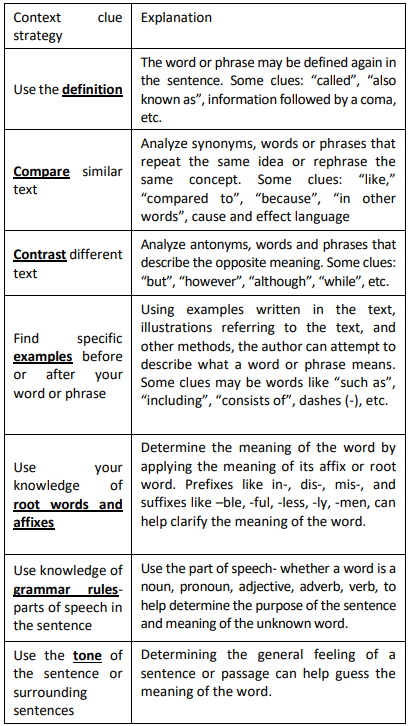
CONTEXT CLUES TO DEFINE NEW WORDS
Model teaching. Reading Comprehension Strategy Tools. Model teaching, 2016. Disponível em: https://www.modelteaching.com/education-articles/reading-ela-instruction/readingcomprehension-strategy-tools. Acesso em: 12 jul. 2024. Adaptado.
Em uma atividade de leitura do texto “Bigger Isn’t Always Better: Narrow Traffic Lanes Make Cities Safer”, os alunos tiveram dificuldade de interpretação do último período por não saberem o sentido do termo ‘narrower’. Sobre isso, analise as estratégias:
I. Procurar a definição do termo em um dicionário inglêsportuguês.
II. Procurar por dicas na imagem que acompanha o artigo.
III. Identificar o sentido dos termos ‘bigger’ e ‘wider’.
IV. Identificar a classe gramatical do termo e o sentido do sufixo -er.
Com base na tabela fornecida, para que os alunos possam entender o sentido do termo (‘narrower’) pelo contexto, o professor deve orientar que eles adotem as seguintes estratégias:
What does a CCQ mean?
A concept checking question is a question designed to help the teacher check students’ understanding of a language item (grammar structure, vocabulary, fixed expression). “Do you understand?”, “Is that clear?”, “We all know that, right?” or “OK?” should be absolute taboos.
When to ask CCQs?
Every time you explain new material or need to check whether students know what you are talking about. CCQs are particularly useful after guided practice and at the end of the lesson as a review.
How to ask CCQs?
There are some simple rules that can help you create good CCQs and use them effectively:
1. CCQs should be easy to understand, use simple language in CCQs.
2. Don’t use the target language in CCQs;
E.g. I’ll meet her tomorrow.
Bad CCQ: Will I meet her next week?
3. Don’t use new vocabulary in CCQs;
4. Plan CCQs in advance;
5. Ask at least 2 CCQs to cover all of the important aspects of the target language;
6. CCQs should check the meaning of the target language, not of the situation.
E.g. She’s been in bed all day.
Bad CCQ: Is she sick?
7. Some of the most efficient CCQs are yes/no questions along with either/or questions; simple Wh-questions and true/false statements.
My TEFL. Concept Checking Questions (CCQs). My Tefl, 2024. Disponível em: https://mytefl.com/wp-content/uploads/2019/09/CCQs.pdf. Acesso em: 12 jul. 2024. Adaptado.
Considere que você precisa ensinar o sentido do termo em destaque na frase “His pink car stands out on the road”. A partir da leitura sobre as CCQ’s, qual das alternativas abaixo apresenta uma CCQ efetiva para checar o entendimento do aluno sobre o sentido do termo ‘stand out’?
Atenção! Leia o texto a seguir para responder à próxima questão.
Ain't It Fun
I don't mind
Letting you down easy, but just give it time
If it don't hurt now then just wait, just wait a while
You're not the big fish in the pond no more
You are what they're feeding on
So what are you gonna do
When the world don't orbit around you?
So what are you gonna do
When the world don't orbit around you?
Ain't it fun?
Living in the real world
Ain't it good?
Being all alone
Where you're from
You might be the one who's running things
Where you can ring anybody's bell and get what you want
See it's easy to ignore trouble
When you're living in a bubble
(…)
WILLIAMS, Hayley; YORK, Taylor. Ain’t it fun. Disponível em: https://www.musixmatch.com/lyrics/Paramore/Ain-t-It-Fun. Acesso em: 12 jul. 2024. Adaptado.
So what are you ____________ do
____________ fun?
You might be the one who ____________ running things.
See it ____________ easy to ignore trouble.
I. I don’t eat meet, I’m a vegetarian.
II. I like to hang outch with my friends on the weekends.
III. I always listen to music while I take a shower. IV. I have brekfast in the morning with my parents.
As frases que precisam ser corrigidas por apresentarem termos grafados incorretamente são:
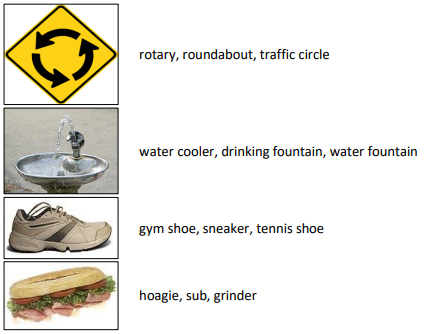


Analyze the following statement about cognates and false cognates.
The English word "fabric" is a cognate of the
Portuguese word "fábrica," both referring to a place
where cloth or textile materials are produced.
Analyze the following statement about cognates and false cognates.
The English word "eventually" and the Portuguese
word "eventualmente" are false cognates, as "eventually"
indicates something that will happen at some point in the
future, while "eventualmente" means something that
happens occasionally or at irregular intervals.
Analyze the following statement about cognates and false cognates.
The English word "apparent" and the Portuguese
word "aparente" are false cognates, as "apparent" in
English means something that seems to be true or real
but may not be, while "aparente" in Portuguese means
something that is clearly visible or obvious.

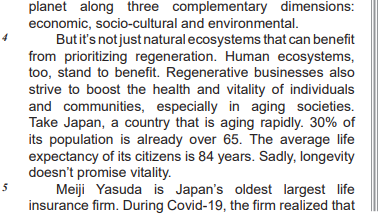

Available at: https://www.weforum.org/agenda/2024/06/businesses
-are-moving-beyond-sustainability-welcome-to-the-age-ofregeneration/. Retrieved on: Jun 14, 2024. Adapted.
Read the text II to answer the question.
TEXT II
JOHN LAURENS:
The ten-dollar Founding Father without a father
Got a lot farther by workin' a lot harder
By bein' a lot smarter
By bein' a self-starter
By fourteen, they placed him in charge of a trading charter
THOMAS JEFFERSON:
And every day while slaves were being slaughtered and carted
Away across the waves, he struggled and kept his guard up
Inside, he was longing for something to be a part of
The brother was ready to beg, steal, borrow, or barter
[…]
AARON BURR:
Well, the word got around, they said, "This kid is insane, man!"
Took up a collection just to send him to the mainland
"Get your education, don't forget from whence you came, and
The world's gonna know your name! What's your name, man?"
Excerpt from the musical Hamilton, with lyrics by Lin-Manuel Miranda.

 Conheça nossos planos