Questões de Concurso Sobre vocabulário | vocabulary em inglês

Foram encontradas 3.111 questões

Q3325795 Inglês

Fog harversting could provide water for arid cities


By Victoria Gill


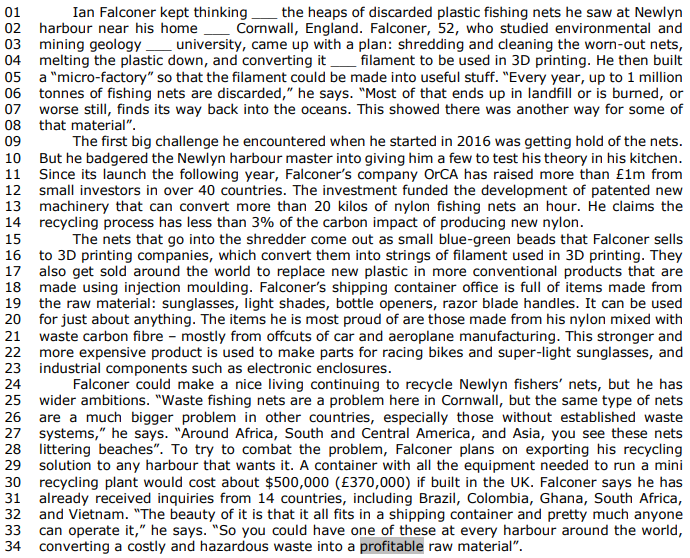
Q41_54.png (684×584)Q41_54__.png (685×162)

Which of the sentences below presents the word “drinking” used in the same way as the highlighted word in line 07? 
Alternativas
Q3321446 Inglês
Rain Is Coming to Burning Los Angeles and Will Bring Its Own Risks


    Rain is forecast to begin as soon as Saturday afternoon and to continue as late as Monday evening, says meteorologist Kristan Lund of the National Weather Service’s Los Angeles office. The area desperately needs the precipitation, but experts are warily monitoring the situation because rain poses its own risks in recently burned areas— most notably the potential occurrence of mudslides and similar hazards. “Rain is good because we’ve been so dry,” Lund says. “However, if we get heavier rain rates or we get the thunderstorms, it’s actually a lot more dangerous because you can get debris flows.”

    Fires do a couple of different things to the landscape that can increase the risk of burned material, soil and detritus hurtling out of control. When fires burn hot or long enough, they leave an invisible layer of waxy material just under the surface of the ground. This develops from decomposing leaves and other organic material, which contain naturally hydrophobic or water-repellent compounds. Fire can vaporize this litter, and the resulting gas seeps into the upper soil—where it quickly cools and condenses, forming the slippery layer.

    When rain falls on ground that has been affected by this phenomenon, it can’t sink beyond the hydrophobic layer— so the water flows away, often hauling debris with it. “All of the trees, branches, everything that’s been burned—unfortunately, if it rains, that stuff just floats,” Lund says. “It’s really concerning.” Even a fire that isn’t severe enough to create a hydrophobic layer can still cause debris flows, says Danielle Touma, a climate scientist at the University of Texas at Austin. Under normal conditions, trees and other plants usually trap some rain above the surface, slowing the water’s downward journey. But on freshly burned land there’s much less greenery to interfere; all the rain immediately hits the ground. [...]

    Fortunately, the rain should also help firefighters tame the blazes that remain active. The largest, the Palisades Fire, is currently 77 percent contained. The second largest, the Eaton Fire, is 95 percent contained. The Hughes Fire is third largest and only 56 percent contained. A fire can be fully contained but still burning. The containment percentage refers to the amount of the perimeter that has barriers that firefighters expect will prevent further spread.


Scientific American. January 27th, 2025. Adaptado. 
O termo "litter”, no parágrafo 2, refere-se
Alternativas
Q3309389 Inglês
Text CB1A2


    Spending time in space and having an unrivalled view of planet Earth is an experience many of us dream of, but the human body evolved to function in the gravity of Earth. So fully recovering from spending time in the weightlessness of space can take years.  

    “It’s a fact that space is by far the most extreme environment that humans have ever encountered and we’ve just not evolved to handle the extreme conditions,” Professor Damian Bailey, who studies human physiology, says. To begin with, the heart and blood vessels have an easier time as they no longer have to pump blood against gravity — and they start to weaken. And the bones become weaker and more brittle. There should be a balance between the cells breaking down old bone and those making new, but that balance is disrupted without the feedback and resistance of working against gravity. “Every month, about 1% of bones and muscles are going to wither away — it’s accelerated ageing,” Professor Bailey says. 

    Microgravity also distorts the vestibular system, which is how you balance and sense which way is up. In space, there is no up, down or sideways. It can be disorientating when you go up — and again when you return to Earth.


James Gallagher. What nine months in space does to the human body.
Internet: <bbc.com> (adapted). 
About the vocabulary used in the second paragraph of text CB1A2, it is correct to affirm that “brittle” (third sentence) and ‘wither away’ (last sentence) 
Alternativas
Q3309006 Inglês
Text 1A4-I


   By the middle years of the 20th century, the optimistic story of limitless progress through scientific and technological advance came to be rivalled and sometimes overshadowed by a much more pessimistic, even apocalyptic vision of the trajectory of the modern project. It began to seem increasingly possible that technology would come to master its creators and carry humanity toward unforeseen and possibly catastrophic outcomes.

   Premonitions of technological wizardry leading to disasters are extremely old, dating back at least to the myth of Icarus, who is said to have fatally fallen into the sea after flying too close to the sun on wings his father, Daedalus, constructed. As the Industrial Revolution gathered steam, dark anticipations became increasingly widespread, in works such as Mary Shelley’s Frankenstein; or, the Modern Prometheus and Karel Capek’s R.U.R. Perhaps technology, not man, was “in the saddle,” as Henry Adams worried. And perhaps machines, becoming ever more capable and interconnected, were the next step in the evolution of life, destined to dominate and eventually eliminate humanity, as Samuel Butler warned. The contours of the future, H. G. Wells announced in one of his famous lectures, “The Discovery of the Future,” were difficult to discern but would surely be unlike the past or the present, and definitely included disasters of new types and magnitudes.

   In the ghastly world wars, technological advances empowered barbarism on a new scale, destroying the credibility of the simple modernist faith that more potent tools are a straight path to human betterment. Rather, technological advance has produced a cornucopia of double-edged swords, with amplified possibilities for both progress and disaster. A growing herd of horsemen of the anthropogenic apocalypse have ominously appeared on the human horizon of possibility: nuclear weapons, genetic engineering, total surveillance despotism, runaway artificial intelligence, and rampant environmental decay.


Daniel Deudney. Dark Skies: Space Expansionism, Planetary Geopolitics, and the Ends of Humanity. New York: Oxford University Press, 2020 (adapted).  
In the last paragraph of text 1A4-I, the 
Alternativas
Q3309005 Inglês
Text 1A4-I


   By the middle years of the 20th century, the optimistic story of limitless progress through scientific and technological advance came to be rivalled and sometimes overshadowed by a much more pessimistic, even apocalyptic vision of the trajectory of the modern project. It began to seem increasingly possible that technology would come to master its creators and carry humanity toward unforeseen and possibly catastrophic outcomes.

   Premonitions of technological wizardry leading to disasters are extremely old, dating back at least to the myth of Icarus, who is said to have fatally fallen into the sea after flying too close to the sun on wings his father, Daedalus, constructed. As the Industrial Revolution gathered steam, dark anticipations became increasingly widespread, in works such as Mary Shelley’s Frankenstein; or, the Modern Prometheus and Karel Capek’s R.U.R. Perhaps technology, not man, was “in the saddle,” as Henry Adams worried. And perhaps machines, becoming ever more capable and interconnected, were the next step in the evolution of life, destined to dominate and eventually eliminate humanity, as Samuel Butler warned. The contours of the future, H. G. Wells announced in one of his famous lectures, “The Discovery of the Future,” were difficult to discern but would surely be unlike the past or the present, and definitely included disasters of new types and magnitudes.

   In the ghastly world wars, technological advances empowered barbarism on a new scale, destroying the credibility of the simple modernist faith that more potent tools are a straight path to human betterment. Rather, technological advance has produced a cornucopia of double-edged swords, with amplified possibilities for both progress and disaster. A growing herd of horsemen of the anthropogenic apocalypse have ominously appeared on the human horizon of possibility: nuclear weapons, genetic engineering, total surveillance despotism, runaway artificial intelligence, and rampant environmental decay.


Daniel Deudney. Dark Skies: Space Expansionism, Planetary Geopolitics, and the Ends of Humanity. New York: Oxford University Press, 2020 (adapted).  
Considering the meaning of the expressions used in text 1A4-I, choose the correct option. 
Alternativas
Q3299083 Inglês
Texto para a questão

Rain Is Coming to Burning Los Angeles and Will Bring Its Own Risks

    Rain is forecast to begin as soon as Saturday afternoon and to continue as late as Monday evening, says meteorologist Kristan Lund of the National Weather Service’s Los Angeles office. The area desperately needs the precipitation, but experts are warily monitoring the situation because rain poses its own risks in recently burned areas— most notably the potential occurrence of mudslides and similar hazards. “Rain is good because we’ve been so dry,” Lund says. “However, if we get heavier rain rates or we get the thunderstorms, it’s actually a lot more dangerous because you can get debris flows.”
    Fires do a couple of different things to the landscape that can increase the risk of burned material, soil and detritus hurtling out of control. When fires burn hot or long enough, they leave an invisible layer of waxy material just under the surface of the ground. This develops from decomposing leaves and other organic material, which contain naturally hydrophobic or water-repellent compounds. Fire can vaporize this litter, and the resulting gas seeps into the upper soil—where it quickly cools and condenses, forming the slippery layer.
    When rain falls on ground that has been affected by this phenomenon, it can’t sink beyond the hydrophobic layer— so the water flows away, often hauling debris with it. “All of the trees, branches, everything that’s been burned—unfortunately, if it rains, that stuff just floats,” Lund says. “It’s really concerning.” Even a fire that isn’t severe enough to create a hydrophobic layer can still cause debris flows, says Danielle Touma, a climate scientist at the University of Texas at Austin. Under normal conditions, trees and other plants usually trap some rain above the surface, slowing the water’s downward journey. But on freshly burned land there’s much less greenery to interfere; all the rain immediately hits the ground. [...]
    Fortunately, the rain should also help firefighters tame the blazes that remain active. The largest, the Palisades Fire, is currently 77 percent contained. The second largest, the Eaton Fire, is 95 percent contained. The Hughes Fire is third largest and only 56 percent contained. A fire can be fully contained but still burning. The containment percentage refers to the amount of the perimeter that has barriers that firefighters expect will prevent further spread.

Scientific American. January 27th, 2025. Adaptado.
O termo "litter”, no parágrafo 2, refere-se
Alternativas
Q3289557 Inglês
Identify the pairing in which the term is correctly matched with its definition in a professional telecommunications setting.
Alternativas
Q3289538 Inglês


Image: NASA / JPL


   Look again at that dot. That's here. That's home. That's us. On it everyone you love, everyone you know, everyone you ever heard of, every human being who ever was, lived out their lives. The aggregate of our joy and suffering, thousands of confident religions, ideologies, and economic doctrines, every hunter and forager, every hero and coward, every creator and destroyer of civilization, every king and peasant, every young couple in love, every mother and father, hopeful child, inventor and explorer, every teacher of morals, every corrupt politician, every "superstar," every "supreme leader," every saint and sinner in the history of our species lived there – on a mote of dust suspended in a sunbeam.

   The Earth is a very small stage in a vast cosmic arena. Think of the rivers of blood spilled by all those generals and emperors so that, in glory and triumph, they could become the momentary masters of a fraction of a dot. Think of the endless cruelties visited by the inhabitants of one corner of this pixel on the scarcely distinguishable inhabitants of some other corner, how frequent their misunderstandings, how eager they are to kill one another, how fervent their hatreds.

   Our posturings, our imagined self-importance, the delusion that we have some privileged position in the Universe, are challenged by this point of pale light. Our planet is a lonely speck in the great enveloping cosmic dark. In our obscurity, in all this vastness, there is no hint that help will come from elsewhere to save us from ourselves.

   The Earth is the only world known so far to harbor life. There is nowhere else, at least in the near future, to which our species could migrate. Visit, yes. Settle, not yet. Like it or not, for the moment the Earth is where we make our stand.”


— Carl Sagan, Pale Blue Dot, 1994
In the sentence:
"Our planet is a lonely speck in the great enveloping cosmic dark."
What is the antonym of "dark"?
Alternativas
Q3286938 Inglês

Climate change poses significant challenges to cattle farming, a sector vital to global food security. Among the most pressing concerns is the increasing frequency and intensity of droughts. Reduced rainfall diminishes pasture quality and availability, limiting feed for livestock and increasing water scarcity. This can lead to decreased animal growth rates, reduced milk production, and increased mortality rates. Moreover, prolonged droughts can contribute to desertification, shrinking available grazing land and forcing farmers to adopt costly alternative feeding strategies.


        Beyond drought, other climate-related impacts include heat stress, which can significantly impact animal health and productivity. Rising temperatures can exacerbate heat stress, leading to decreased feed intake, reduced fertility, and increased mortality in livestock. Furthermore, extreme weather events, such as heavy rainfall and flooding, can cause infrastructure damage, contaminate water sources, and lead to the loss of livestock.


        The cattle farming sector itself contributes to climate change through greenhouse gas emissions, primarily methane produced during animal digestion and nitrous oxide from manure management. Deforestation for pasture expansion also releases significant amounts of carbon dioxide.


        To address these challenges, a multi-pronged approach is crucial.


        • Genetic selection: Breeding programs focused on developing drought-resistant livestock breeds are vital. and heat-tolerant

     • Sustainable feeding strategies: Implementing precision feeding techniques, improving feed efficiency, and exploring alternative drought-resistant forage livestock resilience. feed sources, varieties, such as can enhance

        • Integrated farming systems: Integrating crop and livestock production, such as through agroforestry systems, can improve soil health, enhance water retention, and reduce greenhouse gas emissions.

      • Technological innovations: Utilizing technologies such as precision livestock farming, remote sensing for pasture monitoring, and renewable energy sources can improve resource efficiency and redu


        Furthermore, strong policy support, including incentives for sustainable farming practices, investments in research and development, and improved access to climate information services, are essential for the long-term sustainability of the cattle farming sector.


        Addressing the challenges posed by climate change requires a collaborative effort involving farmers, researchers, policymakers, and consumers. By embracing innovative solutions, prioritizing sustainable practices, and fostering a collective understanding of the importance of climate-resilient livestock production, we can ensure a future when this vital sector continues to thrive while minimizing its environmental impact.


Internet:<conafer.org.br> (adapted).

Judge the following item based on the text above.


The word “Furthermore” (in the second paragraph) can be correctly replaced with the term Besides that without changing the meaning of the tex.  

Alternativas
Q3279102 Inglês
September 7, 1991
Dear friend,


       I do not like high school. The cafeteria is called the "Nutrition Center," which is strange. There is this one girl in my advanced English class named Susan. In middle school, Susan was very fun to be around. She liked movies, and her brother Frank made her tapes of this great music that she shared with us. But over the summer she had her braces taken off, and she got a little (1) taller and prettier and grew breasts. Now, she acts a lot dumber in the hallways, especially when boys are around. And I think it's sad because Susan doesn't look as happy. To tell you the truth, she doesn't like to admit she's in the advanced English class, and she doesn't like to say "hi" to me in the hall anymore.

      When Susan was at the guidance counselor meeting about Michael, she said that Michael once told her that she was the (2) prettiest girl in the whole world, braces and all. Then, he asked her to "go with him," which was a big deal at any school. They call it "going out" in high school. And they kissed and talked about movies, and she missed him terribly because he was her best friend.

      It's funny, too, because boys and girls normally weren't best friends around my school. But Michael and Susan were. Kind of like my Aunt Helen and me. I'm sorry. "My Aunt Helen and I." That's one thing I learned this week. That and more consistent punctuation. I keep quiet most of the time, and only one kid named Sean really seemed to notice me. He waited for me after gym class and said really immature things like how he was going to give me a "swirlie," which is where someone sticks your head in the toilet and flushes to make your hair swirl around. He seemed pretty unhappy as well, and I told him so. Then, he got mad and started hitting me, and I just did the things my brother taught me to do. My brother is a very good fighter.


Book: The Perks of Being a Wallflower. Stephen Chbosky.

What does the phrasal verb "brush up on" mean in the following sentence?


"Before the interview, I need to brush up on my Spanish so I

can speak fluently."


Alternativas
Q3279099 Inglês
September 7, 1991
Dear friend,


       I do not like high school. The cafeteria is called the "Nutrition Center," which is strange. There is this one girl in my advanced English class named Susan. In middle school, Susan was very fun to be around. She liked movies, and her brother Frank made her tapes of this great music that she shared with us. But over the summer she had her braces taken off, and she got a little (1) taller and prettier and grew breasts. Now, she acts a lot dumber in the hallways, especially when boys are around. And I think it's sad because Susan doesn't look as happy. To tell you the truth, she doesn't like to admit she's in the advanced English class, and she doesn't like to say "hi" to me in the hall anymore.

      When Susan was at the guidance counselor meeting about Michael, she said that Michael once told her that she was the (2) prettiest girl in the whole world, braces and all. Then, he asked her to "go with him," which was a big deal at any school. They call it "going out" in high school. And they kissed and talked about movies, and she missed him terribly because he was her best friend.

      It's funny, too, because boys and girls normally weren't best friends around my school. But Michael and Susan were. Kind of like my Aunt Helen and me. I'm sorry. "My Aunt Helen and I." That's one thing I learned this week. That and more consistent punctuation. I keep quiet most of the time, and only one kid named Sean really seemed to notice me. He waited for me after gym class and said really immature things like how he was going to give me a "swirlie," which is where someone sticks your head in the toilet and flushes to make your hair swirl around. He seemed pretty unhappy as well, and I told him so. Then, he got mad and started hitting me, and I just did the things my brother taught me to do. My brother is a very good fighter.


Book: The Perks of Being a Wallflower. Stephen Chbosky.
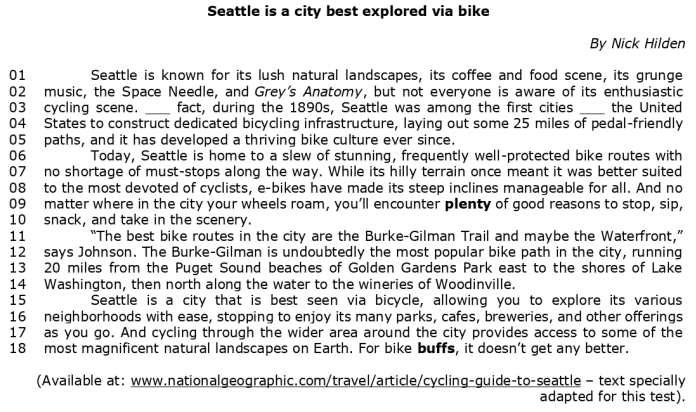
Check the item that correctly displays an antonym for the underlined word.
Alternativas
Q3278330 Inglês


From: https://schulzmuseum.org/wp-content/uploads/2020/11/1963-05-01_WEBscaled.jpg  

The verb “chase” (2nd panel) means
Alternativas
Q3276445 Inglês

TEXT 2


WHAT IS THE COMMUNICATIVE APPROACH?


In the Communicative Approach, real communication and interaction is not only the objective in learning, but also the means through which it takes place. This approach started in the 70s and became prominent as it proposed an alternative to the then ubiquitous systems-oriented approaches, such as the Audiolingual method. That means that, instead of focusing on the acquisition of grammar and vocabulary (grammatical/linguistic competence), the Communicative Approach aimed at developing the learner’s competence to communicate in the target language (communicative competence), with an enhanced focus on real-life situations.


Excerpt extracted and adapted from: https://www.whatiselt.com/single-post/2018/08/23/what-is-thecommunicative-approach

In the excerpt extracted from text 2, which says that the Communicative Approach aimed at developing the learner’s competence to communicate in the target language”, the underlined word (competence) could be INCORRECTLY replaced by:
Alternativas
Q3259817 Inglês
Read the following paragraph about ESP.

“ESP is teaching with the aim of assisting learners’ study or research in the particular variety of English they may need. It has emerged from over 50 years of research and classroom practice and has become a major influence in university and workplace classrooms in many parts of the world. The basic idea behind ESP is that learners’ needs differ enormously according to future academic or occupational goals, and this is why ESP has become so influential in universities around the world in recent years.”
Adapted from: https://doi.org/10.18485/esptoday.2022.10.2.1

ESP stands for: 
Alternativas
Q3259800 Inglês

Read the text below and answer the questions that follow.


Text


Should schools just say no to pupils using phones?


14th July 2024

Natalie Grice – BBC News


“I wouldn’t say it’s a good thing for a child never to have a smartphone. I think it’s part of a balanced life. You’ve got to live in your own time.”


These are not the words you might expect to hear from a teacher at a school that has never in its history allowed pupils under sixth form age to use a mobile phone on the premises.


But Sarah Owen, deputy head at Stanwell School in Penarth, Vale of Glamorgan, was simply expressing a personal opinion, rather than the school’s view about a young person’s wider life.


It is clear that she and the school have very firm opinions on what is best for children while they are on school grounds.


For Stanwell pupils in years 7 to 11, that has always meant no phones. Not in lessons, not in the corridor, not at breaktimes.


It is such a long-established rule that it presumably comes as no surprise to pupils and parents when they join the school, which is starting to seem as if it may have been ahead of a growing curve.


In the past few years, a number of schools across Wales and further afield have introduced total bans on mobiles. While Stanwell only asks pupils to keep phones switched off in their bags, others require the devices to be handed in at the start of the day.


Llanidloes High School in Powys is one which has implemented this policy in the past few years and Ysgol Penrhyn Dewi in St Davids, Pembrokeshire, followed suit at the start of this year.


Sarah Owen has been at Stanwell School since 2000 and says that there has always been a no phone policy in the school. For Sarah, it is a question not of trying to impinge on their students’ freedom, but of giving them vital time away from mobile life, for welfare as well as educational reasons.


“We genuinely believe this is in their best interests,” she said. “Phone addiction and screen addiction and scrolling, the loss of concentration, the loss of soft skills around listening and interacting with others, that’s something we need to be concerned about as a society generally.”


“We want children to be interacting with each other, having conversations, playing football, having those connections and interactions with other people.”


Sarah also believes it gives pupils relief from the possibility of being “photographed, filmed, mocked in some way – that’s not a nice way for children to live”. She said she wanted her pupils to have “some sanctuary from the anxiety of feeling so scrutinised and looked at”. 


Adapted from: https://www.bbc.com/news/articles


In “While Stanwell only asks pupils to keep phones switched off in their bags”, the phrasal verb SWITCHED OFF could be replaced, with no change in meaning, by:
Alternativas
Q3252430 Inglês

Considere o seguinte cartum para responder à questão.


Q55_58.png (505×469)


Fonte: https ://andertoons .com/cartoons /teacher?page=1. Acesso em: 03 nov. 2024. 

Sobre a atitude das pessoas em relação aos remakes de Hollywood, a expressão nobody bats an eye sugere que elas
Alternativas
Q3252410 Inglês
Considere os seguintes texto e imagem para responder à questão.


Q35_37.png (650×573)


Fonte: https ://www.wipo.int/portal/en/index .html. Acesso em: 05 nov. 2024.
O termo substantial (l.1) pode ser substituído por
Alternativas
Q3252408 Inglês
Considere os seguintes texto e imagem para responder à questão.


Q35_37.png (650×573)


Fonte: https ://www.wipo.int/portal/en/index .html. Acesso em: 05 nov. 2024.
O significado do termo brain drain, segundo o texto, se refere
Alternativas
Q3252396 Inglês
Para responder à questão, considere a imagem abaixo. 


Q21_24.png (429×292)

Disponível em: https ://i.pinimg.com/736x /8b/e1/1b/8be11b053574835953a974d5b6817635.jpg. Acesso em: 21 nov. 2024.
O termo Spanglish diz respeito a
Alternativas
Q3243924 Inglês
Check the item that correctly displays an antonym for the underlined word. 
Alternativas
Respostas
461: E
462: E
463: B
464: D
465: E
466: E
467: C
468: C
469: C
470: C
471: C
472: B
473: E
474: B
475: D
476: A
477: A
478: A
479: A
480: A