Questões de Concurso
Sobre verbos | verbs em inglês
Foram encontradas 3.020 questões


Ano: 2011
Banca:
CESPE / CEBRASPE
Órgão:
Instituto Rio Branco
Prova:
CESPE / CEBRASPE - 2011 - Instituto Rio Branco - Diplomata - Bolsa-prêmio de vocação para a Diplomacia - Objetiva |
Q246816
Inglês

In “They are intended to show that the president, plagued by low approval ratings, is working to resolve the nation’s problems” (L.21-23) , if the verb “plagued” was replaced by pleased it would give the opposite idea to the sentence.
Ano: 2011
Banca:
CESPE / CEBRASPE
Órgão:
Instituto Rio Branco
Prova:
CESPE / CEBRASPE - 2011 - Instituto Rio Branco - Diplomata - Bolsa-prêmio de vocação para a Diplomacia - Objetiva |
Q246814
Inglês
In “the administration hopes will help resolve a growing number of critical shortages of vital medicines” (L.2-3), the verb “resolve” could be replaced by finding the solution for without any changes in meaning.
Ano: 2011
Banca:
CESPE / CEBRASPE
Órgão:
Instituto Rio Branco
Prova:
CESPE / CEBRASPE - 2011 - Instituto Rio Branco - Diplomata - Bolsa-prêmio de vocação para a Diplomacia - Objetiva |
Q246808
Inglês


In “as they cleaned up downed electrical wires and fallen branches” (L.20-21) , the term “downed” (L.20) could be replaced by turned down without changing the original meaning of the text.
Ano: 2011
Banca:
CESPE / CEBRASPE
Órgão:
SEBRAE-NACIONAL
Prova:
CESPE - 2011 - SEBRAE-NACIONAL - Analista Técnico - Biblioteconomia |
Q244662
Inglês


The term ‘get through’ (L.21) can be correctly replaced by finish.
Ano: 2011
Banca:
CESPE / CEBRASPE
Órgão:
SEBRAE-NACIONAL
Prova:
CESPE - 2011 - SEBRAE-NACIONAL - Analista Técnico - Economia, Engenharia ou Administração |
Q244478
Inglês
Texto associado


According to the text above, judge the following items.
According to the text above, judge the following items.
The term “creep in” (L.13) is synonymous with sneak in.
Q205813
Inglês

In the excerpts “The promise of a lunch break could make for a more productive morning:” (lines 39-40) and “whether it’s going to the gym or sneaking out to your car to read,”(lines 49-50), the verb phrases ‘make for’ and ‘sneaking out to’ mean, respectively
Ano: 2011
Banca:
CESGRANRIO
Órgão:
FINEP
Provas:
CESGRANRIO - 2011 - FINEP - Analista - Jurídica
|
CESGRANRIO - 2011 - FINEP - Analista - Biblioteconomia |
CESGRANRIO - 2011 - FINEP - Analista - Serviço Social |
CESGRANRIO - 2011 - FINEP - Analista de Suporte |
CESGRANRIO - 2011 - FINEP - Analista - Desenvolvimento de Sistemas |
CESGRANRIO - 2011 - FINEP - Analista - Comunicação Social |
CESGRANRIO - 2011 - FINEP - Analista - Contabilidade |
Q201088
Inglês
Texto associado
Don't spend all your time at the office. Take a break.
By Kim Painter, USA TODAY, April 7th, 2011
Remember the lunch hour? In a more relaxed, less plugged-in era, office workers would rise up midday to eat food at tables, gossip with co-workers, enjoy a book on a park bench or take a walk in the sun. Can it still be done, without invoking the scorn of desk-bound colleagues or enduring constant electronic interruptions? It can and should. Here are five ways to break free: 1. Give yourself permission. As the hair-color ads say, “You're worth it." Taking a break in the workday is more than an indulgence, though: It's a way of taking care of your body and mind, says Laura Stack, a time-management expert and author who blogs at theproductivitypro.com. “You have to eliminate the guilt and remind yourself that the more you take care of yourself, the better you are able to take care of others," she says. “We have to recharge our batteries. We have to refresh. It's OK." 2. Get a posse. “Indeed, many people are wishing they could just peel themselves away, but they don't have the discipline," Stack says. Thus, invite a co-worker to take daily walks with you or a group to gather for Friday lunches. Pretty soon, you'll be working in a happier place (and feeling less like a shirker and more like a leader). 3. Schedule it. Put it on your calendar and on any electronic schedule visible to co-workers. “Code yourself as 'unavailable.' Nobody has to know why," says Laura Vanderkam, author of 168 Hours: You Have More Time Than You Think. And, if a daily hour of “me time" seems impossible right now, then commit to just one or two big breaks a week. Or schedule several 15-minute leg-stretching, mind-freeing breaks each day. Keep those appointments, and spend them in “a cone of silence," without electronic devices, Vanderkam says. 4. Apply deadline pressure. The promise of a lunch break could make for a more productive morning: “Treat it as a deadline or a game," Stack says. Pick a meaty task or two that must be finished before lunch and dive in. Plan what you'll finish in the afternoon, too. That will free your mind to enjoy the break, Vanderkam says. 5. Eat at your desk. That's right: If you can't beat them, seem to join them. If you really don't care about eating elsewhere, “pack your lunch and eat it at your desk, and save the time for something you'd rather do," whether it's going to the gym or sneaking out to your car to read, Vanderkam says. (But remember, you still have to schedule this break.) While most co-workers care less about your habits than you think they do, she says, “this has the extra advantage that you can be seen eating at your desk." . Access on April 7th, 2011. Adapted.
By Kim Painter, USA TODAY, April 7th, 2011
Remember the lunch hour? In a more relaxed, less plugged-in era, office workers would rise up midday to eat food at tables, gossip with co-workers, enjoy a book on a park bench or take a walk in the sun. Can it still be done, without invoking the scorn of desk-bound colleagues or enduring constant electronic interruptions? It can and should. Here are five ways to break free: 1. Give yourself permission. As the hair-color ads say, “You're worth it." Taking a break in the workday is more than an indulgence, though: It's a way of taking care of your body and mind, says Laura Stack, a time-management expert and author who blogs at theproductivitypro.com. “You have to eliminate the guilt and remind yourself that the more you take care of yourself, the better you are able to take care of others," she says. “We have to recharge our batteries. We have to refresh. It's OK." 2. Get a posse. “Indeed, many people are wishing they could just peel themselves away, but they don't have the discipline," Stack says. Thus, invite a co-worker to take daily walks with you or a group to gather for Friday lunches. Pretty soon, you'll be working in a happier place (and feeling less like a shirker and more like a leader). 3. Schedule it. Put it on your calendar and on any electronic schedule visible to co-workers. “Code yourself as 'unavailable.' Nobody has to know why," says Laura Vanderkam, author of 168 Hours: You Have More Time Than You Think. And, if a daily hour of “me time" seems impossible right now, then commit to just one or two big breaks a week. Or schedule several 15-minute leg-stretching, mind-freeing breaks each day. Keep those appointments, and spend them in “a cone of silence," without electronic devices, Vanderkam says. 4. Apply deadline pressure. The promise of a lunch break could make for a more productive morning: “Treat it as a deadline or a game," Stack says. Pick a meaty task or two that must be finished before lunch and dive in. Plan what you'll finish in the afternoon, too. That will free your mind to enjoy the break, Vanderkam says. 5. Eat at your desk. That's right: If you can't beat them, seem to join them. If you really don't care about eating elsewhere, “pack your lunch and eat it at your desk, and save the time for something you'd rather do," whether it's going to the gym or sneaking out to your car to read, Vanderkam says. (But remember, you still have to schedule this break.) While most co-workers care less about your habits than you think they do, she says, “this has the extra advantage that you can be seen eating at your desk." . Access on April 7th, 2011. Adapted.
In the fragments, “office workers
would rise up midday…" (lines 2-3) and “ 'You have to eliminate the guilt…' " (lines 14- 15), the verb forms in bold express the ideas, respectively, of
Q200115
Inglês


In the fragments “…this will inspire people to come up with new ideas that will revolutionize the long-term strategic and financial prospects of the company.” (lines 19-22) and “…customers can’t rely on what they’re going to get.” (lines 52-53), “come up with” and “rely on” could be replaced in the text with, respectively,
Ano: 2011
Banca:
CESPE / CEBRASPE
Órgão:
EBC
Prova:
CESPE - 2011 - EBC - Jornalista - Jornalismo - Conhecimentos Básicos |
Q198862
Inglês
Texto associado


Based on the text above, judge the items below.
Based on the text above, judge the items below.
In the text, “left out” (L.30) is the same as given up.
Ano: 2011
Banca:
CESPE / CEBRASPE
Órgão:
SAEB-BA
Prova:
CESPE - 2011 - SAEB-BA - Professor - Inglês |
Q196264
Inglês

The verb “depends” (l.23) can also be collocated with
Ano: 2011
Banca:
FESMIP-BA
Órgão:
MPE-BA
Provas:
FESMIP-BA - 2011 - MPE-BA - Analista de Sistemas
|
FESMIP-BA - 2011 - MPE-BA - Analista - Tecnologia |
Q177233
Inglês
Texto associado
Information Systems
Information Systems (IS) is concerned with the information that computer systems can provide to aid a company, non-profit or governmental organization in defining and achieving its goals. It is also concerned with the processes that an enterprise can implement and improve using information technology. IS professionals must understand both technical and organizational factors , 5 and must be able to help an organization determine how information and technology-enabled business processes can provide a foundation for superior organizational performance. They serve as a bridge between the technical and management communities within an organization. What information does the enterprise need? How is that information generated? Is it delivered to the people who need it? Is it presented to them in ways that permit them to use it readily? 10 Is the organization structured to be able to use technology effectively? Are the business processes of the organization well designed? Do they use the opportunities created by information technology fully? Does the organization use the communication and collaboration capabilities of information technologies appropriately? Is the organization capable of adapting quickly enough to changing external circumstances? These are the important issues that businesses rely on IS people to 15 address. A majority of IS programs are located in business schools; however, they may have different names such as management information systems, computer information systems, or business information systems. All IS degrees combine business and computing topics, but the emphasis between technical and organizational issues varies among programs. For example, 20 programs differ substantially in the amount of programming required. Traditionally, many graduates of IS programs have functioned in roles that are similar to the roles for which IT programs explicitly prepare their students. Information systems graduates continue to fill these roles, but the new programs in information technology offer an alternative path to these positions. INFORMATION Systems. Disponível em: . Acesso em: 03 jan. 2011.
Information Systems (IS) is concerned with the information that computer systems can provide to aid a company, non-profit or governmental organization in defining and achieving its goals. It is also concerned with the processes that an enterprise can implement and improve using information technology. IS professionals must understand both technical and organizational factors , 5 and must be able to help an organization determine how information and technology-enabled business processes can provide a foundation for superior organizational performance. They serve as a bridge between the technical and management communities within an organization. What information does the enterprise need? How is that information generated? Is it delivered to the people who need it? Is it presented to them in ways that permit them to use it readily? 10 Is the organization structured to be able to use technology effectively? Are the business processes of the organization well designed? Do they use the opportunities created by information technology fully? Does the organization use the communication and collaboration capabilities of information technologies appropriately? Is the organization capable of adapting quickly enough to changing external circumstances? These are the important issues that businesses rely on IS people to 15 address. A majority of IS programs are located in business schools; however, they may have different names such as management information systems, computer information systems, or business information systems. All IS degrees combine business and computing topics, but the emphasis between technical and organizational issues varies among programs. For example, 20 programs differ substantially in the amount of programming required. Traditionally, many graduates of IS programs have functioned in roles that are similar to the roles for which IT programs explicitly prepare their students. Information systems graduates continue to fill these roles, but the new programs in information technology offer an alternative path to these positions. INFORMATION Systems. Disponível em: . Acesso em: 03 jan. 2011.
In the sentence “IS professionals must understand both technical and organizational factors" (linha 4), one can say that the modal verb
Q172043
Inglês

You leave the supermarket and go straight to Heathrow to meet an old friend of yours. But at the entrance, you find the above sign which means you _____ enter.
Ano: 2011
Banca:
FUMARC
Órgão:
BDMG
Provas:
FUMARC - 2011 - BDMG - Advogado
|
FUMARC - 2011 - BDMG - Analista de Sistemas |
Q164677
Inglês
Texto associado
DIRECTIONS: Choose the CORRECT alternative to
answer questions 16 to 25.
Questions 16 to 20: Choose the CORRECT alternative to
answer questions 16 to 20, according to TEXT 01.


answer questions 16 to 25.
Questions 16 to 20: Choose the CORRECT alternative to
answer questions 16 to 20, according to TEXT 01.
Question 25: Choose the CORRECT alternative to answer question 10, according to TEXT 04.
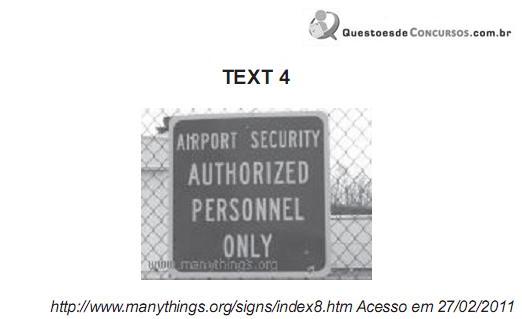
You leave the supermarket and go straight to Heathrow to meet an old friend of yours. But at the entrance, you find the above sign which means you _____ enter.
You leave the supermarket and go straight to Heathrow to meet an old friend of yours. But at the entrance, you find the above sign which means you _____ enter.
Ano: 2011
Banca:
CESGRANRIO
Órgão:
Transpetro
Provas:
CESGRANRIO - 2011 - Transpetro - Administrador Júnior
|
CESGRANRIO - 2011 - Transpetro - Analista de Sistemas Júnior |
CESGRANRIO - 2011 - Transpetro - Contador Júnior - Contábil |
CESGRANRIO - 2011 - Transpetro - Contador Júnior - Auditoria Interna |
CESGRANRIO - 2011 - Transpetro - Economista Júnior |
CESGRANRIO - 2011 - Transpetro - Engenheiro Júnior - Engenharia de Produção |
CESGRANRIO - 2011 - Transpetro - Médico do trabalho |
CESGRANRIO - 2011 - Transpetro - Engenheiro Júnior - Análise de Projetos de Inverstimentos |
CESGRANRIO - 2011 - Transpetro - Engenheiro Júnior - Geotécnica |
CESGRANRIO - 2011 - Transpetro - Engenheiro Júnior - Elétrica |
CESGRANRIO - 2011 - Transpetro - Engenheiro Júnior - Mecânica |
CESGRANRIO - 2011 - Transpetro - Profissional de Meio Ambiente Júnior |
CESGRANRIO - 2011 - Transpetro - Engenheiro Júnior - Processamento |
CESGRANRIO - 2011 - Transpetro - Engenheiro Júnior - Segurança |
CESGRANRIO - 2011 - Transpetro - Engenheiro Júnior - Naval |
CESGRANRIO - 2011 - Transpetro - Químico de Petróleo Júnior |
CESGRANRIO - 2011 - Transpetro - Engenheiro Júnior - Automação |
Q154635
Inglês
Texto associado
Model copes with chaos to deliver relief
Computer program helps responders transport
supplies in tough conditions
By Rachel Ehrenberg Science News, Web edition: Monday, February 21st, 2011
WASHINGTON — Getting blood or other perishable supplies to an area that’s been struck by an earthquake or hurricane isn’t as simple as asking what brown can do for you. But a new model quickly determines the best routes and means for delivering humanitarian aid, even in situations where bridges are out or airport tarmacs are clogged with planes.
The research, presented February 18 at the annual meeting of the American Association for the Advancement of Science, could help get supplies to areas which have experienced natural disasters or help prepare for efficient distribution of vaccines when the flu hits.
Efficient supply chains have long been a goal of manufacturers, but transport in fragile networks — where supply, demand and delivery routes may be in extremely rapid flux — requires a different approach, said Anna Nagurney of the University of Massachusetts Amherst, who presented the new work. Rather than considering the shortest path from one place to another to maximize profit, her system aims for the cleanest path at minimum cost, while capturing factors such as the perishability of the product and the uncertainty of supply routes. ‘You don’t know where demand is, so it’s tricky,’ said Nagurney. ‘It’s a multicriteria decision-making problem.’
By calculating the total cost associated with each link in a network, accounting for congestion and incorporating penalties for time and products that are lost, the computer model calculates the best supply chain in situations where standard routes may be disrupted.
‘Mathematical tools are essential to develop formal means to predict, and to respond to, such critical perturbations,’ said Iain Couzin of Princeton University, who uses similar computational tools to study collective animal behavior. ‘This is particularly important where response must be rapid and effective, such as during disaster scenarios … or during epidemics or breaches of national security.
’ The work can be applied to immediate, pressing situations, such as getting blood, food or medication to a disaster site, or to longer-term problems such as determining the best locations for manufacturing flu vaccines. . Retrieved April 7th, 2011.
By Rachel Ehrenberg Science News, Web edition: Monday, February 21st, 2011
WASHINGTON — Getting blood or other perishable supplies to an area that’s been struck by an earthquake or hurricane isn’t as simple as asking what brown can do for you. But a new model quickly determines the best routes and means for delivering humanitarian aid, even in situations where bridges are out or airport tarmacs are clogged with planes.
The research, presented February 18 at the annual meeting of the American Association for the Advancement of Science, could help get supplies to areas which have experienced natural disasters or help prepare for efficient distribution of vaccines when the flu hits.
Efficient supply chains have long been a goal of manufacturers, but transport in fragile networks — where supply, demand and delivery routes may be in extremely rapid flux — requires a different approach, said Anna Nagurney of the University of Massachusetts Amherst, who presented the new work. Rather than considering the shortest path from one place to another to maximize profit, her system aims for the cleanest path at minimum cost, while capturing factors such as the perishability of the product and the uncertainty of supply routes. ‘You don’t know where demand is, so it’s tricky,’ said Nagurney. ‘It’s a multicriteria decision-making problem.’
By calculating the total cost associated with each link in a network, accounting for congestion and incorporating penalties for time and products that are lost, the computer model calculates the best supply chain in situations where standard routes may be disrupted.
‘Mathematical tools are essential to develop formal means to predict, and to respond to, such critical perturbations,’ said Iain Couzin of Princeton University, who uses similar computational tools to study collective animal behavior. ‘This is particularly important where response must be rapid and effective, such as during disaster scenarios … or during epidemics or breaches of national security.
’ The work can be applied to immediate, pressing situations, such as getting blood, food or medication to a disaster site, or to longer-term problems such as determining the best locations for manufacturing flu vaccines. . Retrieved April 7th, 2011.
In “The work can be applied to immediate, pressing situations," (lines 41-42), the fragment “can be applied" is replaced, without change in meaning, by
Ano: 2011
Banca:
CESPE / CEBRASPE
Órgão:
Correios
Prova:
CESPE - 2011 - Correios - Cargos de Nível Superior - Conhecimentos Básicos - Exceto os Cargos 3, 4, 5, 16 e 26 |
Q131567
Inglês
Texto associado

According to the text, judge the following items.
According to the text, judge the following items.
Everyone should do their best to save wastewater.
Ano: 2011
Banca:
CESPE / CEBRASPE
Órgão:
Instituto Rio Branco
Prova:
CESPE - 2011 - Instituto Rio Branco - Diplomata 2ª Etapa |
Q127651
Inglês

Still in the fields of semantics and grammar of the text, judge if the items below are right (C) or wrong (E).
If “ticked off” (l.24) and “spinning” (l.25) were replaced respectively by marked off and rotating, there would occur no grammar mistakes in the sentence.
If “ticked off” (l.24) and “spinning” (l.25) were replaced respectively by marked off and rotating, there would occur no grammar mistakes in the sentence.
Ano: 2011
Banca:
CESPE / CEBRASPE
Órgão:
Instituto Rio Branco
Prova:
CESPE - 2011 - Instituto Rio Branco - Diplomata 2ª Etapa |
Q127631
Inglês

Which of the following statements about the verbs in the text is correct?
Ano: 2011
Banca:
FCC
Órgão:
TRT - 14ª Região (RO e AC)
Prova:
FCC - 2011 - TRT - 14ª Região (RO e AC) - Técnico Judiciário - Tecnologia da Informação |
Q111557
Inglês

Word 2010’s feature described above
Ano: 2011
Banca:
FCC
Órgão:
TRE-RN
Prova:
FCC - 2011 - TRE-RN - Analista Judiciário - Análise de Sistemas |
Q105200
Inglês


A alternativa que preenche corretamente a lacuna  é
é
é
Ano: 2011
Banca:
FCC
Órgão:
TRT - 14ª Região (RO e AC)
Prova:
FCC - 2011 - TRT - 14ª Região (RO e AC) - Analista Judiciário - Tecnologia da Informação |
Q103918
Inglês
Texto associado
Ten Tips for Microsoft Word and Excel
Our latest tips tell you how to make Microsoft Office 2010's word
processor and spreadsheet apps perform some handy tricks that
Microsoft has documented poorly.
By Edward Mendelson
PCMag.com's Microsoft Office 2010 tips collection
continues, this time with ten tips for Word and Excel users. Most
of these tips are fairly straightforward, and most apply to the
most recent versions of Office. Some of them, however, offer
new twists for the latest version of Office. Expert users will be
familiar with some of these ten tips, but we hope that any user
will find at least a few of these to be useful.
What kind of tips am I talking about this time? Finding
ways to perform poorly documented functions in Word and
Excel. One of these tips, for example, tells you what to do when
Word inserts a horizontal line across the page when you only
wanted to type a few dashes. In the past few months, everyone
in my family has tried and failed to wrestle an unwanted
horizontal line out of a Word document. It might not sound like a
big issue, but once you've got it in your document, good luck
finding help from Microsoft on how to get rid of it.
Some software vendors, like Adobe, continue to provide
help systems that work like improved versions of traditional
software manuals. In those apps, every menu item, every
toolbar icon, is carefully explained, and with a little patience you
can find all the information you need. Microsoft, provides
you with a kind of information supermarket, with huge essays
about topics you don't care about, dozens of selections when
you only need one, and no consistent way to find the information
you want.
Combine Portrait and Landscape Pages in a Word Document
Microsoft Word expects you to organize your documents
in a highly-structured but not very intuitive way. If you want to
format most of a document in portrait mode, but one or two
pages in landscape, you simply change the orientation
of the current page. Instead you need to insert a section break
before and after the text you want to format in landscape mode,
and then apply landscape orientation to the section that you
created. Place the insertion point at the point where you want
landscape orientation to begin. On the Page Layout tab, choose
Breaks, then, under Section Breaks, choose New Page. Then
move the insertion point to the end of the text you want to format
in landscape, and insert the same kind of break. Then put the
insertion point anywhere between the two breaks; return to the
Page Layout tab, and click the down-pointing arrow at the lower
right of the Page Setup group. In the Page Setup dialog, on the
Margins tab, select Landscape orientation, then go to the "Apply
to" dropdown and select This Section.
(Adapted from http://www.pcmag.com/article2/0,2817,
2379207,00.asp#)
Our latest tips tell you how to make Microsoft Office 2010's word
processor and spreadsheet apps perform some handy tricks that
Microsoft has documented poorly.
By Edward Mendelson
PCMag.com's Microsoft Office 2010 tips collection
continues, this time with ten tips for Word and Excel users. Most
of these tips are fairly straightforward, and most apply to the
most recent versions of Office. Some of them, however, offer
new twists for the latest version of Office. Expert users will be
familiar with some of these ten tips, but we hope that any user
will find at least a few of these to be useful.
What kind of tips am I talking about this time? Finding
ways to perform poorly documented functions in Word and
Excel. One of these tips, for example, tells you what to do when
Word inserts a horizontal line across the page when you only
wanted to type a few dashes. In the past few months, everyone
in my family has tried and failed to wrestle an unwanted
horizontal line out of a Word document. It might not sound like a
big issue, but once you've got it in your document, good luck
finding help from Microsoft on how to get rid of it.
Some software vendors, like Adobe, continue to provide
help systems that work like improved versions of traditional
software manuals. In those apps, every menu item, every
toolbar icon, is carefully explained, and with a little patience you
can find all the information you need. Microsoft,
provides you with a kind of information supermarket, with huge essays
about topics you don't care about, dozens of selections when
you only need one, and no consistent way to find the information
you want.
Combine Portrait and Landscape Pages in a Word Document
Microsoft Word expects you to organize your documents
in a highly-structured but not very intuitive way. If you want to
format most of a document in portrait mode, but one or two
pages in landscape, you
simply change the orientation of the current page. Instead you need to insert a section break
before and after the text you want to format in landscape mode,
and then apply landscape orientation to the section that you
created. Place the insertion point at the point where you want
landscape orientation to begin. On the Page Layout tab, choose
Breaks, then, under Section Breaks, choose New Page. Then
move the insertion point to the end of the text you want to format
in landscape, and insert the same kind of break. Then put the
insertion point anywhere between the two breaks; return to the
Page Layout tab, and click the down-pointing arrow at the lower
right of the Page Setup group. In the Page Setup dialog, on the
Margins tab, select Landscape orientation, then go to the "Apply
to" dropdown and select This Section.
(Adapted from http://www.pcmag.com/article2/0,2817,
2379207,00.asp#)
O verbo que preenche corretamente a lacuna [modal] é

 Conheça nossos planos