Questões de Concurso
Sobre verbos | verbs em inglês
Foram encontradas 3.020 questões


Read the sentences below.
I. The Food and Drug Administration had approved marketing of the weight-loss drug lorcaserin, the first prescription anti-obesity medication to win the FDA’s blessing since the agency approved orlistat in 1999.
II. The U.S. Justice Department’s civil fraud division is investigating claims that CVS Caremark wrongly refilled prescriptions and billed insurers without the knowledge or the approval of its customers.
III. Warning signs of a heart attack often includes discomfort at the center of the chest that last more than a few minutes or comes and goes; also possible are pain or discomfort in the arms, back, neck, jaw or stomach; a cold sweat; and shortness of breath.
According to the context, choose the alternative in which the underlined verb is used correctly.
Anxiety Medication: Over Prescribed and
Causing Overdoses
According to a story on NBC New York, more and more patients are ending up in New York City hospitals having over dosed on Xanax. Xanax is in the benzodiaziepine family of drugs and it’s used to treat anxiety, nervousness, and panic attacks by decreasing brain activity.
Xanax Overdoses Way Up
NBC New York reports:
Between 2004 and 2009, New York City emergency room visits involving Xanax and other anti-anxiety prescription drugs known as benzodiazepines increased more than 50 percent. That’s up from 38 out of 100,000 New Yorkers in 2004 to 59 out of 100,000 New Yorkers.
It’s not the drug by itself that causes the overdoses, but used in combination with other drugs and alcohol, it creates a toxic cocktail which isn’t easily metabolized in the body.
The drug is habit forming and withdrawal symptoms can include sweating, shaking, difficulty falling asleep, difficulty concentrating, depression, and nervousness. Many fear that the drug is being over prescribed.
“I don’t believe they take the time with the patients to figure out what the problems are,” Cali Estes, a drug counselor said to NBC New York. “A doctor who is running short on time and nurses and probably isn’t paid as much as he or she used to be finds it easier to say, ‘OK, this person has a problem, here’s your script, have a nice day. Where’s my next patient?’”
Whitney Houston’s Death Tied to Xanax and Other Drugs
Whitney Houston’s recent death is raising questions as to this and other sedatives. Xanax is most often criticized by those in the psychiatric community because it only lasts 6 to 20 hours.
Forbes reports:
On the face of it, this seems like a great combination – you get a quick hit of anxiety relief and the drug leaves your system within a 24-hour period. But in practice what often happens is that because the drug acts so quickly and dissipates quickly, the patient begins taking more of it to maintain the effect. Two pills a day turns into four, which turns into six and so forth.
According to the CDC, prescription drug overdose is now the leading cause of accidental death in the U.S., topping automobile accidents for the first time in 30 years. Currently, Xanax is the 11th most widely prescribed drug in the nation.
Available in: http://blogs.discovery.com
Read the sentence below taken from the text and analyze the assertions.
“Two pills a day turns into four, which turns into six and so forth.”
I. The phrasal verb “to turn into” can be replaced by “in turn”.
II. “Which” refers to the last quantity of pills mentioned.
III. The expression “so forth” infers that, after having 6 pills, the patient restarts taking four pills.
The correct assertion(s) is(are)
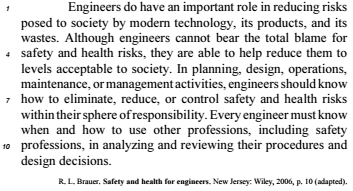
According to the text above, judge the next item.
Even though the verbs “should” (l.6) and “must” (l.8) have
different meanings, they can be used interchangeably in the
text without invalidating the author’s plea.
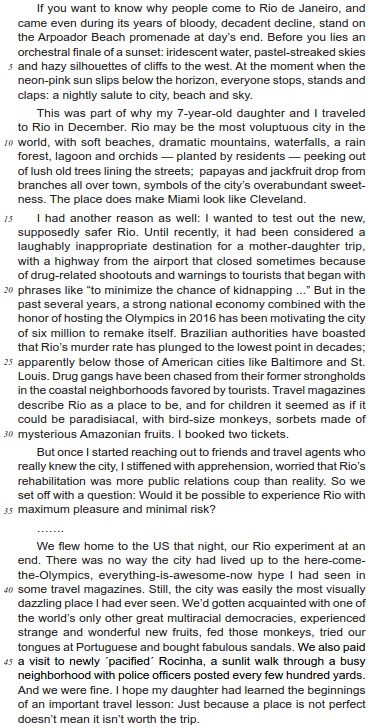
European Union member states could cut their plastic bag use by 80%, the European commission has said, by
charging for bags or even banning them.
Plastic bags are a major cause ofseaborne pollution, which is a serious hazard for marine life, and some regions have already
moved to cut their use through charging. The UK deputy Prime Minister, Nick Clegg, has pledged to bring forward charges in
England that will affect single-use bags given out by supermarkets.
The European commission is proposing a new directive that would require member states to choose between three methods
ofreducing the waste from bags: charges, national reduction targets, or an outright ban.
The packaging industry has responded by saying that most people use their plastic bags more than once, for instance using
them as bins, but that does not cut the overall use.
When plastic bags, or pieces of them, find their way into the seas, they are a major hazard to marine life. A whale found dead
on the Southern Spanish coast was found to have swallowed 17kg of plastic waste, including plastic bags. Fish, seabirds and
mammals can ali ingest plastic, which they cannot digest and which can clog up their guts or cause choking.
One of the key problems with plastic bags is that they are so light and small that they easily escape into the environment,
defying attempts to recycle them. The European commission has identified this as a key reason for cutting the use ofthe bags,
and other plastic packaging. The first moves to legislate atan EU levei were made in 2011, and today's announcement is likely
to take at least two years to put into practice.
According to the most recent estimates, from 2008, the EU produces 3.4m tonnes of plastic bags in a year.
European Union member states could cut their plastic bag use by 80%, the European commission has said, by
charging for bags or even banning them.
Plastic bags are a major cause ofseaborne pollution, which is a serious hazard for marine life, and some regions have already
moved to cut their use through charging. The UK deputy Prime Minister, Nick Clegg, has pledged to bring forward charges in
England that will affect single-use bags given out by supermarkets.
The European commission is proposing a new directive that would require member states to choose between three methods
ofreducing the waste from bags: charges, national reduction targets, or an outright ban.
The packaging industry has responded by saying that most people use their plastic bags more than once, for instance using
them as bins, but that does not cut the overall use.
When plastic bags, or pieces of them, find their way into the seas, they are a major hazard to marine life. A whale found dead
on the Southern Spanish coast was found to have swallowed 17kg of plastic waste, including plastic bags. Fish, seabirds and
mammals can ali ingest plastic, which they cannot digest and which can clog up their guts or cause choking.
One of the key problems with plastic bags is that they are so light and small that they easily escape into the environment,
defying attempts to recycle them. The European commission has identified this as a key reason for cutting the use ofthe bags,
and other plastic packaging. The first moves to legislate atan EU levei were made in 2011, and today's announcement is likely
to take at least two years to put into practice.
According to the most recent estimates, from 2008, the EU produces 3.4m tonnes of plastic bags in a year.
“(...) some regions have already moved (...)”
“The packaging industry has responded by (...)”
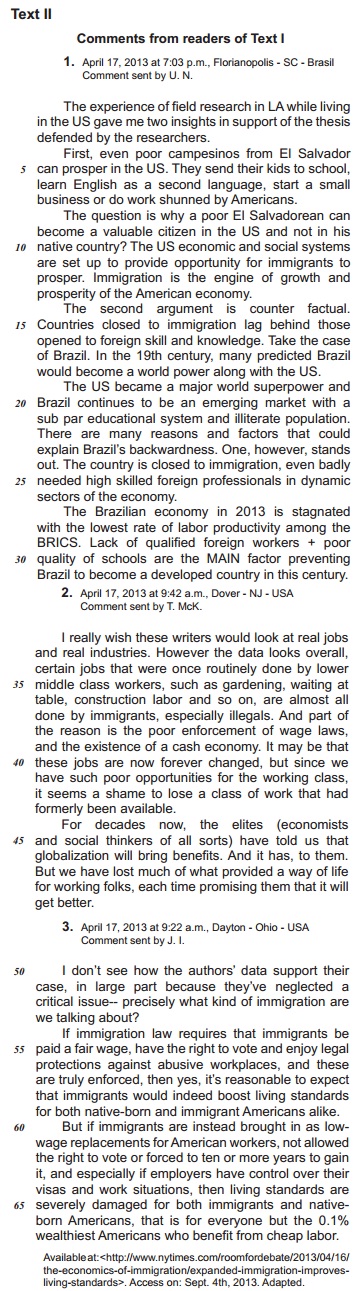
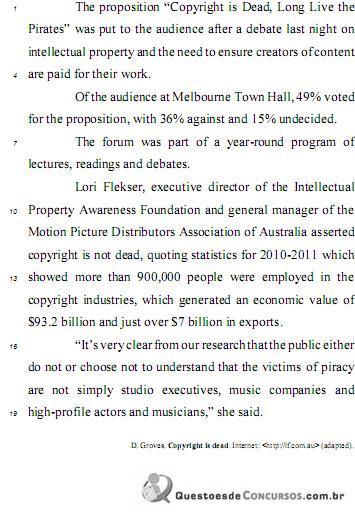
The verb form “ensure” (l.3) could be replaced by make certain without changing the meaning of the text.
…so that you can zero-in on the desired outcomes for the course. (L. 17-18)
The meaning of the underlined phrasal verb above is parallel to:
The modal auxiliaries in “Setting clear pre-requisites can help you…” (L. 11-12) and “… the content may need to be reworked…” (L. 35) convey the notion of:

The verb form “impair” (l.10) is synonymous with

Judge the following items according to the text.

1. “ the first global football championship held in South America”
2. “roads are being built”
3. “people are being employed and trained”
As formas infinitivas dos verbos destacados acima se encontram dispostas, correta e respectivamente, na alternativa:


According to the manual, you _____________ change the originalwiring.

 Conheça nossos planos