Questões de Concurso
Sobre verbos | verbs em inglês
Foram encontradas 3.020 questões


Q1186722
Inglês
Reading Comprehension
Cell Phones: Are they dangerous?
Do you have a cell phone? Do you use it a lot? If the answer to these questions is yes, you should read the following information very carefully.
If you keep on using a cell phone, it will probably cause premature ageing, which might be rather difficult to get over. At least this is what most scientists claim. Low-level radiation from the phone may heat up body cells, damaging skin and making it look slightly lined and tired. Scientists say that if you expose cells to the radiation from a cell phone, the natural process that repairs your skin will probably be affected. Furthermore, radiation produces mutations in the cells and these mutations could be related to other health problems.
Cell phone users have also found out that if they use their phone for a long time they feel other symptoms such as fatigue and memory loss. The fatigue may be caused because, when using phones, people suffer an involuntary speeding up of their heart beat. Apart from that, nearly two out of three people interviewed complained of regular headaches from using their phones, although this may be due to bad posture rather than radiation emissions.
The most surprising fact discovered by researchers is that people exposed to the radiation of a cell phone for 45 minutes go to the bathroom twice as much as usual. This proves that radiation has a biological effect on humans.
So if I were you, I would definitely think twice before using a cell phone if I looked in the mirror and saw wrinkles on my face, felt fatigue, had trouble remembering things, or if I started using my bathroom more often than I used to.
Match the phrasal verbs to their definitions:
Verbs
I. keep on
II. join in
III. find out
IV. take after
V. get over
Definitions
( ) discover
( ) recover
( ) continue, go on
( ) take part in
( ) look like
Choose the alternative which contains the correct sequence, from top to bottom:
Cell Phones: Are they dangerous?
Do you have a cell phone? Do you use it a lot? If the answer to these questions is yes, you should read the following information very carefully.
If you keep on using a cell phone, it will probably cause premature ageing, which might be rather difficult to get over. At least this is what most scientists claim. Low-level radiation from the phone may heat up body cells, damaging skin and making it look slightly lined and tired. Scientists say that if you expose cells to the radiation from a cell phone, the natural process that repairs your skin will probably be affected. Furthermore, radiation produces mutations in the cells and these mutations could be related to other health problems.
Cell phone users have also found out that if they use their phone for a long time they feel other symptoms such as fatigue and memory loss. The fatigue may be caused because, when using phones, people suffer an involuntary speeding up of their heart beat. Apart from that, nearly two out of three people interviewed complained of regular headaches from using their phones, although this may be due to bad posture rather than radiation emissions.
The most surprising fact discovered by researchers is that people exposed to the radiation of a cell phone for 45 minutes go to the bathroom twice as much as usual. This proves that radiation has a biological effect on humans.
So if I were you, I would definitely think twice before using a cell phone if I looked in the mirror and saw wrinkles on my face, felt fatigue, had trouble remembering things, or if I started using my bathroom more often than I used to.
Match the phrasal verbs to their definitions:
Verbs
I. keep on
II. join in
III. find out
IV. take after
V. get over
Definitions
( ) discover
( ) recover
( ) continue, go on
( ) take part in
( ) look like
Choose the alternative which contains the correct sequence, from top to bottom:
Ano: 2009
Banca:
COSEAC
Órgão:
ANCINE
Prova:
COSEAC - 2009 - ANCINE - Especialista em Regulação - Atividade Cinematográfica e Audiovisual E55 |
Q362287
Inglês

The theater seats _____ so _____ thatmy children _____ want to go back there.
Ano: 2009
Banca:
COSEAC
Órgão:
ANCINE
Prova:
COSEAC - 2009 - ANCINE - Especialista em Regulação - Atividade Cinematográfica e Audiovisual E55 |
Q362285
Inglês
The work _____ this script _____made _____ 2003 but it needs brushing _____.
Ano: 2009
Banca:
COSEAC
Órgão:
ANCINE
Provas:
COSEAC - 2009 - ANCINE - Analista Administrativo - Contabilidade
|
COSEAC - 2009 - ANCINE - Analista Administrativo |
Q356149
Inglês

________, if they like the project they______find a way to save it.
Ano: 2009
Banca:
COSEAC
Órgão:
ANCINE
Provas:
COSEAC - 2009 - ANCINE - Analista Administrativo - Contabilidade
|
COSEAC - 2009 - ANCINE - Analista Administrativo |
Q356148
Inglês
I think it _____ be a great show, ______ nobody _____be talking __________ it
Ano: 2009
Banca:
CESPE / CEBRASPE
Órgão:
TCE-RN
Prova:
CESPE - 2009 - TCE-RN - Assessor Técnico de Informática |
Q123248
Inglês
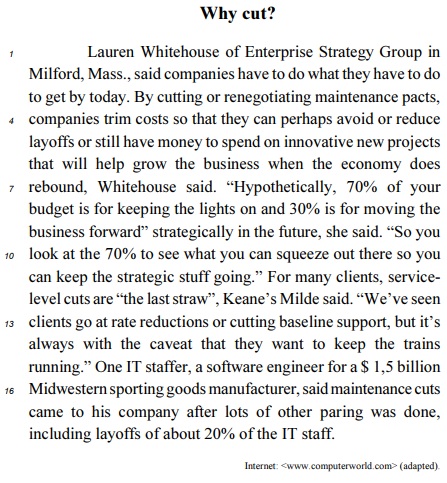
Judge the following iten according to the text above.
The expression “to get by” (L.3) means to survive.
Q122510
Inglês
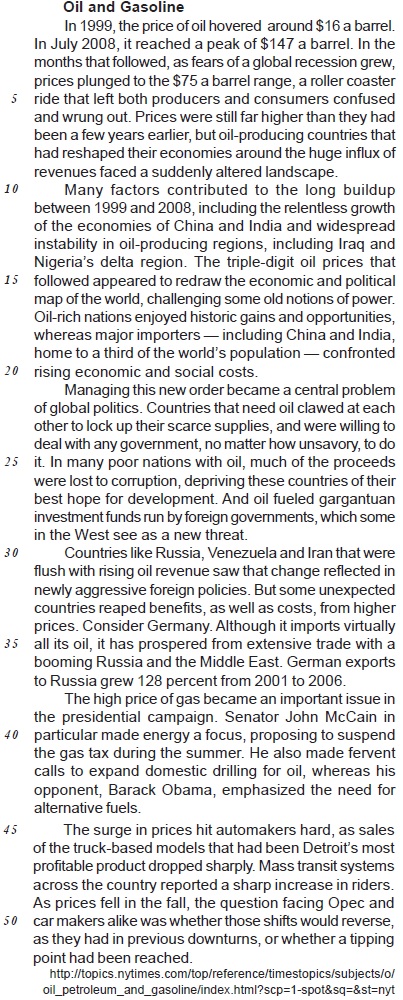
In the sentence “Countries that need oil clawed at each other to lock up their scarce supplies,” (lines 22-23), lock up means the same as
Ano: 2009
Banca:
COSEAC
Órgão:
DATAPREV
Provas:
COSEAC - 2009 - DATAPREV - Analista de Tecnologia da Informação - Banco de Dados
|
COSEAC - 2009 - DATAPREV - Analista de Tecnologia da Informação - Desenvolvimento de Sistemas |
COSEAC - 2009 - DATAPREV - Analista de Tecnologia da Informação - Análise de Informações |
Q113013
Inglês
Texto associado
GadgetDesigners Push the Limits of Size, Safety
By Brian X. Chen, August 28, 2008
Just as small, fast-moving mammals replaced lumbering
dinosaurs, pocketable gadgets are evolving to fill niches that
larger, deskbound computers can't reach. But as they shrink,
these gadgets are faced with problems mammals face, too,
such as efficiently dissipating heat.
The recent example of Apple's first-generation iPod nanos
causing fires in Japan raises the question of whether
increasingly innovative product designs are impinging on
safety. The nano incident illustrates how risk can increase as
devices decrease in size, says Roger Kay, an analyst at
EndpointTechnologies.
"As [gadgets] get smaller, the tradeoffs become more difficult,
the balance becomes more critical and there's less room for
error," Kay said. "I'm not surprised it's happening to the nano
because that's the small one. You're asking it to do a lot in a
very, very small package and that's pushing the envelope.”
There's no question that industrial designers' jobs have
become much more difficult as the industry demands ever
more powerful and smaller gadgets. With paper-thin
subnotebooks, ultrasmall MP3 players, and pinkie finger-
sized Bluetooth headsets becoming increasingly popular, it's
questionable where exactly designers draw the line between
innovation and safety.
By Brian X. Chen, August 28, 2008
Just as small, fast-moving mammals replaced lumbering
dinosaurs, pocketable gadgets are evolving to fill niches that
larger, deskbound computers can't reach. But as they shrink,
these gadgets are faced with problems mammals face, too,
such as efficiently dissipating heat.
The recent example of Apple's first-generation iPod nanos
causing fires in Japan raises the question of whether
increasingly innovative product designs are impinging on
safety. The nano incident illustrates how risk can increase as
devices decrease in size, says Roger Kay, an analyst at
EndpointTechnologies.
"As [gadgets] get smaller, the tradeoffs become more difficult,
the balance becomes more critical and there's less room for
error," Kay said. "I'm not surprised it's happening to the nano
because that's the small one. You're asking it to do a lot in a
very, very small package and that's pushing the envelope.”
There's no question that industrial designers' jobs have
become much more difficult as the industry demands ever
more powerful and smaller gadgets. With paper-thin
subnotebooks, ultrasmall MP3 players, and pinkie finger-
sized Bluetooth headsets becoming increasingly popular, it's
questionable where exactly designers draw the line between
innovation and safety.
Robots ____ have the brains to "intelligently and autonomously search ____ objects" _____ their own.
Ano: 2009
Banca:
COSEAC
Órgão:
DATAPREV
Provas:
COSEAC - 2009 - DATAPREV - Analista de Tecnologia da Informação - Análise de Produção
|
COSEAC - 2009 - DATAPREV - Analista de Tecnologia da Informação - Redes |
Q112964
Inglês
Texto associado
Microsoft to Offer Free Virus Protection Software for
Windows
By ScottGilbertsonNovember 19, 2008
Microsoft plans to offer Windows users a new antivirus
package designed to protect the OS from viruses, spyware,
rootkits and trojans. The new software is tentatively code-
named Morro, and will be available for free to Windows XP,
Vista and 7 users sometime in the second half of 2009.
The new software will reportedly use very minimal resources,
which means it should work well with older PCs. If fact,
Microsoft says Morro has been specially designed for older
PCs and low-spec machines popular in developing nations. In
addition to its minimal processor demands, Morro has been
developed to use very little bandwidth,making it ideal for those
without broadband connections.
Morro will replace Microsoft's current, paid service, Windows
Live OneCare, which has been available on a subscription
basis for $50 per year.
While a free, antivirus solution that ships withWindows would
be a boon for the average user, it could also mean trouble for
third-party software solutions. Given that a bundled solution
could raise antitrust concerns -and would no doubt see
competitors likeMcAfee and Grisoft reaching for the lawyers-
Microsoftwill be offeringMorro as a separate download.
Assuming Morro can deliver decent security it should be a
welcome free addition to Windows, but we don't suggest
throwing away your third-party software just yet. Antivirus
software suites will likely continue to hold an edge over Morro
by offering additional handy tools - like passwordmanagers,
identity theft protection and browser-based phishing
protection.
Still, if you've been runningWindowswith no antivirus software
at all,Morrowill no doubt be better than nothing, and it's hard to
arguewith free.
Windows
By ScottGilbertsonNovember 19, 2008
Microsoft plans to offer Windows users a new antivirus
package designed to protect the OS from viruses, spyware,
rootkits and trojans. The new software is tentatively code-
named Morro, and will be available for free to Windows XP,
Vista and 7 users sometime in the second half of 2009.
The new software will reportedly use very minimal resources,
which means it should work well with older PCs. If fact,
Microsoft says Morro has been specially designed for older
PCs and low-spec machines popular in developing nations. In
addition to its minimal processor demands, Morro has been
developed to use very little bandwidth,making it ideal for those
without broadband connections.
Morro will replace Microsoft's current, paid service, Windows
Live OneCare, which has been available on a subscription
basis for $50 per year.
While a free, antivirus solution that ships withWindows would
be a boon for the average user, it could also mean trouble for
third-party software solutions. Given that a bundled solution
could raise antitrust concerns -and would no doubt see
competitors likeMcAfee and Grisoft reaching for the lawyers-
Microsoftwill be offeringMorro as a separate download.
Assuming Morro can deliver decent security it should be a
welcome free addition to Windows, but we don't suggest
throwing away your third-party software just yet. Antivirus
software suites will likely continue to hold an edge over Morro
by offering additional handy tools - like passwordmanagers,
identity theft protection and browser-based phishing
protection.
Still, if you've been runningWindowswith no antivirus software
at all,Morrowill no doubt be better than nothing, and it's hard to
arguewith free.
If you don't read carfully this manual you ____ be able to learn how this gizmo works.
Ano: 2009
Banca:
COSEAC
Órgão:
DATAPREV
Provas:
COSEAC - 2009 - DATAPREV - Analista de Tecnologia da Informação - Análise de Produção
|
COSEAC - 2009 - DATAPREV - Analista de Tecnologia da Informação - Redes |
Q112963
Inglês
Texto associado
Microsoft to Offer Free Virus Protection Software for
Windows
By ScottGilbertsonNovember 19, 2008
Microsoft plans to offer Windows users a new antivirus
package designed to protect the OS from viruses, spyware,
rootkits and trojans. The new software is tentatively code-
named Morro, and will be available for free to Windows XP,
Vista and 7 users sometime in the second half of 2009.
The new software will reportedly use very minimal resources,
which means it should work well with older PCs. If fact,
Microsoft says Morro has been specially designed for older
PCs and low-spec machines popular in developing nations. In
addition to its minimal processor demands, Morro has been
developed to use very little bandwidth,making it ideal for those
without broadband connections.
Morro will replace Microsoft's current, paid service, Windows
Live OneCare, which has been available on a subscription
basis for $50 per year.
While a free, antivirus solution that ships withWindows would
be a boon for the average user, it could also mean trouble for
third-party software solutions. Given that a bundled solution
could raise antitrust concerns -and would no doubt see
competitors likeMcAfee and Grisoft reaching for the lawyers-
Microsoftwill be offeringMorro as a separate download.
Assuming Morro can deliver decent security it should be a
welcome free addition to Windows, but we don't suggest
throwing away your third-party software just yet. Antivirus
software suites will likely continue to hold an edge over Morro
by offering additional handy tools - like passwordmanagers,
identity theft protection and browser-based phishing
protection.
Still, if you've been runningWindowswith no antivirus software
at all,Morrowill no doubt be better than nothing, and it's hard to
arguewith free.
Windows
By ScottGilbertsonNovember 19, 2008
Microsoft plans to offer Windows users a new antivirus
package designed to protect the OS from viruses, spyware,
rootkits and trojans. The new software is tentatively code-
named Morro, and will be available for free to Windows XP,
Vista and 7 users sometime in the second half of 2009.
The new software will reportedly use very minimal resources,
which means it should work well with older PCs. If fact,
Microsoft says Morro has been specially designed for older
PCs and low-spec machines popular in developing nations. In
addition to its minimal processor demands, Morro has been
developed to use very little bandwidth,making it ideal for those
without broadband connections.
Morro will replace Microsoft's current, paid service, Windows
Live OneCare, which has been available on a subscription
basis for $50 per year.
While a free, antivirus solution that ships withWindows would
be a boon for the average user, it could also mean trouble for
third-party software solutions. Given that a bundled solution
could raise antitrust concerns -and would no doubt see
competitors likeMcAfee and Grisoft reaching for the lawyers-
Microsoftwill be offeringMorro as a separate download.
Assuming Morro can deliver decent security it should be a
welcome free addition to Windows, but we don't suggest
throwing away your third-party software just yet. Antivirus
software suites will likely continue to hold an edge over Morro
by offering additional handy tools - like passwordmanagers,
identity theft protection and browser-based phishing
protection.
Still, if you've been runningWindowswith no antivirus software
at all,Morrowill no doubt be better than nothing, and it's hard to
arguewith free.
You ___ not believe that these possibilties are real, they're based ___ experiments that ___proved until now.
Ano: 2009
Banca:
COSEAC
Órgão:
DATAPREV
Provas:
COSEAC - 2009 - DATAPREV - Analista de Tecnologia da Informação - Ambiente Operacional
|
COSEAC - 2009 - DATAPREV - Analista de Tecnologia da Informação - Banco de Dados |
COSEAC - 2009 - DATAPREV - Analista de Tecnologia da Informação - Desenvolvimento de Sistemas |
COSEAC - 2009 - DATAPREV - Analista de Tecnologia da Informação - Análise de Informações |
Q112904
Inglês
Texto associado
GadgetDesigners Push the Limits of Size, Safety
By Brian X. Chen, August 28, 2008
Just as small, fast-moving mammals replaced lumbering
dinosaurs, pocketable gadgets are evolving to fill niches that
larger, deskbound computers can't reach. But as they shrink,
these gadgets are faced with problems mammals face, too,
such as efficiently dissipating heat.
The recent example of Apple's first-generation iPod nanos
causing fires in Japan raises the question of whether
increasingly innovative product designs are impinging on
safety. The nano incident illustrates how risk can increase as
devices decrease in size, says Roger Kay, an analyst at
EndpointTechnologies.
"As [gadgets] get smaller, the tradeoffs become more difficult,
the balance becomes more critical and there's less room for
error," Kay said. "I'm not surprised it's happening to the nano
because that's the small one. You're asking it to do a lot in a
very, very small package and that's pushing the envelope.”
There's no question that industrial designers' jobs have
become much more difficult as the industry demands ever
more powerful and smaller gadgets. With paper-thin
subnotebooks, ultrasmall MP3 players, and pinkie finger-
sized Bluetooth headsets becoming increasingly popular, it's
questionable where exactly designers draw the line between
innovation and safety.
By Brian X. Chen, August 28, 2008
Just as small, fast-moving mammals replaced lumbering
dinosaurs, pocketable gadgets are evolving to fill niches that
larger, deskbound computers can't reach. But as they shrink,
these gadgets are faced with problems mammals face, too,
such as efficiently dissipating heat.
The recent example of Apple's first-generation iPod nanos
causing fires in Japan raises the question of whether
increasingly innovative product designs are impinging on
safety. The nano incident illustrates how risk can increase as
devices decrease in size, says Roger Kay, an analyst at
EndpointTechnologies.
"As [gadgets] get smaller, the tradeoffs become more difficult,
the balance becomes more critical and there's less room for
error," Kay said. "I'm not surprised it's happening to the nano
because that's the small one. You're asking it to do a lot in a
very, very small package and that's pushing the envelope.”
There's no question that industrial designers' jobs have
become much more difficult as the industry demands ever
more powerful and smaller gadgets. With paper-thin
subnotebooks, ultrasmall MP3 players, and pinkie finger-
sized Bluetooth headsets becoming increasingly popular, it's
questionable where exactly designers draw the line between
innovation and safety.
If this scientific breakthrough is reliable, after years testing it, it _____ lead to the cure of this type of cancer in the future.
Ano: 2009
Banca:
COSEAC
Órgão:
DATAPREV
Provas:
COSEAC - 2009 - DATAPREV - Analista de Tecnologia da Informação - Ambiente Operacional
|
COSEAC - 2009 - DATAPREV - Analista de Tecnologia da Informação - Banco de Dados |
COSEAC - 2009 - DATAPREV - Analista de Tecnologia da Informação - Desenvolvimento de Sistemas |
COSEAC - 2009 - DATAPREV - Analista de Tecnologia da Informação - Análise de Informações |
Q112902
Inglês
Texto associado
GadgetDesigners Push the Limits of Size, Safety
By Brian X. Chen, August 28, 2008
Just as small, fast-moving mammals replaced lumbering
dinosaurs, pocketable gadgets are evolving to fill niches that
larger, deskbound computers can't reach. But as they shrink,
these gadgets are faced with problems mammals face, too,
such as efficiently dissipating heat.
The recent example of Apple's first-generation iPod nanos
causing fires in Japan raises the question of whether
increasingly innovative product designs are impinging on
safety. The nano incident illustrates how risk can increase as
devices decrease in size, says Roger Kay, an analyst at
EndpointTechnologies.
"As [gadgets] get smaller, the tradeoffs become more difficult,
the balance becomes more critical and there's less room for
error," Kay said. "I'm not surprised it's happening to the nano
because that's the small one. You're asking it to do a lot in a
very, very small package and that's pushing the envelope.”
There's no question that industrial designers' jobs have
become much more difficult as the industry demands ever
more powerful and smaller gadgets. With paper-thin
subnotebooks, ultrasmall MP3 players, and pinkie finger-
sized Bluetooth headsets becoming increasingly popular, it's
questionable where exactly designers draw the line between
innovation and safety.
By Brian X. Chen, August 28, 2008
Just as small, fast-moving mammals replaced lumbering
dinosaurs, pocketable gadgets are evolving to fill niches that
larger, deskbound computers can't reach. But as they shrink,
these gadgets are faced with problems mammals face, too,
such as efficiently dissipating heat.
The recent example of Apple's first-generation iPod nanos
causing fires in Japan raises the question of whether
increasingly innovative product designs are impinging on
safety. The nano incident illustrates how risk can increase as
devices decrease in size, says Roger Kay, an analyst at
EndpointTechnologies.
"As [gadgets] get smaller, the tradeoffs become more difficult,
the balance becomes more critical and there's less room for
error," Kay said. "I'm not surprised it's happening to the nano
because that's the small one. You're asking it to do a lot in a
very, very small package and that's pushing the envelope.”
There's no question that industrial designers' jobs have
become much more difficult as the industry demands ever
more powerful and smaller gadgets. With paper-thin
subnotebooks, ultrasmall MP3 players, and pinkie finger-
sized Bluetooth headsets becoming increasingly popular, it's
questionable where exactly designers draw the line between
innovation and safety.
Boeing ____ this week that it ____ successfully ____ a manned airplane powered _____ hydrogen fuel cells.
Q77868
Inglês
Texto associado
Para responder às questões de números 46 a 50, considere o texto abaixo.


O trecho American leadership has been sorely lacking for the past eight years significa que a liderança americana
Q77848
Inglês
Texto associado
Para responder às questões de números 26 a 31, considere o texto abaixo.

O verbo warns, no texto, indica
Ano: 2009
Banca:
FCC
Órgão:
TJ-SE
Prova:
FCC - 2009 - TJ-SE - Analista Judiciário - Tecnologia da Informação |
Q49625
Inglês

The [VERB] that correctly completes the text is
Ano: 2009
Banca:
CESGRANRIO
Órgão:
BNDES
Provas:
CESGRANRIO - 2009 - BNDES - Profissional Básico - Análise de Sistemas - Desenvolvimento
|
CESGRANRIO - 2009 - BNDES - Profissional Básico - Biblioteconomia |
Q47383
Inglês


According to the text, the software developed by Pulman and Moilanen
Ano: 2009
Banca:
FCC
Órgão:
SEFAZ-SP
Prova:
FCC - 2009 - SEFAZ-SP - Agente Fiscal de Rendas - Prova 1 |
Q41009
Inglês

O verbo que pertence ao mesmo grupo semântico de sink - fall - decline - drop é
Ano: 2009
Banca:
FCC
Órgão:
SEFAZ-SP
Prova:
FCC - 2009 - SEFAZ-SP - Agente Fiscal de Rendas - Prova 1 |
Q41007
Inglês
Considerando tão-somente o texto, a alternativa que preenche corretamente a lacuna [VERB] é
Ano: 2009
Banca:
ESAF
Órgão:
Receita Federal
Prova:
ESAF - 2009 - Receita Federal - Auditor Fiscal da Receita Federal - Prova 1 |
Q22495
Inglês

According to paragraph 1, the global economic and fi nancial crisis
Ano: 2009
Banca:
ESAF
Órgão:
MPO
Prova:
ESAF - 2009 - MPOG - Especialista em Políticas Públicas e Gestão Governamental - Prova 1 |
Q14978
Inglês

According to paragraph 2, "taxpayers had reason to be glum". In other words, they

 Conheça nossos planos