Questões de Concurso Sobre inglês
Foram encontradas 25.994 questões


TEXT III
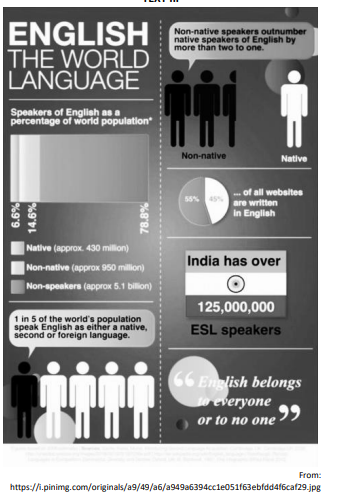
TEXT III
TEXT II
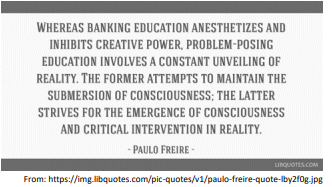
According to the BNCC (p. 61): “Young people have become increasingly engaged as protagonists of digital culture, directly involving themselves in new forms of multimedia and multimodal interaction and social action online.”.
Match the numbers to their corresponding letters in order to create a coherent sentence.
1. Please update
2. Stay in
3. Don’t be
4. It’s not the end
5. Forget the fear
a. of missing out.
b. glued to the screen.
c. your status.
d. touch with everyone.
e. of the world.
The correct sequence is:
TEXT II
TEXT II
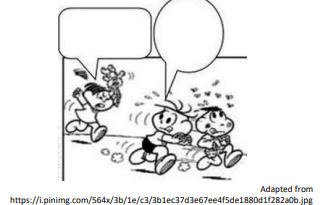
In this case, the most coherent choice to each bubble is, respectively:
TEXT II
TEXT II
TEXT II
TEXT II
TEXT I
The Multimodal Approach in English Language Teaching
In today’s media-rich environment, the vast majority of texts students engage with daily — such as YouTube videos, Instagram reels, TikTok clips, streaming series, video games and blog posts — are not only digital but also multimodal. These texts combine language with image, sound, movement and spatial design to convey meaning, often requiring learners to interpret and respond across multiple modes simultaneously. As digital technologies evolve, the pervasiveness and complexity of multimodal communication grow, reshaping both how we communicate and what it means to be literate.
Contemporary communication extends far beyond speech and writing; it is a layered, dynamic process that includes visual, aural, gestural and spatial elements. As such, literacy can no longer be understood solely as a linguistic skill. To participate fully in today’s social, academic and professional contexts, learners need more than the ability to read and write alphabetic text — they need to view, interpret, evaluate and represent meaning through a range of semiotic resources. In this context, traditional notions of literacy are insufficient and language education must evolve to reflect the multimodal nature of communication in the 21st century […]
Importantly, multimodal literacy also promotes accessibility and inclusion. Learners with reading difficulties, sensory impairments or diverse learning needs often struggle with traditional printbased instruction. Multimodal texts provide alternative pathways to meaning, allowing information to be accessed and expressed through visuals, sound, movement and space. This not only supports learners with special educational needs but benefits all students by offering multiple modes for engagement and expression. By embedding multimodal materials and encouraging students to compose multimodal texts, teachers create more equitable and inclusive classrooms. Multimodal learning reflects how people communicate in real life — and, crucially, supports the development of diverse literacies needed for participation in contemporary society.
In summary, integrating multimodal literacy into language teaching fosters deeper engagement, enhances learning outcomes and equips students with the skills to navigate and contribute meaningfully to today’s complex communicative landscape.
Adapted from https://film-english.com/wp-content/uploads/2025/09/themultimodal-approach-in-language-teaching.pdf
TEXT I
The Multimodal Approach in English Language Teaching
In today’s media-rich environment, the vast majority of texts students engage with daily — such as YouTube videos, Instagram reels, TikTok clips, streaming series, video games and blog posts — are not only digital but also multimodal. These texts combine language with image, sound, movement and spatial design to convey meaning, often requiring learners to interpret and respond across multiple modes simultaneously. As digital technologies evolve, the pervasiveness and complexity of multimodal communication grow, reshaping both how we communicate and what it means to be literate.
Contemporary communication extends far beyond speech and writing; it is a layered, dynamic process that includes visual, aural, gestural and spatial elements. As such, literacy can no longer be understood solely as a linguistic skill. To participate fully in today’s social, academic and professional contexts, learners need more than the ability to read and write alphabetic text — they need to view, interpret, evaluate and represent meaning through a range of semiotic resources. In this context, traditional notions of literacy are insufficient and language education must evolve to reflect the multimodal nature of communication in the 21st century […]
Importantly, multimodal literacy also promotes accessibility and inclusion. Learners with reading difficulties, sensory impairments or diverse learning needs often struggle with traditional printbased instruction. Multimodal texts provide alternative pathways to meaning, allowing information to be accessed and expressed through visuals, sound, movement and space. This not only supports learners with special educational needs but benefits all students by offering multiple modes for engagement and expression. By embedding multimodal materials and encouraging students to compose multimodal texts, teachers create more equitable and inclusive classrooms. Multimodal learning reflects how people communicate in real life — and, crucially, supports the development of diverse literacies needed for participation in contemporary society.
In summary, integrating multimodal literacy into language teaching fosters deeper engagement, enhances learning outcomes and equips students with the skills to navigate and contribute meaningfully to today’s complex communicative landscape.
Adapted from https://film-english.com/wp-content/uploads/2025/09/themultimodal-approach-in-language-teaching.pdf
TEXT I
The Multimodal Approach in English Language Teaching
In today’s media-rich environment, the vast majority of texts students engage with daily — such as YouTube videos, Instagram reels, TikTok clips, streaming series, video games and blog posts — are not only digital but also multimodal. These texts combine language with image, sound, movement and spatial design to convey meaning, often requiring learners to interpret and respond across multiple modes simultaneously. As digital technologies evolve, the pervasiveness and complexity of multimodal communication grow, reshaping both how we communicate and what it means to be literate.
Contemporary communication extends far beyond speech and writing; it is a layered, dynamic process that includes visual, aural, gestural and spatial elements. As such, literacy can no longer be understood solely as a linguistic skill. To participate fully in today’s social, academic and professional contexts, learners need more than the ability to read and write alphabetic text — they need to view, interpret, evaluate and represent meaning through a range of semiotic resources. In this context, traditional notions of literacy are insufficient and language education must evolve to reflect the multimodal nature of communication in the 21st century […]
Importantly, multimodal literacy also promotes accessibility and inclusion. Learners with reading difficulties, sensory impairments or diverse learning needs often struggle with traditional printbased instruction. Multimodal texts provide alternative pathways to meaning, allowing information to be accessed and expressed through visuals, sound, movement and space. This not only supports learners with special educational needs but benefits all students by offering multiple modes for engagement and expression. By embedding multimodal materials and encouraging students to compose multimodal texts, teachers create more equitable and inclusive classrooms. Multimodal learning reflects how people communicate in real life — and, crucially, supports the development of diverse literacies needed for participation in contemporary society.
In summary, integrating multimodal literacy into language teaching fosters deeper engagement, enhances learning outcomes and equips students with the skills to navigate and contribute meaningfully to today’s complex communicative landscape.
Adapted from https://film-english.com/wp-content/uploads/2025/09/themultimodal-approach-in-language-teaching.pdf
I. Ask students to read a printed story that has no images. II. Plan virtual field trips to historical sites and analyse infographics related to the locations. III. Assign projects where students can create videos.
Choose the correct answer.
TEXT I
The Multimodal Approach in English Language Teaching
In today’s media-rich environment, the vast majority of texts students engage with daily — such as YouTube videos, Instagram reels, TikTok clips, streaming series, video games and blog posts — are not only digital but also multimodal. These texts combine language with image, sound, movement and spatial design to convey meaning, often requiring learners to interpret and respond across multiple modes simultaneously. As digital technologies evolve, the pervasiveness and complexity of multimodal communication grow, reshaping both how we communicate and what it means to be literate.
Contemporary communication extends far beyond speech and writing; it is a layered, dynamic process that includes visual, aural, gestural and spatial elements. As such, literacy can no longer be understood solely as a linguistic skill. To participate fully in today’s social, academic and professional contexts, learners need more than the ability to read and write alphabetic text — they need to view, interpret, evaluate and represent meaning through a range of semiotic resources. In this context, traditional notions of literacy are insufficient and language education must evolve to reflect the multimodal nature of communication in the 21st century […]
Importantly, multimodal literacy also promotes accessibility and inclusion. Learners with reading difficulties, sensory impairments or diverse learning needs often struggle with traditional printbased instruction. Multimodal texts provide alternative pathways to meaning, allowing information to be accessed and expressed through visuals, sound, movement and space. This not only supports learners with special educational needs but benefits all students by offering multiple modes for engagement and expression. By embedding multimodal materials and encouraging students to compose multimodal texts, teachers create more equitable and inclusive classrooms. Multimodal learning reflects how people communicate in real life — and, crucially, supports the development of diverse literacies needed for participation in contemporary society.
In summary, integrating multimodal literacy into language teaching fosters deeper engagement, enhances learning outcomes and equips students with the skills to navigate and contribute meaningfully to today’s complex communicative landscape.
Adapted from https://film-english.com/wp-content/uploads/2025/09/themultimodal-approach-in-language-teaching.pdf
TEXT I
The Multimodal Approach in English Language Teaching
In today’s media-rich environment, the vast majority of texts students engage with daily — such as YouTube videos, Instagram reels, TikTok clips, streaming series, video games and blog posts — are not only digital but also multimodal. These texts combine language with image, sound, movement and spatial design to convey meaning, often requiring learners to interpret and respond across multiple modes simultaneously. As digital technologies evolve, the pervasiveness and complexity of multimodal communication grow, reshaping both how we communicate and what it means to be literate.
Contemporary communication extends far beyond speech and writing; it is a layered, dynamic process that includes visual, aural, gestural and spatial elements. As such, literacy can no longer be understood solely as a linguistic skill. To participate fully in today’s social, academic and professional contexts, learners need more than the ability to read and write alphabetic text — they need to view, interpret, evaluate and represent meaning through a range of semiotic resources. In this context, traditional notions of literacy are insufficient and language education must evolve to reflect the multimodal nature of communication in the 21st century […]
Importantly, multimodal literacy also promotes accessibility and inclusion. Learners with reading difficulties, sensory impairments or diverse learning needs often struggle with traditional printbased instruction. Multimodal texts provide alternative pathways to meaning, allowing information to be accessed and expressed through visuals, sound, movement and space. This not only supports learners with special educational needs but benefits all students by offering multiple modes for engagement and expression. By embedding multimodal materials and encouraging students to compose multimodal texts, teachers create more equitable and inclusive classrooms. Multimodal learning reflects how people communicate in real life — and, crucially, supports the development of diverse literacies needed for participation in contemporary society.
In summary, integrating multimodal literacy into language teaching fosters deeper engagement, enhances learning outcomes and equips students with the skills to navigate and contribute meaningfully to today’s complex communicative landscape.
Adapted from https://film-english.com/wp-content/uploads/2025/09/themultimodal-approach-in-language-teaching.pdf
TEXT I
The Multimodal Approach in English Language Teaching
In today’s media-rich environment, the vast majority of texts students engage with daily — such as YouTube videos, Instagram reels, TikTok clips, streaming series, video games and blog posts — are not only digital but also multimodal. These texts combine language with image, sound, movement and spatial design to convey meaning, often requiring learners to interpret and respond across multiple modes simultaneously. As digital technologies evolve, the pervasiveness and complexity of multimodal communication grow, reshaping both how we communicate and what it means to be literate.
Contemporary communication extends far beyond speech and writing; it is a layered, dynamic process that includes visual, aural, gestural and spatial elements. As such, literacy can no longer be understood solely as a linguistic skill. To participate fully in today’s social, academic and professional contexts, learners need more than the ability to read and write alphabetic text — they need to view, interpret, evaluate and represent meaning through a range of semiotic resources. In this context, traditional notions of literacy are insufficient and language education must evolve to reflect the multimodal nature of communication in the 21st century […]
Importantly, multimodal literacy also promotes accessibility and inclusion. Learners with reading difficulties, sensory impairments or diverse learning needs often struggle with traditional printbased instruction. Multimodal texts provide alternative pathways to meaning, allowing information to be accessed and expressed through visuals, sound, movement and space. This not only supports learners with special educational needs but benefits all students by offering multiple modes for engagement and expression. By embedding multimodal materials and encouraging students to compose multimodal texts, teachers create more equitable and inclusive classrooms. Multimodal learning reflects how people communicate in real life — and, crucially, supports the development of diverse literacies needed for participation in contemporary society.
In summary, integrating multimodal literacy into language teaching fosters deeper engagement, enhances learning outcomes and equips students with the skills to navigate and contribute meaningfully to today’s complex communicative landscape.
Adapted from https://film-english.com/wp-content/uploads/2025/09/themultimodal-approach-in-language-teaching.pdf
TEXT I
The Multimodal Approach in English Language Teaching
In today’s media-rich environment, the vast majority of texts students engage with daily — such as YouTube videos, Instagram reels, TikTok clips, streaming series, video games and blog posts — are not only digital but also multimodal. These texts combine language with image, sound, movement and spatial design to convey meaning, often requiring learners to interpret and respond across multiple modes simultaneously. As digital technologies evolve, the pervasiveness and complexity of multimodal communication grow, reshaping both how we communicate and what it means to be literate.
Contemporary communication extends far beyond speech and writing; it is a layered, dynamic process that includes visual, aural, gestural and spatial elements. As such, literacy can no longer be understood solely as a linguistic skill. To participate fully in today’s social, academic and professional contexts, learners need more than the ability to read and write alphabetic text — they need to view, interpret, evaluate and represent meaning through a range of semiotic resources. In this context, traditional notions of literacy are insufficient and language education must evolve to reflect the multimodal nature of communication in the 21st century […]
Importantly, multimodal literacy also promotes accessibility and inclusion. Learners with reading difficulties, sensory impairments or diverse learning needs often struggle with traditional printbased instruction. Multimodal texts provide alternative pathways to meaning, allowing information to be accessed and expressed through visuals, sound, movement and space. This not only supports learners with special educational needs but benefits all students by offering multiple modes for engagement and expression. By embedding multimodal materials and encouraging students to compose multimodal texts, teachers create more equitable and inclusive classrooms. Multimodal learning reflects how people communicate in real life — and, crucially, supports the development of diverse literacies needed for participation in contemporary society.
In summary, integrating multimodal literacy into language teaching fosters deeper engagement, enhances learning outcomes and equips students with the skills to navigate and contribute meaningfully to today’s complex communicative landscape.
Adapted from https://film-english.com/wp-content/uploads/2025/09/themultimodal-approach-in-language-teaching.pdf
( ) Nowadays written words are not the only means of communication. ( ) Printed texts are better than multimodal ones for individuals in supportive learning environment. ( ) Multimodal reading requires approaching different texts one at a time.
The statements are, respectively,

 Conheça nossos planos