Questões de Concurso
Sobre pronomes | pronouns em inglês
Foram encontradas 1.068 questões


By Sally Kane, About.com Guide
Born in the mid-1980's and later, Generation Y legal professionals are in their 20s and are just entering the workforce. With numbers estimated as high as 70 million, Generation Y (also -1- as the Millennials) is the fastest growing segment of today's workforce. As law firms compete for available talent, employers cannot ignore the needs, desires and attitudes of this vast generation. Below are a few common traits that define Generation Y.
Tech-Savvy: Generation Y grew up with technology and rely on it to perform their jobs better. Armed with BlackBerrys, laptops, cellphones and other gadgets, Generation Y is plugged-in 24 hours a day, 7 days a week. This generation prefers to communicate through e-mail and text messaging rather than face-to-face contact and -2- webinars and online technology to traditional lecture-based presentations.
Family-Centric: The fast-track has lost much of its appeal for Generation Y who is willing to trade high pay for fewer billable hours, flexible schedules and a better work/life balance. While older generations may view this attitude as narcissistic or lacking commitment, discipline and drive, Generation Y legal professionals have a different vision of workplace expectations and prioritize family over work.
Achievement-Oriented: Nurtured and pampered -3- parents who did not want to make the mistakes of the previous generation, Generation Y is confident, ambitious and achievement-oriented. They have high expectations of their employers, seek out new challenges and are not afraid to question authority. Generation Y wants meaningful work and a solid learning curve
Team-Oriented: As children, Generation Y participated in team sports, play groups and other group activities. They value teamwork and seek the input and affirmation of others. Part of a no-person-left-behind generation, Generation Y is loyal, committed and wants to be included and involved.
Attention-Craving: Generation Y craves attention in the forms of feedback and guidance. They appreciate being kept in the loop and seek frequent praise and reassurance. Generation Y may benefit greatly from mentors who can help guide and develop their young careers.
Font: http://legalcareers.about.com/od/practicetips/a/Ge...


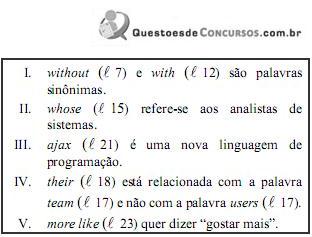
Assinale a alternativa correta.
Lawsuits claim Knoedler made huge profits on fakes
For more than a dozen years the Upper East Side gallery Knoedler & Company was “substantially dependent” on profits it made from selling a mysterious collection of artwork that is at the center of a federal forgery investigation, former clients of this former gallery have charged in court papers. The analysis is based on financial records turned over as part of a lawsuit against the gallery filed by Domenico and Eleanore De Sole, who in 2004 paid $8.3 million for a painting attributed to Mark Rothko that they now say is a worthless fake. The Rothko is one of approximately 40 works that Knoedler, which closed last year, obtained from Glafira Rosales, a littleknown dealer whose collection of works attributed to Modernist masters has no documented provenance and is the subject of an F.B.I. investigation. Between 1996 and 2008, the suit asserts, Knoedler earned approximately $60 million from works that Ms. Rosales provided on consignment or sold outright to the gallery and cleared $40 million in profits. In one year, 2002, for example, the complaint says the gallery’s entire profit — $5.6 million — was derived from the sale of Ms. Rosales’s works. “Knoedler’s viability as a business was substantially — and, in some years, almost entirely — dependent on sales from the Rosales Collection,” the De Soles claimed last month in an amended version of the suit they filed this year. While the forgery allegations are well known and have been the subject of three federal lawsuits against Knoedler, the recent filings expand the known number of Rosales artworks that were handled by the gallery, which was in business for 165 years, and assert that they played a pivotal role in the gallery’s success. After the F.B.I. issued subpoenas to the gallery in the fall of 2009, Michael Hammer, Knoedler’s owner, halted the sale of any Rosales works. Knoedler ended up losing money that year and in 2010, the court papers say. http://www.nytimes.com/2012/10/22/arts/design/knoe...
The analysis is based on financial records turned over as part of a lawsuit against the gallery filed by Domenico and Eleanore De Sole, who in 2004 paid $8.3 million for a painting attributed to Mark Rothko that they now say is a worthless fake.
The Rothko is one of approximately 40 works that Knoedler, which closed last year, obtained from Glafira Rosales, a little- known dealer whose collection of works attributed to Modernist masters has no documented provenance and is the subject of an F.B.I. investigation.
The underlined bold words are


Judge the following items according to the text.

The Underwater Centre secures its biggest ever contract – worth $1.3million - to train Russian saturation divers
Your Oil and Gas News Magazine The world's leading commercial diver and Remotely Operated Vehicle (ROV) training facility, based in the Scottish Highlands and Australia, has secured its biggest ever contract – worth US$ 1.3 million – to train Russian saturation divers.
The award cements its reputation as a major service provider for the growing worldwide oil and gas industry. The men, already experienced air divers, were trained on saturation procedures and techniques and will receive the Australian Diver Accreditation Scheme (ADAS) and the Closed Bell certification. More advanced than the ADAS, the Closed Bell is the certification appropriate to deep water dives of 60 meters / 200 feet, using a trimix tank with 16 percent oxygen (O2). During the training, divers lived in a chamber for up to 28 days, which was pressurized to the same pressure of the sea, exactly at the depth that they will be working at. Living and working at pressure mean that they can be transported quickly and efficiently to the work site under the water without decompression stops, allowing divers to work in much greater depths and for much longer periods of time. MRTS Managing Director Alexander Kolikov said: “Oil and gas firms in Russia are currently facing a skills shortage due to the rapidly increasing amount of exploration work underway at the moment. By investing in the training of our divers in saturation diving, we are addressing this need for experts in maintenance and repair activities vital to maintaining Russia's subsea infrastructure." Steve Ham, General Manager at the Fort William Centre said: “We were delighted when MRTS chose The Underwater Centre to train its divers in saturation diving, and I think this is testament to the hard work we have been putting in to ensure our reputation as a world-class training facility. Available at: . Retrieved on: 28 June 2012. Adapted.

Some of you may be familiar with OSHA - the Occupational Safety & Health Administration. The sole purpose of this agency is to keep American workers safe. Complying with OSHA regulations isn't always easy, but if we work together, we can do it. Yet, complying with regulations is not the real reason for working safely. Our real motive is simple. We care about each and every one of you and will do what is necessary to prevent you from being injured.
However, keeping our workplace safe takes input from everyone. Management, supervisor, and all of you have to come together on this issue, or we're in trouble. For example, upper management has to approve the purchase of safe equipment. Supervisors, including myself, have to ensure that each of you knows how to use that equipment safely. Then it's up to you to follow through the task and use the equipment as you were trained. If any one part of this chain fails, accidents are going to happen and people are going to get hurt.
Responsibility Number One - Recognize Hazards
At the core of your safety responsibilities lies the task of recognizing safety and health hazards. In order to do that, you must first understand what constitutes a hazard. Extreme hazards are often obvious. Our hopes are that you won't find too many of those around here.
There are, however, more subtle hazards that won't jump up and bite you. As a result of your safety training and meetings like these, some things may come to mind. For example, a machine may not be easy to lock out. Common practice may be to use a tag. This is a potential hazard and should be discussed. Maybe something can be changed to make it easier to use a lock. Other subtle hazards include such things as frayed electrical cords, a loose machine guard, a cluttered aisle, or maybe something that just doesn't look right.
Responsibility Number Two - Report Hazards
A big part of recognizing hazards is using your instincts. Nobody knows your job as well as you do, so we're counting on you to let us know about possible problems. Beyond recognizing hazards, you have to correct them or report them to someone who can. This too, is a judgement call. For example, if something spills in your work area you can probably clean it up yourself. However, if there is an unlabeled chemical container and you have no idea what it is, you should report it to your supervisor.
Additional Employee Responsibilities
Good housekeeping is a major part of keeping your work area safe. For example, you should take a few minutes each day to ensure that aisles, hallways, and stairways in your work area are not obstructed. If boxes, equipment, or anything else is left to pile up, you have a tripping hazard on your hands. Those obstructions could keep you from exiting the building quickly and safely should you face an emergency situation.
Also watch out for spills. These can lead to slips and falls. Flammable materials are another thing to be aware of. Make sure they are disposed of properly.
Keep Thinking. Even if you're doing your job safely and you are avoiding hazards, there are often even better ways to work safely. If you have ideas for improving the safety of your job or that of co-workers, share them.
Concluding Remarks
While nothing we do can completely eliminate the threat of an incident, we can work together to improve our odds. As I said, this must be a real team effort and I'm counting on input from all of you. Let's keep communicating and continue to improve safety.
Available at: <http://www.ncsu.edu/ehs/www99/right/training/meeting/emplores.html>.Retrieved on: April 1st, 2012. Adapted.
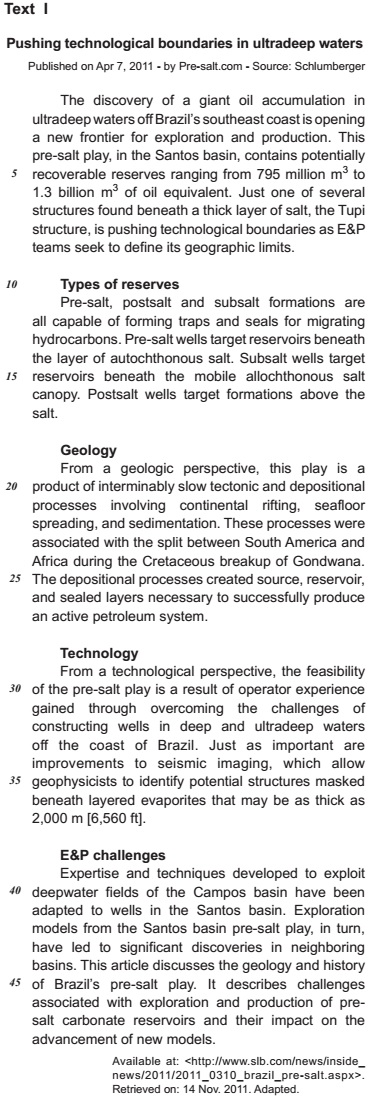


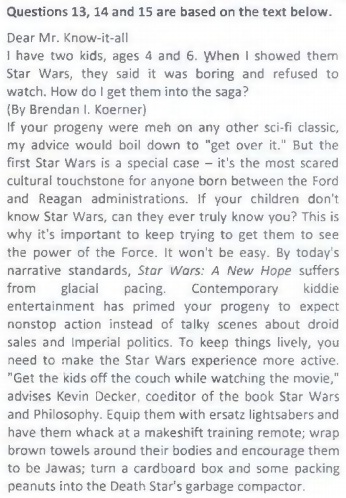
Read each of the sentences below.
I. The word "them" in " When I showed them Star Wars" means "that day".
II. The word "progeny in "If your progeny were meh on any other sci-fi classic" means "kids".
III. The text is a kind of letter to a philosopher.
We can say that:
The x2 is an experimental helicopter being developed by Sikorsky, an American company, which hopes it will be zipping along at more than 460kph. The company, however, is interested in more than just breaking speed records. It plans to use the technology developed for the x2 in commercial helicopters.
Sikorsky reckons that future helicopters built using the x2 technology would be extremely versatile machines. They would dash to and from a medical emergency a lot faster. They would also be very agile in flight, which would increase their capabilities in combat.
(Adapted from The Economist September 11, 2010, page 98)
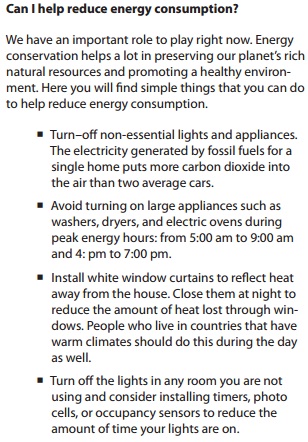
As palavras "We" e "Our" estão sendo usadas no texto como:
Can I help reduce energy consumption?
We have an important role to play right now. Energy conservation helps a lot in preserving our planet’s rich natural resources and promoting a healthy environment. Here you will find simple things that you can do to help reduce energy consumption.
· Turn–off non-essential lights and appliances. The electricity generated by fossil fuels for a single home puts more carbon dioxide into the air than two average cars.
· Avoid turning on large appliances such as washers, dryers, and electric ovens during peak energy hours: from 5:00 am to 9:00 am and 4: pm to 7:00 pm.
· Install white window curtains to reflect heat away from the house. Close them at night to reduce the amount of heat lost through windows. People who live in countries that have warm climates should do this during the day as well.
· Turn off the lights in any room you are not using and consider installing timers, photo cells, or occupancy sensors to reduce the amount of time your lights are on.
In the sentence
In the sentence



 Conheça nossos planos