Questões de Concurso
Sobre pronomes | pronouns em inglês
Foram encontradas 1.068 questões


Mark the only alternative where the word ‘one’ functions as an indefinite personal pronoun.



There are lots of things you can do to save energy at home, from simple things like washing at 30 °C, saving water and
recycling, to insulating your loft and cavity walls. By saving energy you’ll be reducing your home’s carbon dioxide (
 ) emissions
 and helping to fight climate change.
Why should you save energy?
Over 40 per cent of the UK’s man-made
 emissions actually come from energy we use every day – at home and when
 we travel. To generate that energy, we burn fossil fuels (coal, oil and gas) that produce ‘greenhouse’ gases – in particular
 –
– which are changing our climate and damaging the environment.
The greenhouse effect
 and various other gases wrap the Earth in an invisible ‘blanket’, helping to prevent heat from escaping. Without this
 greenhouse effect, the average temperature on Earth would be around -18 ºC, compared with the current average of around +15
ºC. This blanket of gases has remained at a constant concentration for many thousands of years. Since the Industrial Revolution
began around 200 years ago, people have been burning more fossil fuels. This has increased the heating effect of the ‘blanket’,
trapping more of the sun’s energy inside our atmosphere. In turn the Earth’s temperature has increased more rapidly in a shorter
period of time than it has for thousands of years.
The impact of climate change
People sometimes think that climate change will be a positive thing for the UK, giving us warmer summers and fewer cold
winters. But hotter summers and less rain in the south and east will mean water shortages, forest fires and damage to crops and
wildlife. In the north and west there could be much heavier rain and more flooding. As the polar ice caps continue to melt, rising sea
levels will threaten many coastal communities. Overall, the cost to society, the environment, our health and the economy is likely to
far outweigh any benefits.
Make a difference
The average UK household creates around six tonnes of
 every year – that’s 6,000 kg – to heat and power their home.
 Making your home more energy efficient could save you up to £340 a year and reduce your home’s
 emissions by up to 1,500–
2,000 kg. You could save even more by switching to renewable energy sources, by walking, cycling or using public transport
whenever possible, and by driving more efficiently.
(Texto introdutório ao manual “A guide to energy saving in the home”, disponível em: http://www.energysavingtrust.org.uk/Resources/Publications.)


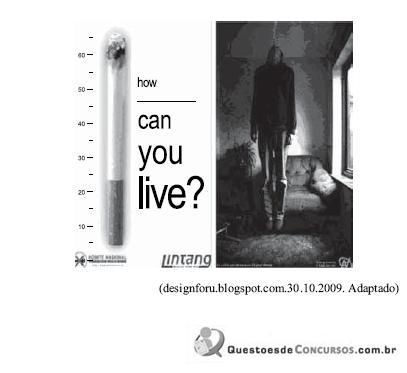
The blank in - how __________ can you live? - is correctly filled with
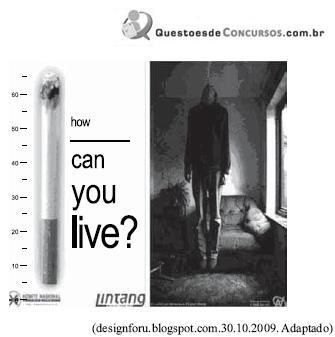
The blank in - how __________ can you live? - is correctly filled with


Judge - right (C) or wrong (E) - the following items with
reference to the text.
O texto a seguir refere-se às questões 29, 30, 31 e 32.
Learning to quit
Jodi Hall started smoking at age 9.
By the time she was 16, she was up to a pack a day – and she wanted to quit. A couple of reasons: one, her health; two, a guy named Mony. “He said that when he kissed me, it was like kissing an ashtray”, Jodi says.
Earlier this year, Jodi, along with 25 of her classmates at Johnson High School, in Savannah, GA, enrolled in the school’s first stop-smoking class. During the eight-week Tobacco Free Teen class, they learned what smoking can do to their body, their wallet and their grades (some kids end up cutting class to satisfy their nicotine cravings). But it wasn’t just about scare tactics. The goal is behavior modification, not punishment, so students are taught techniques for handling stress and resisting the urge to light up even when friends or parents do.
According to the American Lung Association (ALA), which sponsors the class, about half the adults who smoke were regular smokers by age 18. “Theses numbers are only going to get worse,” says Kristine Lewis of the ALA. “The tobacco industry is turning to teens.”
How did the students do? Jodi has been cigaretteless for three months. But she’s the only one. Her classmate Adam Cushman is slowly putting his way back to three packs a day. The 16-year-old says he wants to stop, “but the way things are going, I doubt I’ll be able to.”
Seventeen, June 1996.
O pronome they em “they learned what smoking can do to…” refere-se a Jodi e:
City hall braces for busy marriage day
If love is all you need, you’ll want for nothing in New York Thursday.
The folks who hand out marriage licenses are bracing for what could be their busiest day ever as Valentine’s Day romantics head to the aisle.
“When we are really busy, we have a second chapel we can open,” said First Deputy City Clerk Michael McSweeney. “We are preparing to do that. We’re expecting a lot of couples.”
City Hall’s unofficial record of 318 weddings on that date was set on Valentine’s Day 2002 - also on a Thursday.
And love is definitely in the air Thursday.
Melanie and Joseph Castine married on Valentine’s Day 10 years ago. Today, they’re renewing their vows in the same venue - the Empire State Building.
The couple, who recently moved from Roosevelt Island to Philadelphia, won a letter-writing competition with Brides.com to become one of 14 pairs tying the knot in the iconic building.
“Valentine’s Day is just the perfect day to do it,” said Melanie Castine, who, with her hubby, has been at the skyscraper every year to mark their anniversary.
“Everywhere you go in Manhattan, you can see the Empire State Building. It’s a constant reminder of our marriage. We call it our chapel in the sky.”
Meanwhile, love is being put on ice at one of the city’s most romantic spots.
Rockefeller Center is preparing to clear its rink at 8 p.m for a skater planning to get down on one knee for a surprise engagement.
“It’s a big surprise for her, but we’re sure it’s going to be extremely romantic,” a rink spokeswoman said.
(Available from: http://www.nydailynews.com/news/2008/02/14/2008-02-14 city hall braces for busy marriage day-1.html cited: 14 Feb. 2008)



 Conheça nossos planos