Questões de Concurso
Sobre pronomes | pronouns em inglês
Foram encontradas 1.068 questões


Ano: 2013
Banca:
FCC
Órgão:
MPE-CE
Prova:
FCC - 2013 - MPE-CE - Analista Ministerial - Ciências da Computação |
Q408452
Inglês
Texto associado
Atenção: Para responder às questões de números 17 a 19, considere o texto abaixo.
Facebook and mobile phones
Will Home work?
Apr 4th 2013, 23:24 by M.G | SAN FRANCISCO

A DAY after the mobile phone celebrated its 40th birthday, Facebook has produced something that it hopes will make certain of the devices even more useful. On April 4th the giant social network unveiled Home, new software that is designed to give it more prominence on mobile phones powered by Android, an operating system developed by Google.
This matters because more and more folk are now accessing social networks from mobile devices rather than from desktop computers and because mobile advertising revenues are growing fast, albeit from a low base. Without a robust mobile presence, Facebook could see some of its users siphoned off by rivals born in the mobile era. And it could miss out on a potentially massive source of new revenue.
There had been speculation that Facebook was working on a phone of its own, or at least on a mobile operating system to rival Android or Apple’s iOS. But dabbling in hardware at this stage of its development would be a huge risk for Facebook and developing a rival operating system would risk alienating Apple and Google, whose mobile platforms have helped power its advertising growth. EMarketer, a research firm, reckons Facebook is on track to win 11% of the $13.6 billion likely to be spent around the world on mobile ads this year.
(Adaptado de http://www.economist.com/blogs/babbage/2013/04/facebook-and-mobile-phones; Acessado em 08/04/2013)
Facebook and mobile phones
Will Home work?
Apr 4th 2013, 23:24 by M.G | SAN FRANCISCO
A DAY after the mobile phone celebrated its 40th birthday, Facebook has produced something that it hopes will make certain of the devices even more useful. On April 4th the giant social network unveiled Home, new software that is designed to give it more prominence on mobile phones powered by Android, an operating system developed by Google.
This matters because more and more folk are now accessing social networks from mobile devices rather than from desktop computers and because mobile advertising revenues are growing fast, albeit from a low base. Without a robust mobile presence, Facebook could see some of its users siphoned off by rivals born in the mobile era. And it could miss out on a potentially massive source of new revenue.
There had been speculation that Facebook was working on a phone of its own, or at least on a mobile operating system to rival Android or Apple’s iOS. But dabbling in hardware at this stage of its development would be a huge risk for Facebook and developing a rival operating system would risk alienating Apple and Google, whose mobile platforms have helped power its advertising growth. EMarketer, a research firm, reckons Facebook is on track to win 11% of the $13.6 billion likely to be spent around the world on mobile ads this year.
(Adaptado de http://www.economist.com/blogs/babbage/2013/04/facebook-and-mobile-phones; Acessado em 08/04/2013)
As palavras it e whose, que aparecem sublinhadas no texto, referem-se, respectivamente, a
Q385736
Inglês
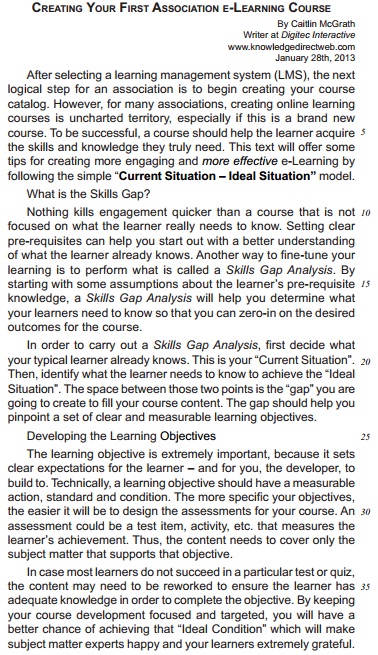
Observe the fragment:
In order to carry out a Skills Gap Analysis, ? rst decide what your typical learner already knows. This is your “Current Situation”. (L. 19-20)
The demonstrative this in the sentence refers to:
In order to carry out a Skills Gap Analysis, ? rst decide what your typical learner already knows. This is your “Current Situation”. (L. 19-20)
The demonstrative this in the sentence refers to:
Ano: 2013
Banca:
CESPE / CEBRASPE
Órgão:
Instituto Rio Branco
Prova:
CESPE - 2013 - Instituto Rio Branco - Diplomata - Prova 2 |
Q359340
Inglês

Regarding the text, judge if the items below are right (C) or wrong (E).
In the sentence “That includes scaling back its bond- buying program beginning later this year.” (l.17-18), the pronoun “its” refers to “economy”, in the previous sentence.
In the sentence “That includes scaling back its bond- buying program beginning later this year.” (l.17-18), the pronoun “its” refers to “economy”, in the previous sentence.
Ano: 2013
Banca:
CESPE / CEBRASPE
Órgão:
Instituto Rio Branco
Prova:
CESPE - 2013 - Instituto Rio Branco - Diplomata - Prova 2 |
Q359339
Inglês
Regarding the text, judge if the items below are right (C) or wrong (E).
In the sentence “Their cue came from the Federal Reserve chairman, Ben Bernanke, who recently suggested that the economic recovery might allow the central bank to ease its efforts to stimulate the economy.” (l.14-17) the relative pronoun “who” may be replaced by whom in more formal contexts.
In the sentence “Their cue came from the Federal Reserve chairman, Ben Bernanke, who recently suggested that the economic recovery might allow the central bank to ease its efforts to stimulate the economy.” (l.14-17) the relative pronoun “who” may be replaced by whom in more formal contexts.
Ano: 2013
Banca:
CESPE / CEBRASPE
Órgão:
Instituto Rio Branco
Prova:
CESPE - 2013 - Instituto Rio Branco - Diplomata - Prova 2 |
Q359332
Inglês
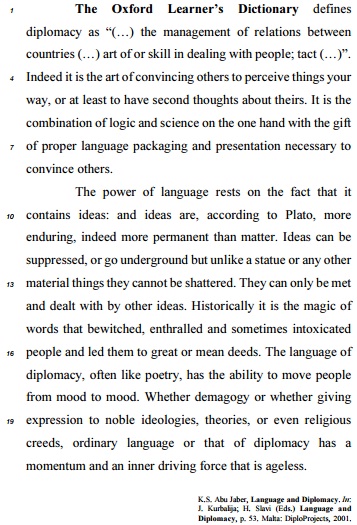
In relation to the pronouns shown in bold in the text above, judge if the items below are right (C) or wrong (E).
The pronoun “they” (l.13) refers to “Ideas” (l.11)
The pronoun “they” (l.13) refers to “Ideas” (l.11)
Ano: 2013
Banca:
CESPE / CEBRASPE
Órgão:
Instituto Rio Branco
Prova:
CESPE - 2013 - Instituto Rio Branco - Diplomata - Prova 2 |
Q359331
Inglês
In relation to the pronouns shown in bold in the text above, judge if the items below are right (C) or wrong (E).
The pronoun “It” (l.5) refers to “diplomacy” (l.2).
The pronoun “It” (l.5) refers to “diplomacy” (l.2).
Ano: 2013
Banca:
CESPE / CEBRASPE
Órgão:
Instituto Rio Branco
Prova:
CESPE - 2013 - Instituto Rio Branco - Diplomata - Prova 2 |
Q359330
Inglês
In relation to the pronouns shown in bold in the text above, judge if the items below are right (C) or wrong (E).
The pronoun “theirs” (l.5) refers to “others” (l.4).
The pronoun “theirs” (l.5) refers to “others” (l.4).
Ano: 2013
Banca:
CESPE / CEBRASPE
Órgão:
Instituto Rio Branco
Prova:
CESPE - 2013 - Instituto Rio Branco - Diplomata - Prova 2 |
Q359329
Inglês
In relation to the pronouns shown in bold in the text above, judge if the items below are right (C) or wrong (E).
The pronoun “that” (l.21) refers to “language” (l.20)
The pronoun “that” (l.21) refers to “language” (l.20)
Ano: 2013
Banca:
CETRO
Órgão:
ANVISA
Prova:
CETRO - 2013 - ANVISA - Analista Administrativo - Conhecimentos Gerais - Todas as Áreas - Prova Anulada |
Q325554
Inglês

Read the sentence below
“Botox's sales grew 1,407% and by 2007, total Botox sales exceeded $500 million. More than 70% of that was for unapproved uses.”
It is correct to affirm that the underlined word refers to
“Botox's sales grew 1,407% and by 2007, total Botox sales exceeded $500 million. More than 70% of that was for unapproved uses.”
It is correct to affirm that the underlined word refers to
Ano: 2013
Banca:
CETRO
Órgão:
ANVISA
Prova:
CETRO - 2013 - ANVISA - Analista Administrativo - Conhecimentos Gerais - Todas as Áreas - Prova Anulada |
Q325553
Inglês
Read the sentence below and choose the alternative that correctly links the underlined words to the nouns they refer to.
An FDA advisory panel, (I) which gave preliminary approval to Allergan's application, wasn't entirely happy with the company's data supporting (II) its safety and efficacy claims for the Lap-Band— (III) its own 149-patient study and six other studies, at least three of (IV) which conducted by researchers with financial links to Allergan.
An FDA advisory panel, (I) which gave preliminary approval to Allergan's application, wasn't entirely happy with the company's data supporting (II) its safety and efficacy claims for the Lap-Band— (III) its own 149-patient study and six other studies, at least three of (IV) which conducted by researchers with financial links to Allergan.
Ano: 2013
Banca:
FCC
Órgão:
SEFAZ-SP
Prova:
FCC - 2013 - SEFAZ-SP - Agente Fiscal de Rendas - Gestão Tributária - Prova 1 |
Q319151
Inglês
For taxpayer advocate, a familiar refrain
By Michelle Singletary, Published: January 15, 2013
It’s not nice to tell people “I told you so.” But if anybody has the right to say that, it’s Nina E. Olson, the national taxpayer advocate.
Olson recently submitted her annual report to Congress and top on her list of things that need to be fixed is the complexity of the tax
code, which she called the most serious problem facing taxpayers.
Let’s just look at the most recent evidence of complexity run amok. The Internal Revenue Service had to delay the tax-filing season so it
could update forms and its programming to accommodate recent changes made under the American Taxpayer Relief Act. The IRS won’t start
processing individual income tax returns until Jan. 30. Yet one thing remains unchanged − the April 15 tax deadline.
Because of the new tax laws, the IRS also had to release updated income-tax withholding tables for 2013. These replace the tables
issued Dec. 31. Yes, let’s just keep making more work for the agency that is already overburdened. Not to mention the extra work for
employers, who have to use the revised information to correct the amount of Social Security tax withheld in 2013. And they have to make that
correction in order to withhold a larger Social Security tax of 6.2 percent on wages, following the expiration of the payroll tax cut in effect for
2011 and 2012.
Oh, and there was the near miss with the alternative minimum tax that could have delayed the tax filing season to late March. The AMT
was created to target high-income taxpayers who were claiming so many deductions that they owed little or no income tax. Olson and many
others have complained for years that the AMT wasn’t indexed for inflation.
“Many middle- and upper-middle-class taxpayers pay the AMT, while most wealthy taxpayers do not, and thousands of millionaires pay
..A.. income tax at all,” Olson said.
As part of the recent “fiscal cliff” deal, the AMT is now fixed, a move that the IRS was anticipating. It had already decided to program its
systems on the assumption that an AMT patch would be passed, Olson said. Had the agency not taken the risk, the time it would have taken to
update the systems “would have brought about the most chaotic filing season in memory,” she said in her report.
The tax code contains almost 4 million words. Since 2001, there have been about 4,680 changes, or an average of more than one
change a day. What else troubles Olson? Here’s what:
− Nearly 60 percent of taxpayers hire paid preparers, and another 30 percent rely on commercial software to prepare their returns.
− Many taxpayers don’t really know how their taxes are computed and what rate of tax they pay.
− The complex code makes tax fraud ..B.. to detect.
− Because the code is so complicated, it creates an impression that many taxpayers are not paying their fair share. This reduces trust
in the system and perhaps leads some people to cheat. Who wants to be the sucker in this game? So someone might not declare
all of his income, rationalizing that millionaires get to use the convoluted code to greatly reduce their tax liability.
− In fiscal year 2012, the IRS received around 125 million calls. But the agency answered only about two out of three calls from
people trying to reach a live person, and those taxpayers had to wait, on average, about 17 minutes to get through.
“I hope 2013 brings about fundamental tax simplification,” Olson pleaded in her report. She urged Congress to reassess the need for
the tax breaks we know as income exclusions, exemptions, deductions and credits. It’s all these tax advantage breaks that complicate the
code. If done right, and without reducing revenue, tax rates could be substantially lowered in exchange for ending tax breaks, she said.
(Adapted from http://js.washingtonpost.com/business/economy/for-taxpayer-advocate-a-familiar-refrain/2013/01/15/a10327ce-5f59-
11e2-b05a-605528f6b712_story.html)
A alternativa que preenche corretamente a lacuna ..A.. é
By Michelle Singletary, Published: January 15, 2013
It’s not nice to tell people “I told you so.” But if anybody has the right to say that, it’s Nina E. Olson, the national taxpayer advocate.
Olson recently submitted her annual report to Congress and top on her list of things that need to be fixed is the complexity of the tax
code, which she called the most serious problem facing taxpayers.
Let’s just look at the most recent evidence of complexity run amok. The Internal Revenue Service had to delay the tax-filing season so it
could update forms and its programming to accommodate recent changes made under the American Taxpayer Relief Act. The IRS won’t start
processing individual income tax returns until Jan. 30. Yet one thing remains unchanged − the April 15 tax deadline.
Because of the new tax laws, the IRS also had to release updated income-tax withholding tables for 2013. These replace the tables
issued Dec. 31. Yes, let’s just keep making more work for the agency that is already overburdened. Not to mention the extra work for
employers, who have to use the revised information to correct the amount of Social Security tax withheld in 2013. And they have to make that
correction in order to withhold a larger Social Security tax of 6.2 percent on wages, following the expiration of the payroll tax cut in effect for
2011 and 2012.
Oh, and there was the near miss with the alternative minimum tax that could have delayed the tax filing season to late March. The AMT
was created to target high-income taxpayers who were claiming so many deductions that they owed little or no income tax. Olson and many
others have complained for years that the AMT wasn’t indexed for inflation.
“Many middle- and upper-middle-class taxpayers pay the AMT, while most wealthy taxpayers do not, and thousands of millionaires pay
..A.. income tax at all,” Olson said.
As part of the recent “fiscal cliff” deal, the AMT is now fixed, a move that the IRS was anticipating. It had already decided to program its
systems on the assumption that an AMT patch would be passed, Olson said. Had the agency not taken the risk, the time it would have taken to
update the systems “would have brought about the most chaotic filing season in memory,” she said in her report.
The tax code contains almost 4 million words. Since 2001, there have been about 4,680 changes, or an average of more than one
change a day. What else troubles Olson? Here’s what:
− Nearly 60 percent of taxpayers hire paid preparers, and another 30 percent rely on commercial software to prepare their returns.
− Many taxpayers don’t really know how their taxes are computed and what rate of tax they pay.
− The complex code makes tax fraud ..B.. to detect.
− Because the code is so complicated, it creates an impression that many taxpayers are not paying their fair share. This reduces trust
in the system and perhaps leads some people to cheat. Who wants to be the sucker in this game? So someone might not declare
all of his income, rationalizing that millionaires get to use the convoluted code to greatly reduce their tax liability.
− In fiscal year 2012, the IRS received around 125 million calls. But the agency answered only about two out of three calls from
people trying to reach a live person, and those taxpayers had to wait, on average, about 17 minutes to get through.
“I hope 2013 brings about fundamental tax simplification,” Olson pleaded in her report. She urged Congress to reassess the need for
the tax breaks we know as income exclusions, exemptions, deductions and credits. It’s all these tax advantage breaks that complicate the
code. If done right, and without reducing revenue, tax rates could be substantially lowered in exchange for ending tax breaks, she said.
(Adapted from http://js.washingtonpost.com/business/economy/for-taxpayer-advocate-a-familiar-refrain/2013/01/15/a10327ce-5f59-
11e2-b05a-605528f6b712_story.html)
A alternativa que preenche corretamente a lacuna ..A.. é
Ano: 2013
Banca:
FUNCAB
Órgão:
CODATA
Prova:
FUNCAB - 2013 - CODATA - Analista de Informática - Banco de Dados |
Q307609
Inglês

The pronoun IT in “It also lists the hardware setup procedures” refers in the text to:
Ano: 2013
Banca:
FUNCAB
Órgão:
CODATA
Prova:
FUNCAB - 2013 - CODATA - Analista de Informática - Banco de Dados |
Q307608
Inglês
The pronoun IT in “the new technology it supports” refers in the text to:
Ano: 2013
Banca:
FCC
Órgão:
TRT - 9ª REGIÃO (PR)
Prova:
FCC - 2013 - TRT - 9ª REGIÃO (PR) - Analista Judiciário - Tecnologia da Informação |
Q302116
Inglês
December 12, 2012
If It’s for Sale, His Lines Sort It
By MARGALIT FOX
It was born on a beach six decades ago, the product of a pressing need, an intellectual spark and the sweep of a young man’s
fingers through the sand.
The result adorns almost every product of contemporary life, including groceries, wayward luggage and, if you are a
traditionalist, the newspaper you are holding.
The man on the beach that day was a mechanical-engineer-in-training named N. Joseph Woodland. With that transformative
stroke of his fingers − yielding a set of literal lines in the sand − Mr. Woodland, who died on Sunday at 91, conceived the modern bar
code.
Mr. Woodland was a graduate student when he and a classmate, Bernard Silver, created a technology, based on a printed
series of wide and narrow striations, that encoded consumer-product information for optical scanning.
Their idea, developed in the late 1940s and patented 60 years ago this fall, turned out to be ahead of its time, and the two men
together made only $15,000 from it, when they sold their patent to Philco. But the curious round symbol they devised would ultimately
give rise to the universal product code, or U.P.C., as the staggeringly prevalent rectangular bar code (it graces tens of millions of
different items) is officially known.

Here is part of the story behind the invention:
To represent information visually, he realized, he would need a code. The only code he knew was the one he had learned in the
Boy Scouts.
What would happen, Mr. Woodland wondered one day, if Morse code, with its elegant simplicity and limitless combinatorial
potential, were adapted graphically? He began trailing his fingers idly through the sand.
“What I’m going to tell you sounds like a fairy tale,” Mr. Woodland told Smithsonian magazine in 1999. “I poked my four fingers
into the sand and for whatever reason − I didn’t know − I pulled my hand toward me and drew four lines. I said: ‘Golly! Now I have four
lines, and they could be wide lines and narrow lines instead of dots and dashes.’ ”
That consequential pass was merely the beginning. “Only seconds later,” Mr. Woodland continued, “I took my four fingers − they
were still in the sand − and I swept them around into a full circle.”
Mr. Woodland favored the circular pattern for its omnidirectionality: a checkout clerk, he reasoned, could scan a product without
regard for its orientation.
But that method − a variegated bull’s-eye of wide and narrow bands −, which depended on an immense scanner equipped with
a 500-watt light, was expensive and unwieldy, and it languished for years.
The two men eventually sold their patent to Philco for $15,000 − all they ever made from their invention.
By the time the patent expired at the end of the 1960s, Mr. Woodland was on the staff of I.B.M., where he worked from 1951
until his retirement in 1987.
Over time, laser scanning technology and the advent of the microprocessor made the bar code viable. In the early 1970s, an
I.B.M. colleague, George J. Laurer, designed the familiar black-and-white rectangle, based on the Woodland-Silver model and drawing
on Mr. Woodland’s considerable input.
(Adapted from http://www.nytimes.com/2012/12/13/business/n-joseph-woodland-inventor-of-the-bar-code-dies-at-91.html?nl=todaysheadlines
&emc=edit_th_20121214&_r=0)
O pronome “It”, no início do texto, refere-se a
If It’s for Sale, His Lines Sort It
By MARGALIT FOX
It was born on a beach six decades ago, the product of a pressing need, an intellectual spark and the sweep of a young man’s
fingers through the sand.
The result adorns almost every product of contemporary life, including groceries, wayward luggage and, if you are a
traditionalist, the newspaper you are holding.
The man on the beach that day was a mechanical-engineer-in-training named N. Joseph Woodland. With that transformative
stroke of his fingers − yielding a set of literal lines in the sand − Mr. Woodland, who died on Sunday at 91, conceived the modern bar
code.
Mr. Woodland was a graduate student when he and a classmate, Bernard Silver, created a technology, based on a printed
series of wide and narrow striations, that encoded consumer-product information for optical scanning.
Their idea, developed in the late 1940s and patented 60 years ago this fall, turned out to be ahead of its time, and the two men
together made only $15,000 from it, when they sold their patent to Philco. But the curious round symbol they devised would ultimately
give rise to the universal product code, or U.P.C., as the staggeringly prevalent rectangular bar code (it graces tens of millions of
different items) is officially known.
Here is part of the story behind the invention:
To represent information visually, he realized, he would need a code. The only code he knew was the one he had learned in the
Boy Scouts.
What would happen, Mr. Woodland wondered one day, if Morse code, with its elegant simplicity and limitless combinatorial
potential, were adapted graphically? He began trailing his fingers idly through the sand.
“What I’m going to tell you sounds like a fairy tale,” Mr. Woodland told Smithsonian magazine in 1999. “I poked my four fingers
into the sand and for whatever reason − I didn’t know − I pulled my hand toward me and drew four lines. I said: ‘Golly! Now I have four
lines, and they could be wide lines and narrow lines instead of dots and dashes.’ ”
That consequential pass was merely the beginning. “Only seconds later,” Mr. Woodland continued, “I took my four fingers − they
were still in the sand − and I swept them around into a full circle.”
Mr. Woodland favored the circular pattern for its omnidirectionality: a checkout clerk, he reasoned, could scan a product without
regard for its orientation.
But that method − a variegated bull’s-eye of wide and narrow bands −, which depended on an immense scanner equipped with
a 500-watt light, was expensive and unwieldy, and it languished for years.
The two men eventually sold their patent to Philco for $15,000 − all they ever made from their invention.
By the time the patent expired at the end of the 1960s, Mr. Woodland was on the staff of I.B.M., where he worked from 1951
until his retirement in 1987.
Over time, laser scanning technology and the advent of the microprocessor made the bar code viable. In the early 1970s, an
I.B.M. colleague, George J. Laurer, designed the familiar black-and-white rectangle, based on the Woodland-Silver model and drawing
on Mr. Woodland’s considerable input.
(Adapted from http://www.nytimes.com/2012/12/13/business/n-joseph-woodland-inventor-of-the-bar-code-dies-at-91.html?nl=todaysheadlines
&emc=edit_th_20121214&_r=0)
O pronome “It”, no início do texto, refere-se a
Ano: 2013
Banca:
CESGRANRIO
Órgão:
BNDES
Provas:
CESGRANRIO - 2013 - BNDES - Nível Superior - Conhecimentos Básicos - Todos os Cargos
|
CESGRANRIO - 2013 - BNDES - Profissional Básico - Biblioteconomia |
CESGRANRIO - 2013 - BNDES - Profissional Básico - Comunicação Social |
Q301255
Inglês

In the fragment “as those experienced by their bigger counterparts” (line 92) the pronoun those refers to
Ano: 2013
Banca:
CESGRANRIO
Órgão:
BNDES
Prova:
CESGRANRIO - 2013 - BNDES - Técnico Administrativo |
Q300571
Inglês

In the excerpt of the text - “are especially critical for workers and managers in a globalized economy defined by its unpredictability and dynamism.” - (lines 39 - 41) the possessive pronoun its refers to
Ano: 2013
Banca:
CESPE / CEBRASPE
Órgão:
CNJ
Prova:
CESPE / CEBRASPE - 2013 - CNJ - Técnico Judiciário - Programação de Sistemas |
Q300327
Inglês
Texto associado

Judge the items according to the text above.
Judge the items according to the text above.
The word “its” in the first paragraph refers to “complaints”.
Ano: 2012
Banca:
FADESP
Órgão:
Prefeitura de Alenquer - PA
Prova:
FADESP - 2012 - Prefeitura de Alenquer - PA - Professor - Língua Inglesa |
Q2913999
Inglês
Texto associado
THERE ARE 10 QUESTIONS OF MULTIPLE CHOICE IN YOUR TEST. EACH QUESTION HAS 4 ALTERNATIVES (A, B, C, AND D) FROM WHICH ONLY ONE IS CORRECT. CHECK THE CORRECT ONE.
A Framework
for Understanding Cross-Cultural
Misunderstandings
Successful communication between human
beings, either within a culture or between
cultures,
requires that the message and meaning
intended by the speaker is correctly
received and interpreted by
the listener. Sustainable error free
communication is rare, and in most human
interactions there is some
degree of miscommunication.
The message
sent from speaker to listener
contains a wide array of features, such as
words,
grammar, syntax, idioms, tone of voice,
emphasis, speed, emotion, and body language,
and the
interpretation requires the listener to
attend to all of these features, while at
the same time constructing
an understanding of the speaker's
intentions, emotions, politeness,
seriousness, character, beliefs,
priorities, motivations, and style of
communicating. In addition, the listener
must also evaluate whether
the utterance is a question or a statement
and how and to what extent a statement
matters to the
speaker (Maltz and Borker, 1982).
Each
of the components of the communication
provides one or more kind of information.
Words
convey abstract logic, tone of voice conveys
attitudes, emotions and emphases, and body
language
communicates "requests versus commands, the
stages of greeting, and turn-taking"
(Schneller 1988, p.
154).
Even assuming that words and body
language
were perfectly understood, there is more
information necessary to successfully
communicate across cultures. For example, in
some countries it is
polite to refuse the first few offers of
refreshment: "Many foreign guests have gone
hungry because their
U.S. host or hostess never presented a third
offer" (Samovar and Porter 1988, p. 326). In
understanding
communication, a listener must pay attention
not just to what is said and when, but also
to how many
times something is said, under what
circumstances, and by whom.
Given all this
complexity, the reason human
communication can often succeed is because
people
learn how to communicate and understand
through interacting with one another
throughout their lives.
Therefore, it is no surprise that culture
and socialization are critical determinants
of communication and
interpretation. "The entire inference
process, from observation through
categorization is a function of
one's socialization" Detweiler (1975).
Socialization influences how input will be
received, and how
perceptions will be organized conceptually
and associated with memories.
The importance of
culture to communication
Some theorists have gone so far
as to claim
that culture not only influences
interpretation, but
constitutes interpretation. The
interpretation of communicative intent is
not predictable on the basis of
referential meaning alone. Matters of
context, social presuppositions, knowledge
of the world, and
individual background all play an important
role in interpretation (Gumperz,
1978b).
Even knowledgeable translators can
have
difficulty with cross-cultural translations.
There may not
be corresponding words or equivalent
concepts in both cultures, jokes and
implications may be
overlooked, and literal translations can
present a host of difficulties. Some
language pairs are very
difficult to translate, while others,
usually in more similar languages, are much
easier (Sechrest, Fay and
Zaidi 1988).
While some of the incremental
difficulties
can be traced to the underlying linguistic
commonalities
between the languages, there may be a more
elusive cultural and ecological basis for
difficulty in
translation. It would be interesting to test
how much of the variance in communication
could be
accounted for by the ease with which the
languages in question could be translated
into one another.
Although it may
facilitate cross-cultural
translations, similarity of languages and
cultures also
increases the likelihood that communicators
will erroneously assume similarity of
meanings. This may
make them more likely to misunderstand
speech and behavior without being aware that
they may have
misinterpreted the speaker's message.
In general,
cross-cultural miscommunication
can be thought to derive from the mistaken
belief
that emics are etics, that words and deeds
mean the same thing across cultures, and
this miscalculation
is perhaps more likely when cultures are
similar in surface attributes but different
in important underlying
ways. In this case miscommunication may
occur instead of non-communication.
(http://www.dattnerconsulting.com/cross.html
)
The pronoun them in “This may make them more likely to misunderstand speech and behavior without being aware that they may have misinterpreted the speaker's message” refers to
Ano: 2012
Banca:
RBO
Órgão:
Prefeitura de Porto Ferreira - SP
Prova:
RBO - 2012 - Prefeitura de Porto Ferreira - SP - Professor de Educação Básica II - Inglês |
Q1203567
Inglês
Complete the sentences below with the appropriate word and choose the best alternative:
“Josh is the boy ______ I met on the party.
She likes pizzas ______ are hot.
These are the old couple _______ house was on fire”.
Ano: 2012
Banca:
CESGRANRIO
Órgão:
Petrobras
Provas:
CESGRANRIO - 2012 - BR Distribuidora - Profissional Júnior - Formação Administração
|
CESGRANRIO - 2012 - BR Distribuidora - Profissional Júnior - Formação Engenharia Mecânica |
CESGRANRIO - 2012 - BR Distribuidora - Profissional Júnior - Formação Ciências Contábeis |
CESGRANRIO - 2012 - BR Distribuidora - Profissional Júnior - Formação Analista de Sistemas - Ênfase em Java - Crm e Web |
Q460777
Inglês

The pronoun they in “they don’t have time to train for those key skills.” (lines 38-39) refers to

 Conheça nossos planos