Questões de Concurso
Sobre pronomes | pronouns em inglês
Foram encontradas 1.068 questões


(Available at: https://www.theguardian.com/uk-news/2026/sep/16/expect-more-potholes-uk-roads-summer-
heatwaves-rac - text specially adapted for this test).
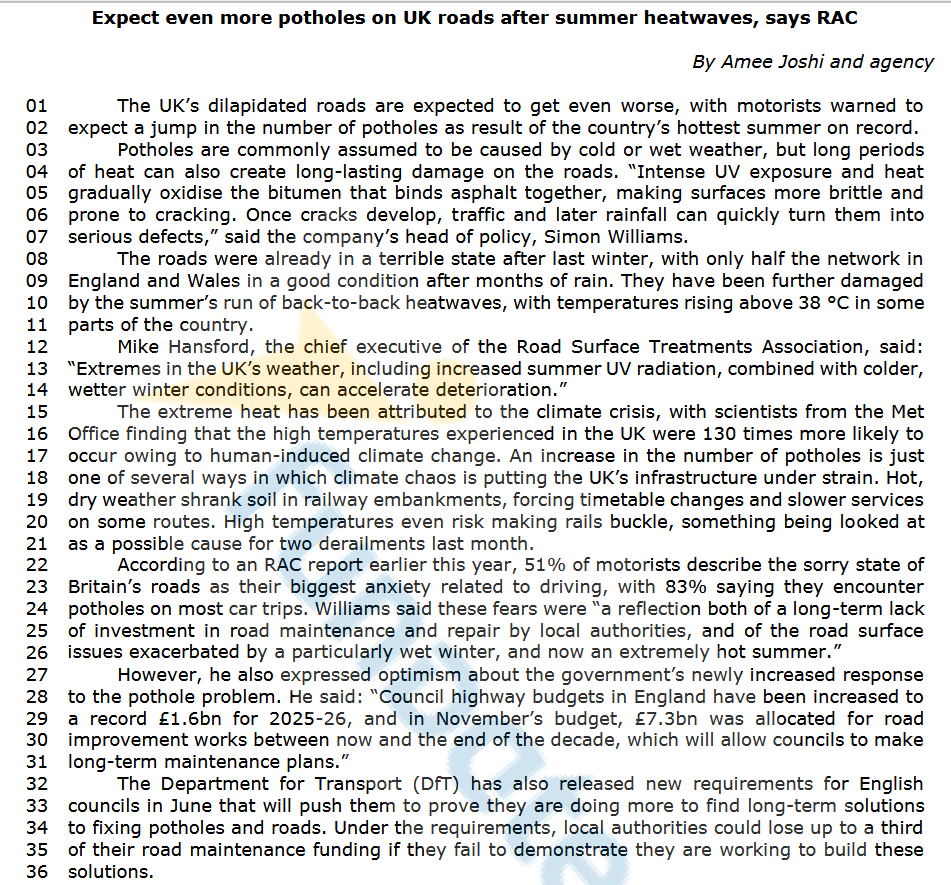
“[…] local authorities could lose up to a third of their road maintenance funding if they fail to demonstrate they are working to build these solutions.” (l. 34-36).
Considering the change of the subject “local authorities” to the singular form “the local authority”, mark the alternative that presents the necessary grammatical changes.
TEXT III

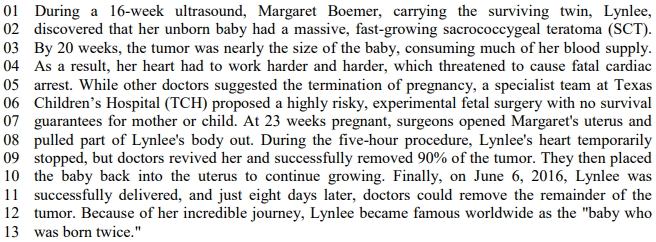
Leila sent the revised schedule to the teachers. They noticed that it still listed the old workshop date. This error forced her to issue a second version before the afternoon meeting.
The cohesive interpretation of the passage depends on correctly identifying several referential relationships.
Analyze the statements below.
I."They" refers to "the teachers."
II."It" refers to "the revised schedule."
III."This error" refers to Leila's decision to issue a second version.
IV."Her" refers to Leila.
It is CORRECT what is stated in:
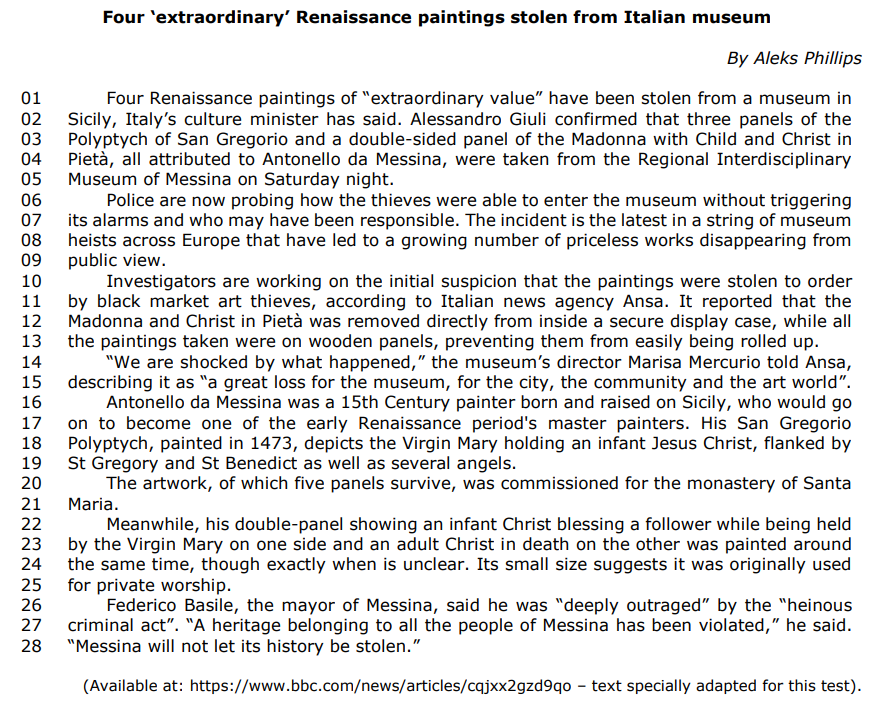
"Neuroscientists have demonstrated that bilingualism sharpens the brain's executive functions. This cognitive advantage, however, is not static; it requires continuous linguistic exercise, ensuring that the former remains active well into old age." (Adaptado de Scientific American.)
No excerto, os elementos coesivos destacados retomam, respectivamente:
The quest to understand the fundamental nature of light has sparked debate for centuries and ultimately played a pivotal role in the development of quantum physics. Even the earliest recorded speculations about light contained the seeds of concepts that would, centuries later, be woven into our quantum understanding of reality. Some of the earliest recorded ideas about the nature of light appeared in the 6th century BCE. In India, for instance, the Vaisheshika school of philosophy described light as consisting of fire-like particles moving at a high speed. In ancient Greece, the Pythagoreans (6th 5th century BCE) and later Euclid (c. 300 BCE) advocated the emission theory of vision, suggesting that rays of light emanate from the eyes toward objects. In contrast, Epicurus (341 270 BCE) proposed an intromission theory, arguing that light consists of material images or "eidola" emitted by objects that travel to the eyes. Further insights into the nature of light emerged in Egypt, where Ptolemy (c. AD 90 168), working in Alexandria, conducted experiments showing that light reflects off smooth surfaces and bends when passing through transparent materials of different optical densities. Building on these concepts, Arab scholars made significant contributions to the understanding of light by establishing foundational principles governing its behavior in lenses, mirrors, and prisms. The most influential among them was the 11th-century scholar Ibn al-Haytham, who lived in present-day Iraq. Ibn al-Haytham corrected the emission theory, stating thatvision results from light entering the eye rather thanemanating from it. By the 17th century, European scientists were dividedbetween two competing theories about the fundamentalnature of light: whether it behaved as a wave or as aparticle. Dutch physicist Christiaan Huygens argued thatlight propagates as waves according to his wave-frontprinciple, which explains how waves evolve when theyencounter obstacles. In contrast, Isaac Newton proposeda corpuscular theory, suggesting that light consists ofparticles traveling in straight paths, capable of reflectingoff surfaces like mirrors. Newton's prism experiments,which showed white light splitting into colors with distinctrefraction angles, supported his corpuscular theory bysuggesting that light consists of particles of differentsizes, each corresponding to a different color, whichbend by different amounts. Both theories, however, were incomplete. Huygens' wavetheory struggled to fully explain why light travels in astraight path, and Newton's particle theory couldn'taccount for diffraction, the spreading of light as it passesaround edges or through narrow openings. Nevertheless,Newton's theory gained significant influence not onlybecause of his clever prism experiments, but alsobecause he was highly revered in the scientificcommunity, making his ideas difficult to challenge foryears. But science doesn't bow to reputation. As RichardFeynman famously pointed out in his 1964 MessengerLectures at Cornell University, "It doesn't matter howbeautiful your theory is, it doesn't matter how smart youare. If it doesn't agree with the experiment, it's wrong."Indeed, nearly a century after Newton's corpusculartheory of 1704, the scientific consensus gradually shiftedtoward the wave theory of light through decades ofexperiments, modeling, and debates. One of the keycontributors to this shift was Thomas Young, an Englishpolymath. In 1801, Young passed sunlight through anarrow slit to produce a coherent light beam. He thenplaced a thin obstacle, such as a hair or a narrow strip,across the beam, splitting it into two waves that spreadout and overlapped. When these waves recombined on ascreen, they produced a pattern of bright and dark bands.This interference pattern provided clear and compellingevidence that light behaves as a wave rather than as aparticle. A familiar example of this phenomenon is when waves onthe surface of water either combine to form larger peaksor cancel each other out. Later, in 1845, another Englishphysicist Michael Faraday showed that magnetic fieldscould alter the polarization plane of light, revealing aconnection between light and electromagnetism. In the1860s, Scottish physicist James Clerk Maxwell built onthis connection by formulating the theory ofelectromagnetism, describing light as an electromagneticwave composed of oscillating electric and magnetic fields at right angles to each other and to the wave's direction of travel. Heinrich Hertz's experimental confirmation of Maxwell's predictions in the 1880s provided further validation of the electromagnetic wave theory of light. By the 1890s, Maxwell's mathematical description of electromagnetic waves was considered so successful, particularly for its predictive power, that many physicists believed the fundamental nature of light was fully understood. But in the early 20th century, experimental discoveries began to challenge this consensus. The electromagnetic wave theory failed to predict how matter emits and absorbs radiation at thermal equilibrium. To address this question, German physicist Max Planck introduced a revolutionary idea known as energy quantization. He proposed that electromagnetic radiation is emitted or absorbed in discrete amounts, now called quanta, with higher frequency light corresponding to larger quanta. His theory accurately matched experimental results and earned him the Nobel Prize in Physics in 1918. Another major blow to the wave theory of light came from the photoelectric effect, first observed by Heinrich Hertz in 1887, when ultraviolet light caused electric charge to be emitted from a metal surface. By 1900, Philipp Lenard conducted detailed experiments to show that the energy of ejected electrons depended on light frequency, not intensity, an observation that classical wave theory struggled to explain. In 1905, Albert Einstein addressed this by proposing that light is made of discrete energy packets, now called photons, each carrying an energy proportional to its frequency according to Planck's quantization rule. This idea successfully explained the photoelectric effect and was later confirmed by Robert Millikan's experiments in 1915, which verified that the energy of the ejected electrons depends on light frequency and that intensity affects only the number of ejected electrons. Einstein's explanation earned him the 1921 Nobel Prize in Physics. The existence of the photon was further reinforced in 1923 by American physicist Arthur Compton, who showed that X-rays scatter off electrons and emerge with smaller frequencies. The photoelectric effect showed that light interacts with matter through discrete, fundamental processes, behaving as if it were made up of particles known as photons. On the other hand, Young's double-slit experiment provided convincing evidence that light also exhibits wave-like behavior through interference. These seemingly contradictory findings reveal the dual nature of light, a concept known as wave-particle duality. Today, this principle is central to quantum physics, which describes light as a quantum electromagnetic field. This field has discrete energy excitations called photons that can produce particle-like effects, while also exhibiting wave-like behavior depending on how light interacts with its environment. https://quantum2025.org/news-link/the-history-of-light-and-the-birth-of-q uantum-physics/ (adapted)
"He then placed a thin obstacle, such as a hair or a narrow strip, across the beam, splitting it into two waves that spread out and overlapped."
In the sentence, the pronoun "it" and the relative pronoun "that" refer, respectively, to:
READ TEXT III AND ANSWER THE QUESTION THAT FOLLOW
TEXT III
ELF and the Brazilian National Core Curriculum
The current Brazilian National Core Curriculum (BNCC) adopts English as a Lingua Franca (ELF) as a guiding concept for English Language Teaching (ELT) across the country’s basic education system. While the measure has sparked debate and controversy, ELF’s inclusion in the document is generally seen as an innovative step. However, its implementation has brought significant challenges, especially for teachers who often lack a clear understanding of the concept or how to incorporate ELF-aware practices into their classrooms. These challenges underscore the pivotal role of teacher education in effectively integrating ELF into ELT in local contexts.
Adapted from: https://periodicos.ufrb.edu.br
In the case of the sentence “its implementation has brought significant challenges”, the possessive adjective is in the
"He is gone from mortal haunts: O’Dignam, sun of our morning. Fleet was his foot on the bracken: Patrick of the beamy brow. Wail, Banba, with your wind: and wail, O ocean, with your whirlwind.
—There he is again, says the citizen, staring out. —Who? says I. —Bloom, says he. He’s on point duty up and down there for the last ten minutes. And, begob, I saw his physog do a peep in and then slider off again. Little Alf was knocked bawways. Faith, he was. —Good Christ! says he. I could have sworn it was him. And says Bob Doran, with the hat on the back of his poll, lowest blackguard in Dublin when he’s under the influence: —Who said Christ is good? —I beg your parsnips, says Alf." JOYCE, James. Ulysses. Paris: Shakespeare and Company, 1922, p. 390.
Considerando-se o uso dos pronomes em Língua Inglesa e seu papel na coesão textual, assinale a alternativa correta.
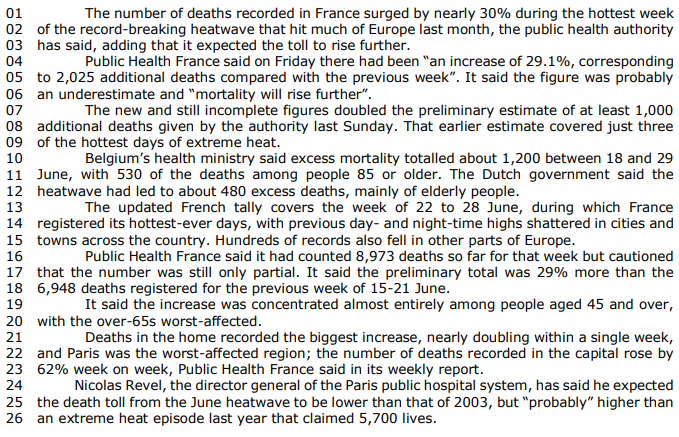
“I always joke that books are not made of glass”
I. ‘I’ is a subject pronoun.
II. The sentence is written in Present Perfect.
III. ‘always’ is an adverb of frequency.
IV. ‘books are not made of glass’ is an example of Passive Voice.
Which statements are completely accurate?

 Conheça nossos planos