Questões de Concurso
Sobre pronomes | pronouns em inglês
Foram encontradas 1.068 questões


Read the text:
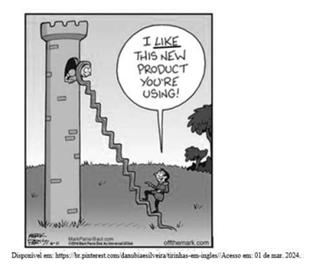
According to the comic above, the word in bold refers to:
- Which T-shirt is yours? The pink one or the black one?
- The black is _______, of course, and the pink is ________. Did you forget?
Which possessive pronouns should be used to properly fill in the blanks in the passage?
Excerpt from Romeo and Juliet" by William Shakespeare
Select the best option that explains the use of "thy" in the sentence "'Tis but thy name that is my enemy;"
Read the following text to answer the question.
Written by Virginia Woolf, the following letter expresses her fear of another mental breakdown and her decision to take her own life.
“Dearest, I feel certain that I am going mad again. I feel we can't go through another of those terrible times. And I shan't recover this time. I begin to hear voices, and I can't concentrate. So I am doing what seems the best thing to do. You have given me the greatest possible happiness. You have been in every way all that anyone could be. I don't think two people could have been happier 'til this terrible disease came. I can't fight any longer. I know that I am spoiling your life, that without me you could work. And you will I know. You see I can't even write this properly. I can't read. What I want to say is I owe all the happiness of my life to you. You have been entirely patient with me and incredibly good. I want to say that – everybody knows it. If anybody could have saved me it would have been you. Everything has gone from me but the certainty of your goodness. I can't go on spoiling your life any longer. I don't think two people could have been happier than we have been. V.”
Read this sentence.
He’s gone out, but I don’t know where ________’s gone.
Which pronoun can be used in the sentence so that it has a coherent and cohesive meaning?
Read Text 1 and answer question.
TEXT 1
English Language Teaching in Brazil:
A Gap in Policy, Problems in Practice
Only three percent of Brazilians are estimated to speak English despite the status of this language as a mandatory subject in grades 10 to 12 of basic education and preferred foreign language in grades 5 to 9. The widespread concept in the Brazilian society that speaking English is beneficial to individuals because it provides access to the globalised world does not seem to be enough to promote the actual learning of the language by the majority of the population, and it is argued here that this fact has to do with a gap in the foreign language teaching policy documents: the 2015 National Education Guidelines and Framework Law (LDB 2015), the Brazilian National Curriculum Parameters for Primary Education (PCN-EF), and the Brazilian National Curriculum Parameters for Secondary Education (PCN-EM). These documents do not prescribe the necessary conditions for English Language Teaching (ELT) to take place effectively, but, instead, provide suggestions for teachers on how to adapt to the status quo, which means focusing on reading to the detriment of the other aspects of the English language due to a number of factors ranging from a lack of resources to a large number of students per class.
Both PCN-EF (Brazil, 1998) and PCN-EM (Brazil, 2000) present progressive ideas about how a foreign language should be taught in the basic education classroom. Such ideas include a social interactionist view of language, which aligns with contemporary research in second language teaching and means a shift from the traditional grammar-translation method largely employed in Brazilian schools in previous decades. The Parameters also recommend interdisciplinary work, the implementation of cross-curricular themes, formative assessment in addition to summative, a value of students’ prior knowledge and position as critical subjects, and, thus, an approach to teaching as negotiation that aims to educate students for the full exercise of citizenship, which includes the notions of respect for difference and diversity that can be promoted by the teaching and learning of foreign languages.
However, the Parameters fail in pointing out the necessary conditions for this teaching and learning process to occur. For example, they acknowledge that reading and writing should be focused on to the detriment of listening and speaking due to the difficulties faced by the teacher in basic education (Brazil, 1998): large classrooms, lack of appropriate resources including class and preparation time for the teacher and opportunities for the students to be exposed to the language outside the classroom, and, in many situations, teachers’ lack of knowledge of the subject matter. Instead, what they should do is to actively propose that a smaller number of students sit in English classes – as it was allowed by LDB 1996 and continues to be so by LDB 2015, that more class and preparation time be granted the teacher, that schools have English resources that students can access to familiarise themselves with the language, and that better teacher education be implemented.
BATISTA, Fernanda. English Language Teaching in Brazil: A Gap in Policy, Problems in Practice. 2020. Disponível em: https://files.eric.ed.gov/fulltext/EJ1262339.pdf. Acesso em 30/12/2023 Adaptado.
Read Text I and answer question.
Is social media harming teens? A dive into the research cites risks but returns few hard answers
A new report from the National Academies of Sciences, Engineering and Medicine grapples with the questions: Is social media harming teenagers? And what can Congress, the Education Department and parents do about it?
The answers are murky. The authors surveyed hundreds of studies across more than a decade and came to complicated, occasionally contradictory, conclusions. On one hand, they found there isn’t enough population data to specifically blame social media for changes in adolescent health. On the other hand, as shown in study after study cited by the report, social media has the clear potential to hurt the health of teenagers, and in situations where a teenager is already experiencing difficulties like a mental health crisis, social media tends to make it worse.
“There is much we still don’t know, but our report lays out a clear path forward for both pursuing the biggest unanswered questions about youth health and social media, and taking steps that can minimize the risk to young people using social media now,” Sandro Galea, dean of the Boston University School of Public Health and chair of the committee behind the report, said in a news release.
According to the report, the ways social media is used seem to make a difference. When a teenager passively scrolls, as opposed to actively posting, that’s connected by many studies to low life satisfaction and feelings of sadness. It may be that showcasing a hobby or an interest on social media doesn’t produce the same harms. But those rates differ by demographic group: Black, non-Hispanic participants in one study reported more negative moods during active social media use, suggesting that the potential benefits of posting on social media are not the same for teenagers of all backgrounds.
In addition, age affects how well certain strategies work. In younger children, a family policy that restricts social media except when it’s actively guided by a parent seems to reduce the risk of problematic use and inappropriate behavior online. But in adolescents, overly restrictive and controlling parental rules, like confiscating a phone for punishment, are often associated with that teenager taking more risks online.
Faced with an urgent need to “create a more transparent industry and a better-informed consumer of social media,” the report calls on companies and regulators to establish international standards, such as clear ways for companies to share data with researchers and accepted best practices to avoid proven harms where possible. It recommends that the International Organization for Standardization – a body that sets global rules in areas such as manufacturing and food safety – be tasked with creating a new system, one that could be used by federal and international agencies to track and evaluate social media companies and the algorithms they build. And it asks for funding from the National Institutes of Health, the National Science Foundation and other agencies to pay for the sort of large, long-term studies that have in the past identified major public health crises.
Adapted from: https://www.nbcnews.com/tech/socialmedia/social-media-harming-teens-dive-research-citesrisks-returns-hard-answ-rcna129490
Identify the subject the following sentence.
Pick up the phone!
As regards pronouns, analyze the sentences below.
I. Mary accidentally cut herself while cooking.
II. Has Lisa ever watched “Everybody hates Chris”?
III. It’s anybody’s fault, so don’t worry.
IV. I usually talk to myself in English.
Choose the correct answer.
The red car is mine, and the blue one is ______. Is that ______ bike or their bike over there?
The beautiful garden is _____ We’ve worked on it for years. _____ cat is very playful and cute. The tickets to the concert are _____ He won them in a contest.
".........são estas agendas? Da Lisa.
“.........esse filme é?155 minutos.
".........aqueles caras são os do lado da sua irmã? Peter e a esposa dele.
"........você joga esse jogo? Quase nunca.
“.........você começou a trabalhar nesta empresa? Depois da reunião

 Conheça nossos planos