Questões de Concurso
Sobre pronomes | pronouns em inglês
Foram encontradas 1.068 questões


“The professional of Teaching English as a Foreign Language”
Author: Anderson Francisco Guimarães Maia
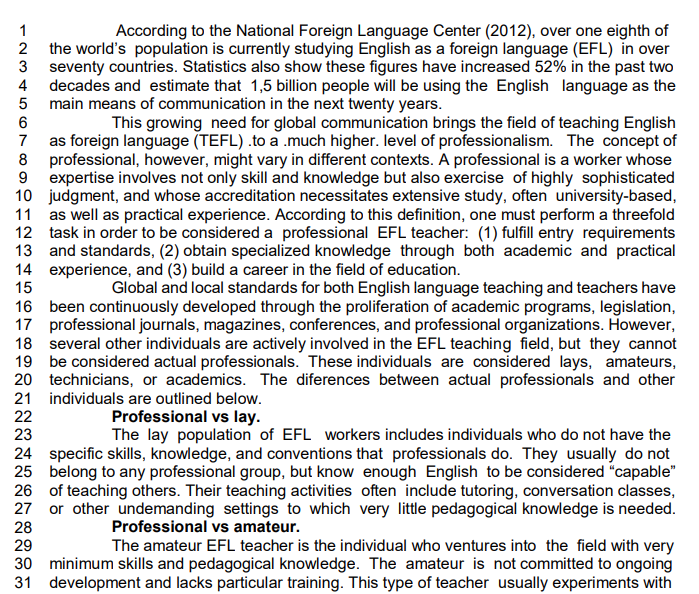
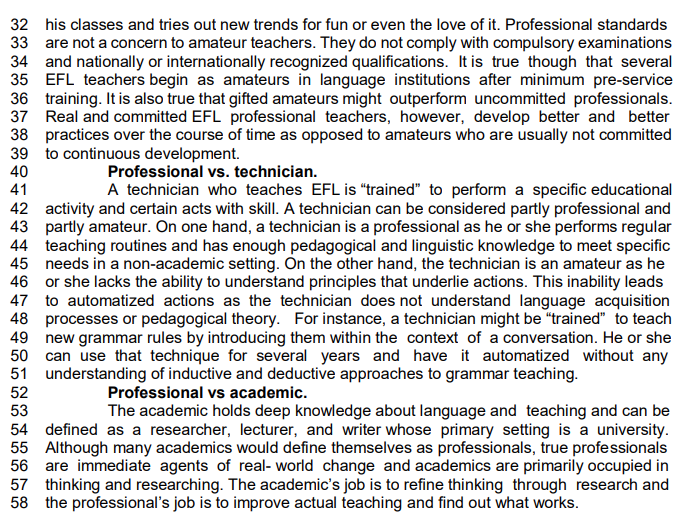
I. The article is about different ways to perform as a professional EFL teacher.
II. The word “whose” in line 10 refers to “worker” in the same sentence.
III. The words “requirements” (line 12) and “standards” (line 13) are synonyms.
IV. The article is predominantly denotative.
The following statement(s) is/are true



Available at: https://www.weforum.org/agenda/2024/06/businesses
-are-moving-beyond-sustainability-welcome-to-the-age-ofregeneration/. Retrieved on: Jun 14, 2024. Adapted.
Read the text III to answer the question.
TEXT III
A new report into world education shows Finland has the best system. The global study is called "The Learning Curve" and is from the British magazine "The Economist". It aims to help governments provide a better education to students. The 52-page report looked at the education system in 50 countries. Researchers analysed millions of statistics on exam grades, literacy rates, attendance, and university graduation rates. Asia did well in the report, with South Korea, Hong Kong, Japan and Singapore finishing second, third, fourth and fifth. The United States came 17th in the study, while Mexico, Brazil and Indonesia filled the bottom three positions in the top 50.
The Learning Curve reported on five things that education leaders should remember. The first is that spending lots of money on schools and teachers does not always mean students will learn. Second is that "good teachers are essential to high-quality education". The report said teachers should be "treated as the valuable professionals they are, not as technicians in a huge, educational machine". Numbers three and four are that a country's culture must have a strong focus on the importance of education, and parents have a key part to play. Finally, countries need to "educate for the future, not just the present." The report said: "Many of today's job titles…simply did not exist 20 years ago."
Sources:
http://www.timeshighereducation.co.uk/story.asp?sectioncode=26&storycode=421944&c=1
http://thelearningcurve.pearson.com/content/download/bankname/components/filename/FINAL%20LearningCurve_Final.pdf
3
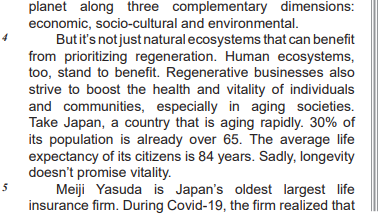
I. “… or to take care of oneself” [Reflexive pronoun].
II. “In 2020, the COVID-19 pandemic …” [Preposition].
III. “… with a glaring loophole that allows…” [Superlative adverb].
IV. “…and professional lives differently to manage burnout” [Phrasal verb].
The information in brackets correctly describes the underlined word/expression in the excerpt(s):
Read the following passage and identify the correct object pronoun to complete the sentence:
"Tom invited ____ to join him at the concert, and he promised to save a seat for ____."
Choose the alternative in which there is, correctly and respectively the bold words:
“The blue car is hers and the red car is ours,”
Choose the CORRECT answer:
“The cat is playing with ______ toy.”
Consider the title of the article:
“An adventure that explores the hidden gems of the city.”
The other word that could replace the pronoun that is:
I. Her aunt will be vacating next week.
II. That toy on the shelf is mine.
III. Did you do it yourself?
IV. She is the girl I was talking to you about.
V. I am going home today evening.
VI. All my friends are coming home for my birthday party.
In the order they were respectively underlined and written in bold letters, the pronouns written in the sentences above have specific functions, check the answer whose pronouns types are correspondent to the ones read above.
Empowering language learning through assessment
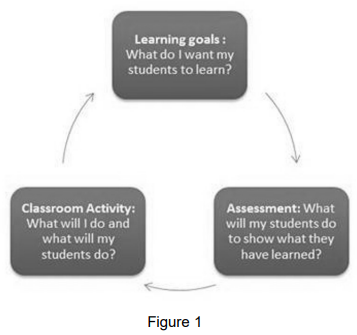
Assessment of, as, and for learning
The Reasons Why We Dance
- As a choreographer, I get asked to share my opinion about a myriad of dance-related
- topics, from the practical, like “How can dance help you get in shape?” to the existential, like “Is
- my dancing a projection of my self-image?”. But the question I think matters most is: why do
- people dance? What is about moving our bodies to a song we love that is so joyfully Pavlovian?
- Why do we watch videos and take lessons on something that could be labeled as trivial? Why do
- we love it so?
- There are the obvious answers. We dance for physical fitness, mental clarity, emotional
- stability, and other such pluses. However, all these benefits could be attained by other means –
- though I confess I have yet to find a better alternative than a great “cha cha”* to lift both one’s
- heart rate and spirits. There must be something glorious about dancing that is more than just
- intangible. We cannot seem to explain it, yet we all know it so well that we do not hesitate to
- tap our feet to a Gershwin melody or pulse with the percussion of a samba rhythm.
- Perhaps dance is the way we express ourselves when words are insufficient. The joy we
- feel over newfound love, the determination we have in the face of great sorrow or adversity, the
- passionate fire of our youth, and the peacefulness of our softer and more graceful years – maybe
- they are never expressed more fully than through a waltz, or a tango, or a jive. We all want to
- be understood, and if we could truly speak the words that describe our feelings, how deep and
- powerful they would surely be. But alas, those words never seem to come to us just right. Maybe
- dance is simply a translator for the human heart.
- Perhaps dance is the medium through which we show the world who we truly are and who
- we can be. All of us, if we are honest, believe deep down that we are not ordinary. We know
- ourselves to be wonderfully unique, with many layers of personality and talent woven in such a
- way that no one on earth could possibly have our same make-up. We know it. We just do not
- always know how to prove it. Maybe dance gives us the opportunity. And perhaps dance is how
- we choose to remember, how we hold on to the past. It is how we relive __ fun-filled days of
- our youth or __ time we looked into their eyes and knew they were the one. It is our tribute to
- the heroes of yesterday who jitterbugged like carefree boys and girls, when tomorrow they would
- march as men and women to defend freedom’s cause. It is the chance to be __ princess again,
- waiting for __ outstretched hand and the call to __ romance that is graceful, true, and not as
- forgotten as the cynics say. When we dance, we can remember them all a little better, feel the
- butterflies once again, and if only for a moment, return to the purest part of our lives when time
- was of no matter…for we were dancing.
- Why do we dance? Every answer will be different, and that is as it should be. Perhaps the
- better question is, “Why would we not?”
*Cha Cha: an energetic modern dance.
(Available in: https://dancewithmeusa.com/why-we-dance-the-reasons/ – text especially adapted for this test).
The sentence “Perhaps dance is the way we express ourselves when words are insufficient.” (l. 13) is an example of how to use reflexive pronouns. Which of the alternatives below also shows a reflexive pronoun used correctly?
Read Text | and answer questions 05 to 13.
Netflix is trying to prove to the world that it's all grown up
Netflix is trying to persuade Wall Street that it is now all grown up. After squeezing out millions of additional subscribers via its password sharing crackdown and through the introduction of cheaper advertiser-supported plans, the streamer knows that its growth spurts are coming to an end — and now it wants investors to stop obsessing over those pesky membership numbers and instead focus on other metrics.
"In our early days, when we had little revenue or profit, membership growth was a strong indicator of our future potential. But now we're generating very substantial profit and free cash flow. We are also developing new revenue streams like advertising and our extra member feature, so memberships are just one component of our growth", Netflix told shareholders as it reported quarterly earnings.
To that end, Netflix said that it will no longer report quarterly subscriber numbers, starting in 2025. Alas, the metric that Wall Street has forever judged Netflix on — the metric that prompted legacy media companies to burn endless piles of cash in their bids to compete with the streamer — will be retired. The decision to shut off transparency on the metric represents a significant turning point in the streaming revolution. For years, Netflix has prided itself on being extraordinarily transparent. Now it is aiming to hold its cards closer to its chest. And given that streaming giant is the trendsetter in the space, one could expect that other media companies will be inspired by the company's move and also opt to cease reporting such data.
To be fair, what Netflix is saying isn't necessarily off base either. As the company shifts its business model away from subscriptions and toward advertising and other revenue streams, it makes sense to consider how much time users are spending on the service. The more content a user consumes on Netflix, the more likely they are to continue paying for the service, and the more money Netflix then makes from that single subscriber. "We're focused on revenue and operating margin as our primary financial metrics — and engagement (i.e. time spent) as our best proxy for customer satisfaction,” Netflix underscored in its letter to shareholders.
Regardless, less transparency in an already opaque industry is not ideal. The walled garden of streaming already lacks the same detailed viewership data that Nielsen collects on linear television broadcasters. Now, visibility into the streaming world will get even dimmer.
The announcement from Netflix managed to overshadow its otherwise stellar quarter. The company handily beat expectations and added a staggering 9.3 million subscribers, meaning it now boasts nearly 270 million in total. Netflix also beat analyst expectations on both earnings and revenue. However, it wasn't all good news. Netflix forecasted its subscriber growth to be lower in quarter two, chalking it up to “typical seasonality.” That led the stock to slide nearly 5% in after-hours trading.
Whether "typical seasonality” is solely to blame, or whether the streamer is simply starting to hit a ceiling, is hard to tell. Perhaps it is a mix of both. Whatever the cause, the stock sliding on the less-than-ideal outlook is a prime example of why Netflix wants Wall Street to stop focusing on its subscriber numbers. And, in one year's time, investors won't have a choice.
Adapted from: https://edition.cnn.com/2024/04/19/media/netflix-subscription-numbers/index.html
There is one pronoun in all sentences below, EXCEPT:
Read Text | and answer questions 05 to 13.
Netflix is trying to prove to the world that it's all grown up
Netflix is trying to persuade Wall Street that it is now all grown up. After squeezing out millions of additional subscribers via its password sharing crackdown and through the introduction of cheaper advertiser-supported plans, the streamer knows that its growth spurts are coming to an end — and now it wants investors to stop obsessing over those pesky membership numbers and instead focus on other metrics.
"In our early days, when we had little revenue or profit, membership growth was a strong indicator of our future potential. But now we're generating very substantial profit and free cash flow. We are also developing new revenue streams like advertising and our extra member feature, so memberships are just one component of our growth", Netflix told shareholders as it reported quarterly earnings.
To that end, Netflix said that it will no longer report quarterly subscriber numbers, starting in 2025. Alas, the metric that Wall Street has forever judged Netflix on — the metric that prompted legacy media companies to burn endless piles of cash in their bids to compete with the streamer — will be retired. The decision to shut off transparency on the metric represents a significant turning point in the streaming revolution. For years, Netflix has prided itself on being extraordinarily transparent. Now it is aiming to hold its cards closer to its chest. And given that streaming giant is the trendsetter in the space, one could expect that other media companies will be inspired by the company's move and also opt to cease reporting such data.
To be fair, what Netflix is saying isn't necessarily off base either. As the company shifts its business model away from subscriptions and toward advertising and other revenue streams, it makes sense to consider how much time users are spending on the service. The more content a user consumes on Netflix, the more likely they are to continue paying for the service, and the more money Netflix then makes from that single subscriber. "We're focused on revenue and operating margin as our primary financial metrics — and engagement (i.e. time spent) as our best proxy for customer satisfaction,” Netflix underscored in its letter to shareholders.
Regardless, less transparency in an already opaque industry is not ideal. The walled garden of streaming already lacks the same detailed viewership data that Nielsen collects on linear television broadcasters. Now, visibility into the streaming world will get even dimmer.
The announcement from Netflix managed to overshadow its otherwise stellar quarter. The company handily beat expectations and added a staggering 9.3 million subscribers, meaning it now boasts nearly 270 million in total. Netflix also beat analyst expectations on both earnings and revenue. However, it wasn't all good news. Netflix forecasted its subscriber growth to be lower in quarter two, chalking it up to “typical seasonality.” That led the stock to slide nearly 5% in after-hours trading.
Whether "typical seasonality” is solely to blame, or whether the streamer is simply starting to hit a ceiling, is hard to tell. Perhaps it is a mix of both. Whatever the cause, the stock sliding on the less-than-ideal outlook is a prime example of why Netflix wants Wall Street to stop focusing on its subscriber numbers. And, in one year's time, investors won't have a choice.
Adapted from: https://edition.cnn.com/2024/04/19/media/netflix-subscription-numbers/index.html
Analyze the sentences below.
|. “(...) to burn endless piles of cash in their bids to compete with the streamer (...)”.
Il. “The company handily beat expectations (...)".
II. "And given that streaming giant is the trendsetter in the space, one could expect that (...)".
IV. Netflix forecasted its subscriber growth to be lower in quarter two (...)".
Choose the correct answer.
Text 1
Structure of education in Singapore
The complete control and management of Singapore’s education is in the hands of the Ministry of Education (MOE). With continuous endeavour from MOE, today Singapore can be considered to have a strong and well-reputed education system. As per recent study Singapore is ranked fourth in terms of World’s Best Education System.
The preschools are run by the private sector, including religious bodies, community foundations, business groups, etc. However, every preschool need to register itself with the Singapore Ministry of Education before being functional.
After completion of 6 years of primary education, students have to appear for a Primary School Leaving Exam (PSLE). All those students who passed the exam are admitted in a secondary level course, which is usually completed in 4-5 years. It is similar to attending seventh grade through tenth grade in the American education system.
After completion of the secondary education, the students need to appear in Singaporean GCE ‘O’ Level exam. Based on the merit in that exam, students proceed to pre-university education, which is similar to attending eleventh grade and twelfth grade as per the American education system. At this level students can opt for a wide range of subjects from varied academic areas covering Humanities, Arts and Languages, Sciences and Mathematics streams.
www.singaporeeducation.info/Education-System/ Structure-of-Education
Read the following sentence from text 1:
However, every preschool need to register itself with the Singapore Ministry of Education before being functional.
Analyze the underlined words.
1. However is an adverb that can be used at the beginning of a sentence, to introduce a contrasting statement.
2. itself is a relative pronoun that can be used to refer back to register.
3. being is a verb in the progressive tense that means life.
Choose the alternative which contains the correct affirmatives.

 Conheça nossos planos