Questões de Concurso Sobre interpretação de texto | reading comprehension em inglês

Foram encontradas 12.687 questões

Q3269543 Inglês

Since January 2023, the Amazon Fund has received BRL 3.9 billion in new donations. The resumption of the fund was accompanied by and results from the return of effective policies to control deforestation in Brazil, with very significant results. The Fund, which had contributions from Germany and Norway, had been frozen by the previous government. Under President Lula's government, it also received resources from Denmark, the European Union, Switzerland, the United Kingdom and the USA.


Ministry of foreign affairs - September 12th, 2023


 In the sentence, what does the subject "it" refer to?

Alternativas
Q3269541 Inglês

“There is a kind of sleep that steals upon us sometimes, which, while it holds the body prisoner, does not free the mind from a sense of things about it, and enable it to ramble at its pleasure. So far as an overpowering heaviness, a prostration of strength, and an utter inability to control our thoughts or power of motion, can be called sleep, this is it; and yet we have a consciousness of all that is going on about us; and if we dream at such a time, words which are really spoken, or sounds which really exist at the moment, accommodate themselves with surprising readiness to our visions, until reality and imagination become so strangely blended that it is afterwards almost a matter of impossibility to separate the two. Nor is this, the most striking phenomenon, incidental to such a state. It is an undoubted fact, that although our senses of touch and sight be for the time dead, yet our sleeping thoughts, and the visionary scenes that pass before us, will be influenced, and materially influenced, by the mere silent presence of some external object: which may not have been near us when we closed our eyes: and of whose vicinity we have had no waking consciousness. ” 


— Charles Dickens, Oliver Twist

Based on Dickens' excerpt, it is correct to state that the sleep state described by the author:
Alternativas
Q3269538 Inglês

“There is a kind of sleep that steals upon us sometimes, which, while it holds the body prisoner, does not free the mind from a sense of things about it, and enable it to ramble at its pleasure. So far as an overpowering heaviness, a prostration of strength, and an utter inability to control our thoughts or power of motion, can be called sleep, this is it; and yet we have a consciousness of all that is going on about us; and if we dream at such a time, words which are really spoken, or sounds which really exist at the moment, accommodate themselves with surprising readiness to our visions, until reality and imagination become so strangely blended that it is afterwards almost a matter of impossibility to separate the two. Nor is this, the most striking phenomenon, incidental to such a state. It is an undoubted fact, that although our senses of touch and sight be for the time dead, yet our sleeping thoughts, and the visionary scenes that pass before us, will be influenced, and materially influenced, by the mere silent presence of some external object: which may not have been near us when we closed our eyes: and of whose vicinity we have had no waking consciousness. ” 


— Charles Dickens, Oliver Twist
Identify the incorrect statement based on the text:
Alternativas
Q3268777 Inglês
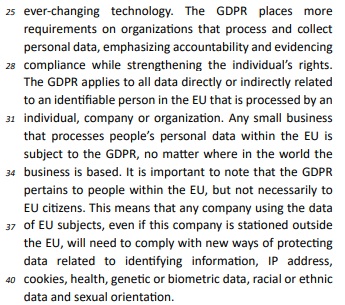
Considering the text, choose the correct alternative about the GDPR.
Alternativas
Q3268776 Inglês
The use of personal information must be explained to consumers in a simple and transparent manner to  
Alternativas
Q3268774 Inglês
According to the text, choose the correct alternative that presents the best describes the purpose of a robust cybersecurity policy.
Alternativas
Q3264957 Inglês
Leia o texto para responder à questão.

        A Construction Technician is a skilled professional involved in construction processes. They can be in general construction or more specialized roles such as drafting, inspecting, and managing, depending on their training or experience. After going through training programs, their scope may extend to monitoring build progress, preparing sites, and drafting blueprints using CAD software. Once they accumulate years of experience, they will be tasked with supervising the contracting team and project.

        This professional’s responsibilities include: the management of all remodel activities; the enforcement of safety requirements to implement safety conditions at work site; the creation of reports about qualitative and quantitative methodologies; the hiring of contractors for maintenance work and upgrades.

        Many hard and soft skills are essential for success and crucial for a construction technician’s day-to-day tasks. Because they have to interpret complex information and transform abstract ideas into tangible products, the number one technical skill necessary for success in construction is excellent communication skills, both receiving and delivering accurate and relevant information.

(https://www.zippia.com/construction-technician-jobs/.10.06.2024. Adaptado)
De acordo com o último parágrafo, comunicação é prioridade máxima porque esse profissional é responsável por
Alternativas
Q3264956 Inglês
Leia o texto para responder à questão.

        A Construction Technician is a skilled professional involved in construction processes. They can be in general construction or more specialized roles such as drafting, inspecting, and managing, depending on their training or experience. After going through training programs, their scope may extend to monitoring build progress, preparing sites, and drafting blueprints using CAD software. Once they accumulate years of experience, they will be tasked with supervising the contracting team and project.

        This professional’s responsibilities include: the management of all remodel activities; the enforcement of safety requirements to implement safety conditions at work site; the creation of reports about qualitative and quantitative methodologies; the hiring of contractors for maintenance work and upgrades.

        Many hard and soft skills are essential for success and crucial for a construction technician’s day-to-day tasks. Because they have to interpret complex information and transform abstract ideas into tangible products, the number one technical skill necessary for success in construction is excellent communication skills, both receiving and delivering accurate and relevant information.

(https://www.zippia.com/construction-technician-jobs/.10.06.2024. Adaptado)
According to the second paragraph, the construction technician is responsible for
Alternativas
Q3264954 Inglês
Leia o texto para responder à questão.

        A Construction Technician is a skilled professional involved in construction processes. They can be in general construction or more specialized roles such as drafting, inspecting, and managing, depending on their training or experience. After going through training programs, their scope may extend to monitoring build progress, preparing sites, and drafting blueprints using CAD software. Once they accumulate years of experience, they will be tasked with supervising the contracting team and project.

        This professional’s responsibilities include: the management of all remodel activities; the enforcement of safety requirements to implement safety conditions at work site; the creation of reports about qualitative and quantitative methodologies; the hiring of contractors for maintenance work and upgrades.

        Many hard and soft skills are essential for success and crucial for a construction technician’s day-to-day tasks. Because they have to interpret complex information and transform abstract ideas into tangible products, the number one technical skill necessary for success in construction is excellent communication skills, both receiving and delivering accurate and relevant information.

(https://www.zippia.com/construction-technician-jobs/.10.06.2024. Adaptado)
A expressão such as, em “roles such as” (1º parágrafo), introduz
Alternativas
Q3264953 Inglês
Leia o texto para responder à questão.

        A Construction Technician is a skilled professional involved in construction processes. They can be in general construction or more specialized roles such as drafting, inspecting, and managing, depending on their training or experience. After going through training programs, their scope may extend to monitoring build progress, preparing sites, and drafting blueprints using CAD software. Once they accumulate years of experience, they will be tasked with supervising the contracting team and project.

        This professional’s responsibilities include: the management of all remodel activities; the enforcement of safety requirements to implement safety conditions at work site; the creation of reports about qualitative and quantitative methodologies; the hiring of contractors for maintenance work and upgrades.

        Many hard and soft skills are essential for success and crucial for a construction technician’s day-to-day tasks. Because they have to interpret complex information and transform abstract ideas into tangible products, the number one technical skill necessary for success in construction is excellent communication skills, both receiving and delivering accurate and relevant information.

(https://www.zippia.com/construction-technician-jobs/.10.06.2024. Adaptado)
Read the titles below and decide the one that best represents the content of the text.
Alternativas
Q3263847 Inglês
Leia o texto para responder à questão.

         The correction of genetic errors associated with disease in animals suggests that gene editing has potential applications in gene therapy for humans. Gene therapy is the introduction of a normal gene into an individual’s genome in order to repair a mutation that causes a genetic disease. When a normal gene is inserted into a mutant nucleus, it most likely will integrate into a chromosomal site different from the defective allele. Although this may repair the mutation, a new mutation may result if the normal gene integrates into another functional gene. If the normal gene replaces the mutant allele, there is a chance that the transformed cells will proliferate and produce enough normal gene product for the entire body to be restored to the undiseased phenotype.

(www.britannica.com/science/genetic-engineering/ Process-and-techniques. Adaptado)
According to the text, gene therapy intends to
Alternativas
Q3263846 Inglês
Leia o texto para responder à questão.

         The correction of genetic errors associated with disease in animals suggests that gene editing has potential applications in gene therapy for humans. Gene therapy is the introduction of a normal gene into an individual’s genome in order to repair a mutation that causes a genetic disease. When a normal gene is inserted into a mutant nucleus, it most likely will integrate into a chromosomal site different from the defective allele. Although this may repair the mutation, a new mutation may result if the normal gene integrates into another functional gene. If the normal gene replaces the mutant allele, there is a chance that the transformed cells will proliferate and produce enough normal gene product for the entire body to be restored to the undiseased phenotype.

(www.britannica.com/science/genetic-engineering/ Process-and-techniques. Adaptado)
No trecho do texto – it most likely will integrate into a chromosomal site different from the defective allele – o termo em negrito indica 
Alternativas
Q3263845 Inglês
Leia o texto para responder à questão.

         The correction of genetic errors associated with disease in animals suggests that gene editing has potential applications in gene therapy for humans. Gene therapy is the introduction of a normal gene into an individual’s genome in order to repair a mutation that causes a genetic disease. When a normal gene is inserted into a mutant nucleus, it most likely will integrate into a chromosomal site different from the defective allele. Although this may repair the mutation, a new mutation may result if the normal gene integrates into another functional gene. If the normal gene replaces the mutant allele, there is a chance that the transformed cells will proliferate and produce enough normal gene product for the entire body to be restored to the undiseased phenotype.

(www.britannica.com/science/genetic-engineering/ Process-and-techniques. Adaptado)
The part of the text that indicates that an unwanted problem may happen is: 
Alternativas
Q3263844 Inglês
Leia o texto para responder à questão.

        Cell culture experiments are widely used in biomedical research, regenerative medicine, and biotechnological production. Due to restrictions on the use of laboratory animals by animal protection laws and the strict implementation of the 3Rs (Replacement, Reduction, and Refinement) formulated by William Russell and Rex Burch to improve the welfare of animals, it can be expected that the general use of cell lines will further increase during the next years to substitute animal-based research. However, it should be noted that cell culture experiments, if not properly conducted, are prone to errors. Therefore, it is essential that cell culture studies are performed with good cell culture practice (GCCP) to assure the reproducibility of in vitro experimentation.

        In particular, inter- and intra-specific cross-contamination and cell misidentification, genetic drift, contamination with bacteria, fungi, yeast, viruses, or chemicals, and lack of quality control testing are widespread fatal cell culture problems that contaminate the literature with false and irreproducible results. Rough estimates suggest that the number of published papers that used problematic cell lines is about 16.1%. Moreover, the International Cell Line Authentication Committee (ICLAC) lists 576 misidentified or cross-contaminated cell lines in its latest register released in June 2021.

(Weiskirchen S, Schröder SK, Buhl EM, Weiskirchen R. A Beginner’s
Guide to Cell Culture: Practical Advice for Preventing Needless Problems.
Cells. 2023 Feb 21;12(5):682. doi: 10.3390/cells12050682.
PMID: 36899818; PMCID: PMC10000895.
www.ncbi.nlm.nih.gov/pmc/articles/PMC10000895/. Adaptado)
De acordo com o texto, é fundamental que experimentos com culturas de células in vitro
Alternativas
Q3263843 Inglês
Leia o texto para responder à questão.

        Cell culture experiments are widely used in biomedical research, regenerative medicine, and biotechnological production. Due to restrictions on the use of laboratory animals by animal protection laws and the strict implementation of the 3Rs (Replacement, Reduction, and Refinement) formulated by William Russell and Rex Burch to improve the welfare of animals, it can be expected that the general use of cell lines will further increase during the next years to substitute animal-based research. However, it should be noted that cell culture experiments, if not properly conducted, are prone to errors. Therefore, it is essential that cell culture studies are performed with good cell culture practice (GCCP) to assure the reproducibility of in vitro experimentation.

        In particular, inter- and intra-specific cross-contamination and cell misidentification, genetic drift, contamination with bacteria, fungi, yeast, viruses, or chemicals, and lack of quality control testing are widespread fatal cell culture problems that contaminate the literature with false and irreproducible results. Rough estimates suggest that the number of published papers that used problematic cell lines is about 16.1%. Moreover, the International Cell Line Authentication Committee (ICLAC) lists 576 misidentified or cross-contaminated cell lines in its latest register released in June 2021.

(Weiskirchen S, Schröder SK, Buhl EM, Weiskirchen R. A Beginner’s
Guide to Cell Culture: Practical Advice for Preventing Needless Problems.
Cells. 2023 Feb 21;12(5):682. doi: 10.3390/cells12050682.
PMID: 36899818; PMCID: PMC10000895.
www.ncbi.nlm.nih.gov/pmc/articles/PMC10000895/. Adaptado)
According to the second paragraph, an example of contaminant that may be present during in vitro cell culture is:
Alternativas
Q3263840 Inglês
Leia o texto para responder à questão.

        Cell culture experiments are widely used in biomedical research, regenerative medicine, and biotechnological production. Due to restrictions on the use of laboratory animals by animal protection laws and the strict implementation of the 3Rs (Replacement, Reduction, and Refinement) formulated by William Russell and Rex Burch to improve the welfare of animals, it can be expected that the general use of cell lines will further increase during the next years to substitute animal-based research. However, it should be noted that cell culture experiments, if not properly conducted, are prone to errors. Therefore, it is essential that cell culture studies are performed with good cell culture practice (GCCP) to assure the reproducibility of in vitro experimentation.

        In particular, inter- and intra-specific cross-contamination and cell misidentification, genetic drift, contamination with bacteria, fungi, yeast, viruses, or chemicals, and lack of quality control testing are widespread fatal cell culture problems that contaminate the literature with false and irreproducible results. Rough estimates suggest that the number of published papers that used problematic cell lines is about 16.1%. Moreover, the International Cell Line Authentication Committee (ICLAC) lists 576 misidentified or cross-contaminated cell lines in its latest register released in June 2021.

(Weiskirchen S, Schröder SK, Buhl EM, Weiskirchen R. A Beginner’s
Guide to Cell Culture: Practical Advice for Preventing Needless Problems.
Cells. 2023 Feb 21;12(5):682. doi: 10.3390/cells12050682.
PMID: 36899818; PMCID: PMC10000895.
www.ncbi.nlm.nih.gov/pmc/articles/PMC10000895/. Adaptado)
No trecho do primeiro parágrafo – Due to restrictions on the use of laboratory animals – a expressão em negrito introduz uma
Alternativas
Q3263839 Inglês
Leia o texto para responder à questão.

        Cell culture experiments are widely used in biomedical research, regenerative medicine, and biotechnological production. Due to restrictions on the use of laboratory animals by animal protection laws and the strict implementation of the 3Rs (Replacement, Reduction, and Refinement) formulated by William Russell and Rex Burch to improve the welfare of animals, it can be expected that the general use of cell lines will further increase during the next years to substitute animal-based research. However, it should be noted that cell culture experiments, if not properly conducted, are prone to errors. Therefore, it is essential that cell culture studies are performed with good cell culture practice (GCCP) to assure the reproducibility of in vitro experimentation.

        In particular, inter- and intra-specific cross-contamination and cell misidentification, genetic drift, contamination with bacteria, fungi, yeast, viruses, or chemicals, and lack of quality control testing are widespread fatal cell culture problems that contaminate the literature with false and irreproducible results. Rough estimates suggest that the number of published papers that used problematic cell lines is about 16.1%. Moreover, the International Cell Line Authentication Committee (ICLAC) lists 576 misidentified or cross-contaminated cell lines in its latest register released in June 2021.

(Weiskirchen S, Schröder SK, Buhl EM, Weiskirchen R. A Beginner’s
Guide to Cell Culture: Practical Advice for Preventing Needless Problems.
Cells. 2023 Feb 21;12(5):682. doi: 10.3390/cells12050682.
PMID: 36899818; PMCID: PMC10000895.
www.ncbi.nlm.nih.gov/pmc/articles/PMC10000895/. Adaptado)
According to what is stated in the first paragraph, William Russel and Rex Burch aimed at improving
Alternativas
Q3263838 Inglês
Leia o texto para responder à questão.

        Cell culture experiments are widely used in biomedical research, regenerative medicine, and biotechnological production. Due to restrictions on the use of laboratory animals by animal protection laws and the strict implementation of the 3Rs (Replacement, Reduction, and Refinement) formulated by William Russell and Rex Burch to improve the welfare of animals, it can be expected that the general use of cell lines will further increase during the next years to substitute animal-based research. However, it should be noted that cell culture experiments, if not properly conducted, are prone to errors. Therefore, it is essential that cell culture studies are performed with good cell culture practice (GCCP) to assure the reproducibility of in vitro experimentation.

        In particular, inter- and intra-specific cross-contamination and cell misidentification, genetic drift, contamination with bacteria, fungi, yeast, viruses, or chemicals, and lack of quality control testing are widespread fatal cell culture problems that contaminate the literature with false and irreproducible results. Rough estimates suggest that the number of published papers that used problematic cell lines is about 16.1%. Moreover, the International Cell Line Authentication Committee (ICLAC) lists 576 misidentified or cross-contaminated cell lines in its latest register released in June 2021.

(Weiskirchen S, Schröder SK, Buhl EM, Weiskirchen R. A Beginner’s
Guide to Cell Culture: Practical Advice for Preventing Needless Problems.
Cells. 2023 Feb 21;12(5):682. doi: 10.3390/cells12050682.
PMID: 36899818; PMCID: PMC10000895.
www.ncbi.nlm.nih.gov/pmc/articles/PMC10000895/. Adaptado)
The text is mainly about
Alternativas
Q3258846 Inglês
Text I


Shock of the old: Believe it or not, battery-powered vehicles
have been around since Victorian times.

   The history of the electric car is surprisingly enraging. If you imagine early electric vehicles at all (full disclosure: I didn’t until recently), it will probably be as the quixotic and possibly dangerous dream of a few eccentrics, maybe in the 1920s or 1930s, when domestic electrification became widespread. It’s easy to imagine some stiff-collared proto-Musk getting bored of hunting and affairs, eyeing his newly installed electric lights speculatively, then wreaking untold havoc and mass electrocutions. The reality is entirely different.

   By 1900, a third of all cars on the road in the US were electric; we’re looking at the history of a cruelly missed opportunity, and it started astonishingly early. The Scottish engineer Robert Anderson had a go at an electric car of sorts way back in the 1830s, though his invention was somewhat stymied by the fact rechargeable batteries were not invented until 1859, making his crude carriage something of a one-trick pony (and far less useful than an actual pony).

   It’s debatable whether or not Scotland was ready for this brave new world anyway: in 1842, Robert Davidson (another Scot, who had, a few years earlier, also tried his hand at an electric vehicle) saw his electric locomotive Galvani “broken by some malicious hands almost beyond repair” in Perth. The contemporary consensus was that it was attacked by railway workers fearful for their jobs.

   Despite this unpromising start, electric vehicles had entered widespread commercial circulation by the start of the 20th century, particularly in the US. Electric cabs crisscrossed Manhattan, 1897’s bestselling US car was electric and, when he was shot in 1901, President McKinley was taken to hospital in an electric ambulance. London had Walter Bersey’s electric taxis, and Berlin’s fire engines went electric in 1908; the future looked bright, clean and silent.

   By the 1930s, however, the tide had definitively turned against electric, cursed by range limitations and impractical charging times while petrol gained the upper hand thanks partly – and ironically – to the electric starter motor. The Horseless Age magazine, which vehemently backed the petrol non-horse, would have been delighted. There was a brief resurgence of interest in the late 1960s, when the US Congress passed a bill promoting electrical vehicle development, but nothing much actually happened until the Nissan Leaf sparked interest in 2009. Electric still isn’t quite there yet, battling infrastructure and battery problems that might have been familiar to Anderson and friends.


Adapted from The Guardian, Tuesday 24 October 2023, p. 6 https://www.theguardian.com/lifeandstyle/series/shock-of-the-old/2023/oct/24/all
The idiom in “the tide had definitively turned” (5th paragraph) implies that the course of events had:
Alternativas
Q3258843 Inglês
Text I


Shock of the old: Believe it or not, battery-powered vehicles
have been around since Victorian times.

   The history of the electric car is surprisingly enraging. If you imagine early electric vehicles at all (full disclosure: I didn’t until recently), it will probably be as the quixotic and possibly dangerous dream of a few eccentrics, maybe in the 1920s or 1930s, when domestic electrification became widespread. It’s easy to imagine some stiff-collared proto-Musk getting bored of hunting and affairs, eyeing his newly installed electric lights speculatively, then wreaking untold havoc and mass electrocutions. The reality is entirely different.

   By 1900, a third of all cars on the road in the US were electric; we’re looking at the history of a cruelly missed opportunity, and it started astonishingly early. The Scottish engineer Robert Anderson had a go at an electric car of sorts way back in the 1830s, though his invention was somewhat stymied by the fact rechargeable batteries were not invented until 1859, making his crude carriage something of a one-trick pony (and far less useful than an actual pony).

   It’s debatable whether or not Scotland was ready for this brave new world anyway: in 1842, Robert Davidson (another Scot, who had, a few years earlier, also tried his hand at an electric vehicle) saw his electric locomotive Galvani “broken by some malicious hands almost beyond repair” in Perth. The contemporary consensus was that it was attacked by railway workers fearful for their jobs.

   Despite this unpromising start, electric vehicles had entered widespread commercial circulation by the start of the 20th century, particularly in the US. Electric cabs crisscrossed Manhattan, 1897’s bestselling US car was electric and, when he was shot in 1901, President McKinley was taken to hospital in an electric ambulance. London had Walter Bersey’s electric taxis, and Berlin’s fire engines went electric in 1908; the future looked bright, clean and silent.

   By the 1930s, however, the tide had definitively turned against electric, cursed by range limitations and impractical charging times while petrol gained the upper hand thanks partly – and ironically – to the electric starter motor. The Horseless Age magazine, which vehemently backed the petrol non-horse, would have been delighted. There was a brief resurgence of interest in the late 1960s, when the US Congress passed a bill promoting electrical vehicle development, but nothing much actually happened until the Nissan Leaf sparked interest in 2009. Electric still isn’t quite there yet, battling infrastructure and battery problems that might have been familiar to Anderson and friends.


Adapted from The Guardian, Tuesday 24 October 2023, p. 6 https://www.theguardian.com/lifeandstyle/series/shock-of-the-old/2023/oct/24/all
The last sentence indicates that some hurdles remain to be:
Alternativas
Respostas
2761: A
2762: B
2763: D
2764: E
2765: C
2766: B
2767: B
2768: E
2769: C
2770: D
2771: E
2772: A
2773: C
2774: D
2775: B
2776: A
2777: B
2778: D
2779: A
2780: B
