Questões de Concurso
Sobre interpretação de texto | reading comprehension em inglês
Foram encontradas 13.188 questões


Ano: 2025
Banca:
CESPE / CEBRASPE
Órgão:
InoversaSul
Provas:
CESPE / CEBRASPE - 2025 - InoversaSul - Analista Administrativo de Projetos
|
CESPE / CEBRASPE - 2025 - InoversaSul - Analista de Planejamento |
Q3145755
Inglês
Texto associado
A majority of remote workers would quit their jobs if forced to return to the office, according to a new study. In FlexJobs’ recent report, 57 percent of remote workers surveyed said they would absolutely look for a new job if they were not allowed to continue working remotely. “Obviously, an employer has the right to call employees back to the office from remote or hybrid positions at any time, but for many who have had these jobs since the early days of the pandemic, working from home during all or part of the week has become a way of life, and they’ve scheduled virtually all other priorities around it,” says Alex Beene, a financial literacy instructor at the University of Tennessee.
The numbers could indicate a significant turnover issue as companies continue to look for ways to be fully in-person again, as just under 25 percent of workers said their employer had already instituted a return-to-office mandate. The report is based on a poll of 3,000 American professionals between August 5 and August 18. Overall, Americans were eager to leave their jobs in pursuit of higher wages or more flexible work, as 67 percent said they planned to change jobs in the next six months. But key things like a promotion, remote work and a better company culture could convince some workers to stay, according to the survey. Between 33 percent and 38 percent of workers said these factors could convince them to stay in their current roles.
Working remotely continues to be a huge draw when it comes to attracting talent, and it can even convince some employees to accept lower salaries. In the report, 58 percent of workers said they’d accept a salary decrease if it meant they could work from home. “We have a generation of employees that live in locations far removed from their actual employer due to work-from-home policies,” Beene said. “For many, hours of commuting may either not be feasible or not add up financially to make sense given their current role.”
And because many remote workers don’t feel a productivity loss, companies are still “vying for talent and willing to accommodate,” said Kevin Thompson, a finance expert and founder and CEO of 9i Capital Group. As a result, workers still largely have the power over their employers, Thompson said. “The only reason they would not is if businesses began to collude and mandated everyone return to work,” Thompson told Newsweek. “As long as the market remains free and fair, the ability to find remote work should actually continue.”
Putting productivity aside, Thompson said the main loss from remote work has been in corporate culture. “I don’t believe you can build a culture through Zoom, but that does not mean it is not possible,” Thompson said. “The consequences of remote work won’t be felt for a number of years.”
Internet: <newsweek.com> (adapted).
About the ideas conveyed by the preceding text, as well as its linguistic aspects, judge the following item.
It is correct to conclude from the second paragraph of the text that companies might experience staff shortage due to strict policies that tie down all employees to the office.
It is correct to conclude from the second paragraph of the text that companies might experience staff shortage due to strict policies that tie down all employees to the office.
Ano: 2025
Banca:
CESPE / CEBRASPE
Órgão:
InoversaSul
Provas:
CESPE / CEBRASPE - 2025 - InoversaSul - Analista Administrativo de Projetos
|
CESPE / CEBRASPE - 2025 - InoversaSul - Analista de Planejamento |
Q3145754
Inglês
Texto associado
A majority of remote workers would quit their jobs if forced to return to the office, according to a new study. In FlexJobs’ recent report, 57 percent of remote workers surveyed said they would absolutely look for a new job if they were not allowed to continue working remotely. “Obviously, an employer has the right to call employees back to the office from remote or hybrid positions at any time, but for many who have had these jobs since the early days of the pandemic, working from home during all or part of the week has become a way of life, and they’ve scheduled virtually all other priorities around it,” says Alex Beene, a financial literacy instructor at the University of Tennessee.
The numbers could indicate a significant turnover issue as companies continue to look for ways to be fully in-person again, as just under 25 percent of workers said their employer had already instituted a return-to-office mandate. The report is based on a poll of 3,000 American professionals between August 5 and August 18. Overall, Americans were eager to leave their jobs in pursuit of higher wages or more flexible work, as 67 percent said they planned to change jobs in the next six months. But key things like a promotion, remote work and a better company culture could convince some workers to stay, according to the survey. Between 33 percent and 38 percent of workers said these factors could convince them to stay in their current roles.
Working remotely continues to be a huge draw when it comes to attracting talent, and it can even convince some employees to accept lower salaries. In the report, 58 percent of workers said they’d accept a salary decrease if it meant they could work from home. “We have a generation of employees that live in locations far removed from their actual employer due to work-from-home policies,” Beene said. “For many, hours of commuting may either not be feasible or not add up financially to make sense given their current role.”
And because many remote workers don’t feel a productivity loss, companies are still “vying for talent and willing to accommodate,” said Kevin Thompson, a finance expert and founder and CEO of 9i Capital Group. As a result, workers still largely have the power over their employers, Thompson said. “The only reason they would not is if businesses began to collude and mandated everyone return to work,” Thompson told Newsweek. “As long as the market remains free and fair, the ability to find remote work should actually continue.”
Putting productivity aside, Thompson said the main loss from remote work has been in corporate culture. “I don’t believe you can build a culture through Zoom, but that does not mean it is not possible,” Thompson said. “The consequences of remote work won’t be felt for a number of years.”
Internet: <newsweek.com> (adapted).
About the ideas conveyed by the preceding text, as well as its linguistic aspects, judge the following item.
The text defends the thesis that in the aftermath of the pandemic there has been a significant shift in corporate culture.
The text defends the thesis that in the aftermath of the pandemic there has been a significant shift in corporate culture.
Ano: 2025
Banca:
Avança SP
Órgão:
Prefeitura de Morungaba - SP
Prova:
Avança SP - 2025 - Prefeitura de Morungaba - SP - Professor de Educação Básica II - Língua Inglesa |
Q3143804
Inglês

Available at: https://www.gocomics.com/pickles
In the comic strip, the grandfather responds, “So far, so good.” What does this expression mean?
Ano: 2025
Banca:
Avança SP
Órgão:
Prefeitura de Morungaba - SP
Prova:
Avança SP - 2025 - Prefeitura de Morungaba - SP - Professor de Educação Básica II - Língua Inglesa |
Q3143800
Inglês

Available at: https://www.gocomics.com/nonsequitur/2012/12/07
What is the woman describing in her speech bubble?
Ano: 2025
Banca:
Avança SP
Órgão:
Prefeitura de Morungaba - SP
Prova:
Avança SP - 2025 - Prefeitura de Morungaba - SP - Professor de Educação Básica II - Língua Inglesa |
Q3143796
Inglês

Available at: https://www.gocomics.com/nonsequitur/2024/11/18
What does the term ‘boundaries’ mean in the context of the comic?
Ano: 2025
Banca:
OBJETIVA
Órgão:
Prefeitura de Galvão - SC
Prova:
OBJETIVA - 2025 - Prefeitura de Galvão - SC - Professor – Língua Inglesa |
Q3139907
Inglês
Texto associado
Who votes for the Academy Awards?
After the glitzy red-carpet arrivals, the feel-good
montages, and the host’s opening roast, the Oscars
ceremony switches to its raison d’être: revealing the
previous year’s highest achievers in cinema. One after
another, the presenters list the nominees, open a lavish
envelope, and reveal the winner in each category. The
champions breathlessly accept their awards and, over and
over, effusively thank their mothers, God, and the
academy... What is this obscure body? The academy—that
is, the Academy of Motion Picture Arts and Sciences—is the
organization that votes for the Oscar winners.
The academy is an exclusive Hollywood institution
that has its own governing body, 17 separate branches, and
a thorough rule book on membership eligibility and voting
processes. Since 2016, when the board announced that it
would diversify its membership, the academy has grown to
about 8,000 members. It doesn’t publicize the names of all
those members, but each spring it releases a list of the
individuals it has invited to join its ranks.
The rest of the academy members are not listed,
but we can guess who a few are by looking at some of the
requirements to join the institution. To qualify, an individual
must work in the film industry. This means that neither
individuals who work exclusively in television nor members
of the press may join. Oscar nominees are often considered
for membership automatically, while other candidates must
be sponsored by two active members of the branch they
wish to join. Each branch also has its own specific
requirements.
Encyclopaedia Britannica. Adaptation.
Which author, associated with the Modernist movement, is known for employing a stream-of-consciousness narrative style in works such as Mrs. Dalloway and To the Lighthouse?
Ano: 2025
Banca:
OBJETIVA
Órgão:
Prefeitura de Galvão - SC
Prova:
OBJETIVA - 2025 - Prefeitura de Galvão - SC - Professor – Língua Inglesa |
Q3139905
Inglês
Texto associado
Who votes for the Academy Awards?
After the glitzy red-carpet arrivals, the feel-good
montages, and the host’s opening roast, the Oscars
ceremony switches to its raison d’être: revealing the
previous year’s highest achievers in cinema. One after
another, the presenters list the nominees, open a lavish
envelope, and reveal the winner in each category. The
champions breathlessly accept their awards and, over and
over, effusively thank their mothers, God, and the
academy... What is this obscure body? The academy—that
is, the Academy of Motion Picture Arts and Sciences—is the
organization that votes for the Oscar winners.
The academy is an exclusive Hollywood institution
that has its own governing body, 17 separate branches, and
a thorough rule book on membership eligibility and voting
processes. Since 2016, when the board announced that it
would diversify its membership, the academy has grown to
about 8,000 members. It doesn’t publicize the names of all
those members, but each spring it releases a list of the
individuals it has invited to join its ranks.
The rest of the academy members are not listed,
but we can guess who a few are by looking at some of the
requirements to join the institution. To qualify, an individual
must work in the film industry. This means that neither
individuals who work exclusively in television nor members
of the press may join. Oscar nominees are often considered
for membership automatically, while other candidates must
be sponsored by two active members of the branch they
wish to join. Each branch also has its own specific
requirements.
Encyclopaedia Britannica. Adaptation.
According to the text, mark the CORRECT item.
Ano: 2025
Banca:
OBJETIVA
Órgão:
Prefeitura de Galvão - SC
Prova:
OBJETIVA - 2025 - Prefeitura de Galvão - SC - Professor – Língua Inglesa |
Q3139902
Inglês
Texto associado
Who votes for the Academy Awards?
After the glitzy red-carpet arrivals, the feel-good
montages, and the host’s opening roast, the Oscars
ceremony switches to its raison d’être: revealing the
previous year’s highest achievers in cinema. One after
another, the presenters list the nominees, open a lavish
envelope, and reveal the winner in each category. The
champions breathlessly accept their awards and, over and
over, effusively thank their mothers, God, and the
academy... What is this obscure body? The academy—that
is, the Academy of Motion Picture Arts and Sciences—is the
organization that votes for the Oscar winners.
The academy is an exclusive Hollywood institution
that has its own governing body, 17 separate branches, and
a thorough rule book on membership eligibility and voting
processes. Since 2016, when the board announced that it
would diversify its membership, the academy has grown to
about 8,000 members. It doesn’t publicize the names of all
those members, but each spring it releases a list of the
individuals it has invited to join its ranks.
The rest of the academy members are not listed,
but we can guess who a few are by looking at some of the
requirements to join the institution. To qualify, an individual
must work in the film industry. This means that neither
individuals who work exclusively in television nor members
of the press may join. Oscar nominees are often considered
for membership automatically, while other candidates must
be sponsored by two active members of the branch they
wish to join. Each branch also has its own specific
requirements.
Encyclopaedia Britannica. Adaptation.
The word “lavish”, underlined in the first paragraph, means:
Ano: 2025
Banca:
Unesc
Órgão:
Prefeitura de Campos Novos - SC
Prova:
Unesc - 2025 - Prefeitura de Campos Novos - SC - Professor de Inglês |
Q3139405
Inglês
Leia o trecho abaixo e responda à questão:
"The world is facing a climate crisis. Scientists warn that if we don't take drastic action to reduce greenhouse gas emissions, the consequences will be catastrophic."
O principal objetivo do texto é:
"The world is facing a climate crisis. Scientists warn that if we don't take drastic action to reduce greenhouse gas emissions, the consequences will be catastrophic."
O principal objetivo do texto é:
Ano: 2024
Banca:
METRÓPOLE
Órgão:
Prefeitura de Ipuiúna - MG
Prova:
METRÓPOLE - 2024 - Prefeitura de Ipuiúna - MG - Professor de Inglês |
Q4412416
Inglês
Texto associado
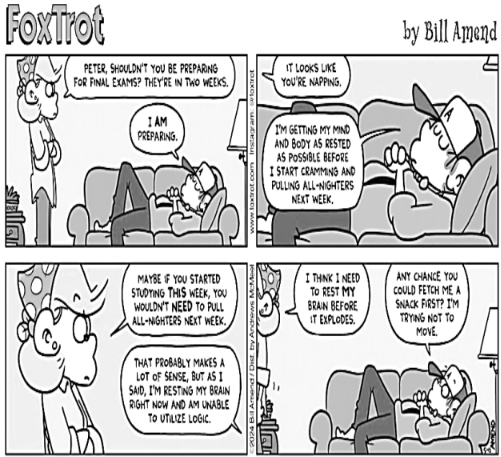
Read the text below to answer question.
Source:
https://www.gocomics.com/foxtrot/2024/05/1
2 (Accessed: Nov 28, 2024).
Why does Peter want a snack brought to
him?
Ano: 2024
Banca:
METRÓPOLE
Órgão:
Prefeitura de Ipuiúna - MG
Prova:
METRÓPOLE - 2024 - Prefeitura de Ipuiúna - MG - Professor de Inglês |
Q4412415
Inglês
Texto associado
Read the text below to answer question.
Source:
https://www.gocomics.com/foxtrot/2024/05/1
2 (Accessed: Nov 28, 2024).
In the third panel, the woman stresses the
importance of starting to study "this week" in
order to:
Ano: 2024
Banca:
METRÓPOLE
Órgão:
Prefeitura de Ipuiúna - MG
Prova:
METRÓPOLE - 2024 - Prefeitura de Ipuiúna - MG - Professor de Inglês |
Q4412414
Inglês
Texto associado
Read the text below to answer question.
Source:
https://www.gocomics.com/foxtrot/2024/05/1
2 (Accessed: Nov 28, 2024).
Peter's strategy to prepare for his final
exams is by:
Ano: 2024
Banca:
METRÓPOLE
Órgão:
Prefeitura de Ipuiúna - MG
Prova:
METRÓPOLE - 2024 - Prefeitura de Ipuiúna - MG - Professor de Inglês |
Q4412413
Inglês
Texto associado
Read the text below to answer question.
Source:
https://www.gocomics.com/foxtrot/2024/05/1
2 (Accessed: Nov 28, 2024).
In the second panel, Peter talks about
“pulling all-nighters”, which means to:
Ano: 2024
Banca:
METRÓPOLE
Órgão:
Prefeitura de Ipuiúna - MG
Prova:
METRÓPOLE - 2024 - Prefeitura de Ipuiúna - MG - Professor de Inglês |
Q4412412
Inglês
Texto associado
Read the text below to answer question.
Source:
https://www.gocomics.com/foxtrot/2024/05/1
2 (Accessed: Nov 28, 2024).
Which of the following sentences best
illustrates Peter’s approach to his final exams?
Ano: 2024
Banca:
METRÓPOLE
Órgão:
Prefeitura de Ipuiúna - MG
Prova:
METRÓPOLE - 2024 - Prefeitura de Ipuiúna - MG - Professor de Inglês |
Q4412411
Inglês
Texto associado
Read the text below to answer question.
Yes, that viral LinkedIn post you read was
probably AI-generated
[1] AI-generated writing is
now all over the internet. The introduction of
automated prose can sometimes change a
website’s character, like when once beloved
publications get purchased and overhauled
into AI content mills. Other times, however,
it’s harder to argue that AI really changed
anything. For example, look at LinkedIn. The
Microsoft-owned social media site for
business professionals has embraced AI, even
offering LinkedIn Premium subscribers access
to its own in-house AI writing tools that can
“rewrite” posts, profiles, and direct messages.
The initiative appears to be working: over 54
percent of longer English-language posts on
LinkedIn are likely AI-generated, according to
an analysis by the startup Originality AI.
The startup scanned a sample of 8,795 public
LinkedIn posts over 100 words long that were published from January 2018 to October 2024.
It found out that the use of AI writing tools on
LinkedIn was negligible for the first few years.
A major increase then occurred at the
beginning of 2023. At that point, Originality
found the number of likely AI-generated posts
had spiked 189 percent; it has since leveled
off.
About this topic, LinkedIn says it doesn’t track
how many posts on the site are written or
edited with AI tools. Adam Walkiewicz, the
platform’s head of feed relevance, points out
“we do have robust defenses in place to
proactively identify low-quality, and exact or
near-exact duplicate content. When we detect
such content, we take action to ensure it is
not broadly promoted. We see AI as a tool
that can help with review of a draft or to beat
the blank page problem”.
[2] Generally, LinkedIn is used for finding a
new job and keeping in touch with former
coworkers, that is, a relatively staid social
media platform. Nevertheless, in recent years,
it’s developed its own network
of influencers and is surprisingly popular with
Gen Z, including teenagers. Like everywhere
else on the internet, people on LinkedIn are
thirsty for attention, and companies have
realized there’s money to be made helping
them grow their audiences.
That is why there’s a cottage industry of AI
LinkedIn comment and post generators to
help the career-minded churn out content to
dazzle potential bosses or prospective
customers. Instead of spending four minutes
puzzling over the right tone with which to
congratulate an ex-colleague on their
promotion, it now takes four seconds to
conjure up an algorithmically generated
accolade.
[3] But writing with AI is a topic that receives
varied opinions. On the one hand, LinkedIn
users who spoke to WIRED say that they do
not rely on AI tools when trying to cobble
their LinkedIn posts together. On the other
hand, several non-native English speakers who
also spoke to WIRED say they lean on AI tools to polish their English writing and fix grammar
errors.
Besides, some people who have embraced AI
on LinkedIn have received blowback. For
instance, the entrepreneur Zack Fosdyck has
gotten mixed feedback about his use of
automated tools. According to him, some
people engaged positively, appreciating the
clarity and structure of the posts. Others,
though, were skeptical or critical, often
focusing on the fact that AI was involved
rather than the content itself. He completes
by saying “I find it fascinating how polarizing
this technology can be, especially since tools
like calculators or spellcheck, which are also
forms of assistance, are widely accepted.”
[4] From one angle, LinkedIn may have
inadvertently created the ideal laboratory for
AI writing. Nobody’s logging on expecting
profundity, hilarity, or sincerity. It’s the place
where people strive to be the most anodyne
versions of themselves, pleasant and
inoffensive. Artificiality, in other words, is
what everyone is expecting from it.
Adapted from:
https://www.wired.com/story/linkedin-aigenerated-influencers/
Published: Nov 26, 2024 – Accessed: Nov 28,
2024.
Read the following fragments of the text
and mark the assertions as Correct (C) or
Incorrect (I).
I- “Others, though, were skeptical or critical, often focusing on (…)”.
II- “(…) with which to congratulate an excolleague on their promotion, it now takes four seconds to conjure up an algorithmically generated accolade”.
III- “(…) it’s developed its own network of influencers and is surprisingly popular with Gen Z (…)”.
IV- “That is why there’s a cottage industry of AI LinkedIn comment and post generators to help (…)”.
( ) Rewriting fragment I with “thorough” instead of “though” preserves the meaning of the sentence.
( ) In fragment II, “it takes four seconds to” is equivalent to saying “take your time”.
( ) While in fragment III, ’s is the contraction of “has”; in fragment IV, ’s is the contraction of “is”.
( ) In fragment III, “its” refers to “LinkedIn”.
( ) In fragment IV, “there’s” has to be replaced by “have”, for grammar correction.
The assertions are, from up to down, respectively:
Ano: 2024
Banca:
METRÓPOLE
Órgão:
Prefeitura de Ipuiúna - MG
Prova:
METRÓPOLE - 2024 - Prefeitura de Ipuiúna - MG - Professor de Inglês |
Q4412410
Inglês
Texto associado
Read the text below to answer question.
Yes, that viral LinkedIn post you read was
probably AI-generated
[1] AI-generated writing is
now all over the internet. The introduction of
automated prose can sometimes change a
website’s character, like when once beloved
publications get purchased and overhauled
into AI content mills. Other times, however,
it’s harder to argue that AI really changed
anything. For example, look at LinkedIn. The
Microsoft-owned social media site for
business professionals has embraced AI, even
offering LinkedIn Premium subscribers access
to its own in-house AI writing tools that can
“rewrite” posts, profiles, and direct messages.
The initiative appears to be working: over 54
percent of longer English-language posts on
LinkedIn are likely AI-generated, according to
an analysis by the startup Originality AI.
The startup scanned a sample of 8,795 public
LinkedIn posts over 100 words long that were published from January 2018 to October 2024.
It found out that the use of AI writing tools on
LinkedIn was negligible for the first few years.
A major increase then occurred at the
beginning of 2023. At that point, Originality
found the number of likely AI-generated posts
had spiked 189 percent; it has since leveled
off.
About this topic, LinkedIn says it doesn’t track
how many posts on the site are written or
edited with AI tools. Adam Walkiewicz, the
platform’s head of feed relevance, points out
“we do have robust defenses in place to
proactively identify low-quality, and exact or
near-exact duplicate content. When we detect
such content, we take action to ensure it is
not broadly promoted. We see AI as a tool
that can help with review of a draft or to beat
the blank page problem”.
[2] Generally, LinkedIn is used for finding a
new job and keeping in touch with former
coworkers, that is, a relatively staid social
media platform. Nevertheless, in recent years,
it’s developed its own network
of influencers and is surprisingly popular with
Gen Z, including teenagers. Like everywhere
else on the internet, people on LinkedIn are
thirsty for attention, and companies have
realized there’s money to be made helping
them grow their audiences.
That is why there’s a cottage industry of AI
LinkedIn comment and post generators to
help the career-minded churn out content to
dazzle potential bosses or prospective
customers. Instead of spending four minutes
puzzling over the right tone with which to
congratulate an ex-colleague on their
promotion, it now takes four seconds to
conjure up an algorithmically generated
accolade.
[3] But writing with AI is a topic that receives
varied opinions. On the one hand, LinkedIn
users who spoke to WIRED say that they do
not rely on AI tools when trying to cobble
their LinkedIn posts together. On the other
hand, several non-native English speakers who
also spoke to WIRED say they lean on AI tools to polish their English writing and fix grammar
errors.
Besides, some people who have embraced AI
on LinkedIn have received blowback. For
instance, the entrepreneur Zack Fosdyck has
gotten mixed feedback about his use of
automated tools. According to him, some
people engaged positively, appreciating the
clarity and structure of the posts. Others,
though, were skeptical or critical, often
focusing on the fact that AI was involved
rather than the content itself. He completes
by saying “I find it fascinating how polarizing
this technology can be, especially since tools
like calculators or spellcheck, which are also
forms of assistance, are widely accepted.”
[4] From one angle, LinkedIn may have
inadvertently created the ideal laboratory for
AI writing. Nobody’s logging on expecting
profundity, hilarity, or sincerity. It’s the place
where people strive to be the most anodyne
versions of themselves, pleasant and
inoffensive. Artificiality, in other words, is
what everyone is expecting from it.
Adapted from:
https://www.wired.com/story/linkedin-aigenerated-influencers/
Published: Nov 26, 2024 – Accessed: Nov 28,
2024.
In the segment [4], the author states that
LinkedIn is “the place where people strive to
be the most anodyne versions of themselves”,
which means people are:
Ano: 2024
Banca:
METRÓPOLE
Órgão:
Prefeitura de Ipuiúna - MG
Prova:
METRÓPOLE - 2024 - Prefeitura de Ipuiúna - MG - Professor de Inglês |
Q4412409
Inglês
Texto associado
Read the text below to answer question.
Yes, that viral LinkedIn post you read was
probably AI-generated
[1] AI-generated writing is
now all over the internet. The introduction of
automated prose can sometimes change a
website’s character, like when once beloved
publications get purchased and overhauled
into AI content mills. Other times, however,
it’s harder to argue that AI really changed
anything. For example, look at LinkedIn. The
Microsoft-owned social media site for
business professionals has embraced AI, even
offering LinkedIn Premium subscribers access
to its own in-house AI writing tools that can
“rewrite” posts, profiles, and direct messages.
The initiative appears to be working: over 54
percent of longer English-language posts on
LinkedIn are likely AI-generated, according to
an analysis by the startup Originality AI.
The startup scanned a sample of 8,795 public
LinkedIn posts over 100 words long that were published from January 2018 to October 2024.
It found out that the use of AI writing tools on
LinkedIn was negligible for the first few years.
A major increase then occurred at the
beginning of 2023. At that point, Originality
found the number of likely AI-generated posts
had spiked 189 percent; it has since leveled
off.
About this topic, LinkedIn says it doesn’t track
how many posts on the site are written or
edited with AI tools. Adam Walkiewicz, the
platform’s head of feed relevance, points out
“we do have robust defenses in place to
proactively identify low-quality, and exact or
near-exact duplicate content. When we detect
such content, we take action to ensure it is
not broadly promoted. We see AI as a tool
that can help with review of a draft or to beat
the blank page problem”.
[2] Generally, LinkedIn is used for finding a
new job and keeping in touch with former
coworkers, that is, a relatively staid social
media platform. Nevertheless, in recent years,
it’s developed its own network
of influencers and is surprisingly popular with
Gen Z, including teenagers. Like everywhere
else on the internet, people on LinkedIn are
thirsty for attention, and companies have
realized there’s money to be made helping
them grow their audiences.
That is why there’s a cottage industry of AI
LinkedIn comment and post generators to
help the career-minded churn out content to
dazzle potential bosses or prospective
customers. Instead of spending four minutes
puzzling over the right tone with which to
congratulate an ex-colleague on their
promotion, it now takes four seconds to
conjure up an algorithmically generated
accolade.
[3] But writing with AI is a topic that receives
varied opinions. On the one hand, LinkedIn
users who spoke to WIRED say that they do
not rely on AI tools when trying to cobble
their LinkedIn posts together. On the other
hand, several non-native English speakers who
also spoke to WIRED say they lean on AI tools to polish their English writing and fix grammar
errors.
Besides, some people who have embraced AI
on LinkedIn have received blowback. For
instance, the entrepreneur Zack Fosdyck has
gotten mixed feedback about his use of
automated tools. According to him, some
people engaged positively, appreciating the
clarity and structure of the posts. Others,
though, were skeptical or critical, often
focusing on the fact that AI was involved
rather than the content itself. He completes
by saying “I find it fascinating how polarizing
this technology can be, especially since tools
like calculators or spellcheck, which are also
forms of assistance, are widely accepted.”
[4] From one angle, LinkedIn may have
inadvertently created the ideal laboratory for
AI writing. Nobody’s logging on expecting
profundity, hilarity, or sincerity. It’s the place
where people strive to be the most anodyne
versions of themselves, pleasant and
inoffensive. Artificiality, in other words, is
what everyone is expecting from it.
Adapted from:
https://www.wired.com/story/linkedin-aigenerated-influencers/
Published: Nov 26, 2024 – Accessed: Nov 28,
2024.
Structure used in the segment [3] to
tackle two different opinions on writing with
AI:
Ano: 2024
Banca:
METRÓPOLE
Órgão:
Prefeitura de Ipuiúna - MG
Prova:
METRÓPOLE - 2024 - Prefeitura de Ipuiúna - MG - Professor de Inglês |
Q4412408
Inglês
Texto associado
Read the text below to answer question.
Yes, that viral LinkedIn post you read was
probably AI-generated
[1] AI-generated writing is
now all over the internet. The introduction of
automated prose can sometimes change a
website’s character, like when once beloved
publications get purchased and overhauled
into AI content mills. Other times, however,
it’s harder to argue that AI really changed
anything. For example, look at LinkedIn. The
Microsoft-owned social media site for
business professionals has embraced AI, even
offering LinkedIn Premium subscribers access
to its own in-house AI writing tools that can
“rewrite” posts, profiles, and direct messages.
The initiative appears to be working: over 54
percent of longer English-language posts on
LinkedIn are likely AI-generated, according to
an analysis by the startup Originality AI.
The startup scanned a sample of 8,795 public
LinkedIn posts over 100 words long that were published from January 2018 to October 2024.
It found out that the use of AI writing tools on
LinkedIn was negligible for the first few years.
A major increase then occurred at the
beginning of 2023. At that point, Originality
found the number of likely AI-generated posts
had spiked 189 percent; it has since leveled
off.
About this topic, LinkedIn says it doesn’t track
how many posts on the site are written or
edited with AI tools. Adam Walkiewicz, the
platform’s head of feed relevance, points out
“we do have robust defenses in place to
proactively identify low-quality, and exact or
near-exact duplicate content. When we detect
such content, we take action to ensure it is
not broadly promoted. We see AI as a tool
that can help with review of a draft or to beat
the blank page problem”.
[2] Generally, LinkedIn is used for finding a
new job and keeping in touch with former
coworkers, that is, a relatively staid social
media platform. Nevertheless, in recent years,
it’s developed its own network
of influencers and is surprisingly popular with
Gen Z, including teenagers. Like everywhere
else on the internet, people on LinkedIn are
thirsty for attention, and companies have
realized there’s money to be made helping
them grow their audiences.
That is why there’s a cottage industry of AI
LinkedIn comment and post generators to
help the career-minded churn out content to
dazzle potential bosses or prospective
customers. Instead of spending four minutes
puzzling over the right tone with which to
congratulate an ex-colleague on their
promotion, it now takes four seconds to
conjure up an algorithmically generated
accolade.
[3] But writing with AI is a topic that receives
varied opinions. On the one hand, LinkedIn
users who spoke to WIRED say that they do
not rely on AI tools when trying to cobble
their LinkedIn posts together. On the other
hand, several non-native English speakers who
also spoke to WIRED say they lean on AI tools to polish their English writing and fix grammar
errors.
Besides, some people who have embraced AI
on LinkedIn have received blowback. For
instance, the entrepreneur Zack Fosdyck has
gotten mixed feedback about his use of
automated tools. According to him, some
people engaged positively, appreciating the
clarity and structure of the posts. Others,
though, were skeptical or critical, often
focusing on the fact that AI was involved
rather than the content itself. He completes
by saying “I find it fascinating how polarizing
this technology can be, especially since tools
like calculators or spellcheck, which are also
forms of assistance, are widely accepted.”
[4] From one angle, LinkedIn may have
inadvertently created the ideal laboratory for
AI writing. Nobody’s logging on expecting
profundity, hilarity, or sincerity. It’s the place
where people strive to be the most anodyne
versions of themselves, pleasant and
inoffensive. Artificiality, in other words, is
what everyone is expecting from it.
Adapted from:
https://www.wired.com/story/linkedin-aigenerated-influencers/
Published: Nov 26, 2024 – Accessed: Nov 28,
2024.
The entrepreneur Zack Fosdyck said: “I
find it fascinating how polarizing this
technology can be, especially since tools like
calculators or spellcheck, which are also forms
of assistance, are widely accepted.”
By using “find”, he:
By using “find”, he:
Ano: 2024
Banca:
METRÓPOLE
Órgão:
Prefeitura de Ipuiúna - MG
Prova:
METRÓPOLE - 2024 - Prefeitura de Ipuiúna - MG - Professor de Inglês |
Q4412407
Inglês
Texto associado
Read the text below to answer question.
Yes, that viral LinkedIn post you read was
probably AI-generated
[1] AI-generated writing is
now all over the internet. The introduction of
automated prose can sometimes change a
website’s character, like when once beloved
publications get purchased and overhauled
into AI content mills. Other times, however,
it’s harder to argue that AI really changed
anything. For example, look at LinkedIn. The
Microsoft-owned social media site for
business professionals has embraced AI, even
offering LinkedIn Premium subscribers access
to its own in-house AI writing tools that can
“rewrite” posts, profiles, and direct messages.
The initiative appears to be working: over 54
percent of longer English-language posts on
LinkedIn are likely AI-generated, according to
an analysis by the startup Originality AI.
The startup scanned a sample of 8,795 public
LinkedIn posts over 100 words long that were published from January 2018 to October 2024.
It found out that the use of AI writing tools on
LinkedIn was negligible for the first few years.
A major increase then occurred at the
beginning of 2023. At that point, Originality
found the number of likely AI-generated posts
had spiked 189 percent; it has since leveled
off.
About this topic, LinkedIn says it doesn’t track
how many posts on the site are written or
edited with AI tools. Adam Walkiewicz, the
platform’s head of feed relevance, points out
“we do have robust defenses in place to
proactively identify low-quality, and exact or
near-exact duplicate content. When we detect
such content, we take action to ensure it is
not broadly promoted. We see AI as a tool
that can help with review of a draft or to beat
the blank page problem”.
[2] Generally, LinkedIn is used for finding a
new job and keeping in touch with former
coworkers, that is, a relatively staid social
media platform. Nevertheless, in recent years,
it’s developed its own network
of influencers and is surprisingly popular with
Gen Z, including teenagers. Like everywhere
else on the internet, people on LinkedIn are
thirsty for attention, and companies have
realized there’s money to be made helping
them grow their audiences.
That is why there’s a cottage industry of AI
LinkedIn comment and post generators to
help the career-minded churn out content to
dazzle potential bosses or prospective
customers. Instead of spending four minutes
puzzling over the right tone with which to
congratulate an ex-colleague on their
promotion, it now takes four seconds to
conjure up an algorithmically generated
accolade.
[3] But writing with AI is a topic that receives
varied opinions. On the one hand, LinkedIn
users who spoke to WIRED say that they do
not rely on AI tools when trying to cobble
their LinkedIn posts together. On the other
hand, several non-native English speakers who
also spoke to WIRED say they lean on AI tools to polish their English writing and fix grammar
errors.
Besides, some people who have embraced AI
on LinkedIn have received blowback. For
instance, the entrepreneur Zack Fosdyck has
gotten mixed feedback about his use of
automated tools. According to him, some
people engaged positively, appreciating the
clarity and structure of the posts. Others,
though, were skeptical or critical, often
focusing on the fact that AI was involved
rather than the content itself. He completes
by saying “I find it fascinating how polarizing
this technology can be, especially since tools
like calculators or spellcheck, which are also
forms of assistance, are widely accepted.”
[4] From one angle, LinkedIn may have
inadvertently created the ideal laboratory for
AI writing. Nobody’s logging on expecting
profundity, hilarity, or sincerity. It’s the place
where people strive to be the most anodyne
versions of themselves, pleasant and
inoffensive. Artificiality, in other words, is
what everyone is expecting from it.
Adapted from:
https://www.wired.com/story/linkedin-aigenerated-influencers/
Published: Nov 26, 2024 – Accessed: Nov 28,
2024.
Analyze the assertions.
(1) WIRED’s analysis omitted that the use of AI writing tools on LinkedIn was negligible for the first few years.
(2) LinkedIn’s in-house AI writing tools that can “rewrite” posts, profiles, and direct messages are offered to all its subscribers.
(3) Originality AI scanned a sample of 8,795 public LinkedIn posts over one hundred words long.
Based on the segment [1] of the text, the correct assertion(s) is(are):
Ano: 2024
Banca:
METRÓPOLE
Órgão:
Prefeitura de Ipuiúna - MG
Prova:
METRÓPOLE - 2024 - Prefeitura de Ipuiúna - MG - Professor de Inglês |
Q4412406
Inglês
Texto associado
Read the text below to answer question.
Yes, that viral LinkedIn post you read was
probably AI-generated
[1] AI-generated writing is
now all over the internet. The introduction of
automated prose can sometimes change a
website’s character, like when once beloved
publications get purchased and overhauled
into AI content mills. Other times, however,
it’s harder to argue that AI really changed
anything. For example, look at LinkedIn. The
Microsoft-owned social media site for
business professionals has embraced AI, even
offering LinkedIn Premium subscribers access
to its own in-house AI writing tools that can
“rewrite” posts, profiles, and direct messages.
The initiative appears to be working: over 54
percent of longer English-language posts on
LinkedIn are likely AI-generated, according to
an analysis by the startup Originality AI.
The startup scanned a sample of 8,795 public
LinkedIn posts over 100 words long that were published from January 2018 to October 2024.
It found out that the use of AI writing tools on
LinkedIn was negligible for the first few years.
A major increase then occurred at the
beginning of 2023. At that point, Originality
found the number of likely AI-generated posts
had spiked 189 percent; it has since leveled
off.
About this topic, LinkedIn says it doesn’t track
how many posts on the site are written or
edited with AI tools. Adam Walkiewicz, the
platform’s head of feed relevance, points out
“we do have robust defenses in place to
proactively identify low-quality, and exact or
near-exact duplicate content. When we detect
such content, we take action to ensure it is
not broadly promoted. We see AI as a tool
that can help with review of a draft or to beat
the blank page problem”.
[2] Generally, LinkedIn is used for finding a
new job and keeping in touch with former
coworkers, that is, a relatively staid social
media platform. Nevertheless, in recent years,
it’s developed its own network
of influencers and is surprisingly popular with
Gen Z, including teenagers. Like everywhere
else on the internet, people on LinkedIn are
thirsty for attention, and companies have
realized there’s money to be made helping
them grow their audiences.
That is why there’s a cottage industry of AI
LinkedIn comment and post generators to
help the career-minded churn out content to
dazzle potential bosses or prospective
customers. Instead of spending four minutes
puzzling over the right tone with which to
congratulate an ex-colleague on their
promotion, it now takes four seconds to
conjure up an algorithmically generated
accolade.
[3] But writing with AI is a topic that receives
varied opinions. On the one hand, LinkedIn
users who spoke to WIRED say that they do
not rely on AI tools when trying to cobble
their LinkedIn posts together. On the other
hand, several non-native English speakers who
also spoke to WIRED say they lean on AI tools to polish their English writing and fix grammar
errors.
Besides, some people who have embraced AI
on LinkedIn have received blowback. For
instance, the entrepreneur Zack Fosdyck has
gotten mixed feedback about his use of
automated tools. According to him, some
people engaged positively, appreciating the
clarity and structure of the posts. Others,
though, were skeptical or critical, often
focusing on the fact that AI was involved
rather than the content itself. He completes
by saying “I find it fascinating how polarizing
this technology can be, especially since tools
like calculators or spellcheck, which are also
forms of assistance, are widely accepted.”
[4] From one angle, LinkedIn may have
inadvertently created the ideal laboratory for
AI writing. Nobody’s logging on expecting
profundity, hilarity, or sincerity. It’s the place
where people strive to be the most anodyne
versions of themselves, pleasant and
inoffensive. Artificiality, in other words, is
what everyone is expecting from it.
Adapted from:
https://www.wired.com/story/linkedin-aigenerated-influencers/
Published: Nov 26, 2024 – Accessed: Nov 28,
2024.
In the title of the text, the word
“probably” conveys:

 Conheça nossos planos