Questões de Concurso
Sobre ensino da língua estrangeira inglesa em inglês
Foram encontradas 2.182 questões


Ano: 2023
Banca:
Avança SP
Órgão:
Prefeitura de São Lourenço da Serra - SP
Prova:
Avança SP - 2023 - Prefeitura de São Lourenço da Serra - SP - Professor de Educação Básica II - Língua Inglesa |
Q2209565
Inglês
What is the importance of contextual knowledge, including knowledge of interlocutors, time, place,
and communicative purpose, in foreign language learning?
Ano: 2023
Banca:
Avança SP
Órgão:
Prefeitura de São Lourenço da Serra - SP
Prova:
Avança SP - 2023 - Prefeitura de São Lourenço da Serra - SP - Professor de Educação Básica II - Língua Inglesa |
Q2209561
Inglês
In the study of the English language, it is essential to develop skills that allow the comprehension,
interpretation, and production of different types of texts. Reading strategies, text typology, structure,
and organization are some of the important elements that contribute to the development of these skills.
Which of the following reading techniques can be used to identify specific information in a text?
Which of the following reading techniques can be used to identify specific information in a text?
Ano: 2023
Banca:
Avança SP
Órgão:
Prefeitura de São Lourenço da Serra - SP
Prova:
Avança SP - 2023 - Prefeitura de São Lourenço da Serra - SP - Professor de Educação Básica II - Língua Inglesa |
Q2209560
Inglês
"The communicative approach to language
teaching emphasizes the importance of using
language for communication in authentic
situations. It focuses on developing learners'
communicative competence through the
integration of language skills such as speaking,
listening, reading and writing."
A abordagem comunicativa para o ensino de línguas enfatiza a importância de usar a língua para comunicação em situações autênticas. Em que consiste a abordagem comunicativa?
A abordagem comunicativa para o ensino de línguas enfatiza a importância de usar a língua para comunicação em situações autênticas. Em que consiste a abordagem comunicativa?
Ano: 2023
Banca:
FGV
Órgão:
SEDUC-TO
Prova:
FGV - 2023 - SEDUC-TO - Professor da Educação Básica - Professor Regente Letras - Inglês |
Q2206472
Inglês
Texto associado
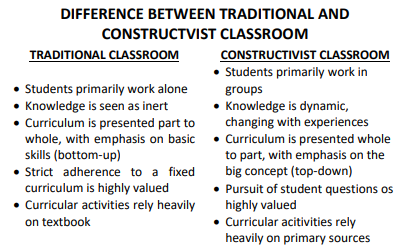
Text VIII
From: https://slideplayer.com/slide/7593575/
Read the following skills:
1. Emphasizing social interaction. 2. Asking students to memorize. 3. Building on previous knowledge. 4. Providing repetition exercises. 5. Copying facial expressions. 6. Interacting with students.
The skills which are typical of a constructivist class are, respectively,
1. Emphasizing social interaction. 2. Asking students to memorize. 3. Building on previous knowledge. 4. Providing repetition exercises. 5. Copying facial expressions. 6. Interacting with students.
The skills which are typical of a constructivist class are, respectively,
Ano: 2023
Banca:
FGV
Órgão:
SEDUC-TO
Prova:
FGV - 2023 - SEDUC-TO - Professor da Educação Básica - Professor Regente Letras - Inglês |
Q2206471
Inglês
Texto associado
Text VIII
From: https://slideplayer.com/slide/7593575/
Based on the information provided by Text, mark the
statements below as true (T) or false (F).
( ) Traditional classes always use authentic materials. ( ) In constructivist classrooms, students work exclusively by themselves. ( ) Students’ experiences are taken into consideration in a constructivist environment.
The statements are, respectively,
( ) Traditional classes always use authentic materials. ( ) In constructivist classrooms, students work exclusively by themselves. ( ) Students’ experiences are taken into consideration in a constructivist environment.
The statements are, respectively,
Ano: 2023
Banca:
FGV
Órgão:
SEDUC-TO
Prova:
FGV - 2023 - SEDUC-TO - Professor da Educação Básica - Professor Regente Letras - Inglês |
Q2206470
Inglês
Texto associado


Text VII
Here are two multicultural picture books about immigration thathave been suggested for elementary school children:
Here I Am
by Patti Kim
Newly arrived in America from an Asian country, a young boy
is overwhelmed by the lights and noise of a busy city. He finds
comfort in a red seed he brought from his faraway home country.
When he loses the seed, the search for it eventually leads him to
new friendship. Without words and in expressive cartoon
style, Here I am describes the confusion and sadness of an
uprooted child.
Dear Baobab
by Cheryl Foggo
Moving from Tanzania to Canada with his aunt and uncle, little
Maiko feels homesick. He remembers the big baobab tree in his
home village, and feels a connection to a small spruce tree in his
new home. Seven years old just like Maiko, the tree sings to him
and shares his secrets. When there is talk of cutting down the tree
because it is too close to the house, Maiko tries to save it. After all
he knows what it feels like to be planted in the wrong place. Dear
Baobab is one of my favourite multicultural picture books about
immigration, because of its easy-to-relate-to allegory of an
uprooted tree.
From: https://coloursofus.com/multicultural-picture-books-immigration/
To be in line with the BNCC, if teaching Dear Baobab to elementary school children, teachers should
Ano: 2023
Banca:
FGV
Órgão:
SEDUC-TO
Prova:
FGV - 2023 - SEDUC-TO - Professor da Educação Básica - Professor Regente Letras - Inglês |
Q2206463
Inglês
Texto associado
Text VII
Here are two multicultural picture books about immigration thathave been suggested for elementary school children:
Here I Am
by Patti Kim
Newly arrived in America from an Asian country, a young boy
is overwhelmed by the lights and noise of a busy city. He finds
comfort in a red seed he brought from his faraway home country.
When he loses the seed, the search for it eventually leads him to
new friendship. Without words and in expressive cartoon
style, Here I am describes the confusion and sadness of an
uprooted child.
Dear Baobab
by Cheryl Foggo
Moving from Tanzania to Canada with his aunt and uncle, little
Maiko feels homesick. He remembers the big baobab tree in his
home village, and feels a connection to a small spruce tree in his
new home. Seven years old just like Maiko, the tree sings to him
and shares his secrets. When there is talk of cutting down the tree
because it is too close to the house, Maiko tries to save it. After all
he knows what it feels like to be planted in the wrong place. Dear
Baobab is one of my favourite multicultural picture books about
immigration, because of its easy-to-relate-to allegory of an
uprooted tree.
From: https://coloursofus.com/multicultural-picture-books-immigration/
Teachers of English as an Additional Language may use these
stories to
Ano: 2023
Banca:
FGV
Órgão:
SEDUC-TO
Prova:
FGV - 2023 - SEDUC-TO - Professor da Educação Básica - Professor Regente Letras - Inglês |
Q2206443
Inglês
Texto associado
Text I
What is “World Englishes?”
The term World Englishes refers to the differences in the
English language that emerge as it is used in various contexts
across the world. Scholars of World Englishes identify the varieties
of English used in different sociolinguistic contexts, analyzing their
history, background, function, and influence.
Languages develop to fulfill the needs of the societies that use
them. Because societies contain a diverse range of social needs,
and because these needs can differ across cultures and
geographies, multiple varieties of the English language exist. These
include American English, British English, Australian English,
Canadian English, Indian English, and so on.
While there is no single way for a new variety of English to
emerge, its development can generally be described as a process
of adaptation. A certain group of speakers take a familiar variety
of English and adapt the features of that variety to suit the needs
of their social context.
For example, a store selling alcoholic beverages is called a
“liquor store” in American English, whereas it is called an “offlicence” in British English. The latter term derives from British law,
which distinguishes between businesses licensed to sell alcoholic
beverages for consumption off the premises and those licensed for
consumption at the point of sale (i.e., bars and pubs).
Such variations do not occur in terms of word choice only. They
happen also in terms of spelling, pronunciation, sentence
structure, accent, and meaning. As new linguistic adaptations
accumulate over time, a distinct variety of English eventually
emerges.
World Englishes scholars use a range of different criteria to
recognize a new English variant as an established World English.
These include the sociolinguistic context of its use, its range of
functional domains, and the ease with which new speakers can
become acculturated to it, among other criteria.
Adapted from:
https://owl.purdue.edu/owl/multilingual/world_englishes/#:~:text=The%20term%2
0World%20Englishes%20refers,background%2C%20function%2C%20and%20influen
ce.
An English as an Additional Language teacher aware of World
Englishes should prefer materials that
Ano: 2023
Banca:
FGV
Órgão:
SEDUC-TO
Prova:
FGV - 2023 - SEDUC-TO - Professor da Educação Básica - Professor Regente Letras - Inglês |
Q2206442
Inglês
Texto associado
Text I
What is “World Englishes?”
The term World Englishes refers to the differences in the
English language that emerge as it is used in various contexts
across the world. Scholars of World Englishes identify the varieties
of English used in different sociolinguistic contexts, analyzing their
history, background, function, and influence.
Languages develop to fulfill the needs of the societies that use
them. Because societies contain a diverse range of social needs,
and because these needs can differ across cultures and
geographies, multiple varieties of the English language exist. These
include American English, British English, Australian English,
Canadian English, Indian English, and so on.
While there is no single way for a new variety of English to
emerge, its development can generally be described as a process
of adaptation. A certain group of speakers take a familiar variety
of English and adapt the features of that variety to suit the needs
of their social context.
For example, a store selling alcoholic beverages is called a
“liquor store” in American English, whereas it is called an “offlicence” in British English. The latter term derives from British law,
which distinguishes between businesses licensed to sell alcoholic
beverages for consumption off the premises and those licensed for
consumption at the point of sale (i.e., bars and pubs).
Such variations do not occur in terms of word choice only. They
happen also in terms of spelling, pronunciation, sentence
structure, accent, and meaning. As new linguistic adaptations
accumulate over time, a distinct variety of English eventually
emerges.
World Englishes scholars use a range of different criteria to
recognize a new English variant as an established World English.
These include the sociolinguistic context of its use, its range of
functional domains, and the ease with which new speakers can
become acculturated to it, among other criteria.
Adapted from:
https://owl.purdue.edu/owl/multilingual/world_englishes/#:~:text=The%20term%2
0World%20Englishes%20refers,background%2C%20function%2C%20and%20influen
ce.
The World Englishes perspective and the National Common
Curricular Base (BNCC) guidelines recognize that
Ano: 2023
Banca:
FGV
Órgão:
SEDUC-TO
Prova:
FGV - 2023 - SEDUC-TO - Professor da Educação Básica - Professor Regente Letras - Inglês |
Q2206436
Inglês
Texto associado
Text I
What is “World Englishes?”
The term World Englishes refers to the differences in the
English language that emerge as it is used in various contexts
across the world. Scholars of World Englishes identify the varieties
of English used in different sociolinguistic contexts, analyzing their
history, background, function, and influence.
Languages develop to fulfill the needs of the societies that use
them. Because societies contain a diverse range of social needs,
and because these needs can differ across cultures and
geographies, multiple varieties of the English language exist. These
include American English, British English, Australian English,
Canadian English, Indian English, and so on.
While there is no single way for a new variety of English to
emerge, its development can generally be described as a process
of adaptation. A certain group of speakers take a familiar variety
of English and adapt the features of that variety to suit the needs
of their social context.
For example, a store selling alcoholic beverages is called a
“liquor store” in American English, whereas it is called an “offlicence” in British English. The latter term derives from British law,
which distinguishes between businesses licensed to sell alcoholic
beverages for consumption off the premises and those licensed for
consumption at the point of sale (i.e., bars and pubs).
Such variations do not occur in terms of word choice only. They
happen also in terms of spelling, pronunciation, sentence
structure, accent, and meaning. As new linguistic adaptations
accumulate over time, a distinct variety of English eventually
emerges.
World Englishes scholars use a range of different criteria to
recognize a new English variant as an established World English.
These include the sociolinguistic context of its use, its range of
functional domains, and the ease with which new speakers can
become acculturated to it, among other criteria.
Adapted from:
https://owl.purdue.edu/owl/multilingual/world_englishes/#:~:text=The%20term%2
0World%20Englishes%20refers,background%2C%20function%2C%20and%20influen
ce.
Based on the information provided by Text, mark the statements
below as true (T) or false (F).
( ) World Englishes is a concept that recognizes and validates different varieties of the English language. ( ) A new variety of English depends on changes on the lexical level alone. ( ) Languages are dynamic and may vary to satisfy the needs of users.
The statements are, respectively,
( ) World Englishes is a concept that recognizes and validates different varieties of the English language. ( ) A new variety of English depends on changes on the lexical level alone. ( ) Languages are dynamic and may vary to satisfy the needs of users.
The statements are, respectively,
Ano: 2023
Banca:
FGV
Órgão:
SEDUC-TO
Prova:
FGV - 2023 - SEDUC-TO - Professor da Educação Básica - Professor Regente Letras - Inglês |
Q2206435
Inglês
Texto associado
Text I
What is “World Englishes?”
The term World Englishes refers to the differences in the
English language that emerge as it is used in various contexts
across the world. Scholars of World Englishes identify the varieties
of English used in different sociolinguistic contexts, analyzing their
history, background, function, and influence.
Languages develop to fulfill the needs of the societies that use
them. Because societies contain a diverse range of social needs,
and because these needs can differ across cultures and
geographies, multiple varieties of the English language exist. These
include American English, British English, Australian English,
Canadian English, Indian English, and so on.
While there is no single way for a new variety of English to
emerge, its development can generally be described as a process
of adaptation. A certain group of speakers take a familiar variety
of English and adapt the features of that variety to suit the needs
of their social context.
For example, a store selling alcoholic beverages is called a
“liquor store” in American English, whereas it is called an “offlicence” in British English. The latter term derives from British law,
which distinguishes between businesses licensed to sell alcoholic
beverages for consumption off the premises and those licensed for
consumption at the point of sale (i.e., bars and pubs).
Such variations do not occur in terms of word choice only. They
happen also in terms of spelling, pronunciation, sentence
structure, accent, and meaning. As new linguistic adaptations
accumulate over time, a distinct variety of English eventually
emerges.
World Englishes scholars use a range of different criteria to
recognize a new English variant as an established World English.
These include the sociolinguistic context of its use, its range of
functional domains, and the ease with which new speakers can
become acculturated to it, among other criteria.
Adapted from:
https://owl.purdue.edu/owl/multilingual/world_englishes/#:~:text=The%20term%2
0World%20Englishes%20refers,background%2C%20function%2C%20and%20influen
ce.
The title indicates that Text aims at
Ano: 2023
Banca:
FGV
Órgão:
Prefeitura de Jaboatão dos Guararapes - PE
Prova:
FGV - 2023 - Prefeitura de Jaboatão dos Guararapes - PE - Professor 2 - Língua inglesa |
Q2204956
Inglês
Texto associado
Text I
What is English as a Lingua Franca?
‘English’, as a language, has for some time been seen as a
global phenomenon and, therefore, as no longer defined by fixed
territorial, cultural and social functions. At the same time, people
using English around the world have been shaping it and adapting
it to their contexts of use and have made it relevant to their
socio-cultural settings. English as a Lingua Franca, or ELF for
short, is a field of research interest that was born out of this
tension between the global and the local, and it originally began
as a ramification of the World Englishes framework in order to
address the international, or, rather, transnational perspective on
English in the world. The field of ELF very quickly took on a nature
of its own in its attempt to address the communication, attitudes,
ideologies in transnational contexts, which go beyond the
national categorisations of World Englishes (such as descriptions
of Nigerian English, Malaysian English and other national
varieties). ELF research, therefore, has built on World Englishes
research by focusing on the diversity of English, albeit from more
transnational, intercultural and multilingual perspectives.
ELF is an intercultural medium of communication used among people from different socio-cultural and linguistic backgrounds,
and usually among people from different first languages.
Although it is possible that many people who use ELF have learnt
it formally as a foreign language, at school or in an educational
institution, the emphasis is on using rather than on learning. And
this is a fundamental difference between ELF and English as a
Foreign Language, or EFL, whereby people learn English to
assimilate to or emulate native speakers. In ELF, instead, speakers
are considered language users in their own right, and not failed
native speakers or deficient learners of English. Some examples
of typical ELF contexts may include communication among a
group of neuroscientists, from, say, Belgium, Brazil and Russia, at
an international conference on neuroscience, discussing their
work in English, or an international call concerning a business
project between Chinese and German business experts, or a
group of migrants from Syria, Ethiopia and Iraq discussing their
migration documents and requirements in English. The use of
English will of course depend on the linguistic profile of the
participants in these contexts, and they may have another
common language at their disposal (other than English), but
today ELF is the most common medium of intercultural
communication, especially in transnational contexts.
So, research in ELF pertains to roughly the same area of
research as English as a contact language and English
sociolinguistics. However, the initial impetus to conducting
research in ELF originated from a pedagogical rationale – it
seemed irrelevant and unrealistic to expect learners of English
around the world to conform to native norms, British or
American, or even to new English national varieties, which would
be only suitable to certain socio-cultural and geographical
locations. So, people from Brazil, France, Russia, Mozambique, or
others around the world, would not need to acquire the norms
originated and relevant to British or American English speakers,
but could orientate themselves towards more appropriate and
relevant ways of using English, or ELF. Researchers called for
“closing a conceptual gap” between descriptions of native English
varieties and new empirical and analytical approaches to English
in the world. With the compilation of a number of corpora, ELF
empirical research started to explore how English is developing,
emerging and changing in its international uses around the world.
Since the empirical corpus work started, research has expanded
beyond the pedagogical aim, to include explorations of
communication in different domains of expertise (professional,
academic, etc.) and in relation to other concepts and research,
such as culture, ideology and identity.
Adapted from https://www.gold.ac.uk/glits-e/
back-issues/english-as-a-lingua-franca/
Based on Text I, mark the statements below as TRUE (T) or
FALSE (F)
( ) English as a Lingua Franca (ELF) and as a Foreign Language (EFL) present different perspectives. ( ) In an ELF context, learners look up to native language speakers as models. ( ) Research in the area of ELF has involved areas other than pedagogical settings.
The statements are, respectively:
( ) English as a Lingua Franca (ELF) and as a Foreign Language (EFL) present different perspectives. ( ) In an ELF context, learners look up to native language speakers as models. ( ) Research in the area of ELF has involved areas other than pedagogical settings.
The statements are, respectively:
Ano: 2023
Banca:
AMEOSC
Órgão:
Prefeitura de São João do Oeste - SC
Prova:
AMEOSC - 2023 - Prefeitura de São João do Oeste - SC - Professor de Inglês |
Q2189350
Inglês
Judge the following statements as TRUE or FALSE.
1.(__)Studying a foreign language makes it possible to understand nuances of the local culture, such as idiomatic expressions and ways of thinking, in addition to facilitating communication.
2.(__)By learning a language, we can access literature, films, music, and other cultural productions in their original form, without relying on translations or interpretations.
3.(__)When we learn a language, we are just learning how to communicate with people who speak that language.
The CORRECT sequence is:
1.(__)Studying a foreign language makes it possible to understand nuances of the local culture, such as idiomatic expressions and ways of thinking, in addition to facilitating communication.
2.(__)By learning a language, we can access literature, films, music, and other cultural productions in their original form, without relying on translations or interpretations.
3.(__)When we learn a language, we are just learning how to communicate with people who speak that language.
The CORRECT sequence is:
Ano: 2023
Banca:
AMEOSC
Órgão:
Prefeitura de São João do Oeste - SC
Prova:
AMEOSC - 2023 - Prefeitura de São João do Oeste - SC - Professor de Inglês |
Q2189348
Inglês
Considere a seguinte situação abaixo.
Um(a) professor(a) de Língua Inglesa do Ensino Fundamental, em uma reunião de professores, faz a seguinte colocação: "Segundo a Lei nº 9.394/96, o Ensino Fundamental obrigatório, com duração de 9 (nove) anos, iniciando-se aos 6 (seis) anos de idade, terá por objetivo a formação básica do cidadão, mediante o desenvolvimento da capacidade de aprender, tendo como meios básicos o pleno domínio da leitura, da escrita e do cálculo; compreensão do ambiente natural e social, do sistema político, da tecnologia, das artes e dos valores em que se fundamenta a sociedade; o desenvolvimento da capacidade de aprendizagem, tendo em vista a aquisição de conhecimentos e habilidades e a formação de atitudes e valores; e o fortalecimento dos vínculos de família, dos laços de solidariedade humana e de tolerância recíproca em que se assenta a vida social".
Podemos afirmar que a fala do(a) professor(a) está:
Um(a) professor(a) de Língua Inglesa do Ensino Fundamental, em uma reunião de professores, faz a seguinte colocação: "Segundo a Lei nº 9.394/96, o Ensino Fundamental obrigatório, com duração de 9 (nove) anos, iniciando-se aos 6 (seis) anos de idade, terá por objetivo a formação básica do cidadão, mediante o desenvolvimento da capacidade de aprender, tendo como meios básicos o pleno domínio da leitura, da escrita e do cálculo; compreensão do ambiente natural e social, do sistema político, da tecnologia, das artes e dos valores em que se fundamenta a sociedade; o desenvolvimento da capacidade de aprendizagem, tendo em vista a aquisição de conhecimentos e habilidades e a formação de atitudes e valores; e o fortalecimento dos vínculos de família, dos laços de solidariedade humana e de tolerância recíproca em que se assenta a vida social".
Podemos afirmar que a fala do(a) professor(a) está:
Ano: 2023
Banca:
OBJETIVA
Órgão:
Prefeitura de Lavras do Sul - RS
Prova:
OBJETIVA - 2023 - Prefeitura de Lavras do Sul - RS - Professor - Inglês |
Q2189253
Inglês
Em relação ao ensino-aprendizagem de língua
estrangeira, assinalar a alternativa CORRETA:
Ano: 2023
Banca:
IF-MT
Órgão:
IF-MT
Prova:
IF-MT - 2023 - IF-MT - Professor do Ensino Básico, Técnico e Tecnológico - Português-Inglês |
Q2188982
Inglês
“A lesson plan is a set of notes that helps us think through what we are going to teach and how we are going
to teach. It also guides us during and after the lesson. We can identify the most important components of a
lesson plan by thinking carefully about what we want our learners to do and how we want them to do it. So,
it helps the teacher before the lesson (writing down the aims and procedures for each stage of the lesson),
during the lesson (timing each stage) and after the lesson (using the plan and notes to help plan the next
lesson)”.
(THORNBURY, 2005, p. 91-92)
Considering Thornbury’s (a very famous applied linguistics in the early 2000s) quotation, put the numbers 1 – 5 in the correct place in the following lesson plan: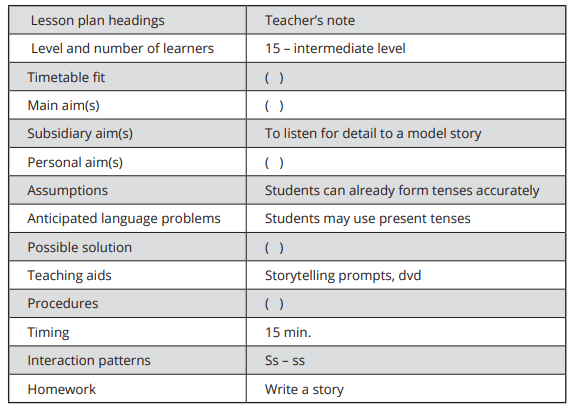
1. To enable students to use past tenses accurately and put events in order in simple narratives.
2. Students listen to the model story, then, in groups, plan and write their own stories.
3. Use gestures to remind students to use past tenses.
4. To follow on from work on past tenses and to prepare for the storytelling project.
5. To make sure that board writing is clear and readable.
Choose the CORRECT sequence.
(THORNBURY, 2005, p. 91-92)
Considering Thornbury’s (a very famous applied linguistics in the early 2000s) quotation, put the numbers 1 – 5 in the correct place in the following lesson plan:
1. To enable students to use past tenses accurately and put events in order in simple narratives.
2. Students listen to the model story, then, in groups, plan and write their own stories.
3. Use gestures to remind students to use past tenses.
4. To follow on from work on past tenses and to prepare for the storytelling project.
5. To make sure that board writing is clear and readable.
Choose the CORRECT sequence.
Ano: 2023
Banca:
IF-MT
Órgão:
IF-MT
Prova:
IF-MT - 2023 - IF-MT - Professor do Ensino Básico, Técnico e Tecnológico - Português-Inglês |
Q2188981
Inglês
“Communicative activities are classroom activities designed to get learners to speak and listen to one
another. We normally communicate when one of us has information (facts, opinions, ideas, etc.) that
another does not have. This is known as an ‘information gap’. The aim of a communicative activity in class
is to get learners to use the language they are learning to interact in realistic and meaningful ways, usually
involving exchanges of information”.
(SCRIVINER, 2003, p. 62)
Consider the definition above, choose the item that is a proposal for a communicative activity.
(SCRIVINER, 2003, p. 62)
Consider the definition above, choose the item that is a proposal for a communicative activity.
Ano: 2023
Banca:
IF-MT
Órgão:
IF-MT
Prova:
IF-MT - 2023 - IF-MT - Professor do Ensino Básico, Técnico e Tecnológico - Português-Inglês |
Q2188980
Inglês
Read the quote about error to get familiarized with the topic.
“Mistakes are often divided into errors and slips. Errors happen when learners try to say something that is beyond their current level of language processing. Usually, learners cannot correct errors themselves because they don’t understand what is wrong. Errors play a necessary and important part in language learning. Slips are the result of tiredness, worry or other temporary emotions or circumstances. These kinds of mistakes can be corrected by learners once they realize they have made them.”
(SPRATT; PULLVERNESS; WILLIAMS, 2005, p. 44)
Judge the items below as (T) True or (F) False.
1. There are two main reasons why learners make errors. The first reason is influence from the learner’s first language (L1) on the second language. This is called interference or transfer. Learners may use sound patterns, lexis or grammatical structures from their own language in English. The second reason is because they are unconsciously working out or organizing language, but this process is not yet complete. This kind of error is called a developmental error.
2. Errors in which learners wrongly apply a rule for one item of the language to another item are known as overgeneralization, and as a second language learners’ language ability increases, these kinds of errors also reduce.
3. Errors are part of learner’s interlanguage, which develops and progresses as they learn more. Experts think that interlanguage is an essential and unavoidable stage in language learning. In other words, interlanguage and errors are necessary to language learning.
4. Errors are a natural part of learning. They usually show that learners are learning and that their internal mental processes are working on experimenting with language.
5. Sometimes errors do not disappear, but get fossilized. These fossilized errors may be the result of lack of exposure to the second language and/or of a learner’s lack of motivation to improve their level of accuracy.
Choose the CORRECT sequence.
“Mistakes are often divided into errors and slips. Errors happen when learners try to say something that is beyond their current level of language processing. Usually, learners cannot correct errors themselves because they don’t understand what is wrong. Errors play a necessary and important part in language learning. Slips are the result of tiredness, worry or other temporary emotions or circumstances. These kinds of mistakes can be corrected by learners once they realize they have made them.”
(SPRATT; PULLVERNESS; WILLIAMS, 2005, p. 44)
Judge the items below as (T) True or (F) False.
1. There are two main reasons why learners make errors. The first reason is influence from the learner’s first language (L1) on the second language. This is called interference or transfer. Learners may use sound patterns, lexis or grammatical structures from their own language in English. The second reason is because they are unconsciously working out or organizing language, but this process is not yet complete. This kind of error is called a developmental error.
2. Errors in which learners wrongly apply a rule for one item of the language to another item are known as overgeneralization, and as a second language learners’ language ability increases, these kinds of errors also reduce.
3. Errors are part of learner’s interlanguage, which develops and progresses as they learn more. Experts think that interlanguage is an essential and unavoidable stage in language learning. In other words, interlanguage and errors are necessary to language learning.
4. Errors are a natural part of learning. They usually show that learners are learning and that their internal mental processes are working on experimenting with language.
5. Sometimes errors do not disappear, but get fossilized. These fossilized errors may be the result of lack of exposure to the second language and/or of a learner’s lack of motivation to improve their level of accuracy.
Choose the CORRECT sequence.
Ano: 2023
Banca:
IF-MT
Órgão:
IF-MT
Prova:
IF-MT - 2023 - IF-MT - Professor do Ensino Básico, Técnico e Tecnológico - Português-Inglês |
Q2188979
Inglês
Read the following exchange between two people having breakfast together.
A – Coffee?
B – Please.
A – Milk? Sugar?
B – No milk. One sugar, thanks.
A – Toast?
B – No thanks.
A – Juice?
B – Mmm.
(Thornbury, 2005, p. 3)
After reading the dialogue, choose the item that DOES NOT describe a correct reflection about grammar.
Ano: 2023
Banca:
IF-MT
Órgão:
IF-MT
Prova:
IF-MT - 2023 - IF-MT - Professor do Ensino Básico, Técnico e Tecnológico - Português-Inglês |
Q2188978
Inglês
Applied linguists for a long time have been publishing many books and materials on teaching and learning English
as a second and a foreign language. So, in this question, we provoke some reflections about these studies and
how they could affect practice in our English classes.
Considering language and background to language learning and teaching, match the topic to its definition.
( 1 ) Grammar ( 2 ) Lexis ( 3 ) Phonology ( 4 ) Function
( ) is the study of the sound features used in a language to communicate meaning. ( ) is a reason why we communicate. ( ) describes how we combine, organize and change words and parts of words to make meaning. ( ) is individual words or sets of words that have a specific meaning.
Choose the item with the CORRECT sequence.
Considering language and background to language learning and teaching, match the topic to its definition.
( 1 ) Grammar ( 2 ) Lexis ( 3 ) Phonology ( 4 ) Function
( ) is the study of the sound features used in a language to communicate meaning. ( ) is a reason why we communicate. ( ) describes how we combine, organize and change words and parts of words to make meaning. ( ) is individual words or sets of words that have a specific meaning.
Choose the item with the CORRECT sequence.

 Conheça nossos planos