Questões de Concurso
Sobre ensino da língua estrangeira inglesa em inglês
Foram encontradas 2.182 questões


Ano: 2023
Banca:
IF-MG
Órgão:
IF-MG
Prova:
IF-MG - 2023 - IF-MG - Professor EBTT Área/Disciplina: Letras - Língua Inglesa, Linguística e Literatura - Ponte Nova |
Q2169474
Inglês
Texto associado
Read the poem I too below to answer QUESTION.
I, Too
Langston Hughes - 1901-1967
I, too, sing America.
I am the darker brother.
They send me to eat in the kitchen
When company comes,
But I laugh,
And eat well,
And grow strong.
Tomorrow,
I'll be at the table
When company comes.
Nobody'll dare
Say to me,
“Eat in the kitchen,”
Then.
Besides,
They'll see how beautiful I am
And be ashamed —
I, too, am America.
Source: The Collected Poems of Langston Hughes, published by Knopf and Vintage Books.
Copyright © 1994 by the Estate of Langston Hughes. All rights reserved. Used by permission of
Harold Ober Associates Incorporated.
A. Read the excerpt below and answer the question:
A collocation, as one of the units of formulaic language, is a series of words or terms that cooccur more often than would be expected by chance. In phraseology, a collocation is a type of compositional phraseme, meaning that it can be understood from the words that make it up. This contrasts with an idiom, where the meaning of the whole cannot be inferred from its parts, and may be completely unrelated (WARD, 2007; SCHMITT, 2007; 2012). B. Refer to the poem line “But I laugh, And eat well, And grow strong”. Which is the best definition for the collocation grow strong?
A collocation, as one of the units of formulaic language, is a series of words or terms that cooccur more often than would be expected by chance. In phraseology, a collocation is a type of compositional phraseme, meaning that it can be understood from the words that make it up. This contrasts with an idiom, where the meaning of the whole cannot be inferred from its parts, and may be completely unrelated (WARD, 2007; SCHMITT, 2007; 2012). B. Refer to the poem line “But I laugh, And eat well, And grow strong”. Which is the best definition for the collocation grow strong?
Ano: 2023
Banca:
IF-MG
Órgão:
IF-MG
Prova:
IF-MG - 2023 - IF-MG - Professor EBTT Área/Disciplina: Letras - Língua Inglesa, Linguística e Literatura - Ponte Nova |
Q2169468
Inglês
Texto associado
Read the excerpt of the chapter “Decolonization” from the book Post-Colonial Studies:
The Key Concepts below to answer QUESTION.
“Decolonization is the process of revealing and dismantling colonialist power in all its forms.
This includes dismantling the hidden aspects of those institutional and cultural forces that had
maintained the colonialist power and that remain even after political independence is achieved.
Initially, in many places in the colonized world, the process of resistance was conducted in
terms or institutions appropriated from the colonizing culture itself. This was only to be
expected, since early nationalists had been educated to perceive themselves as potential heirs
to European political systems and models of culture. This occurred not only in settler colonies
where the white colonial élite was a direct product of the system, but even in colonies of
occupation. Macaulay’s infamous 1835 Minute on Indian Education had proposed the
deliberate creation in India of just such a class of ‘brown white men’, educated to value
European culture above their own. This is the locus classicus of this hegemonic process of
control, but there are numerous other examples in the practices of other colonies. […]
As well as direct and indirect economic control, the continuing influence of Eurocentric cultural
models privileged the imported over the indigenous: colonial languages over local languages;
writing over orality and linguistic culture over inscriptive cultures of other kinds (dance, graphic
arts, which had often been designated ‘folk culture’). Against all these occlusions and
overwritings of pre-colonial cultural practices, a number of programmes of decolonization have
been attempted. Notable among these have been those that seek to revive and revalue local
languages. The pressure of the global economy means that élite communication is dominated
by the use of the ex-colonial languages, notably the new ‘world language’ of English, whose
power derives from its historical use across the largest of the modern empires and from its use
by the United States.” (ASHCROFT, et al., 2007, p. 56-57)
A. Read the excerpt from the text and answer the question:
“Decolonization is the process of revealing and dismantling colonialist power in all its forms. This includes dismantling the hidden aspects of those institutional and cultural forces that had maintained the colonialist power and that remain even after political independence is achieved.” (ASHCROFT, et al., 2007, p. 56).
B. Considering this discussion, how could a teacher follow a decolonial approach while teaching English as a Foreign Language?
“Decolonization is the process of revealing and dismantling colonialist power in all its forms. This includes dismantling the hidden aspects of those institutional and cultural forces that had maintained the colonialist power and that remain even after political independence is achieved.” (ASHCROFT, et al., 2007, p. 56).
B. Considering this discussion, how could a teacher follow a decolonial approach while teaching English as a Foreign Language?
Ano: 2023
Banca:
IGEDUC
Órgão:
Prefeitura de Tupanatinga - PE
Prova:
IGEDUC - 2023 - Prefeitura de Tupanatinga - PE - Professor II Inglês |
Q2163889
Inglês
Texto associado
Julgue o item subsequente.
A aprendizagem de uma língua estrangeira deve
possibilitar o aluno a se envolver nos processos de
construir significados nessa língua se torne um ser
discursivo no uso de uma língua estrangeira.
Ano: 2023
Banca:
IGEDUC
Órgão:
Prefeitura de Tupanatinga - PE
Prova:
IGEDUC - 2023 - Prefeitura de Tupanatinga - PE - Professor II Inglês |
Q2163888
Inglês
Texto associado
Julgue o item subsequente.
No que diz respeito ao processo avaliativo de língua
inglesa, é correto afirmar que a aprendizagem da língua
inglesa deve ser avaliada preferencialmente por meio de
ferramentas quantitativas, com o objetivo de classificar
os alunos e prepará-los para exames.
Ano: 2023
Banca:
IGEDUC
Órgão:
Prefeitura de Tupanatinga - PE
Prova:
IGEDUC - 2023 - Prefeitura de Tupanatinga - PE - Professor II Inglês |
Q2163844
Inglês
Texto associado
Julgue o item subsequente.
Even though it is generally considered obsolete, the
Grammar-Translation Method, also called “Classic
Method”, is still widely used, especially when the focus is
on teaching reading and writing skills.
Ano: 2023
Banca:
IGEDUC
Órgão:
Prefeitura de Tupanatinga - PE
Prova:
IGEDUC - 2023 - Prefeitura de Tupanatinga - PE - Professor II Inglês |
Q2163842
Inglês
Texto associado
Julgue o item subsequente.
According to Vygotsky, the learning process results of the
mediation of teachers, peers and parents on the Proximal
Development Zone of students.
Ano: 2023
Banca:
FUNDEP (Gestão de Concursos)
Órgão:
Prefeitura de Sete Lagoas - MG
Prova:
FUNDEP (Gestão de Concursos) - 2023 - Prefeitura de Sete Lagoas - MG - Professor de Educação Básica - Língua Inglesa |
Q2143851
Inglês
Learning goals, which are referred to in version 3 of the BNCC as abilities, are intended to list the basic knowledge to be
acquired by students, and to serve as a reference for drafting and updating the regional, state and municipal curricula.
[…]
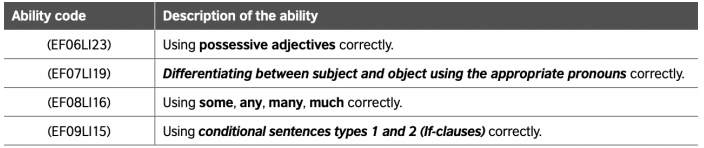
Available at: https://www.britishcouncil.org.br/sites/default/files/leitura_critica_bncc_-_en_-_v4_final.pdf. [Fragment]. Accessed on: Oct. 10, 2022.
The BNCC abilities listed above are examples of ones which reinforce the use of basic skills and systemic knowledge of the English language. In the English teaching context, it is strongly recommended that English teachers mainly help students
[…]
Available at: https://www.britishcouncil.org.br/sites/default/files/leitura_critica_bncc_-_en_-_v4_final.pdf. [Fragment]. Accessed on: Oct. 10, 2022.
The BNCC abilities listed above are examples of ones which reinforce the use of basic skills and systemic knowledge of the English language. In the English teaching context, it is strongly recommended that English teachers mainly help students
Ano: 2023
Banca:
MS Consultoria
Órgão:
Prefeitura de Ituberá - BA
Prova:
MS Consultoria - 2023 - Prefeitura de Ituberá - BA - Professor Fundamental II - Letras Vernáculas com Habilitação em Inglês |
Q2130504
Inglês
Sobre Listening and speaking strategies,
correlacione os conceitos com suas
respectivas descrições e em seguida,
marque a alternativa correta.
1. Mix-and-match. 2. Listen-retell. 3. Fan n’ pick.
( ) It is a straightforward strategy that assesses student comprehension while working to develop learners' listening and speaking skills. For this exercise, students work in pairs. Facilitator gives each pair a prompt that is relevant to a topic being studied. ( ) It is a Kagan cooperative strategy that can be used to activate background knowledge, facilitate discussion on a topic or review a concept. ( ) Encourages students to interact with one another in a guided format and allows for movement within the classroom. This exercise works well across all content areas.
1. Mix-and-match. 2. Listen-retell. 3. Fan n’ pick.
( ) It is a straightforward strategy that assesses student comprehension while working to develop learners' listening and speaking skills. For this exercise, students work in pairs. Facilitator gives each pair a prompt that is relevant to a topic being studied. ( ) It is a Kagan cooperative strategy that can be used to activate background knowledge, facilitate discussion on a topic or review a concept. ( ) Encourages students to interact with one another in a guided format and allows for movement within the classroom. This exercise works well across all content areas.
Ano: 2023
Banca:
MS Consultoria
Órgão:
Prefeitura de Ituberá - BA
Prova:
MS Consultoria - 2023 - Prefeitura de Ituberá - BA - Professor Fundamental II - Letras Vernáculas com Habilitação em Inglês |
Q2130503
Inglês
Assinale a alternativa que não
corresponde a uma boa técnica para
desenvolver o listening.
Ano: 2023
Banca:
MS Consultoria
Órgão:
Prefeitura de Ituberá - BA
Prova:
MS Consultoria - 2023 - Prefeitura de Ituberá - BA - Professor Fundamental II - Letras Vernáculas com Habilitação em Inglês |
Q2130502
Inglês
Sobre writing strategies, analise as
analise as assertivas a seguir e assinale
(T) para a true e (F) para false.
( ) Listing questions the writer has about an expository topic. ( ) Listing opinions from many perspectives for an argumentative piece. ( ) Using a plot diagram to outline a narrative.
( ) Listing questions the writer has about an expository topic. ( ) Listing opinions from many perspectives for an argumentative piece. ( ) Using a plot diagram to outline a narrative.
Ano: 2023
Banca:
MS Consultoria
Órgão:
Prefeitura de Ituberá - BA
Prova:
MS Consultoria - 2023 - Prefeitura de Ituberá - BA - Professor Fundamental II - Letras Vernáculas com Habilitação em Inglês |
Q2130501
Inglês
Acerca do tema Literature in English
Class, assinale a alternativa incorreta.
Ano: 2023
Banca:
AMEOSC
Órgão:
Prefeitura de São José do Cedro - SC
Prova:
AMEOSC - 2023 - Prefeitura de São José do Cedro - SC - Professor de Inglês |
Q2127436
Inglês
Julgue as frases abaixo.
I.Aprender uma língua estrangeira pode ser uma forma de promover a tolerância e o respeito mútuo entre culturas a partir de uma perspectiva etnocêntrica.
II.Ao falar fluentemente uma língua estrangeira, a pessoa pode construir relacionamentos interpessoais e expandir sua rede global.
III.A língua é um elemento fundamental da identidade cultural de uma pessoa e aprender uma língua estrangeira pode ser uma forma de entrar em contato com uma cultura diferente e compreender suas tradições, valores e modos de pensar.
Está(ão) CORRETA(S) a(s) seguinte(s) proposição(ões).
Ano: 2023
Banca:
VUNESP
Órgão:
Prefeitura de São Bernardo do Campo - SP
Prova:
VUNESP - 2023 - Prefeitura de São Bernardo do Campo - SP - Professor II de Educação Básica – Inglês |
Q2121452
Inglês
Texto associado
Leia o texto para responder a questão.
Learning strategies are defined as “specific actions,
behaviors, steps, or techniques—such as seeking out
conversation partners, or giving one self-encouragement to
tackle a difficult language task—used by students to enhance
their own learning. When the learner consciously chooses
strategies that suit his or her learning style and the L2 task
at hand, these strategies become a useful toolkit for active,
conscious, and purposeful self-regulation of learning. Learning
strategies can be classified into six types; the compensatory
strategies, for example, are those that help the learner make
up for missing knowledge.
A given strategy is neither good nor bad; it is neutral until
the context of its use is thoroughly considered. What makes a
strategy positive and helpful for a given learner? A strategy is
useful if the following conditions are present: (a) the strategy
relates to the L2 task at hand; (b) the strategy fits the particular
student’s learning style preferences to one degree or another;
and (c) the student employs the strategy effectivety and links
it with other relevant strategies. Strategies that fulfill these
conditions “make learning easier, faster, more enjoyable,
more self-directed, more effective, and more transferable
to new situations” (Oxford 1990, p. 8). Learning strategies
can also enable students to become more independent and
lifelong learners.
(Rebecca Oxford. Language Learning Styles and Strategies. Adaptado)
It is an example of a compensatory strategy a good reader
would resort to while reading an unknown text:
Ano: 2023
Banca:
VUNESP
Órgão:
Prefeitura de São Bernardo do Campo - SP
Prova:
VUNESP - 2023 - Prefeitura de São Bernardo do Campo - SP - Professor II de Educação Básica – Inglês |
Q2121451
Inglês
Texto associado
Leia o texto para responder a questão.
Learning strategies are defined as “specific actions,
behaviors, steps, or techniques—such as seeking out
conversation partners, or giving one self-encouragement to
tackle a difficult language task—used by students to enhance
their own learning. When the learner consciously chooses
strategies that suit his or her learning style and the L2 task
at hand, these strategies become a useful toolkit for active,
conscious, and purposeful self-regulation of learning. Learning
strategies can be classified into six types; the compensatory
strategies, for example, are those that help the learner make
up for missing knowledge.
A given strategy is neither good nor bad; it is neutral until
the context of its use is thoroughly considered. What makes a
strategy positive and helpful for a given learner? A strategy is
useful if the following conditions are present: (a) the strategy
relates to the L2 task at hand; (b) the strategy fits the particular
student’s learning style preferences to one degree or another;
and (c) the student employs the strategy effectivety and links
it with other relevant strategies. Strategies that fulfill these
conditions “make learning easier, faster, more enjoyable,
more self-directed, more effective, and more transferable
to new situations” (Oxford 1990, p. 8). Learning strategies
can also enable students to become more independent and
lifelong learners.
(Rebecca Oxford. Language Learning Styles and Strategies. Adaptado)
In a reading class, the text is about “World Cup host
countries in the 21st century”. Aware of the fact that “a
strategy is useful if it relates to the L2 task at hand”,
the teacher coherently offers the following instruction to
develop learners’ ability to scan texts in English:
Ano: 2023
Banca:
VUNESP
Órgão:
Prefeitura de São Bernardo do Campo - SP
Prova:
VUNESP - 2023 - Prefeitura de São Bernardo do Campo - SP - Professor II de Educação Básica – Inglês |
Q2121450
Inglês
Texto associado
Leia o texto para responder a questão.
Learning strategies are defined as “specific actions,
behaviors, steps, or techniques—such as seeking out
conversation partners, or giving one self-encouragement to
tackle a difficult language task—used by students to enhance
their own learning. When the learner consciously chooses
strategies that suit his or her learning style and the L2 task
at hand, these strategies become a useful toolkit for active,
conscious, and purposeful self-regulation of learning. Learning
strategies can be classified into six types; the compensatory
strategies, for example, are those that help the learner make
up for missing knowledge.
A given strategy is neither good nor bad; it is neutral until
the context of its use is thoroughly considered. What makes a
strategy positive and helpful for a given learner? A strategy is
useful if the following conditions are present: (a) the strategy
relates to the L2 task at hand; (b) the strategy fits the particular
student’s learning style preferences to one degree or another;
and (c) the student employs the strategy effectivety and links
it with other relevant strategies. Strategies that fulfill these
conditions “make learning easier, faster, more enjoyable,
more self-directed, more effective, and more transferable
to new situations” (Oxford 1990, p. 8). Learning strategies
can also enable students to become more independent and
lifelong learners.
(Rebecca Oxford. Language Learning Styles and Strategies. Adaptado)
The second paragraph points to the fact that the use of
strategies
Ano: 2023
Banca:
VUNESP
Órgão:
Prefeitura de São Bernardo do Campo - SP
Prova:
VUNESP - 2023 - Prefeitura de São Bernardo do Campo - SP - Professor II de Educação Básica – Inglês |
Q2121449
Inglês
Texto associado
Leia o texto para responder a questão.
Learning strategies are defined as “specific actions,
behaviors, steps, or techniques—such as seeking out
conversation partners, or giving one self-encouragement to
tackle a difficult language task—used by students to enhance
their own learning. When the learner consciously chooses
strategies that suit his or her learning style and the L2 task
at hand, these strategies become a useful toolkit for active,
conscious, and purposeful self-regulation of learning. Learning
strategies can be classified into six types; the compensatory
strategies, for example, are those that help the learner make
up for missing knowledge.
A given strategy is neither good nor bad; it is neutral until
the context of its use is thoroughly considered. What makes a
strategy positive and helpful for a given learner? A strategy is
useful if the following conditions are present: (a) the strategy
relates to the L2 task at hand; (b) the strategy fits the particular
student’s learning style preferences to one degree or another;
and (c) the student employs the strategy effectivety and links
it with other relevant strategies. Strategies that fulfill these
conditions “make learning easier, faster, more enjoyable,
more self-directed, more effective, and more transferable
to new situations” (Oxford 1990, p. 8). Learning strategies
can also enable students to become more independent and
lifelong learners.
(Rebecca Oxford. Language Learning Styles and Strategies. Adaptado)
In the fragment from the first paragraph “Learning
strategies are defined as “specific actions, behaviors,
steps, or techniques—such as seeking out conversation
partners, or giving one self-encouragement to tackle a
difficult language task—used by students to enhance
their own learning. When the learner consciously chooses
strategies that suit his or her learning style and the L2
task at hand”, the underlined verbs mean in the context,
respectively,
Ano: 2023
Banca:
VUNESP
Órgão:
Prefeitura de São Bernardo do Campo - SP
Prova:
VUNESP - 2023 - Prefeitura de São Bernardo do Campo - SP - Professor II de Educação Básica – Inglês |
Q2121448
Inglês
Texto associado
Leia o texto para responder a questão.
Communicating successfully in another language
means shifting frames of reference, shifting norms, shifting
assumptions of what can and cannot be said, what might
be considered ambiguous, what should be explicit and what
ought to remain tacit, and so on. In other words, using another
language effectively involves more than vocabulary and
structures; it involves thinking differently about language and
communication.
The question is, how can we begin to understand another
way of thinking, how can we be sensitized to different
cultural frames, when we are in a classroom in Nebraska,
Nairobi, or New South Wales? One answer, I will argue, is
by reading, writing, and discussing texts. By examining the
particular ways in which language is used to capture and
express experiences, we not only learn a great deal about the
conventions of the language, but can also begin to glimpse
the beliefs and values that underlie the discourse.
The basic message is a simple one: academic language
teaching must foster literacy, not only in terms of basic reading
and writing skills, but also in terms of a broader discourse
competence that involves the ability to interpret and critically
evaluate a wide variety of written and spoken texts. Preparing
students to communicate in multiple cultural contexts, both
at home and abroad, means sensitizing them to discourse
practices in other societies and to the ways those discourse
practices both reflect and create cultural norms. I here argue
that this kind of literacy is essential to real communicative
ability in a language, and is therefore an indispensable goal
in our efforts to prepare future generations for the challenges
associated with the increased internationalization of many
aspects of our society.
(Richard Kern, Literacy and language teaching. Adaptado)
O segundo e terceiro parágrafos destacam, de forma
explícita, a importância de os currículos de língua inglesa
na Educação Básica incluírem questões relativas
Ano: 2023
Banca:
VUNESP
Órgão:
Prefeitura de São Bernardo do Campo - SP
Prova:
VUNESP - 2023 - Prefeitura de São Bernardo do Campo - SP - Professor II de Educação Básica – Inglês |
Q2121446
Inglês
Texto associado
Leia o texto para responder a questão.
Communicating successfully in another language
means shifting frames of reference, shifting norms, shifting
assumptions of what can and cannot be said, what might
be considered ambiguous, what should be explicit and what
ought to remain tacit, and so on. In other words, using another
language effectively involves more than vocabulary and
structures; it involves thinking differently about language and
communication.
The question is, how can we begin to understand another
way of thinking, how can we be sensitized to different
cultural frames, when we are in a classroom in Nebraska,
Nairobi, or New South Wales? One answer, I will argue, is
by reading, writing, and discussing texts. By examining the
particular ways in which language is used to capture and
express experiences, we not only learn a great deal about the
conventions of the language, but can also begin to glimpse
the beliefs and values that underlie the discourse.
The basic message is a simple one: academic language
teaching must foster literacy, not only in terms of basic reading
and writing skills, but also in terms of a broader discourse
competence that involves the ability to interpret and critically
evaluate a wide variety of written and spoken texts. Preparing
students to communicate in multiple cultural contexts, both
at home and abroad, means sensitizing them to discourse
practices in other societies and to the ways those discourse
practices both reflect and create cultural norms. I here argue
that this kind of literacy is essential to real communicative
ability in a language, and is therefore an indispensable goal
in our efforts to prepare future generations for the challenges
associated with the increased internationalization of many
aspects of our society.
(Richard Kern, Literacy and language teaching. Adaptado)
The content in the text leads to a broader notion of
the concept of “literacy” and, as for foreign or second
language teachers, it means that they should
Ano: 2023
Banca:
VUNESP
Órgão:
Prefeitura de São Bernardo do Campo - SP
Prova:
VUNESP - 2023 - Prefeitura de São Bernardo do Campo - SP - Professor II de Educação Básica – Inglês |
Q2121444
Inglês
Texto associado
Leia o texto para responder a questão.
The teaching of English as a Lingua Franca
An inexorable trend in the use of global English is that
fewer interactions now involve a native speaker. Proponents
of teaching English as a Lingua Franca (ELF) suggest that the
way English is taught and assessed should reflect the needs
and aspirations of the ever-growing number of non-native
speakers who use English to communicate with other nonnatives. Understanding how non-native speakers use English
among themselves has now become a serious research area.
Different priorities in teaching English pronunciation, for
example, have been defined. Teaching certain pronunciation
features, such as the articulation of ‘th’ as an interdental
fricative, appears to be a waste of time whereas other common
pronunciation problems (such as simplifying consonant
clusters) contribute to problems of understanding. Such an
approach is allowing researchers to identify a ‘Lingua Franca
Core’ (LFC) which provides guiding principles in creating
syllabuses and assessment materials.
Unlike traditional ESL (English as Second Language), ELF
focuses also on pragmatic strategies required in intercultural
communication. The target model of English, within the ELF
framework, is not a native speaker but a fluent bilingual
speaker, who retains a national identity in terms of accent,
and who also has the special skills required to negotiate
understanding with another non-native speaker. Research is
also beginning to show how bad some native speakers are at
using English for international communication. It may be that
elements of an ELF syllabus could usefully be taught within a
mother tongue curriculum.
(David Graddol, English Next. Adaptado)
O aprendiz brasileiro, por influência de sua língua materna, tende a erroneamente acrescentar uma vogal a
palavras em Língua Inglesa que terminam em grupo consonantal. Dessa forma, adiciona uma nova sílaba à palavra, possivelmente dificultando a compreensão. Assinale
a alternativa correta contendo uma palavra que ilustraria
tal fenômeno.
Ano: 2023
Banca:
VUNESP
Órgão:
Prefeitura de São Bernardo do Campo - SP
Prova:
VUNESP - 2023 - Prefeitura de São Bernardo do Campo - SP - Professor II de Educação Básica – Inglês |
Q2121442
Inglês
Texto associado
Leia o texto para responder a questão.
The teaching of English as a Lingua Franca
An inexorable trend in the use of global English is that
fewer interactions now involve a native speaker. Proponents
of teaching English as a Lingua Franca (ELF) suggest that the
way English is taught and assessed should reflect the needs
and aspirations of the ever-growing number of non-native
speakers who use English to communicate with other nonnatives. Understanding how non-native speakers use English
among themselves has now become a serious research area.
Different priorities in teaching English pronunciation, for
example, have been defined. Teaching certain pronunciation
features, such as the articulation of ‘th’ as an interdental
fricative, appears to be a waste of time whereas other common
pronunciation problems (such as simplifying consonant
clusters) contribute to problems of understanding. Such an
approach is allowing researchers to identify a ‘Lingua Franca
Core’ (LFC) which provides guiding principles in creating
syllabuses and assessment materials.
Unlike traditional ESL (English as Second Language), ELF
focuses also on pragmatic strategies required in intercultural
communication. The target model of English, within the ELF
framework, is not a native speaker but a fluent bilingual
speaker, who retains a national identity in terms of accent,
and who also has the special skills required to negotiate
understanding with another non-native speaker. Research is
also beginning to show how bad some native speakers are at
using English for international communication. It may be that
elements of an ELF syllabus could usefully be taught within a
mother tongue curriculum.
(David Graddol, English Next. Adaptado)
No que diz respeito ao ensino-aprendizagem da língua
inglesa em escolas brasileiras, a BNCC

 Conheça nossos planos