Questões de Concurso Sobre ensino da língua estrangeira inglesa em inglês

Foram encontradas 2.339 questões

Q4227852 Inglês

Leia o texto para responder à questão.


    Assessment is perhaps one of the least understood areas of language teaching and learning. Students may see tests as a threat to their competence because they are afraid they will not perform well. Teachers often do not like to construct tests and are not altogether satisfied with the results when they do.


     A more constructive view of language testing exists when (a) testing is undertood as an opportunity for interaction between teacher and student; (b) students are judged on the basis of the knowledge they have; (c) the criteria for success on the test are clear to students; (d) students receive a grade for their performance on a set of tests representing different testing methods (not just one!); (e) the tests are intended to help students improve their skills; (f) the results are discussed.


    The seminal efforts by Canalle e Swain (1980) to operationalize Hymes’ (1972) communicative competence have provided a relevant set of criteria for describing tests. Tests should be seen as tapping one or more of the four components making up the construct of communicative competence: grammatical, discourse, sociolinguistic and strategic competence.


(Andrew D.Cohen. Second language Assessment. IN: Marianne

Cerce-Murcia(ed). Teaching English as a second or foreign language.

Boston, Massachusstes: Heinle&Heinle. 2nd edition. 2001. Adaptado)

When preparing a reading test, a teacher who follows strict structuralist views of language and language learning will give priority to test items which evaluate, for example, the ability to
Alternativas
Q4227849 Inglês
Leia o texto para responder à questão.

    Through practice and experience in an increasingly wide range of communicative contexts and events, learners gradually expand their communicative competence, consisting of grammatical competence, discourse competence, sociocultural competence and strategic competence. All these components are interrelated. An increase in one component interacts with other components to produce a corresponding increase in overall communicative competence.

    Grammatical competence refers to sentence-level grammatical form, the ability to recognize the lexical, morphological, syntactic and phonological feature of a language and to make use of these features to interpret and form words and whole sentences. One demonstrates grammatical competence not by stating a rule but by using a rule in the interpretation, expression or negotiation of meaning.

    Discourse competence is concerned not with isolated words or phrases but with the interconnectedness of a series of utterances, written words and/or phrases to build a text, a meaningful whole. Two familiar concepts to talk about discourse competence are text coherence and cohesion. Text coherence is the relation of all sentences or utterances in a text to a single global proposition. Local connections or structural links between individual sentences provide cohesion. Sociocultural competence extends well beyond linguistic forms and is an interdisciplinary field of inquiry having to do with the social rules of language use.

    Sociocultural competence requires an understanding of the social context where language is used: the roles of the participants, the information they share, and the function of the interation. And although we are far from an adequate description of sociocultural rules of appropriateness, we use them to communicate successfully in many different contexts of situation. Sociocultural competence also includes a willingness to suspend judgement and take into consideration the possibility of cultural differences in convention and use. Thus the importance of the term cultural flexibility or cultural awareness.

    The ‘’ideal native speaker,’’ someone who knows a language perfectly and uses it appropriately in all social interactions, exists in theory only. None of us knows all there is to know of English in its many manifestations, both around the world and in our own backyards. Communicative competence is always relative. The coping strategies we use in unfamiliar contexts, with constraints due to imperfect knowledge of rules or limiting factors in their application such as fatigue or distraction, are represented as strategic competence. With practice and experience, we gain in grammatical, discourse, and socio-cultural competence. The relative importance of strategic competence thus decreases. However, the effective use of coping strategies is important for communicative competence in all contexts and distinguishes highly competent communicators from those who are less so.


(Sandra J. Savignon. Communicative language teaching for the
twenty-first century. IN: Marianne Celce-Murcia. Teaching English as a
second or foreign language. Boston, Massachusstes: Heinle&Heinle.
3rd edition. 2002. Adaptado)
 As to the development of oral communicative competence, communicative language teaching advocates
Alternativas
Q4227838 Inglês
Leia o texto para responder à questão.

    Through practice and experience in an increasingly wide range of communicative contexts and events, learners gradually expand their communicative competence, consisting of grammatical competence, discourse competence, sociocultural competence and strategic competence. All these components are interrelated. An increase in one component interacts with other components to produce a corresponding increase in overall communicative competence.

    Grammatical competence refers to sentence-level grammatical form, the ability to recognize the lexical, morphological, syntactic and phonological feature of a language and to make use of these features to interpret and form words and whole sentences. One demonstrates grammatical competence not by stating a rule but by using a rule in the interpretation, expression or negotiation of meaning.

    Discourse competence is concerned not with isolated words or phrases but with the interconnectedness of a series of utterances, written words and/or phrases to build a text, a meaningful whole. Two familiar concepts to talk about discourse competence are text coherence and cohesion. Text coherence is the relation of all sentences or utterances in a text to a single global proposition. Local connections or structural links between individual sentences provide cohesion. Sociocultural competence extends well beyond linguistic forms and is an interdisciplinary field of inquiry having to do with the social rules of language use.

    Sociocultural competence requires an understanding of the social context where language is used: the roles of the participants, the information they share, and the function of the interation. And although we are far from an adequate description of sociocultural rules of appropriateness, we use them to communicate successfully in many different contexts of situation. Sociocultural competence also includes a willingness to suspend judgement and take into consideration the possibility of cultural differences in convention and use. Thus the importance of the term cultural flexibility or cultural awareness.

    The ‘’ideal native speaker,’’ someone who knows a language perfectly and uses it appropriately in all social interactions, exists in theory only. None of us knows all there is to know of English in its many manifestations, both around the world and in our own backyards. Communicative competence is always relative. The coping strategies we use in unfamiliar contexts, with constraints due to imperfect knowledge of rules or limiting factors in their application such as fatigue or distraction, are represented as strategic competence. With practice and experience, we gain in grammatical, discourse, and socio-cultural competence. The relative importance of strategic competence thus decreases. However, the effective use of coping strategies is important for communicative competence in all contexts and distinguishes highly competent communicators from those who are less so.


(Sandra J. Savignon. Communicative language teaching for the
twenty-first century. IN: Marianne Celce-Murcia. Teaching English as a
second or foreign language. Boston, Massachusstes: Heinle&Heinle.
3rd edition. 2002. Adaptado)
A course grounded on the idea that simply teaching students to use a language rule is not enough, and dedicates a considerable amount of time and effort to stating the rule, would be following
Alternativas
Q4212060 Inglês
Complete the sentence below with the correct verb. Choose the CORRECT answer.
Talking to my wife: “When will this renovation end? We are spending a lot of money on it.
Last month we ________ around U$15,000.’’

Alternativas
Q4212058 Inglês
Look at the map below and complete the sentence with the correct word. Choose the CORRECT answer. 
11.jpg (276×191)
“The church is _________ the school.” 
Alternativas
Q4205816 Inglês
Considerando-se a Base Nacional Comum Curricular: Língua Inglesa, sobre os Eixos Organizadores, numerar a 2ª coluna de acordo com a 1ª e, após, assinalar a alternativa que apresenta a sequência CORRETA:
(1) Oralidade. (2) Leitura. (3) Escrita.
(_) Aborda práticas de linguagem decorrentes da interação do leitor com o texto escrito, especialmente sob o foco da construção de significados, com base na compreensão e interpretação dos gêneros escritos em língua inglesa, que circulam nos diversos campos e esferas da sociedade.
(_) Por um lado, enfatiza sua natureza processual e colaborativa e por outro é também concebida como prática social e reitera sua finalidade condizente com essa prática, oportunizando aos alunos agir com protagonismo.
(_) Envolve as práticas de linguagem em situações de uso oral da língua inglesa, com foco na compreensão (ou escuta) e na produção oral (ou fala), articuladas pela negociação na construção de significados partilhados pelos interlocutores e/ou participantes envolvidos, com ou sem contato face a face.
Alternativas
Q4177572 Inglês

Silent letters in English


    The English language is full of words whose written form can , in English we rarely The English language is full of words whose written form can be deceptive. Unlike a language like Spanish, in English we rarely sound out all the letters that we see.


    The result is a series of words which are written in a way which seems very different from their sound. Lots of these strange ‘silent’ letters are due to the history of the English only has it absorbed plenty of vocabulary from invaders, like French, Latin and Norse, but the eventual standardization of sounds in the English language has meant that certain words, whilst keeping their older forms of spelling, have The result is a series of words which are written in a way which seems very different from their sound. Lots of these strange ‘silent’ letters are due to the history of the English language. Not only has it absorbed plenty of vocabulary from invaders, like French, Latin and Norse, but the eventual standardization of sounds in the English language has meant that certain words, whilst keeping their older forms of spelling, have had their sounds refined and softened. [...] 


Disponível em: <https://englishlive.ef.com/blog/language-lab/silent-pronounce/>. Acesso em: 22 mar. 2020. (Adaptado).


Assinale a alternativa cujas letras sublinhadas são todas sem som.

Alternativas
Q4117502 Inglês
Consider the word order in the sentences below:

I. Could you tell me what time the coffee shop opens?

II. Do you know if is Brenda coming to the party?

III. How many people have you traveled with?

Which sentences are correct? 
Alternativas
Q4117497 Inglês
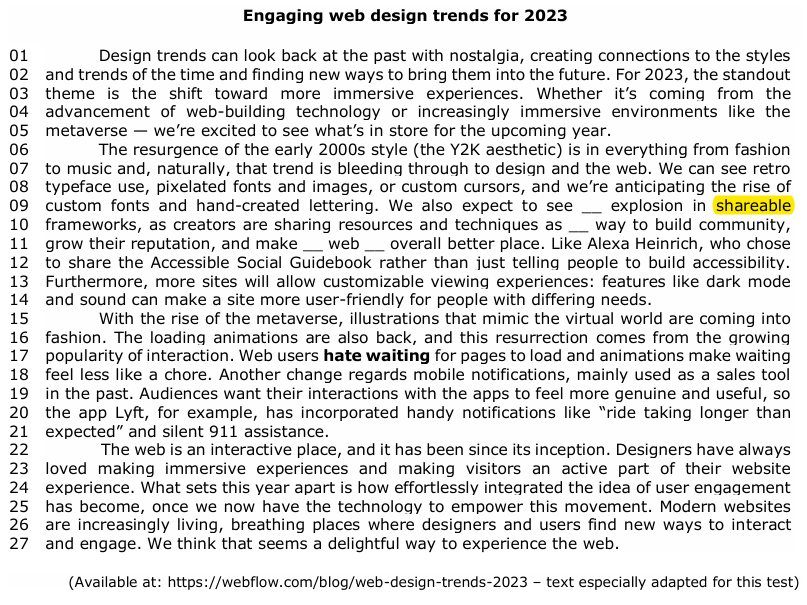
Consider the following statements about the text: 

I. The author thinks trends are just copies of styles used in the past.

II. Developers sharing their work brings benefits to themselves, the community, and the web users.

III. The web was not supposed to be a place for interaction, but web designers are changing that.

Which statements are correct? 
Alternativas
Q4117495 Inglês
According to the author, why are the changes predicted to happen in 2023 expected to be different from the changes that happened in the previous years? 
Alternativas
Q4014289 Inglês
Como professor de Língua Inglesa no 6º Ano do Ensino Fundamental, você está planejando uma aula com base na metodologia audio-lingual. Considerando que o tema da aula é "Família e Descrição Física", qual dos seguintes procedimentos está alinhado com a metodologia aplicada e seria mais apropriada para alcançar os objetivos da aula?
Alternativas
Q4014285 Inglês
No contexto do ensino de Língua Inglesa, a escolha dos procedimentos metodológicos desempenha um papel fundamental no processo de aprendizagem dos estudantes. Considerando os métodos e abordagens utilizados no ensino de Língua Inglesa, assinale a alternativa CORRETA:
Alternativas
Q3989702 Inglês
Qual é a diferença fundamental entre skimming e scanning como estratégias de leitura?
Alternativas
Q3989699 Inglês
Imagine you have witnessed a significant environmental issue in your local community, such as pollution in a nearby river. You want to write a persuasive letter to the local government urging them to take action. Which of the following strategies would you employ to make your letter more effective? 
Alternativas
Q3892729 Inglês
Which statement accurately reflects the principles of the Communicative Approach in language teaching? 
Alternativas
Q3892726 Inglês
The Common National Curriculum for English Language in Upper Elementary School Grades is meticulously designed, emphasizing the integration of axes, thematic units, knowledge objects, and skills. The recurring nature of thematic units ensures a cohesive learning experience, allowing the refinement and extension of corresponding skills. In the context ofstudents learning English, particular attention is dedicated to the mastery of "Writing – Construction of Persuasion." Through a structured approach, learners are guided to not only understand the nuances of persuasion but also to skillfully construct compelling arguments, thereby fostering a comprehensive development of their English language proficiency. For students learning English, what is the main emphasis in what concerns "Writing – Construction of Persuasion"?
Alternativas
Q3892724 Inglês
“[…] a lingua franca is a contact language used among people who do not share a first language, and is commonly understood to mean a second (or subsequent) language of its speakers”
JENKINS, Jennifer. English as a Lingua Franca: Attitude and Identity.

How does the curriculum need to be adjusted to accommodate English as a lingua franca, and what significant implications arise from this consideration?
Alternativas
Q3892720 Inglês
Total Physical Response (TPR) is a language teaching method developed by James Asher in the late 1960s. About this approach, judge the items as true or false (T and F):

I - TPR emphasizes the association of language with physical actions, using the imperative mood and a command-response technique.

II - TPR is often employed in language instruction for young children and beginners, aiming to create a stress-free and enjoyable learning environment.

III - TPR primarily focuses on developing advanced language skills, making it suitable for learners at higher proficiency levels.

IV - The TPR method discourages the use of repetition and reinforcement in language learning, as it relies solely on physical actions for understanding.

V - TPR was developed in the early 2000s as a response to the limitations of traditional language teaching methods.


The correct order is:

Alternativas
Q3733295 Inglês
Marque a alternativa que corresponde à preposição que preenche "___ 6 o'clock".
Alternativas
Q3733288 Inglês
Marque a alternativa que corresponde à preposição que preenche "___ July".
Alternativas
Respostas
1581: C
1582: B
1583: A
1584: A
1585: A
1586: A
1587: C
1588: D
1589: B
1590: C
1591: B
1592: A
1593: D
1594: A
1595: B
1596: C
1597: C
1598: E
1599: E
1600: D