Questões de Concurso
Sobre ensino da língua estrangeira inglesa em inglês
Foram encontradas 2.182 questões


Text 7
From EFL to ELF in Brazil: what the Brazilian education guidelines suggest.
At the beginning of the text devoted to English language teaching in the BNCC, it is made clear that the notion of an increasingly globalized, plural social world is fundamental to shed light on the relevance of learning the English language. According to the document,
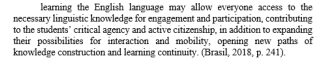
Based on this formative assessment, the BNCC lists three important functions of English language teaching (henceforward ELT): (1) to review the relations between language, territory and culture; (2) to broaden the understanding of literacy; and (3) to situate the English language in its lingua franca status.
Before delving into the first function of ELT, a brief, clear definition of English as a lingua franca (henceforward ELF) is necessary. Jenkins (2012, p. 486) states that ‘it is a means of communication between people who come from different first language backgrounds.’ In this sense, any English speaker can be an ELF speaker, be they native users of English or not. She also adds that ‘ELF is not a language variety in the traditional sense of the term.’
The first ELT function described in the BNCC is in line with Jenkins’s view of ELF.
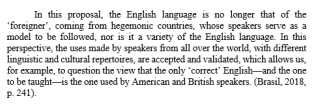
This quote argues that treating English as a lingua franca validates the uses of the language by speakers from places where English is neither the first language (L1) nor an official language, which is the case of Brazilian users of English. The BNCC also contributes to the ownership debate concerning the English language, which has been brought to the fore by Widdowson (1994), who points out that native speakers of English who live in the US or the UK no longer ‘own’ the language. Given the fact that English has become an international language, he argues that ‘no nation can have custody over it’ (Widdowson, 1994, p. 385).
FRANCO, C. P. Teaching English as a Lingua Franca in Brazil: insights into materials writing. In: International Journal of English Linguistics; Vol. 11, No. 3; 2021. P. 62-63
Text 7
From EFL to ELF in Brazil: what the Brazilian education guidelines suggest.
At the beginning of the text devoted to English language teaching in the BNCC, it is made clear that the notion of an increasingly globalized, plural social world is fundamental to shed light on the relevance of learning the English language. According to the document,
Based on this formative assessment, the BNCC lists three important functions of English language teaching (henceforward ELT): (1) to review the relations between language, territory and culture; (2) to broaden the understanding of literacy; and (3) to situate the English language in its lingua franca status.
Before delving into the first function of ELT, a brief, clear definition of English as a lingua franca (henceforward ELF) is necessary. Jenkins (2012, p. 486) states that ‘it is a means of communication between people who come from different first language backgrounds.’ In this sense, any English speaker can be an ELF speaker, be they native users of English or not. She also adds that ‘ELF is not a language variety in the traditional sense of the term.’
The first ELT function described in the BNCC is in line with Jenkins’s view of ELF.
This quote argues that treating English as a lingua franca validates the uses of the language by speakers from places where English is neither the first language (L1) nor an official language, which is the case of Brazilian users of English. The BNCC also contributes to the ownership debate concerning the English language, which has been brought to the fore by Widdowson (1994), who points out that native speakers of English who live in the US or the UK no longer ‘own’ the language. Given the fact that English has become an international language, he argues that ‘no nation can have custody over it’ (Widdowson, 1994, p. 385).
FRANCO, C. P. Teaching English as a Lingua Franca in Brazil: insights into materials writing. In: International Journal of English Linguistics; Vol. 11, No. 3; 2021. P. 62-63
Text 5
What should feedback be mainly on: language? content? organization?
The problem
When a student submits a piece of original writing, the most important thing about it is arguably its content: whether the ideas or events that are written about are significant and interesting. Then there is the organization and presentation: whether the ideas are arranged in a way that is easy to follow and pleasing to read. Finally, there is the question of language forms: whether the grammar, vocabulary, spelling and punctuation is of an acceptable standard of accuracy.
Many teachers are aware that content and organization are important, but find themselves relating mainly to language forms in their feedback, conveying the implicit message that these are what matters. This is for various reasons:
1. Mistakes in spelling or grammar catch the eye and seem to demand to be corrected; they are very difficult to ignore.
2. Students also want their language mistakes to be corrected. (Ask them! And see Leki, 1991.)
3. Language mistakes are far more easily and quickly diagnosed and corrected than ones of content and organization.
Advice
We should, I think, correct language mistakes; our problem is how to do so without conveying the message that these are the only, or main, basis for evaluation of a piece of writing. One possibility is to note corrections within the body of the text, and devote comments at the end to matters of content and organization, followed by the evaluation. Alternatively, we may correct mistakes and make suggestions as to content and organization, but not evaluate; and give the evaluation only on the basis of the rewritten, polished version.
UR, Penny. A Course in Language Teaching - Practice and Theory. Cambridge: Cambridge University Press, 2009, p.170.
Text 5
What should feedback be mainly on: language? content? organization?
The problem
When a student submits a piece of original writing, the most important thing about it is arguably its content: whether the ideas or events that are written about are significant and interesting. Then there is the organization and presentation: whether the ideas are arranged in a way that is easy to follow and pleasing to read. Finally, there is the question of language forms: whether the grammar, vocabulary, spelling and punctuation is of an acceptable standard of accuracy.
Many teachers are aware that content and organization are important, but find themselves relating mainly to language forms in their feedback, conveying the implicit message that these are what matters. This is for various reasons:
1. Mistakes in spelling or grammar catch the eye and seem to demand to be corrected; they are very difficult to ignore.
2. Students also want their language mistakes to be corrected. (Ask them! And see Leki, 1991.)
3. Language mistakes are far more easily and quickly diagnosed and corrected than ones of content and organization.
Advice
We should, I think, correct language mistakes; our problem is how to do so without conveying the message that these are the only, or main, basis for evaluation of a piece of writing. One possibility is to note corrections within the body of the text, and devote comments at the end to matters of content and organization, followed by the evaluation. Alternatively, we may correct mistakes and make suggestions as to content and organization, but not evaluate; and give the evaluation only on the basis of the rewritten, polished version.
UR, Penny. A Course in Language Teaching - Practice and Theory. Cambridge: Cambridge University Press, 2009, p.170.
Text 4
Help students to learn vocabulary in context
The best internalization of vocabulary comes from encounters (comprehension or production) with words within the context of surrounding discourse. Data from linguistic corpora can provide real-world actual language that has been printed or spoken. Rather than isolating words and/or focusing on dictionary definitions, learners can benefit from attending to vocabulary within a communicative framework in which items appear. Students will then associate new words with a meaningful context to which they apply. For example, for a beginning level of students, pictures, realia, and gestures can be used to describe meaning in context. For a more advanced level of students, encourage them to consult online corpora (e.g., the British National Corpus, or the Corpus of Contemporary American English: COCA) to gain knowledge of patterned sequences, particularly collocations or words that go together (Liu & Jiang, 2009).
Encourage students to develop word-learning strategies
Included in the discussion of teaching reading were such strategies as guessing vocabulary in context. A number of clues are available to learners to develop word-attack strategies.
Considering that only a small fraction of the word list can be covered inside the classroom, it is necessary for students to develop effective strategies for learning vocabulary on their own. Word-learning strategies refer to “the planned approaches that a word-learner takes as an agent of his or her own word learning” (Zimmerman, 2014, p. 297). Once they encounter unknown words, they can try to figure out how the words are used by asking questions such as:
• Is the word countable or uncountable?
• Is there a particular preposition that follows it?
• Is it a formal word?
• Does it have positive or negative connotations? (Zimmerman, 2014, p. 298)
An effective way to encourage word-learning is to urge students to use vocabulary notebooks to enter new words, and to review them daily, once they identify their learning goals. Studies show that in order to understand television shows learners need to know about 3,000 word families and have knowledge of proper nouns (Web & Rodgers, 2009). If they wish to read novels and newspapers comfortably, they need to have a vocabulary size of 8,000–9,000 word families (Nation, 2006). The fact that increasing vocabulary size will influence the degree to which they can understand and use language may motivate them to be determined to expand their vocabulary notebooks.
Unfortunately, professional pendulums have a disturbing way of swinging too far one way or the other, and sometimes the only way we can get enough perspective to see these overly long arcs is through hindsight. Hindsight has now taught us that there was some overreaction to the almost exclusive attention that grammar and vocabulary received in the first two-thirds of the twentieth century. So-called “natural” approaches in which grammar was considered damaging were equally overreactive. Advocating the “absorption” of grammar and vocabulary with no overt attention whatsoever to language forms went too far. We now seem to have a healthy respect for the place of form-focused instruction — attention to those basic “bits and pieces” of a language — in an interactive curriculum. And now we can pursue the business of finding better and better techniques for getting these bits and pieces into the communicative repertoires of our learners.
BROWN, H. D.; LEE, H.. Teaching by Principles: An Interactive Approach to Language Pedagogy. Fourth Edition. New York: Longman. 2015.
Text 4
Help students to learn vocabulary in context
The best internalization of vocabulary comes from encounters (comprehension or production) with words within the context of surrounding discourse. Data from linguistic corpora can provide real-world actual language that has been printed or spoken. Rather than isolating words and/or focusing on dictionary definitions, learners can benefit from attending to vocabulary within a communicative framework in which items appear. Students will then associate new words with a meaningful context to which they apply. For example, for a beginning level of students, pictures, realia, and gestures can be used to describe meaning in context. For a more advanced level of students, encourage them to consult online corpora (e.g., the British National Corpus, or the Corpus of Contemporary American English: COCA) to gain knowledge of patterned sequences, particularly collocations or words that go together (Liu & Jiang, 2009).
Encourage students to develop word-learning strategies
Included in the discussion of teaching reading were such strategies as guessing vocabulary in context. A number of clues are available to learners to develop word-attack strategies.
Considering that only a small fraction of the word list can be covered inside the classroom, it is necessary for students to develop effective strategies for learning vocabulary on their own. Word-learning strategies refer to “the planned approaches that a word-learner takes as an agent of his or her own word learning” (Zimmerman, 2014, p. 297). Once they encounter unknown words, they can try to figure out how the words are used by asking questions such as:
• Is the word countable or uncountable?
• Is there a particular preposition that follows it?
• Is it a formal word?
• Does it have positive or negative connotations? (Zimmerman, 2014, p. 298)
An effective way to encourage word-learning is to urge students to use vocabulary notebooks to enter new words, and to review them daily, once they identify their learning goals. Studies show that in order to understand television shows learners need to know about 3,000 word families and have knowledge of proper nouns (Web & Rodgers, 2009). If they wish to read novels and newspapers comfortably, they need to have a vocabulary size of 8,000–9,000 word families (Nation, 2006). The fact that increasing vocabulary size will influence the degree to which they can understand and use language may motivate them to be determined to expand their vocabulary notebooks.
Unfortunately, professional pendulums have a disturbing way of swinging too far one way or the other, and sometimes the only way we can get enough perspective to see these overly long arcs is through hindsight. Hindsight has now taught us that there was some overreaction to the almost exclusive attention that grammar and vocabulary received in the first two-thirds of the twentieth century. So-called “natural” approaches in which grammar was considered damaging were equally overreactive. Advocating the “absorption” of grammar and vocabulary with no overt attention whatsoever to language forms went too far. We now seem to have a healthy respect for the place of form-focused instruction — attention to those basic “bits and pieces” of a language — in an interactive curriculum. And now we can pursue the business of finding better and better techniques for getting these bits and pieces into the communicative repertoires of our learners.
BROWN, H. D.; LEE, H.. Teaching by Principles: An Interactive Approach to Language Pedagogy. Fourth Edition. New York: Longman. 2015.
Text 4
Help students to learn vocabulary in context
The best internalization of vocabulary comes from encounters (comprehension or production) with words within the context of surrounding discourse. Data from linguistic corpora can provide real-world actual language that has been printed or spoken. Rather than isolating words and/or focusing on dictionary definitions, learners can benefit from attending to vocabulary within a communicative framework in which items appear. Students will then associate new words with a meaningful context to which they apply. For example, for a beginning level of students, pictures, realia, and gestures can be used to describe meaning in context. For a more advanced level of students, encourage them to consult online corpora (e.g., the British National Corpus, or the Corpus of Contemporary American English: COCA) to gain knowledge of patterned sequences, particularly collocations or words that go together (Liu & Jiang, 2009).
Encourage students to develop word-learning strategies
Included in the discussion of teaching reading were such strategies as guessing vocabulary in context. A number of clues are available to learners to develop word-attack strategies.
Considering that only a small fraction of the word list can be covered inside the classroom, it is necessary for students to develop effective strategies for learning vocabulary on their own. Word-learning strategies refer to “the planned approaches that a word-learner takes as an agent of his or her own word learning” (Zimmerman, 2014, p. 297). Once they encounter unknown words, they can try to figure out how the words are used by asking questions such as:
• Is the word countable or uncountable?
• Is there a particular preposition that follows it?
• Is it a formal word?
• Does it have positive or negative connotations? (Zimmerman, 2014, p. 298)
An effective way to encourage word-learning is to urge students to use vocabulary notebooks to enter new words, and to review them daily, once they identify their learning goals. Studies show that in order to understand television shows learners need to know about 3,000 word families and have knowledge of proper nouns (Web & Rodgers, 2009). If they wish to read novels and newspapers comfortably, they need to have a vocabulary size of 8,000–9,000 word families (Nation, 2006). The fact that increasing vocabulary size will influence the degree to which they can understand and use language may motivate them to be determined to expand their vocabulary notebooks.
Unfortunately, professional pendulums have a disturbing way of swinging too far one way or the other, and sometimes the only way we can get enough perspective to see these overly long arcs is through hindsight. Hindsight has now taught us that there was some overreaction to the almost exclusive attention that grammar and vocabulary received in the first two-thirds of the twentieth century. So-called “natural” approaches in which grammar was considered damaging were equally overreactive. Advocating the “absorption” of grammar and vocabulary with no overt attention whatsoever to language forms went too far. We now seem to have a healthy respect for the place of form-focused instruction — attention to those basic “bits and pieces” of a language — in an interactive curriculum. And now we can pursue the business of finding better and better techniques for getting these bits and pieces into the communicative repertoires of our learners.
BROWN, H. D.; LEE, H.. Teaching by Principles: An Interactive Approach to Language Pedagogy. Fourth Edition. New York: Longman. 2015.
Text 4
Help students to learn vocabulary in context
The best internalization of vocabulary comes from encounters (comprehension or production) with words within the context of surrounding discourse. Data from linguistic corpora can provide real-world actual language that has been printed or spoken. Rather than isolating words and/or focusing on dictionary definitions, learners can benefit from attending to vocabulary within a communicative framework in which items appear. Students will then associate new words with a meaningful context to which they apply. For example, for a beginning level of students, pictures, realia, and gestures can be used to describe meaning in context. For a more advanced level of students, encourage them to consult online corpora (e.g., the British National Corpus, or the Corpus of Contemporary American English: COCA) to gain knowledge of patterned sequences, particularly collocations or words that go together (Liu & Jiang, 2009).
Encourage students to develop word-learning strategies
Included in the discussion of teaching reading were such strategies as guessing vocabulary in context. A number of clues are available to learners to develop word-attack strategies.
Considering that only a small fraction of the word list can be covered inside the classroom, it is necessary for students to develop effective strategies for learning vocabulary on their own. Word-learning strategies refer to “the planned approaches that a word-learner takes as an agent of his or her own word learning” (Zimmerman, 2014, p. 297). Once they encounter unknown words, they can try to figure out how the words are used by asking questions such as:
• Is the word countable or uncountable?
• Is there a particular preposition that follows it?
• Is it a formal word?
• Does it have positive or negative connotations? (Zimmerman, 2014, p. 298)
An effective way to encourage word-learning is to urge students to use vocabulary notebooks to enter new words, and to review them daily, once they identify their learning goals. Studies show that in order to understand television shows learners need to know about 3,000 word families and have knowledge of proper nouns (Web & Rodgers, 2009). If they wish to read novels and newspapers comfortably, they need to have a vocabulary size of 8,000–9,000 word families (Nation, 2006). The fact that increasing vocabulary size will influence the degree to which they can understand and use language may motivate them to be determined to expand their vocabulary notebooks.
Unfortunately, professional pendulums have a disturbing way of swinging too far one way or the other, and sometimes the only way we can get enough perspective to see these overly long arcs is through hindsight. Hindsight has now taught us that there was some overreaction to the almost exclusive attention that grammar and vocabulary received in the first two-thirds of the twentieth century. So-called “natural” approaches in which grammar was considered damaging were equally overreactive. Advocating the “absorption” of grammar and vocabulary with no overt attention whatsoever to language forms went too far. We now seem to have a healthy respect for the place of form-focused instruction — attention to those basic “bits and pieces” of a language — in an interactive curriculum. And now we can pursue the business of finding better and better techniques for getting these bits and pieces into the communicative repertoires of our learners.
BROWN, H. D.; LEE, H.. Teaching by Principles: An Interactive Approach to Language Pedagogy. Fourth Edition. New York: Longman. 2015.
Text 3
Assessment and Testing
Assessment is “appraising or estimating the level or magnitude of some attribute of a person” (Mousavi, 2009, p. 35). In educational practice, assessment is an ongoing process that encompasses a wide range of methodological techniques. Whenever a student responds to a question, offers a comment, or tries a new word or structure, the teacher subconsciously appraises the student’s performance. Written work — from a jotted-down phrase to a formal essay — is a performance that ultimately is “judged” by self, teacher, and possibly other students. Reading and listening activities usually require some sort of productive performance that the teacher observes and then implicitly appraises, however peripheral that appraisal may be. A good teacher never ceases to assess students, whether those assessments are incidental or intended.
Tests, on the other hand, are a subset of assessment, a genre of assessment techniques. They are prepared administrative procedures that occur at identifiable times in a curriculum when learners muster all their faculties to offer peak performance, knowing that their responses are being measured and evaluated.
In scientific terms, a test is a method of measuring a person’s ability, knowledge, or performance in a given domain. Let’s look at the components of this definition. A test is first a method. It’s an instrument — a set of techniques, procedures, or items — that requires performance on the part of die test-taker. To qualify as a test, the method must be explicit and structured: multiple-choice questions with prescribed correct answers, a writing prompt with a scoring rubric, an oral interview based on a question script, or a checklist of expected responses to be completed by the administrator.
BROWN, H. D.; ABEYWICKRAMA, P. Language Assessment: principles and classroom practices. New York: Pearson, 2018. 3r ed.
Coherence and cohesion are two essential concepts in English language teaching. They refer to the way that sentences and clauses are connected together to form a coherent and logical text. Coherence is the overall sense of unity and meaning in a text. It is created by the use of logical connections between ideas, such as causeand-effect, comparison, contrast, and sequence. Cohesion is the use of grammatical devices to connect sentences and clauses together. It is created by the use of words and phrases such as pronouns, conjunctions, and transition words. Both coherence and cohesion are important for effective communication in English. They help to make texts clear, concise, and easy to understand. The use of pronouns, conjunctions, and transition words to connect sentences and clauses together is known as:
_ The focus is on the development of communicative competence, which is the ability to use language in real-life situations.
_ Students are encouraged to use the language for real purposes, such as giving presentations, participating in discussions, and writing emails.
_ The teacher plays the role of facilitator, providing opportunities for students to practice using the language.
Which of the following is NOT a principle of the communicative approach to English language teaching?
............................. describes the theory or philosophy underlying how a language should be taught; a method or methodology describes, in general terms, a way of ........................................ the approach (syllabus, progression, kinds of materials); techniques describe ...................................... practical classroom tasks and activities.
Choose the alternative that has the correct words to complete the sentence.
In our modern world, there are many factors that place the wellbeing of the planet in jeopardy. While some people have the opinion that environmental problems are just a natural occurrence, others believe that human beings have a huge impaction the environment. Regardless of your viewpoint, take into consideration the following factors that place our environment as well as the planet Earth in danger.
Global warming or climate change is a major contributing factor to environmental damage. Because of
global warming, we have seen an increase in melting
ice caps, a rise in sea levels, and the formation of new
weather patterns. These weather patterns have caused
stronger storms, droughts, and flooding in places that
they formerly did not occur.
Air pollution is primarily caused as a result of excessive
and unregulated emissions of carbon dioxide into the
air. Pollutants mostly emerge ____________the burning_________fossil fuels______ addition __________ chemicals, toxic substances, and improper waste disposal.
Air pollutants are absorbed into the atmosphere, and
they can cause smog, a combination of smoke and
fog, in valleys as well as produce acidic precipitation in
areas far away from the pollution source.
In many areas, people and local governments do not
sustainably use their natural resources. Mining for
natural gases, deforestation, and even improper use of
water resources can have tremendous effects on the
environment. While these strategies often attempt
to boost local economies, their effects can lead to oil
spills, interrupted animal habitats, and droughts.
Ultimately, the effects of the modern world on the
environment can lead to many problems. Human
beings need to consider the repercussions of their
actions, trying to reduce, reuse, and recycle materials
while establishing environmentally sustainable habits.
If measures are not taken to protect the environment,
we can potentially witness the extinction of more
endangered species, worldwide pollution, and a completely uninhabitable planet.
source: lingua.com
Study these sentences below and decide if they are true ( T ) or false ( F ), about Communicative Language Teaching.
( ) Its goal is to develop learners’ communicative competence across all four skills.
( ) Native speaker input is seen as highly desirable, though not essential.
( ) Physical games and dictations are specific activities that are used only in CLT approach.
( ) This approach is based on a structuralist view of language and draws on the psychology of behaviourism as the basis of its learning theory, employing stimulus and response.
Choose the alternative which presents the correct sequence, from top to bottom.
Read Text I and answer question.
Text I
More More More: What Is Money Dysmorphia?
Do you ever worry that you don't have enough money, even though your bank account suggests you're doing fine? You might be experiencing "money dysmorphia.” This is a term for when a person has a distorted view of their financial situation — particularly when a wealthy person believes they don't have enough money to be secure. The idea is similar to body dysmorphia, where a person agonizes about flaws they perceive in their body, even if they are not noticeable to others.
American lawyer and financial expert Ali Katz may have been the first to use the term, having written about money dysmorphia extensively in 2016. But it wasn't until late 2023 that it started trending. Because, as it turns out, the feeling can be pretty common — especially among young people.
In August 2023, Bloomberg published the results of a survey of over 1,000 Americans making over $175,000 a year. And while earning this much would put these people among the 10% richest in the country, a quarter of them said they felt "very poor," "poor,” or that they were just managing to get by.
In addition, a December 2023 survey for Intuit Credit Karma found that, out of 1,006 Americans, 29% experienced money dysmorphia — which the survey defined as "having a distorted view of one's finances that could lead them to make poor decisions.” That figure rose to 41% among millennials, who are usually defined as those born between 1981 and 1996. And it was 43% among Generation Z, typically considered to have been born between 1997 and 2012.
Some believe social media is to blame. With Instagram and TikTok full of influencers flaunting lavish lifestyles, it's understandable that young people might feel insecure about their own financial situations. And as well as causing stress, money dysmorphia might make people stay in jobs they don't like, or choose work over spending time with their families.
Speaking to Business Insider, Katz said it's important to actually calculate how much is enough for you — and "know the difference between what you need and what you want."
Adapted from: https://engoo.com.br/app/dailynews/article/more-more-more-what-is-moneydysmorphia/eMBHgsr7Ee6RxDeDj30Epw
Read the excerpt below from Text I and choose the correct answer.
"That figure rose to 41% among millennials, who are usually defined as those born between 1981 and 1996."
What is the past participle form of the verb “rose"?
Which of the following activities are typical of the TPR methodology?

 Conheça nossos planos