Questões de Concurso
Sobre ensino da língua estrangeira inglesa em inglês
Foram encontradas 2.182 questões


Q4158888
Inglês
A High School English teacher prepared an activity in order to engage students in critical reflection on the
impact of social media on teenager’s lives and promote responsible digital citizenship. Initially, the teacher
introduced the concept of responsible digital citizenship, stressing the importance of understanding both
the positive and negative aspects of social media use. Then, students were divided into small groups and
assigned specific aspects of social media impact to research, such as cyberbullying, body image and privacy
concerns. Their task was to create presentations to share their findings with other groups, employing
creative visual tools like infographics and incorporating real-life examples to reinforce their arguments.
Based on this case study, we can state that the approach used is communicative because the teacher
Based on this case study, we can state that the approach used is communicative because the teacher
Q4158887
Inglês
In a High School English class, when dealing with a reading comprehension activity, the teacher brought
to the class the textual genre “movie poster” and presented the following example:
 Available at: https://www.pastposters.com. Accessed on: Jun. 7, 2024.
To help the students interpret the text, the teacher should choose the most relevant teaching strategy to go beyond literal meanings, that is, to
Available at: https://www.pastposters.com. Accessed on: Jun. 7, 2024.
To help the students interpret the text, the teacher should choose the most relevant teaching strategy to go beyond literal meanings, that is, to
Q4158869
Inglês
A High School teacher brought to his English class a text about English as a lingua franca. After reading the
text and discussing it with the students, he asked them to write a text related to the theme. The students
argued that they would have difficulties with linguistic issues to accomplish the task. The teacher told
them that there was a technology lab at the school with internet access, so he took the students there
and taught them how to use some translation tools available.
Considering this situation, the teacher’s decision to allow students to use electronic translation tools to accomplish the task will
Considering this situation, the teacher’s decision to allow students to use electronic translation tools to accomplish the task will
Q4151680
Inglês
The postmethod condition is a sustainable state of affairs that compels us to fundamentally restructure
our view of language teaching and teacher education. It urges us to review the character and content of
classroom teaching in all its pedagogical and ideological perspectives. It drives us to streamline our teacher
education by refiguring the reified relationship between theory and practice. In short, it demands that we
seriously contemplate the essentials of a coherent postmethod pedagogy.
KUMARAVADIVELU, B. Understanding language teaching: from method to postmethod. New Jersey: Lawrence Erlbaum Associates, 2006 (adapted).
Considering the ideas contained in the text, a successful lesson plan should include activities that
KUMARAVADIVELU, B. Understanding language teaching: from method to postmethod. New Jersey: Lawrence Erlbaum Associates, 2006 (adapted).
Considering the ideas contained in the text, a successful lesson plan should include activities that
Q4151678
Inglês
During an English class, a teacher presents samples of texts for students so that they identify features
found in imaginative, informative and persuasive texts. The teacher asks students to pay attention to how
headings, subheadings, bold type and graphic organizers are used to order and present information. The
text set contains samples from different genres, media and levels of reading difficulties. By the end of this
lesson, students will be able to (i) identify and describe the purpose of persuasive texts; (ii) identify and
describe the text structure of persuasive writing; and (iii) demonstrate an understanding of persuasive
text conventions.
In this context, the language concept that supported this lesson is
In this context, the language concept that supported this lesson is
Q4151672
Inglês
TEXT 1
After the students have repeated the dialogue several times, the teacher gives them a chance to adopt the role of Bill while she says Sally’s lines. Before the class actually says each line, the teacher models it. In effect, the class is experiencing a repetition drill where the students have to listen carefully and attempt to mimic the teacher’s model as accurately as possible.
LARSEN-FREEMAN, D.; ANDERSON, M. Techniques & principles in language teaching. Oxford: OUP, 2011 (adapted).
TEXT 2
The teacher greets the class and distributes a handout. There is writing on both sides. On one side is a copy of a sports column from a recent newspaper. The reporter is discussing the last World Cup competition. The teacher asks the students to read it and then to underline the predictions the reporter makes about the next World Cup. He gives them these directions in the target language. Then, he and the students discuss which predictions the reporter feels more certain about and which predictions he feels less certain about.
LARSEN-FREEMAN, D.; ANDERSON, M. Techniques & principles in language teaching. Oxford: OUP, 2011 (adapted).
Considering the concept of language learning methods and their characteristics, we can state about text 1 and text 2, respectively, that
After the students have repeated the dialogue several times, the teacher gives them a chance to adopt the role of Bill while she says Sally’s lines. Before the class actually says each line, the teacher models it. In effect, the class is experiencing a repetition drill where the students have to listen carefully and attempt to mimic the teacher’s model as accurately as possible.
LARSEN-FREEMAN, D.; ANDERSON, M. Techniques & principles in language teaching. Oxford: OUP, 2011 (adapted).
TEXT 2
The teacher greets the class and distributes a handout. There is writing on both sides. On one side is a copy of a sports column from a recent newspaper. The reporter is discussing the last World Cup competition. The teacher asks the students to read it and then to underline the predictions the reporter makes about the next World Cup. He gives them these directions in the target language. Then, he and the students discuss which predictions the reporter feels more certain about and which predictions he feels less certain about.
LARSEN-FREEMAN, D.; ANDERSON, M. Techniques & principles in language teaching. Oxford: OUP, 2011 (adapted).
Considering the concept of language learning methods and their characteristics, we can state about text 1 and text 2, respectively, that
Q4151665
Inglês
The Technological Pedagogical Content Knowledge (TPACK) is a model that seeks to identify the types of
knowledge a teacher needs to master to integrate Information and Communication Technologies (ICT) in
an effective way in the teaching process. Its main objective is the articulation of the three knowledges that
form its basis. The model can be viewed in the figure below.
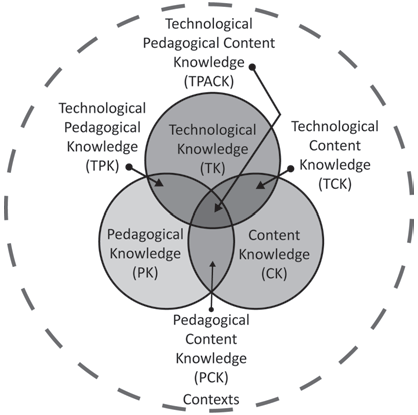 SILVA, J. B.; BILESSIMO, S. M. S.; MACHADO, L. R. Integration of technology in education:
proposal for a teacher training model inspired by TPACK.
Educação em revista, v. 27, 2021 (adapted).
SILVA, J. B.; BILESSIMO, S. M. S.; MACHADO, L. R. Integration of technology in education:
proposal for a teacher training model inspired by TPACK.
Educação em revista, v. 27, 2021 (adapted).
After a two-week workshop on TPACK, a High School teacher prepared a class to be taught in a computer lab in which he had to focus on a coursebook unit entitled Fashion & English, and on the Base Nacional Comum Curricular (BNCC) skill EM13LP17, which covers the phenomenon of regional language variation in its pragmatic-discursive dimension and seeks to promote a students’ broader understanding of the living and dynamic nature of the English language.
Based on these informations, which of the following class ideas can he develop in order to meet the elements presented above?
SILVA, J. B.; BILESSIMO, S. M. S.; MACHADO, L. R. Integration of technology in education:
proposal for a teacher training model inspired by TPACK.
Educação em revista, v. 27, 2021 (adapted).
After a two-week workshop on TPACK, a High School teacher prepared a class to be taught in a computer lab in which he had to focus on a coursebook unit entitled Fashion & English, and on the Base Nacional Comum Curricular (BNCC) skill EM13LP17, which covers the phenomenon of regional language variation in its pragmatic-discursive dimension and seeks to promote a students’ broader understanding of the living and dynamic nature of the English language.
Based on these informations, which of the following class ideas can he develop in order to meet the elements presented above?
Q4151663
Inglês
 AMOS, E.; CONDI, R. (Orgs.). Peacemakers: 6º Ano. 2 ed. São Paulo: Richmond, 2022.
Due to the spread of English in the 21st century to countries where it is neither a first nor an official language, its use is evident in various contexts, as illustrated in the textbook pictures above. A teacher could use this material to
Q4151660
Inglês
Imagine a situation in which an English teacher has to deal with students’ diverse linguistic background
knowledge and make them recognize and value the different English dialects and varieties, promoting a
pluralistic view of English.
Considering this scenario, to foster an inclusive learning environment, the teacher should address the linguistic diversity and geopolitical aspects of English by
Considering this scenario, to foster an inclusive learning environment, the teacher should address the linguistic diversity and geopolitical aspects of English by
Q4151653
Inglês
An Elementary School English teacher wants to create a didactic sequence based on the theme “social
media”. The teacher decided to explore the following texts with her students, considering the principles
of a critical approach and the principles proposed in the Base Nacional Comum Curricular (BNCC).
TEXT 1
News is irrelevant. Out of the approximately 10,000 news stories you have read in the last 12 months, name one that – because you consumed it – allowed you to make a better decision about a serious matter affecting your life, your career or your business. The point is: the consumption of news is irrelevant to you. But people find it very difficult to recognise what’s relevant. It’s much easier to recognise what’s new. The relevant versus the new is the fundamental battle of the current age. In reality, news consumption is a competitive disadvantage. The less news you consume, the bigger the advantage you have.
Available at: https://www.theguardian.com/. Accessed on: June 06, 2024 (adapted).
TEXT 2
What students are saying about how social media affects their body image?
By The Learning Network – March 31, 2022
As we regularly do when The Times writes about an issue that touches the lives of young people, we used our daily Student Opinion forum to ask teenagers to share their perspectives on social media and body image. Let’s see what students from Hanover Horton High School think about it:
Student: LB, Hoggard High School, Wilmington NC
“When I was in fifth grade, I got Instagram and, at first, I was obsessed… It was all so new, but eventually I realized there was “no harm”. I regret thinking that. I would follow all the celebrities my friends did [...]. I started to feel inadequate about the way I dressed and looked… Eventually, I couldn’t stand the unhappiness of it all and I deleted the app. At first it felt weird. I would turn my phone to check it and nothing was there, in the end I forgot about it and I am better because of it. Social media makes you feel like you are less than you are.”
Student: Alexis, Hanover Horton High School “I find that I encounter more body positive content than negative. The reason for this though depends who you follow and surround yourself with, and I make sure to surround myself and follow those who encourage me instead of putting me down. When I see body positive content on social media I find that it just makes me feel normal for the body I have. Positive content can show people that your body doesn’t define you.”
Available at: https://www.nytimes.com/. Accessed on: August 9, 2024 (adapted). *R1001202422* LETRAS - INGLÊS 23
TEXT 3
Available at: https://inglesnoteclado.com.br/. Accessed on: August 9, 2024.
The Base Nacional Comum Curricular (BNCC) objective that could be covered in such a teaching proposal is
TEXT 1
News is irrelevant. Out of the approximately 10,000 news stories you have read in the last 12 months, name one that – because you consumed it – allowed you to make a better decision about a serious matter affecting your life, your career or your business. The point is: the consumption of news is irrelevant to you. But people find it very difficult to recognise what’s relevant. It’s much easier to recognise what’s new. The relevant versus the new is the fundamental battle of the current age. In reality, news consumption is a competitive disadvantage. The less news you consume, the bigger the advantage you have.
Available at: https://www.theguardian.com/. Accessed on: June 06, 2024 (adapted).
TEXT 2
What students are saying about how social media affects their body image?
By The Learning Network – March 31, 2022
As we regularly do when The Times writes about an issue that touches the lives of young people, we used our daily Student Opinion forum to ask teenagers to share their perspectives on social media and body image. Let’s see what students from Hanover Horton High School think about it:
Student: LB, Hoggard High School, Wilmington NC
“When I was in fifth grade, I got Instagram and, at first, I was obsessed… It was all so new, but eventually I realized there was “no harm”. I regret thinking that. I would follow all the celebrities my friends did [...]. I started to feel inadequate about the way I dressed and looked… Eventually, I couldn’t stand the unhappiness of it all and I deleted the app. At first it felt weird. I would turn my phone to check it and nothing was there, in the end I forgot about it and I am better because of it. Social media makes you feel like you are less than you are.”
Student: Alexis, Hanover Horton High School “I find that I encounter more body positive content than negative. The reason for this though depends who you follow and surround yourself with, and I make sure to surround myself and follow those who encourage me instead of putting me down. When I see body positive content on social media I find that it just makes me feel normal for the body I have. Positive content can show people that your body doesn’t define you.”
Available at: https://www.nytimes.com/. Accessed on: August 9, 2024 (adapted). *R1001202422* LETRAS - INGLÊS 23
TEXT 3
Available at: https://inglesnoteclado.com.br/. Accessed on: August 9, 2024.
The Base Nacional Comum Curricular (BNCC) objective that could be covered in such a teaching proposal is
Ano: 2024
Banca:
Instituto JK
Órgão:
Prefeitura de Afonso Cunha - MA
Prova:
Instituto JK - 2024 - Prefeitura de Afonso Cunha - MA - Professor Anos Finais - Inglês |
Q3991288
Inglês
Which sentence correctly uses “how much” or “how many”?
Ano: 2024
Banca:
Instituto JK
Órgão:
Prefeitura de Alto Alegre do Maranhão - MA
Prova:
Instituto JK - 2024 - Prefeitura de Alto Alegre do Maranhão - MA - Professor Nível II - Inglês |
Q3984281
Inglês
Read the sentences below and mark the option
that displays the correct form of the verbs in
the simple present:
1. We_______ (eat) pasta for lunch.
2. He_______ (get up) early on Mondays.
3. It_______(rain) on the winter days.
4. You______ (arrive) early at work.
1. We_______ (eat) pasta for lunch.
2. He_______ (get up) early on Mondays.
3. It_______(rain) on the winter days.
4. You______ (arrive) early at work.
Ano: 2024
Banca:
POLICON
Órgão:
Prefeitura de Canarana - MT
Prova:
POLICON - 2024 - Prefeitura de Canarana - MT - Professor de Língua Estrangeira - Inglês |
Q3620074
Inglês
O uso de metodologias ativas no ensino de Língua Inglesa
auxiliam o processo de ensino-aprendizagem pois:
Ano: 2024
Banca:
POLICON
Órgão:
Prefeitura de Canarana - MT
Prova:
POLICON - 2024 - Prefeitura de Canarana - MT - Professor de Língua Estrangeira - Inglês |
Q3620073
Inglês
Analise as afirmativas a seguir das habilidades a serem
desenvolvidas no ensino de Língua Inglesa e que devem
ser trabalhadas simultaneamente:
I – Ler
II – Escrever
III – Ouvir
IV - Falar
Está correto o que se diz em:
I – Ler
II – Escrever
III – Ouvir
IV - Falar
Está correto o que se diz em:
Ano: 2024
Banca:
POLICON
Órgão:
Prefeitura de Canarana - MT
Prova:
POLICON - 2024 - Prefeitura de Canarana - MT - Professor de Língua Estrangeira - Inglês |
Q3620069
Inglês
Acerca do processo de aprendizagem assinale a
alternativa correta:
Ano: 2024
Banca:
IMPARH
Órgão:
Prefeitura de Fortaleza - CE
Prova:
IMPARH - 2024 - Prefeitura de Fortaleza - CE - Professor - Língua Inglesa |
Q3595986
Inglês
Learning vocabulary through reading is a topic which has
been discussed by many researchers. Concerning vocabulary
learning in ESP, judge the following statements as TRUE (T) or
FALSE (F).
I. Teachers should adopt activities that provide the systematization of vocabulary.
II. The source of presentation of new words does not interfere in vocabulary learning.
III. Teachers should select texts in terms of familiar topics in order to allow top-down processing for inferring the meaning of new words.
IV. As a procedure, the use of a dictionary gives the learners autonomy to continue learning outside the classroom.
V. Finding the part of speech of an unknown word is not a possible vocabulary learning tool in ESP.
The CORRECT sequence is, then:
I. Teachers should adopt activities that provide the systematization of vocabulary.
II. The source of presentation of new words does not interfere in vocabulary learning.
III. Teachers should select texts in terms of familiar topics in order to allow top-down processing for inferring the meaning of new words.
IV. As a procedure, the use of a dictionary gives the learners autonomy to continue learning outside the classroom.
V. Finding the part of speech of an unknown word is not a possible vocabulary learning tool in ESP.
The CORRECT sequence is, then:
Ano: 2024
Banca:
FURB
Órgão:
FURB - SC
Prova:
FURB - 2024 - FURB - SC - Instrutor de Idiomas - Inglês |
Q3550594
Inglês
When considering methodological approaches to
teaching English as a second language, which of the
following best aligns with communicative language
teaching (CLT)?
The appropriate answer fills the gap in the following sentence: _____________ focuses on engaging learners in authentic language tasks to promote communication and language acquisition, making it the best fit for CLT principles.
The appropriate answer fills the gap in the following sentence: _____________ focuses on engaging learners in authentic language tasks to promote communication and language acquisition, making it the best fit for CLT principles.
Ano: 2024
Banca:
FURB
Órgão:
FURB - SC
Prova:
FURB - 2024 - FURB - SC - Instrutor de Idiomas - Inglês |
Q3550593
Inglês
In English language teaching, understanding phonemes
— the smallest units of sound that distinguish meaning —
is crucial for learners to develop accurate pronunciation
and enhance their overall oral communication skills.
When delving into English phonetics, it's essential to
grasp the distinction between voiced and voiceless
consonants, which significantly impacts pronunciation
and can influence in word differentiation. Observe the
following statements about the text from question number
one and choose the correct one:
Ano: 2024
Banca:
FURB
Órgão:
FURB - SC
Prova:
FURB - 2024 - FURB - SC - Instrutor de Idiomas - Inglês |
Q3550588
Inglês
Read the following statements about necessary abilities
to be developed by students of English as an
additional/foreign language. Choose the correct one:
Ano: 2024
Banca:
FURB
Órgão:
FURB - SC
Prova:
FURB - 2024 - FURB - SC - Instrutor de Idiomas - Inglês |
Q3550587
Inglês
In English Language Teaching, some steps are involved
in planning a communicative activity to enhance students'
speaking skills. Observe four examples of those
important steps:
1.Preceding the main speaking task, engaging learners in a preliminary activity designed to activate prior knowledge or evoke intellectual curiosity proves instrumental in priming them for the forthcoming linguistic challenge.
2.Selecting a communicative objective with deliberate intentionality serves as the foundational step in orchestrating a speaking activity geared towards enhancing students' linguistic proficiency.
3.Facilitating a whole-group discourse session wherein students partake in an expansive exchange of ideas and opinions not only hones their oral communication skills but also cultivates a collaborative learning environment.
4.Following the culmination of the speaking activity, providing constructive feedback to individual students regarding their performance offers invaluable insights for refinement and continuous improvement in their linguistic competence.
The appropriate sequence for developing a classroom activity focusing on communication is:
1.Preceding the main speaking task, engaging learners in a preliminary activity designed to activate prior knowledge or evoke intellectual curiosity proves instrumental in priming them for the forthcoming linguistic challenge.
2.Selecting a communicative objective with deliberate intentionality serves as the foundational step in orchestrating a speaking activity geared towards enhancing students' linguistic proficiency.
3.Facilitating a whole-group discourse session wherein students partake in an expansive exchange of ideas and opinions not only hones their oral communication skills but also cultivates a collaborative learning environment.
4.Following the culmination of the speaking activity, providing constructive feedback to individual students regarding their performance offers invaluable insights for refinement and continuous improvement in their linguistic competence.
The appropriate sequence for developing a classroom activity focusing on communication is:

 Conheça nossos planos