Questões de Concurso
Sobre ensino da língua estrangeira inglesa em inglês
Foram encontradas 2.182 questões


O texto seguinte servirá de base para responder à questão.
Inside the charming city named 'Europe's highest capital' - with no trains or airports
Most of Europe's capital cities are full of tourists wanting to come and see the beautiful scenery and architecture.
But only one can say it's the highest in the continent.
High up in the Pyrenees mountains, 1,023m (3,356ft) above sea level, is Andorra la Vella, in Andorra.
The capital city - also one of the smallest in Europe - spans just five square miles, making London more than 120 times bigger than it.
And it's very hard to get to - due to the fact that no airport or train station can be found throughout the entire country of Andorra.
But that hasn't stopped 8 to 10 million people visiting the tiny place every year.
The best way of getting to Andorra is by flying to Barcelona, Girona or Lleida, in Spain, or Toulouse, France, and driving from any of them.
And while there, you can take advantage of Avinguda Meritxell, the Shopping Mile, filled with huge department stores and duty-free shopping, as Andorra has one of the lowest VATs in Europe.
One person on Tripadvisor described: 'It is a giant duty free shopping haven.
'Selling cigarettes, alcoholic drinks, perfumes and, more cigarettes, alcoholic drinks, perfumes, and even more clothes, shoes and the likes.
'Very good for local economy, very boring.'
Another draw for tourists to Andorra is the Caldea spa, the largest thermal spa in southern Europe - designed in 1987, using the hot springs that naturally flow in the region.
Here, you'll find indoor saunas, hammams and various types of baths, as well as an outdoor lagoon, surrounded by awe-inspiring mountain views.
The basic package for three hours access starts from ?30.50.
One person on Tripadvisor said: 'Fantastic spa with hydro massage pools and overlapping pools with futuristic design.'
Another visitor, who booked the basic entry, added: 'Very clean, very nicely designed and enjoyable. Absolutely worth it, 3 hours is more than enough.'
For the historians, Andorra's Old Town has a pre-Roman church, called Sant Esteve, dating back to the 9th century.
And Andorra La Vella is also an excellent place to stay if you want to head into the Pyrenees mountains.
When it comes to the weather, don't expect too much sun in Andorra.
In the mountains, the highs are as little as 8C in January and February, with the country having an average annual snowfall of 228cm.
Meanwhile, temperatures peak at 24C in July and August.
https://www.dailymail.co.uk/travel/article-15003409/Inside-charming-city -named-Europes-highest-capital-no-trains-airports.html (Adapted)
(__)Technology integration should completely replace traditional reading activities and printed materials in English classes.
(__)Virtual tours and online travel resources can enhance students' understanding of places mentioned in reading texts.
(__)Digital tools enable students to access authentic materials and current information about global destinations.
(__)Technology-enhanced lessons can promote intercultural competence by connecting students with diverse English-speaking contexts.
Indicate the correct order of true (T) or false (F) statements:
O texto seguinte servirá de base para responder à questão.
Inside the charming city named 'Europe's highest capital' - with no trains or airports
Most of Europe's capital cities are full of tourists wanting to come and see the beautiful scenery and architecture.
But only one can say it's the highest in the continent.
High up in the Pyrenees mountains, 1,023m (3,356ft) above sea level, is Andorra la Vella, in Andorra.
The capital city - also one of the smallest in Europe - spans just five square miles, making London more than 120 times bigger than it.
And it's very hard to get to - due to the fact that no airport or train station can be found throughout the entire country of Andorra.
But that hasn't stopped 8 to 10 million people visiting the tiny place every year.
The best way of getting to Andorra is by flying to Barcelona, Girona or Lleida, in Spain, or Toulouse, France, and driving from any of them.
And while there, you can take advantage of Avinguda Meritxell, the Shopping Mile, filled with huge department stores and duty-free shopping, as Andorra has one of the lowest VATs in Europe.
One person on Tripadvisor described: 'It is a giant duty free shopping haven.
'Selling cigarettes, alcoholic drinks, perfumes and, more cigarettes, alcoholic drinks, perfumes, and even more clothes, shoes and the likes.
'Very good for local economy, very boring.'
Another draw for tourists to Andorra is the Caldea spa, the largest thermal spa in southern Europe - designed in 1987, using the hot springs that naturally flow in the region.
Here, you'll find indoor saunas, hammams and various types of baths, as well as an outdoor lagoon, surrounded by awe-inspiring mountain views.
The basic package for three hours access starts from ?30.50.
One person on Tripadvisor said: 'Fantastic spa with hydro massage pools and overlapping pools with futuristic design.'
Another visitor, who booked the basic entry, added: 'Very clean, very nicely designed and enjoyable. Absolutely worth it, 3 hours is more than enough.'
For the historians, Andorra's Old Town has a pre-Roman church, called Sant Esteve, dating back to the 9th century.
And Andorra La Vella is also an excellent place to stay if you want to head into the Pyrenees mountains.
When it comes to the weather, don't expect too much sun in Andorra.
In the mountains, the highs are as little as 8C in January and February, with the country having an average annual snowfall of 228cm.
Meanwhile, temperatures peak at 24C in July and August.
https://www.dailymail.co.uk/travel/article-15003409/Inside-charming-city -named-Europes-highest-capital-no-trains-airports.html (Adapted)
Which statements are correct?
I.Travel texts can develop empathy by exposing students to different cultures and ways of life around the world.
II.Socioemotional learning in English classes should be avoided because it distracts from language skill development.
III.Discussion activities about travel destinations can promote tolerance and respect for cultural diversity.
IV.English learning environments can foster global citizenship by connecting students with international perspectives and experiences.
O texto seguinte servirá de base para responder à questão.
Inside the charming city named 'Europe's highest capital' - with no trains or airports
Most of Europe's capital cities are full of tourists wanting to come and see the beautiful scenery and architecture.
But only one can say it's the highest in the continent.
High up in the Pyrenees mountains, 1,023m (3,356ft) above sea level, is Andorra la Vella, in Andorra.
The capital city - also one of the smallest in Europe - spans just five square miles, making London more than 120 times bigger than it.
And it's very hard to get to - due to the fact that no airport or train station can be found throughout the entire country of Andorra.
But that hasn't stopped 8 to 10 million people visiting the tiny place every year.
The best way of getting to Andorra is by flying to Barcelona, Girona or Lleida, in Spain, or Toulouse, France, and driving from any of them.
And while there, you can take advantage of Avinguda Meritxell, the Shopping Mile, filled with huge department stores and duty-free shopping, as Andorra has one of the lowest VATs in Europe.
One person on Tripadvisor described: 'It is a giant duty free shopping haven.
'Selling cigarettes, alcoholic drinks, perfumes and, more cigarettes, alcoholic drinks, perfumes, and even more clothes, shoes and the likes.
'Very good for local economy, very boring.'
Another draw for tourists to Andorra is the Caldea spa, the largest thermal spa in southern Europe - designed in 1987, using the hot springs that naturally flow in the region.
Here, you'll find indoor saunas, hammams and various types of baths, as well as an outdoor lagoon, surrounded by awe-inspiring mountain views.
The basic package for three hours access starts from ?30.50.
One person on Tripadvisor said: 'Fantastic spa with hydro massage pools and overlapping pools with futuristic design.'
Another visitor, who booked the basic entry, added: 'Very clean, very nicely designed and enjoyable. Absolutely worth it, 3 hours is more than enough.'
For the historians, Andorra's Old Town has a pre-Roman church, called Sant Esteve, dating back to the 9th century.
And Andorra La Vella is also an excellent place to stay if you want to head into the Pyrenees mountains.
When it comes to the weather, don't expect too much sun in Andorra.
In the mountains, the highs are as little as 8C in January and February, with the country having an average annual snowfall of 228cm.
Meanwhile, temperatures peak at 24C in July and August.
https://www.dailymail.co.uk/travel/article-15003409/Inside-charming-city -named-Europes-highest-capital-no-trains-airports.html (Adapted)
Mark the correct alternative:
The expression that completes the paragraph above correctly is:
Observe the image below:
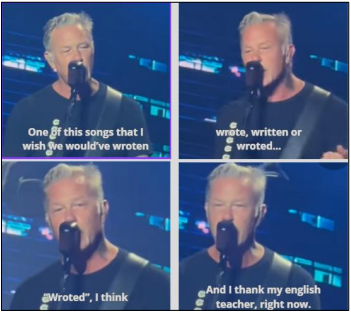
(Available on: https://www.youtube.com/ . Accessed on: may 2025. Adapted.)
The singer humorously misuses the past form of the irregular verb “to write”. The correct use of the irregular verb “to write” in the past participle form is:
Read the following text to answer question
CLIL is an abbreviation for Content and Language Integrated Learning. It is a way of teaching where subject content — such as history, science or physical education — is taught in another language (often English). We like the following definition of CLIL by Coyle, Hood and Marsh (2010, р. 1):
Content and Language Integrated Learning (CLIL) is a dual-focused educational approach in which another language is used for the learning and teaching of both content and language. That is, in the teaching and learning process, there is a focus not only on content, and not only on language. Each is interwoven, even if the emphasis is greater on one or the other at a given time.
(Liz Dale, Rosie Tanner. CLIL activities:
a resource for subjects and language teachers,
2012. Adaptado)
• Instruction is given in the native language of the students. • The target language is rarely used for communication. • Focus falls on grammatical description, explanation and analysis. • The result of this approach is usually an inability on the part of the student to use the language for communication. • The teacher does not have to be able to speak the target language.
The characteristics are consistent with
Read the following text to answer question
his paper presents the concept of task as the location for learning a foreign language (FL), a space for creation in and with the target language, with the tasks utilized simulating as closely as possible the situations which the students will encounter outside the classroom and which, moreover, emphasize meaning. Throughout the paper, the theory of the use of tasks for the teaching/learning of a FL present in the literature will be discussed, and an approach which is based on the utilization of tasks as the backbone for the planning of course is presented. In addition to emphasizing meaning, the tasks analyzed take a relatively long time to complete, i.e. they last more than a single class. Thus, the input can be remembered and re-worked as it reappears in different ways, thus making it possible for learning to be more long-lasting and significant.
(José Carlos Paes de Almeida Filho e Rita Barbirato.
Ambientes comunicativos para aprender línguas estrangeiras,
2000. Adaptado)
Read the following anecdote to answer question
In Salzburg as a group of about 15 family and friends. We asked a nice German woman to take our photo. She takes one then says “OK, back up”. So, we all shuffle as a group like 3 feet backwards. She immediately starts laughing and explains she meant she was taking a backup photo. Safe to say the smiles in the second photo were genuine.
(https://www.boredpanda.com/funny-travel-miscommunications/)
( ) In Brazilian EFL classes, teaching of reading through textual genres should not be restricted to the decoding of words and structures and should involve reflection on the communicative purpose and social-discursive function of the texts. For instance, if students are asked to read an opinion piece on climate change and figure out the position of the writer, the evidence used to support their argument, and how this relates to their lives, they are engaging in critical reading. This methodology is in consonance with the theoretical statements of Kleiman (2013) and Rojo (2012), who suggest reading is a social practice and working with different text genres is key to develop students’ critical stance and participation in the social debate.
( ) High School English teacher displays a job ad, asks students what it is for, how it is laid out, and who might read it. The teacher next directs students to write an ad of their own in small groups. This exercise fits in with a genre-based approach, according to Marcuschi (2008), by relating form, function, and communicative context.
( ) Reading strategies (e.g., skimming, scanning and inference) do not need to be taught when using genres since genre-based reading addresses the social function of texts but consider reading strategies as less relevant.
( ) In a 9th-grade class, students read Instagram captions and TikTok comments in English. The teacher asks them to analyze tone, abbreviations, emojis, and interactional purposes. This activity aligns with Rojo’s (2012) view that digital and multimodal genres are essential for inclusive and socially relevant reading instruction.
The correct order of filling in the parentheses, from top to bottom, is:
Analyze the following statementes about teaching tense and time in Brazilian EFL classrooms:
I. Brazilian learners tend to confuse the present perfect with the simple past because of L1 interference.
II. Explicit instruction on tense/time distinction is unnecessary because learners acquire it naturally.
III. Emphasizing communicative contexts helps learners understand tense use more effectively.
IV. Aspectual distinctions are essential for explaining English verb usage.
Which ones are correct?

 Conheça nossos planos