🎯 Saiba o que estudar

Avançado com Treinador a partir de R$ 0,76/dia

Questões Discursivas

Foram encontradas 6.702 questões

Resolva questões gratuitamente!

Junte-se a mais de 4 milhões de concurseiros!

Q4189436 Inglês
Leia o texto a seguir para responder à questão:


   Knowledge of a language enables you to combine sounds to form words, words to form phrases, and phrases to form sentences. You cannot buy a dictionary or phrase book of any language with all the sentences of the language. No dictionary can list all the possible sentences, because the number of sentences in a language is infinite. Knowing a language means being able to produce and understand new sentences never spoken before. This is the creative aspect of language. Not every speaker can create great literature, but everybody who knows a language can create and understand new sentences.

   This creative aspect of language is quite easy to illustrate. If for every sentence in the language a longer sentence can be formed, then there is no limit to the number of sentences. If you know English, you have the knowledge to add any number of adjectives as modifiers to a noun and to form sentences with indefinite numbers of clauses.

   All human languages permit their speakers to increase the length and complexity of sentences in these ways; creativity is a universal property of human language.

  Our knowledge of language not only allows us to produce and understand an infinite number of well-formed (even if silly and illogical) sentences, but also permits us to distinguish well-formed (grammatical) sentences from ill-formed (ungrammatical) sentences – or non-sentences.


(Fromkin, Rodman and Hyams, An Introduction to Language, 2013. Adaptado)
A teacher is discussing aspects of knowledge of the language and creativity, and also introduces the concept of sentences (grammatically well-formed) and non-sentences (grammatically ill-formed) discussed by Fromkin, Rodman and Hyams. Students are asked to get in groups and discuss the 5 following sentences to decide which one, among them, can be considered a non-sentence according to the authors’ view. Based on this context, select the option that presents a non-sentence.
Alternativas
Q4189435 Inglês
Leia o texto a seguir para responder à questão:


   Knowledge of a language enables you to combine sounds to form words, words to form phrases, and phrases to form sentences. You cannot buy a dictionary or phrase book of any language with all the sentences of the language. No dictionary can list all the possible sentences, because the number of sentences in a language is infinite. Knowing a language means being able to produce and understand new sentences never spoken before. This is the creative aspect of language. Not every speaker can create great literature, but everybody who knows a language can create and understand new sentences.

   This creative aspect of language is quite easy to illustrate. If for every sentence in the language a longer sentence can be formed, then there is no limit to the number of sentences. If you know English, you have the knowledge to add any number of adjectives as modifiers to a noun and to form sentences with indefinite numbers of clauses.

   All human languages permit their speakers to increase the length and complexity of sentences in these ways; creativity is a universal property of human language.

  Our knowledge of language not only allows us to produce and understand an infinite number of well-formed (even if silly and illogical) sentences, but also permits us to distinguish well-formed (grammatical) sentences from ill-formed (ungrammatical) sentences – or non-sentences.


(Fromkin, Rodman and Hyams, An Introduction to Language, 2013. Adaptado)
The sentence in the fourth paragraph displays one correct use of paired conjunctions.

The alternative in which the paired conjunctions help form a grammatically correct sentence is:
Alternativas
Q4189434 Inglês
Leia o texto a seguir para responder à questão:


   Knowledge of a language enables you to combine sounds to form words, words to form phrases, and phrases to form sentences. You cannot buy a dictionary or phrase book of any language with all the sentences of the language. No dictionary can list all the possible sentences, because the number of sentences in a language is infinite. Knowing a language means being able to produce and understand new sentences never spoken before. This is the creative aspect of language. Not every speaker can create great literature, but everybody who knows a language can create and understand new sentences.

   This creative aspect of language is quite easy to illustrate. If for every sentence in the language a longer sentence can be formed, then there is no limit to the number of sentences. If you know English, you have the knowledge to add any number of adjectives as modifiers to a noun and to form sentences with indefinite numbers of clauses.

   All human languages permit their speakers to increase the length and complexity of sentences in these ways; creativity is a universal property of human language.

  Our knowledge of language not only allows us to produce and understand an infinite number of well-formed (even if silly and illogical) sentences, but also permits us to distinguish well-formed (grammatical) sentences from ill-formed (ungrammatical) sentences – or non-sentences.


(Fromkin, Rodman and Hyams, An Introduction to Language, 2013. Adaptado)
O conectivo que pode ser usado para relacionar as duas sentenças do terceiro parágrafo sem corromper o significado é
Alternativas
Q4189433 Inglês
Leia o texto a seguir para responder à questão:


   Knowledge of a language enables you to combine sounds to form words, words to form phrases, and phrases to form sentences. You cannot buy a dictionary or phrase book of any language with all the sentences of the language. No dictionary can list all the possible sentences, because the number of sentences in a language is infinite. Knowing a language means being able to produce and understand new sentences never spoken before. This is the creative aspect of language. Not every speaker can create great literature, but everybody who knows a language can create and understand new sentences.

   This creative aspect of language is quite easy to illustrate. If for every sentence in the language a longer sentence can be formed, then there is no limit to the number of sentences. If you know English, you have the knowledge to add any number of adjectives as modifiers to a noun and to form sentences with indefinite numbers of clauses.

   All human languages permit their speakers to increase the length and complexity of sentences in these ways; creativity is a universal property of human language.

  Our knowledge of language not only allows us to produce and understand an infinite number of well-formed (even if silly and illogical) sentences, but also permits us to distinguish well-formed (grammatical) sentences from ill-formed (ungrammatical) sentences – or non-sentences.


(Fromkin, Rodman and Hyams, An Introduction to Language, 2013. Adaptado)
No final do primeiro parágrafo, o trecho “everybody who knows a language” contém um pronome relativo que não pode ser suprimido sem prejuízo da gramaticalidade da frase. Da mesma forma, não pode ser omitido o pronome relativo em: 
Alternativas
Q4189432 Inglês
Leia o texto a seguir para responder à questão:


   Knowledge of a language enables you to combine sounds to form words, words to form phrases, and phrases to form sentences. You cannot buy a dictionary or phrase book of any language with all the sentences of the language. No dictionary can list all the possible sentences, because the number of sentences in a language is infinite. Knowing a language means being able to produce and understand new sentences never spoken before. This is the creative aspect of language. Not every speaker can create great literature, but everybody who knows a language can create and understand new sentences.

   This creative aspect of language is quite easy to illustrate. If for every sentence in the language a longer sentence can be formed, then there is no limit to the number of sentences. If you know English, you have the knowledge to add any number of adjectives as modifiers to a noun and to form sentences with indefinite numbers of clauses.

   All human languages permit their speakers to increase the length and complexity of sentences in these ways; creativity is a universal property of human language.

  Our knowledge of language not only allows us to produce and understand an infinite number of well-formed (even if silly and illogical) sentences, but also permits us to distinguish well-formed (grammatical) sentences from ill-formed (ungrammatical) sentences – or non-sentences.


(Fromkin, Rodman and Hyams, An Introduction to Language, 2013. Adaptado)
No trecho do primeiro parágrafo “Knowledge of a language enables you to”, a palavra destacada é formada pela adição do prefixo en- à raiz “able”. A alternativa em que o prefixo en- desempenha o mesmo papel que em “enable” é:
Alternativas
Q4189431 Inglês
Leia o texto a seguir para responder à questão:


   Knowledge of a language enables you to combine sounds to form words, words to form phrases, and phrases to form sentences. You cannot buy a dictionary or phrase book of any language with all the sentences of the language. No dictionary can list all the possible sentences, because the number of sentences in a language is infinite. Knowing a language means being able to produce and understand new sentences never spoken before. This is the creative aspect of language. Not every speaker can create great literature, but everybody who knows a language can create and understand new sentences.

   This creative aspect of language is quite easy to illustrate. If for every sentence in the language a longer sentence can be formed, then there is no limit to the number of sentences. If you know English, you have the knowledge to add any number of adjectives as modifiers to a noun and to form sentences with indefinite numbers of clauses.

   All human languages permit their speakers to increase the length and complexity of sentences in these ways; creativity is a universal property of human language.

  Our knowledge of language not only allows us to produce and understand an infinite number of well-formed (even if silly and illogical) sentences, but also permits us to distinguish well-formed (grammatical) sentences from ill-formed (ungrammatical) sentences – or non-sentences.


(Fromkin, Rodman and Hyams, An Introduction to Language, 2013. Adaptado)
According to the first paragraph, the creative aspect of language allows the user to
Alternativas
Q4189430 Pedagogia

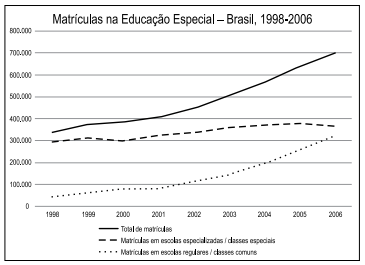
Observe o gráfico a seguir:


Imagem associada para resolução da questão


(Censo Escolar, 2006)


Assinale a alternativa correta que identifica a interpretação dos dados que seja condizente com o que afirma a Política Nacional de Educação Especial na Perspectiva da Educação Inclusiva (Brasil, 2008).

Alternativas
Q4189429 Pedagogia
Ao refletir sobre os saberes docentes, Tardif (2018) problematiza a imprecisão e equivocidade da noção de “saber”. O autor apresenta três concepções, uma das quais entende o saber como argumento ou discussão.

A respeito da concepção de saber como argumento, assinale a alternativa que enuncia corretamente a perspectiva do autor.
Alternativas
Q4189428 Pedagogia
Paulilo (2017) resgata pesquisas que mapeiam historicamente a produção sobre o fracasso escolar no Brasil. O autor entende que há dois tipos de deslocamento na compreensão do fracasso escolar, sendo o primeiro deles a transição da busca de 
Alternativas
Q4189427 Pedagogia
Paro (2008) afirma que “a estrutura da escola deve assumir uma forma democrática, que favoreça a vontade dos sujeitos envolvidos no processo pedagógico”.

O autor entende que esse imperativo parte da concepção de educação como
Alternativas
Q4189426 Pedagogia
Frade, Araújo e Glória (2018) defendem que “a relação com a leitura e a escrita se torna mais rica quando se aprende a lidar desde cedo com as possibilidades que cada um dos suportes textuais pode proporcionar àqueles que o experimentam”.

Para as autoras, isso significa, dentre outros aspectos,
Alternativas
Q4189425 Pedagogia
Dias et al. (2022) defendem que, ao se basear uma proposta pedagógica na resolução de problemas, se deve tomar a seguinte asserção como um de seus princípios:
Alternativas
Q4189424 Pedagogia
Coll e Monereo (2010) tratam de fenômenos, tendências e características que são especialmente importantes como pano de fundo da educação na Sociedade da Informação (SI) e de suas instáveis transformações.

Entre os elementos que os autores destacam, está
Alternativas
Q4189423 Português
Leia o texto para responder à questão:


Após participar de um ciclo formativo a respeito da aprendizagem baseada em projetos (ABP), a professora Ana decidiu trabalhar a partir dessa abordagem com suas turmas de 7o ano do ensino fundamental ao tematizar o componente curricular relacionado ao corpo humano. Ela tem, agora, o desafio do pré-planejamento da ABP, desenhando a proposta que realizará com os estudantes na intenção de fomentar a alfabetização e o letramento científicos (AC/LC).
Ana tem refletido sobre os propósitos e justificativas de seu trabalho de AC/LC. Lendo o texto de Santos (2007), compreendeu que as definições e propostas de AC/LC são diversas e variam a partir do contexto social em que são pensadas, mas que convergem em dois grandes grupos de categorias.

Coerentemente ao que afirma o texto, Ana deve se atentar ao trabalho em dois domínios: um quanto 
Alternativas
Q4189422 Pedagogia
Leia o texto para responder à questão:


Após participar de um ciclo formativo a respeito da aprendizagem baseada em projetos (ABP), a professora Ana decidiu trabalhar a partir dessa abordagem com suas turmas de 7o ano do ensino fundamental ao tematizar o componente curricular relacionado ao corpo humano. Ela tem, agora, o desafio do pré-planejamento da ABP, desenhando a proposta que realizará com os estudantes na intenção de fomentar a alfabetização e o letramento científicos (AC/LC).
Baseando-se corretamente na obra de Bender (2014), a respeito da ABP, Ana deve desenvolver 
Alternativas
Q4189421 Pedagogia
Barbosa (2007) atrela a concepção de pluralidade das infâncias à compreensão da infância como 
Alternativas
Q4189260 Banco de Dados
No que se refere ao controle de concorrência aplicado em sistemas de bancos de dados, há diversos tipos de protocolos, sendo dois desses tipos os protocolos baseados em 
Alternativas
Q4189259 Banco de Dados

 Considerando um banco de dados relacional, deseja-se criar uma tabela de nome Teste, contendo os atributos Código (inteiro), Nome (caractere com 20 posições) e Tipo (caractere com 10 posições).


O comando SQL para criar essa tabela é:

Alternativas
Q4189258 Banco de Dados
As entidades presentes em um modelo entidade-relacionamento possuem atributos, sobre os quais é correto afirmar que os atributos
Alternativas
Q4189257 Gerência de Projetos
O PMBOK define cinco grupos de processos de gerenciamento de projetos, sendo que, especificamente, dois desses grupos referem-se aos processos de
Alternativas
Respostas
341: C
342: E
343: B
344: A
345: D
346: C
347: A
348: B
349: C
350: E
351: A
352: C
353: D
354: E
355: B
356: A
357: B
358: B
359: D
360: A