Questões Militares
Comentadas para exército
Foram encontradas 9.511 questões
Resolva questões gratuitamente!
Junte-se a mais de 4 milhões de concurseiros!


Ano: 2025
Banca:
Exército
Órgão:
EsPCEx
Prova:
Exército - 2025 - EsPCEx - Cadete do Exército - 2º Dia |
Q3909808
História
Ao longo da história, os historiadores identificaram grandes momentos ou mesmo fases da
industrialização mundial e, ao considerarem os países envolvidos e as inovações técnicas,
classificaram esses momentos ou fases em Primeira, Segunda e Terceira Revoluções Industriais. Na
chamada “Primeira Revolução Industrial”, entre os séculos XVIII e XIX, foi de notável importância
para o desenvolvimento das fábricas a (o)
Ano: 2025
Banca:
Exército
Órgão:
EsPCEx
Prova:
Exército - 2025 - EsPCEx - Cadete do Exército - 2º Dia |
Q3909807
História
Josef Stalin, tendo ficado 29 anos no poder (até sua morte, em 1953) e estimulado um forte
culto à sua personalidade, comandou a consolidação da hoje extinta União das Repúblicas
Socialistas Soviéticas (URSS). Quando Stalin faleceu, seu sucessor libertou presos políticos,
diminuiu a censura à imprensa, desativou campos de trabalhos forçados e denunciou os crimes
praticados por seu antecessor, desnorteando os partidos comunistas mundo afora. Cerca de uma
década depois, este foi sucedido por um membro da ala conservadora do Partido Comunista, que
restaurou diversos horrores da época stalinista. Os dois líderes soviéticos que se seguiram a Stalin
e aos quais o texto se refere foram, respectivamente,
Ano: 2025
Banca:
Exército
Órgão:
EsPCEx
Prova:
Exército - 2025 - EsPCEx - Cadete do Exército - 2º Dia |
Q3909806
História
Pode-se dizer que o Nazismo emergiu da derrota alemã na 1a Guerra Mundial e da humilhação
das condições impostas pelo Tratado de Versalhes. Hitler, na sua obra “Minha Luta” (Mein Kampf),
desenvolveu os fundamentos dessa ideologia, que apresentava algumas similaridades com o fascismo italiano, de Mussolini. Relativamente a essas ideologias ou doutrinas, analise os fundamentos
abaixo relacionados.
I – Nacionalismo e totalitarismo.
II – Corporativismo (o Estado deve buscar a harmonização dos interesses do capital e do trabalho dentro dos quadros das corporações) e militarismo (presença de milícias armadas ou polícia paramilitar).
III – Expansionismo (necessidade do domínio de territórios indispensáveis ao desenvolvimento do novo império) e noção de superioridade racial.
IV – Anticomunismo.
Assinale a alternativa que apresenta somente fundamentos presentes tanto no nazismo quanto no fascismo.
I – Nacionalismo e totalitarismo.
II – Corporativismo (o Estado deve buscar a harmonização dos interesses do capital e do trabalho dentro dos quadros das corporações) e militarismo (presença de milícias armadas ou polícia paramilitar).
III – Expansionismo (necessidade do domínio de territórios indispensáveis ao desenvolvimento do novo império) e noção de superioridade racial.
IV – Anticomunismo.
Assinale a alternativa que apresenta somente fundamentos presentes tanto no nazismo quanto no fascismo.
Ano: 2025
Banca:
Exército
Órgão:
EsPCEx
Prova:
Exército - 2025 - EsPCEx - Cadete do Exército - 2º Dia |
Q3909805
História
Eleito Presidente da República nas eleições de 1955, Juscelino Kubitschek (JK, como era
conhecido) iniciou seu governo lançando um ambicioso plano nacional de desenvolvimento,
conhecido como “Plano de Metas”. Ali estavam definidos os principais objetivos a serem atingidos
durante seu governo, agrupados em cinco setores: energia, transporte, indústria, educação e
alimentação. Relativamente ao Plano de Metas de JK, analise as assertivas abaixo.
I – Nos setores de indústria e de transporte, foram implantadas novas fábricas de veículos e construídos cerca de 20 mil quilômetros de rodovias.
II – As metas nos setores de educação e alimentação não foram alcançadas.
III – No setor de energia, foram construídas duas grandes usinas hidrelétricas, ambas em Minas Gerais, e a extração de Petróleo cresceu mais de 150%.
IV – A construção de Brasília, conhecida como “meta-síntese”, era uma das metas originais do Plano.
Assinale a alternativa que apresenta somente assertivas corretas.
I – Nos setores de indústria e de transporte, foram implantadas novas fábricas de veículos e construídos cerca de 20 mil quilômetros de rodovias.
II – As metas nos setores de educação e alimentação não foram alcançadas.
III – No setor de energia, foram construídas duas grandes usinas hidrelétricas, ambas em Minas Gerais, e a extração de Petróleo cresceu mais de 150%.
IV – A construção de Brasília, conhecida como “meta-síntese”, era uma das metas originais do Plano.
Assinale a alternativa que apresenta somente assertivas corretas.
Ano: 2025
Banca:
Exército
Órgão:
EsPCEx
Prova:
Exército - 2025 - EsPCEx - Cadete do Exército - 2º Dia |
Q3909804
Geografia
“Segundo o Censo Demográfico 2022, do total de 203,1 milhões de pessoas que vivem no
país, 177,5 milhões (87,4%) residiam em áreas urbanas, enquanto 25,6 milhões (12,6%) estavam
em áreas rurais. Em relação a 2010, quando o grau de urbanização foi de 84,4%, houve aumento
de 16,6 milhões de pessoas morando em áreas urbanas e queda de 4,3 milhões vivendo em áreas
rurais”.
(Fonte:https://agenciadenoticias.ibge.gov.br/agencia-noticias/2012-agencia-de-noticias/noticias/41901-censo-2022-87-da-populacao-brasileira-vive-em-areas-urbanas).
Analise as assertivas a seguir:
I – O Brasil possui mais de 5500 municípios, sendo que muitos deles são economicamente deficitários. A criação de novos municípios implica mais despesas para os poderes estadual e federal.
II – A definição de áreas urbanas no Brasil segue parâmetros funcionais definidos pela Organização para a Cooperação e Desenvolvimento Econômico (OCDE) após a 2ª Guerra Mundial, quando a urbanização avançava de forma acelerada em países periféricos.
III – A criação e gestão das regiões metropolitanas (RM) é de competência da esfera federal, tendo em vista que, em muitos casos, as diversas RM englobam municípios de mais de uma unidade da federação.
IV – A expansão do perímetro urbano favorece o aumento da arrecadação tributária das municipalidades.
Assinale a alternativa que apresenta somente assertivas corretas.
(Fonte:https://agenciadenoticias.ibge.gov.br/agencia-noticias/2012-agencia-de-noticias/noticias/41901-censo-2022-87-da-populacao-brasileira-vive-em-areas-urbanas).
Analise as assertivas a seguir:
I – O Brasil possui mais de 5500 municípios, sendo que muitos deles são economicamente deficitários. A criação de novos municípios implica mais despesas para os poderes estadual e federal.
II – A definição de áreas urbanas no Brasil segue parâmetros funcionais definidos pela Organização para a Cooperação e Desenvolvimento Econômico (OCDE) após a 2ª Guerra Mundial, quando a urbanização avançava de forma acelerada em países periféricos.
III – A criação e gestão das regiões metropolitanas (RM) é de competência da esfera federal, tendo em vista que, em muitos casos, as diversas RM englobam municípios de mais de uma unidade da federação.
IV – A expansão do perímetro urbano favorece o aumento da arrecadação tributária das municipalidades.
Assinale a alternativa que apresenta somente assertivas corretas.
Ano: 2025
Banca:
Exército
Órgão:
EsPCEx
Prova:
Exército - 2025 - EsPCEx - Cadete do Exército - 2º Dia |
Q3909802
Conhecimentos Gerais
“O homem de Estado que conduz a política externa só pode tomar em conta os valores de justiça,
equidade e tolerância na medida em que contribuam ao objetivo de poder ou enquanto não interfiram nele.
Pode utilizá-los como instrumentos que desde o ponto de vista moral justifiquem a aspiração de poder,
porém deve rechaçá-los no instante em que sua aplicação se traduza em debilidade. Não se busca o poder
para o alcance de valores morais, porém se utilizam os valores morais para facilitar a aquisição de poder”.
(Fonte: Nicholas Spykman. America’s Strategy in World Politics, 1942, p.26).
A presença de bases militares norte-americanas em diversas partes do mundo expressa a projeção mundial de poder dos EUA.
Escolha a única opção em que todos os países listados possuem bases militares dos Estados Unidos.
(Fonte: Nicholas Spykman. America’s Strategy in World Politics, 1942, p.26).
A presença de bases militares norte-americanas em diversas partes do mundo expressa a projeção mundial de poder dos EUA.
Escolha a única opção em que todos os países listados possuem bases militares dos Estados Unidos.
Ano: 2025
Banca:
Exército
Órgão:
EsPCEx
Prova:
Exército - 2025 - EsPCEx - Cadete do Exército - 2º Dia |
Q3909800
Engenharia Ambiental e Sanitária
“O bairro Menino Deus, localizado na região centro-sul de Porto Alegre, voltou a registrar ruas
inundadas menos de uma semana depois de a água do rio Guaíba ter baixado. A reportagem registrou a
saída de moradores e trabalhadores do comércio no cruzamento das ruas Grão-Pará e José de Alencar,
onde a água alcançava a altura do joelho. Após dias de trégua, a chuva voltou a castigar Porto Alegre
nesta quinta-feira (23)”.
(Fonte: https://agenciabrasil.ebc.com.br/geral/noticia/2024-05/porto-alegre-enfrenta-chuva-e-bairro-menino-deus-volta-a-alagar).
As inundações urbanas expõem a população a riscos materiais e imateriais. Esses eventos tendem a afetar de forma mais severa as populações mais vulneráveis.
Constituem-se problemas relacionados às inundações e suas respectivas medidas de mitigação:
(Fonte: https://agenciabrasil.ebc.com.br/geral/noticia/2024-05/porto-alegre-enfrenta-chuva-e-bairro-menino-deus-volta-a-alagar).
As inundações urbanas expõem a população a riscos materiais e imateriais. Esses eventos tendem a afetar de forma mais severa as populações mais vulneráveis.
Constituem-se problemas relacionados às inundações e suas respectivas medidas de mitigação:
Ano: 2025
Banca:
Exército
Órgão:
EsPCEx
Prova:
Exército - 2025 - EsPCEx - Cadete do Exército - 2º Dia |
Q3909799
Engenharia Ambiental e Sanitária
“A água é vital para a existência de vida na Terra. Apesar de alguns seres vivos sobreviverem sem
ar, nenhum organismo pode sobreviver sem água. A água é necessária para a fotossíntese, a formação do
solo e a absorção de nutrientes pelos animais e plantas.”
(Fonte: PETERSEN, James F. Fundamentos de Geografia Física. São Paulo: Cengage Learning, 2014. pág. 100).
Analise as considerações a respeito do precioso recurso tratado no texto acima.
I – O conceito de estresse hídrico evidencia o panorama global da crise da água, levando em consideração tão somente os distintos totais pluviométricos e, consequentemente, a formação de reservas superficiais e subterrâneas de água.
II – No Brasil, a superexploração das águas e a elevada impermeabilização dos solos impactam diretamente os volumes de água dos reservatórios subterrâneos. Como consequências diretas desses processos, podem-se citar: a redução do volume de água de recarga dos aquíferos e a extinção de nascentes.
III – A água é considerada um recurso que se renova constantemente por meio do ciclo natural que envolve a atmosfera, a crosta terrestre e a hidrosfera. Entretanto, é considerada um recurso finito e tem a sua distribuição pelo planeta considerada bastante desigual.
IV – Globalmente, as atividades agrícolas são responsáveis pela maior parte da demanda de água. Sendo assim, não se pode afirmar que os padrões de consumo desse recurso variam em função dos distintos níveis de desenvolvimento dos países.
V – A água doce disponível no mundo ainda é suficiente para atender às necessidades de consumo atuais, de modo que a crise hídrica do presente decorre da má distribuição geográfica dos recursos hídricos e da carência, por parte dos países pobres, de sistemas adequados de fornecimento e tratamento de água.
Assinale a alternativa que apresenta somente assertivas corretas.
(Fonte: PETERSEN, James F. Fundamentos de Geografia Física. São Paulo: Cengage Learning, 2014. pág. 100).
Analise as considerações a respeito do precioso recurso tratado no texto acima.
I – O conceito de estresse hídrico evidencia o panorama global da crise da água, levando em consideração tão somente os distintos totais pluviométricos e, consequentemente, a formação de reservas superficiais e subterrâneas de água.
II – No Brasil, a superexploração das águas e a elevada impermeabilização dos solos impactam diretamente os volumes de água dos reservatórios subterrâneos. Como consequências diretas desses processos, podem-se citar: a redução do volume de água de recarga dos aquíferos e a extinção de nascentes.
III – A água é considerada um recurso que se renova constantemente por meio do ciclo natural que envolve a atmosfera, a crosta terrestre e a hidrosfera. Entretanto, é considerada um recurso finito e tem a sua distribuição pelo planeta considerada bastante desigual.
IV – Globalmente, as atividades agrícolas são responsáveis pela maior parte da demanda de água. Sendo assim, não se pode afirmar que os padrões de consumo desse recurso variam em função dos distintos níveis de desenvolvimento dos países.
V – A água doce disponível no mundo ainda é suficiente para atender às necessidades de consumo atuais, de modo que a crise hídrica do presente decorre da má distribuição geográfica dos recursos hídricos e da carência, por parte dos países pobres, de sistemas adequados de fornecimento e tratamento de água.
Assinale a alternativa que apresenta somente assertivas corretas.
Ano: 2025
Banca:
Exército
Órgão:
EsPCEx
Prova:
Exército - 2025 - EsPCEx - Cadete do Exército - 2º Dia |
Q3909797
Geografia
“As ligações internas entre as ‘ilhas’ econômicas eram frágeis, pois os mercados externos tinham
importância muito maior que o embrionário mercado nacional. [...] No século XX, a industrialização rompeu o isolamento dos mercados regionais. Os manufaturados de São Paulo e Rio de Janeiro, produzidos
com tecnologia superior e em escala industrial, invadiram todo o país.”
(Fonte: MAGNOLI, Demétrio. Geografia para o Ensino Médio. 2. ed. São Paulo: Atual, 2012. pág. 250).
O texto acima reforça uma transformação na estrutura econômica brasileira ocorrida entre as últimas décadas do século XIX e a primeira metade do século passado. Como uma das consequências diretas desta transformação, pode-se apontar:
(Fonte: MAGNOLI, Demétrio. Geografia para o Ensino Médio. 2. ed. São Paulo: Atual, 2012. pág. 250).
O texto acima reforça uma transformação na estrutura econômica brasileira ocorrida entre as últimas décadas do século XIX e a primeira metade do século passado. Como uma das consequências diretas desta transformação, pode-se apontar:
Ano: 2025
Banca:
Exército
Órgão:
EsPCEx
Prova:
Exército - 2025 - EsPCEx - Cadete do Exército - 2º Dia |
Q3909796
Geografia
O povoamento e desenvolvimento da Amazônia brasileira foram fundados de acordo com o
paradigma de relação sociedade-natureza, que Kenneth Boulding denomina de economia de fronteira,
significando com isso que o crescimento econômico é visto como linear e infinito. Tal crescimento baseia-se na contínua incorporação de terra e recursos naturais, que são também percebidos como infinitos.
Esse paradigma de economia de fronteira realmente caracteriza toda a formação latino-americana.
(Fonte: Becker, B. Geopolítica da Amazônia. In: Estudos Avançados. 19 (53), 2005. (texto adaptado)).
Analise as assertivas abaixo.
I – A Amazônia é uma região de elevada biodiversidade, onde predominam áreas de planícies, conforme a classificação do relevo brasileiro de Jurandyr Ross.
II – A Amazônia converteu-se em fronteira demográfica para os fluxos migratórios orientados em torno dos eixos sul-norte das rodovias Belém-Brasília, Cuiabá-Santarém e Brasília-Acre.
III – A Amazônia é um extenso “vazio demográfico”, o que se confirma pela ocupação rarefeita, inclusive nas capitais de estado, dentre as quais não figura nenhuma metrópole.
IV – O SIVAM (Sistema de Vigilância da Amazônia) é uma rede integrada de sensoriamento remoto e de telecomunicações que abrange a maior parte da Amazônia Legal.
Assinale a alternativa que apresenta somente a(s) assertiva(s) correta(s).
(Fonte: Becker, B. Geopolítica da Amazônia. In: Estudos Avançados. 19 (53), 2005. (texto adaptado)).
Analise as assertivas abaixo.
I – A Amazônia é uma região de elevada biodiversidade, onde predominam áreas de planícies, conforme a classificação do relevo brasileiro de Jurandyr Ross.
II – A Amazônia converteu-se em fronteira demográfica para os fluxos migratórios orientados em torno dos eixos sul-norte das rodovias Belém-Brasília, Cuiabá-Santarém e Brasília-Acre.
III – A Amazônia é um extenso “vazio demográfico”, o que se confirma pela ocupação rarefeita, inclusive nas capitais de estado, dentre as quais não figura nenhuma metrópole.
IV – O SIVAM (Sistema de Vigilância da Amazônia) é uma rede integrada de sensoriamento remoto e de telecomunicações que abrange a maior parte da Amazônia Legal.
Assinale a alternativa que apresenta somente a(s) assertiva(s) correta(s).
Ano: 2025
Banca:
Exército
Órgão:
EsPCEx
Prova:
Exército - 2025 - EsPCEx - Cadete do Exército - 2º Dia |
Q3909794
Geografia
“Se um quadro vale mil palavras, um mapa vale um milhão. Uma vez que os mapas são representações gráficas e utilizam linguagem simbólica, eles mostram relações espaciais e retratam informações geográficas com muito mais eficácia. Os mapas fornecem uma quantidade de informações gráficas que necessitaria de várias páginas para descrevê-las (provavelmente com menos sucesso).”
(Fonte: PETERSEN, James F. Fundamentos de Geografia Física. São Paulo: Cengage Learning, 2014. pág. 29)
Analise as assertivas abaixo.
I – Em um mapa, os elementos que compõem o espaço geográfico podem ser representados de diversas formas. Entretanto, diante da complexidade do espaço geográfico, algumas informações são sempre priorizadas em detrimento de outras.
II – No caso dos mapas e cartas topográficas, as escalas cartográficas utilizadas em sua confecção pouco ou nada interferem no detalhamento e na precisão com que as variáveis da superfície terrestre são representadas.
III – Dependendo da escala cartográfica utilizada, um fenômeno que normalmente é representado de maneira pontual pode passar a ser representado de maneira zonal, passando-se a enfatizar a área ocupada por ele.
IV – Numa anamorfose geográfica, busca-se, através da manutenção da escala cartográfica em todo o mapa, demonstrar o grau de participação dos países em relação a fenômenos escolhidos e representados.
V – Nos mapas temáticos, os quais contêm informações selecionadas sobre determinados fenômenos ou temas do espaço geográfico, as representações quantitativas e qualitativas são mais relevantes que a precisão planimétrica ou altimétrica.
Assinale a alternativa que apresenta somente assertivas corretas.
(Fonte: PETERSEN, James F. Fundamentos de Geografia Física. São Paulo: Cengage Learning, 2014. pág. 29)
Analise as assertivas abaixo.
I – Em um mapa, os elementos que compõem o espaço geográfico podem ser representados de diversas formas. Entretanto, diante da complexidade do espaço geográfico, algumas informações são sempre priorizadas em detrimento de outras.
II – No caso dos mapas e cartas topográficas, as escalas cartográficas utilizadas em sua confecção pouco ou nada interferem no detalhamento e na precisão com que as variáveis da superfície terrestre são representadas.
III – Dependendo da escala cartográfica utilizada, um fenômeno que normalmente é representado de maneira pontual pode passar a ser representado de maneira zonal, passando-se a enfatizar a área ocupada por ele.
IV – Numa anamorfose geográfica, busca-se, através da manutenção da escala cartográfica em todo o mapa, demonstrar o grau de participação dos países em relação a fenômenos escolhidos e representados.
V – Nos mapas temáticos, os quais contêm informações selecionadas sobre determinados fenômenos ou temas do espaço geográfico, as representações quantitativas e qualitativas são mais relevantes que a precisão planimétrica ou altimétrica.
Assinale a alternativa que apresenta somente assertivas corretas.
Ano: 2025
Banca:
Exército
Órgão:
EsPCEx
Prova:
Exército - 2025 - EsPCEx - Cadete do Exército - 2º Dia |
Q3909793
Geografia
“O relevo não é estático, mas dinâmico. O modelado da crosta continua em transformação. Esse
fluxo pode ser muito lento e quase sempre nossos sentidos são incapazes de captá-lo. As transformações
morfológicas são provocadas por dois tipos de força: os agentes internos ou modeladores resultam de
forças oriundas do interior do planeta; os agentes externos ou esculpidores resultam de forças oriundas
da atmosfera.”
(Fonte: MAGNOLI, Demétrio. Geografia para o Ensino Médio. 2. ed. São Paulo: Atual, 2012. pág. 38).
A respeito da atuação dos agentes expostos no enunciado, julgue as assertivas a seguir: I – Como exemplo típico de intemperismo físico, as intensas variações diárias de temperatura, muito atuantes nos desertos, podem ocasionar a desintegração mecânica das rochas.
II – Como agentes erosivos, os ventos conseguem transportar poeira fina por centenas ou mesmo milhares de quilômetros, fazendo-a atravessar, inclusive, mares e oceanos.
III – No que diz respeito aos abalos sísmicos, a profundidade do foco em nada interfere na extensão da área afetada, bem como nas possibilidades de destruição geradas por esse fenômeno.
IV – Enquanto a epirogênese age sobre regiões estáveis da crosta, levando à ocorrência de áreas soerguidas e rebaixadas, a orogênese atua nos limites das placas tectônicas, resultando em dobras e falhas.
V – Comparando as possibilidades de atuação dos principais agentes envolvidos nos intemperismos físico e químico, conclui-se que as condições climáticas são irrelevantes para a prevalência, ou mesmo ocorrência, de um ou de outro processo.
Assinale a alternativa que apresenta todas as assertivas corretas.
(Fonte: MAGNOLI, Demétrio. Geografia para o Ensino Médio. 2. ed. São Paulo: Atual, 2012. pág. 38).
A respeito da atuação dos agentes expostos no enunciado, julgue as assertivas a seguir: I – Como exemplo típico de intemperismo físico, as intensas variações diárias de temperatura, muito atuantes nos desertos, podem ocasionar a desintegração mecânica das rochas.
II – Como agentes erosivos, os ventos conseguem transportar poeira fina por centenas ou mesmo milhares de quilômetros, fazendo-a atravessar, inclusive, mares e oceanos.
III – No que diz respeito aos abalos sísmicos, a profundidade do foco em nada interfere na extensão da área afetada, bem como nas possibilidades de destruição geradas por esse fenômeno.
IV – Enquanto a epirogênese age sobre regiões estáveis da crosta, levando à ocorrência de áreas soerguidas e rebaixadas, a orogênese atua nos limites das placas tectônicas, resultando em dobras e falhas.
V – Comparando as possibilidades de atuação dos principais agentes envolvidos nos intemperismos físico e químico, conclui-se que as condições climáticas são irrelevantes para a prevalência, ou mesmo ocorrência, de um ou de outro processo.
Assinale a alternativa que apresenta todas as assertivas corretas.
Ano: 2025
Banca:
Exército
Órgão:
EsPCEx
Prova:
Exército - 2025 - EsPCEx - Cadete do Exército - 2º Dia |
Q3909791
Matemática
No plano cartesiano, A(−2, 1) e B(4, 7) são dois vértices de um triângulo retângulo
isósceles ABC. Sabendo que  é a hipotenusa, que a abscissa do ponto C é um número positivo, e que y = mx + n é a reta que passa pelo vértice C e pelo ponto médio de , a soma m + n é igual a:
é a hipotenusa, que a abscissa do ponto C é um número positivo, e que y = mx + n é a reta que passa pelo vértice C e pelo ponto médio de , a soma m + n é igual a:
Ano: 2025
Banca:
Exército
Órgão:
EsPCEx
Prova:
Exército - 2025 - EsPCEx - Cadete do Exército - 2º Dia |
Q3909790
Matemática
Considere o prisma hexagonal regular de altura 12 cm e o segmento  que une os
vértices D e M formando um ângulo de 60° com o plano da base, como indicado na figura
abaixo.
que une os
vértices D e M formando um ângulo de 60° com o plano da base, como indicado na figura
abaixo.
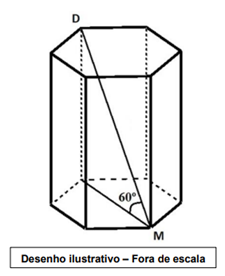
Determine, em cm3, o volume do prisma.
que une os
vértices D e M formando um ângulo de 60° com o plano da base, como indicado na figura
abaixo. Determine, em cm3, o volume do prisma.
Ano: 2025
Banca:
Exército
Órgão:
EsPCEx
Prova:
Exército - 2025 - EsPCEx - Cadete do Exército - 2º Dia |
Q3909789
Matemática
Considere ABC um triângulo retângulo em B e uma circunferência λ a ele inscrita,
sendo D ∈  e F ∈
e F ∈  os pontos de tangência entre os lados do triângulo e a
circunferência. Sabendo-se que os catetos
os pontos de tangência entre os lados do triângulo e a
circunferência. Sabendo-se que os catetos  medem, respectivamente, 16 cm e 12 cm,
calcule, em cm2, a área do quadrilátero DBEF.
medem, respectivamente, 16 cm e 12 cm,
calcule, em cm2, a área do quadrilátero DBEF.
e F ∈ os pontos de tangência entre os lados do triângulo e a
circunferência. Sabendo-se que os catetos medem, respectivamente, 16 cm e 12 cm,
calcule, em cm2, a área do quadrilátero DBEF.
Ano: 2025
Banca:
Exército
Órgão:
EsPCEx
Prova:
Exército - 2025 - EsPCEx - Cadete do Exército - 2º Dia |
Q3909775
Matemática
Em um triângulo ABC, traçam-se as bissetrizes interna  e externa
  em relação ao
vértice A, conforme figura abaixo.
em relação ao
vértice A, conforme figura abaixo.
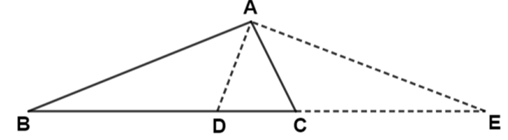
Sabe-se que o perímetro do triângulo ABC mede 30 cm, o lado mede 10 cm e o
segmento
mede 10 cm e o
segmento  mede 24 cm. O valor, em cm, do módulo da diferença entre as medidas dos lados
  é igual a:
e externa em relação ao
vértice A, conforme figura abaixo. Sabe-se que o perímetro do triângulo ABC mede 30 cm, o lado
mede 10 cm e o
segmento mede 24 cm. O valor, em cm, do módulo da diferença entre as medidas dos lados é igual a:
Ano: 2025
Banca:
Exército
Órgão:
IME
Prova:
Exército - 2025 - IME - Oficial Engenheiro - Português/Inglês |
Q3692549
Inglês
Texto associado
Text 1
ChatGPT May Be Eroding Critical Thinking Skills, According to a New MIT Study
By Andrew R. Chow
The study divided 54 subjects — 18 to 39 year-olds from the Boston area — into three groups, and asked them to
write several SAT essays using OpenAl's ChatGPT, Google’s search engine, and nothing at all, respectively. Researchers used an (electroencephalogram) EEG to record the writers’ brain activity across 32 regions, and found that of the
three groups, ChatGPT users had the lowest brain engagement and “consistently underperformed at neural, linguistic,
and behavioral levels.” Over the course of several months, ChatGPT users got lazier with each subsequent essay, often
resorting to copy-and-paste by the end of the study.
The paper suggests that the usage of (Large Language Model) LLMs could actually harm learning, especially for
younger users. The paper has not yet been peer reviewed, and its sample size is relatively small. But its paper’s main
author Nataliya Kosmyna felt it was important to release the findings to elevate concerns that as society increasingly
relies upon LLMs for immediate convenience, long-term brain development may be sacrificed in the process.
The group that wrote essays using ChatGPT all delivered extremely similar essays that lacked original thought,
relying on the same expressions and ideas. Two English teachers who assessed the essays called them largely
“soulless” The EEGs revealed low executive control and attentional engagement. And by their third essay, many of
the writers simply gave the prompt to ChatGPT and had it do almost all of the work. “It was more like, ‘just give me the
essay, refine this sentence, edit it, and 'm done,” Kosmyna says.
The brain-only group, conversely, showed the highest neural connectivity, especially in alpha, theta and delta bands,
which are associated with creativity ideation, memory load, and semantic processing. Researchers found this group
was more engaged and curious, and claimed ownership and expressed higher satisfaction with their essays.
The third group, which used Google Search, also expressed high satisfaction and active brain function. The
difference here is notable because many people now search for information within Al chatbots as opposed to Google
Search.
After writing the three essays, the subjects were then asked to re-write one of their previous efforts—but the
ChatGPT group had to do so without the tool, while the brain-only group could now use ChatGPT. The first group
remembered little of their own essays, and showed weaker alpha and theta brain waves, which likely reflected a
bypassing of deep memory processes.
The second group, in contrast, performed well, exhibiting a significant increase in brain connectivity across all EEG
frequency bands. This gives rise to the hope that Al, if used properly, could enhance learning as opposed to diminishing it.
Adapted from: TIME in [Accessed on 15th July 2025].
Why did the researchers mention the small sample size?
Ano: 2025
Banca:
Exército
Órgão:
IME
Prova:
Exército - 2025 - IME - Oficial Engenheiro - Português/Inglês |
Q3692548
Inglês
Texto associado
Text 1
ChatGPT May Be Eroding Critical Thinking Skills, According to a New MIT Study
By Andrew R. Chow
The study divided 54 subjects — 18 to 39 year-olds from the Boston area — into three groups, and asked them to
write several SAT essays using OpenAl's ChatGPT, Google’s search engine, and nothing at all, respectively. Researchers used an (electroencephalogram) EEG to record the writers’ brain activity across 32 regions, and found that of the
three groups, ChatGPT users had the lowest brain engagement and “consistently underperformed at neural, linguistic,
and behavioral levels.” Over the course of several months, ChatGPT users got lazier with each subsequent essay, often
resorting to copy-and-paste by the end of the study.
The paper suggests that the usage of (Large Language Model) LLMs could actually harm learning, especially for
younger users. The paper has not yet been peer reviewed, and its sample size is relatively small. But its paper’s main
author Nataliya Kosmyna felt it was important to release the findings to elevate concerns that as society increasingly
relies upon LLMs for immediate convenience, long-term brain development may be sacrificed in the process.
The group that wrote essays using ChatGPT all delivered extremely similar essays that lacked original thought,
relying on the same expressions and ideas. Two English teachers who assessed the essays called them largely
“soulless” The EEGs revealed low executive control and attentional engagement. And by their third essay, many of
the writers simply gave the prompt to ChatGPT and had it do almost all of the work. “It was more like, ‘just give me the
essay, refine this sentence, edit it, and 'm done,” Kosmyna says.
The brain-only group, conversely, showed the highest neural connectivity, especially in alpha, theta and delta bands,
which are associated with creativity ideation, memory load, and semantic processing. Researchers found this group
was more engaged and curious, and claimed ownership and expressed higher satisfaction with their essays.
The third group, which used Google Search, also expressed high satisfaction and active brain function. The
difference here is notable because many people now search for information within Al chatbots as opposed to Google
Search.
After writing the three essays, the subjects were then asked to re-write one of their previous efforts—but the
ChatGPT group had to do so without the tool, while the brain-only group could now use ChatGPT. The first group
remembered little of their own essays, and showed weaker alpha and theta brain waves, which likely reflected a
bypassing of deep memory processes.
The second group, in contrast, performed well, exhibiting a significant increase in brain connectivity across all EEG
frequency bands. This gives rise to the hope that Al, if used properly, could enhance learning as opposed to diminishing it.
Adapted from: TIME in [Accessed on 15th July 2025].
Researchers highlighted the following main difference between using Google Search and Al chatbots for information
gathering:
Ano: 2025
Banca:
Exército
Órgão:
IME
Prova:
Exército - 2025 - IME - Oficial Engenheiro - Português/Inglês |
Q3692547
Inglês
Texto associado
Text 1
ChatGPT May Be Eroding Critical Thinking Skills, According to a New MIT Study
By Andrew R. Chow
The study divided 54 subjects — 18 to 39 year-olds from the Boston area — into three groups, and asked them to
write several SAT essays using OpenAl's ChatGPT, Google’s search engine, and nothing at all, respectively. Researchers used an (electroencephalogram) EEG to record the writers’ brain activity across 32 regions, and found that of the
three groups, ChatGPT users had the lowest brain engagement and “consistently underperformed at neural, linguistic,
and behavioral levels.” Over the course of several months, ChatGPT users got lazier with each subsequent essay, often
resorting to copy-and-paste by the end of the study.
The paper suggests that the usage of (Large Language Model) LLMs could actually harm learning, especially for
younger users. The paper has not yet been peer reviewed, and its sample size is relatively small. But its paper’s main
author Nataliya Kosmyna felt it was important to release the findings to elevate concerns that as society increasingly
relies upon LLMs for immediate convenience, long-term brain development may be sacrificed in the process.
The group that wrote essays using ChatGPT all delivered extremely similar essays that lacked original thought,
relying on the same expressions and ideas. Two English teachers who assessed the essays called them largely
“soulless” The EEGs revealed low executive control and attentional engagement. And by their third essay, many of
the writers simply gave the prompt to ChatGPT and had it do almost all of the work. “It was more like, ‘just give me the
essay, refine this sentence, edit it, and 'm done,” Kosmyna says.
The brain-only group, conversely, showed the highest neural connectivity, especially in alpha, theta and delta bands,
which are associated with creativity ideation, memory load, and semantic processing. Researchers found this group
was more engaged and curious, and claimed ownership and expressed higher satisfaction with their essays.
The third group, which used Google Search, also expressed high satisfaction and active brain function. The
difference here is notable because many people now search for information within Al chatbots as opposed to Google
Search.
After writing the three essays, the subjects were then asked to re-write one of their previous efforts—but the
ChatGPT group had to do so without the tool, while the brain-only group could now use ChatGPT. The first group
remembered little of their own essays, and showed weaker alpha and theta brain waves, which likely reflected a
bypassing of deep memory processes.
The second group, in contrast, performed well, exhibiting a significant increase in brain connectivity across all EEG
frequency bands. This gives rise to the hope that Al, if used properly, could enhance learning as opposed to diminishing it.
Adapted from: TIME in [Accessed on 15th July 2025].
Based on the brain-only group’s later use of ChatGPT, researchers expressed the following hope:
Ano: 2025
Banca:
Exército
Órgão:
IME
Prova:
Exército - 2025 - IME - Oficial Engenheiro - Português/Inglês |
Q3692546
Inglês
Texto associado
Text 1
ChatGPT May Be Eroding Critical Thinking Skills, According to a New MIT Study
By Andrew R. Chow
The study divided 54 subjects — 18 to 39 year-olds from the Boston area — into three groups, and asked them to
write several SAT essays using OpenAl's ChatGPT, Google’s search engine, and nothing at all, respectively. Researchers used an (electroencephalogram) EEG to record the writers’ brain activity across 32 regions, and found that of the
three groups, ChatGPT users had the lowest brain engagement and “consistently underperformed at neural, linguistic,
and behavioral levels.” Over the course of several months, ChatGPT users got lazier with each subsequent essay, often
resorting to copy-and-paste by the end of the study.
The paper suggests that the usage of (Large Language Model) LLMs could actually harm learning, especially for
younger users. The paper has not yet been peer reviewed, and its sample size is relatively small. But its paper’s main
author Nataliya Kosmyna felt it was important to release the findings to elevate concerns that as society increasingly
relies upon LLMs for immediate convenience, long-term brain development may be sacrificed in the process.
The group that wrote essays using ChatGPT all delivered extremely similar essays that lacked original thought,
relying on the same expressions and ideas. Two English teachers who assessed the essays called them largely
“soulless” The EEGs revealed low executive control and attentional engagement. And by their third essay, many of
the writers simply gave the prompt to ChatGPT and had it do almost all of the work. “It was more like, ‘just give me the
essay, refine this sentence, edit it, and 'm done,” Kosmyna says.
The brain-only group, conversely, showed the highest neural connectivity, especially in alpha, theta and delta bands,
which are associated with creativity ideation, memory load, and semantic processing. Researchers found this group
was more engaged and curious, and claimed ownership and expressed higher satisfaction with their essays.
The third group, which used Google Search, also expressed high satisfaction and active brain function. The
difference here is notable because many people now search for information within Al chatbots as opposed to Google
Search.
After writing the three essays, the subjects were then asked to re-write one of their previous efforts—but the
ChatGPT group had to do so without the tool, while the brain-only group could now use ChatGPT. The first group
remembered little of their own essays, and showed weaker alpha and theta brain waves, which likely reflected a
bypassing of deep memory processes.
The second group, in contrast, performed well, exhibiting a significant increase in brain connectivity across all EEG
frequency bands. This gives rise to the hope that Al, if used properly, could enhance learning as opposed to diminishing it.
Adapted from: TIME in [Accessed on 15th July 2025].
What did the EEG data suggest about ChatGPT users' executive control during essay writing?

 Conheça nossos planos