Questões de Concurso Militar CBM-MA 2026 para Praça Combatente Bombeiro Militar (QPBM-0)
Foram encontradas 95 questões


Ano: 2026
Banca:
CESPE / CEBRASPE
Órgão:
CBM-MA
Provas:
CESPE / CEBRASPE - 2026 - CBM-MA - Praça Combatente Bombeiro Militar (QPBM-0)
|
CESPE / CEBRASPE - 2026 - CBM-MA - Praça Especialista Músico Bombeiro Militar - Cargos 2 a 12 |
Q4404304
Geografia
A respeito da agricultura maranhense, assinale a opção correta.
Ano: 2026
Banca:
CESPE / CEBRASPE
Órgão:
CBM-MA
Provas:
CESPE / CEBRASPE - 2026 - CBM-MA - Praça Combatente Bombeiro Militar (QPBM-0)
|
CESPE / CEBRASPE - 2026 - CBM-MA - Praça Especialista Músico Bombeiro Militar - Cargos 2 a 12 |
Q4404305
Geografia
Em relação ao Complexo Portuário de São Luís, localizado na
capital do estado do Maranhão, assinale a opção correta.
Ano: 2026
Banca:
CESPE / CEBRASPE
Órgão:
CBM-MA
Provas:
CESPE / CEBRASPE - 2026 - CBM-MA - Praça Combatente Bombeiro Militar (QPBM-0)
|
CESPE / CEBRASPE - 2026 - CBM-MA - Praça Especialista Músico Bombeiro Militar - Cargos 2 a 12 |
Q4404306
Inglês
Texto associado
Text CG1A4
When wildfire evacuation orders are lifted, returning
residents often mistake “cleared to return” for “safe.” However,
recovering from a wildfire requires careful navigation of hidden
post-fire hazards. As seen following destructive blazes like the
August 2026 fires in Spokane, Washington, three main areas
require cautious attention before reoccupying or rebuilding.
First, surviving buildings may hold toxins. Homes spared
by flames can still harbor severe indoor contamination. Smoke,
ash, and toxic chemicals enter through vents, windows, and
HVAC systems, settling into carpets, walls, and ductwork. These
contaminants can include dangerous heavy metals like lead and
arsenic, asbestos, and volatile organic compounds (VOCs).
Because these hazards cannot be identified by sight or smell,
property owners should hire qualified professionals to inspect
and test air and surfaces. If contamination is found, professional
remediation and independent confirmation testing are essential
before moving back in.
Furthermore, drinking water may be chemically
contaminated. A functioning tap offers a false sense of security.
Fire-induced pressure drops can draw smoke and toxic debris into
water networks, while extreme heat can melt plastic plumbing,
leaching cancer-causing chemicals like benzene into the supply.
Boiling water will not remove these chemicals and can actually
increase exposure by releasing toxic vapors into indoor air. While
utilities handle public infrastructure, property owners are
responsible for testing their own plumbing, irrigation systems,
and private wells. Stagnant water samples (typically resting in
pipes for 72 hours) should be tested for VOCs, metals, and
bacteria. Until safety is verified, residents should rely on bottled
water for drinking, cooking, and bathing.
Also, debris removal is only the first step. Clearing ash,
damaged vehicles, and surface soil does not mean a property is
automatically ready for rebuilding. Past wildfire studies show
that up to 34% of cleared properties still contained dangerous soil
contamination, such as heavy metals. Soil testing should be
conducted by independent, board-licensed engineers or geologists
before construction begins, and local environmental or health
agencies should review the findings.
Ultimately, safety cannot be judged by appearance or odor
alone. Engaging licensed professionals to evaluate air, water, and
soil is the safest path to a full recovery.
Internet: <https://theconversation.com> (adapted).
According to the first paragraph of text CG1A4, the expression
‘cleared to return’ indicates that
Ano: 2026
Banca:
CESPE / CEBRASPE
Órgão:
CBM-MA
Provas:
CESPE / CEBRASPE - 2026 - CBM-MA - Praça Combatente Bombeiro Militar (QPBM-0)
|
CESPE / CEBRASPE - 2026 - CBM-MA - Praça Especialista Músico Bombeiro Militar - Cargos 2 a 12 |
Q4404307
Inglês
Texto associado
Text CG1A4
When wildfire evacuation orders are lifted, returning
residents often mistake “cleared to return” for “safe.” However,
recovering from a wildfire requires careful navigation of hidden
post-fire hazards. As seen following destructive blazes like the
August 2026 fires in Spokane, Washington, three main areas
require cautious attention before reoccupying or rebuilding.
First, surviving buildings may hold toxins. Homes spared
by flames can still harbor severe indoor contamination. Smoke,
ash, and toxic chemicals enter through vents, windows, and
HVAC systems, settling into carpets, walls, and ductwork. These
contaminants can include dangerous heavy metals like lead and
arsenic, asbestos, and volatile organic compounds (VOCs).
Because these hazards cannot be identified by sight or smell,
property owners should hire qualified professionals to inspect
and test air and surfaces. If contamination is found, professional
remediation and independent confirmation testing are essential
before moving back in.
Furthermore, drinking water may be chemically
contaminated. A functioning tap offers a false sense of security.
Fire-induced pressure drops can draw smoke and toxic debris into
water networks, while extreme heat can melt plastic plumbing,
leaching cancer-causing chemicals like benzene into the supply.
Boiling water will not remove these chemicals and can actually
increase exposure by releasing toxic vapors into indoor air. While
utilities handle public infrastructure, property owners are
responsible for testing their own plumbing, irrigation systems,
and private wells. Stagnant water samples (typically resting in
pipes for 72 hours) should be tested for VOCs, metals, and
bacteria. Until safety is verified, residents should rely on bottled
water for drinking, cooking, and bathing.
Also, debris removal is only the first step. Clearing ash,
damaged vehicles, and surface soil does not mean a property is
automatically ready for rebuilding. Past wildfire studies show
that up to 34% of cleared properties still contained dangerous soil
contamination, such as heavy metals. Soil testing should be
conducted by independent, board-licensed engineers or geologists
before construction begins, and local environmental or health
agencies should review the findings.
Ultimately, safety cannot be judged by appearance or odor
alone. Engaging licensed professionals to evaluate air, water, and
soil is the safest path to a full recovery.
Internet: <https://theconversation.com> (adapted).
According to the information presented in the third paragraph of
text CG1A4, a functioning water tap
Ano: 2026
Banca:
CESPE / CEBRASPE
Órgão:
CBM-MA
Provas:
CESPE / CEBRASPE - 2026 - CBM-MA - Praça Combatente Bombeiro Militar (QPBM-0)
|
CESPE / CEBRASPE - 2026 - CBM-MA - Praça Especialista Músico Bombeiro Militar - Cargos 2 a 12 |
Q4404308
Inglês
Texto associado
Text CG1A4
When wildfire evacuation orders are lifted, returning
residents often mistake “cleared to return” for “safe.” However,
recovering from a wildfire requires careful navigation of hidden
post-fire hazards. As seen following destructive blazes like the
August 2026 fires in Spokane, Washington, three main areas
require cautious attention before reoccupying or rebuilding.
First, surviving buildings may hold toxins. Homes spared
by flames can still harbor severe indoor contamination. Smoke,
ash, and toxic chemicals enter through vents, windows, and
HVAC systems, settling into carpets, walls, and ductwork. These
contaminants can include dangerous heavy metals like lead and
arsenic, asbestos, and volatile organic compounds (VOCs).
Because these hazards cannot be identified by sight or smell,
property owners should hire qualified professionals to inspect
and test air and surfaces. If contamination is found, professional
remediation and independent confirmation testing are essential
before moving back in.
Furthermore, drinking water may be chemically
contaminated. A functioning tap offers a false sense of security.
Fire-induced pressure drops can draw smoke and toxic debris into
water networks, while extreme heat can melt plastic plumbing,
leaching cancer-causing chemicals like benzene into the supply.
Boiling water will not remove these chemicals and can actually
increase exposure by releasing toxic vapors into indoor air. While
utilities handle public infrastructure, property owners are
responsible for testing their own plumbing, irrigation systems,
and private wells. Stagnant water samples (typically resting in
pipes for 72 hours) should be tested for VOCs, metals, and
bacteria. Until safety is verified, residents should rely on bottled
water for drinking, cooking, and bathing.
Also, debris removal is only the first step. Clearing ash,
damaged vehicles, and surface soil does not mean a property is
automatically ready for rebuilding. Past wildfire studies show
that up to 34% of cleared properties still contained dangerous soil
contamination, such as heavy metals. Soil testing should be
conducted by independent, board-licensed engineers or geologists
before construction begins, and local environmental or health
agencies should review the findings.
Ultimately, safety cannot be judged by appearance or odor
alone. Engaging licensed professionals to evaluate air, water, and
soil is the safest path to a full recovery.
Internet: <https://theconversation.com> (adapted).
It can be concluded from the fourth and fifth paragraphs of text
CG1A4 that post-wildfire recovery
Ano: 2026
Banca:
CESPE / CEBRASPE
Órgão:
CBM-MA
Provas:
CESPE / CEBRASPE - 2026 - CBM-MA - Praça Combatente Bombeiro Militar (QPBM-0)
|
CESPE / CEBRASPE - 2026 - CBM-MA - Praça Especialista Músico Bombeiro Militar - Cargos 2 a 12 |
Q4404309
Inglês
Texto associado
Text CG1A4
When wildfire evacuation orders are lifted, returning
residents often mistake “cleared to return” for “safe.” However,
recovering from a wildfire requires careful navigation of hidden
post-fire hazards. As seen following destructive blazes like the
August 2026 fires in Spokane, Washington, three main areas
require cautious attention before reoccupying or rebuilding.
First, surviving buildings may hold toxins. Homes spared
by flames can still harbor severe indoor contamination. Smoke,
ash, and toxic chemicals enter through vents, windows, and
HVAC systems, settling into carpets, walls, and ductwork. These
contaminants can include dangerous heavy metals like lead and
arsenic, asbestos, and volatile organic compounds (VOCs).
Because these hazards cannot be identified by sight or smell,
property owners should hire qualified professionals to inspect
and test air and surfaces. If contamination is found, professional
remediation and independent confirmation testing are essential
before moving back in.
Furthermore, drinking water may be chemically
contaminated. A functioning tap offers a false sense of security.
Fire-induced pressure drops can draw smoke and toxic debris into
water networks, while extreme heat can melt plastic plumbing,
leaching cancer-causing chemicals like benzene into the supply.
Boiling water will not remove these chemicals and can actually
increase exposure by releasing toxic vapors into indoor air. While
utilities handle public infrastructure, property owners are
responsible for testing their own plumbing, irrigation systems,
and private wells. Stagnant water samples (typically resting in
pipes for 72 hours) should be tested for VOCs, metals, and
bacteria. Until safety is verified, residents should rely on bottled
water for drinking, cooking, and bathing.
Also, debris removal is only the first step. Clearing ash,
damaged vehicles, and surface soil does not mean a property is
automatically ready for rebuilding. Past wildfire studies show
that up to 34% of cleared properties still contained dangerous soil
contamination, such as heavy metals. Soil testing should be
conducted by independent, board-licensed engineers or geologists
before construction begins, and local environmental or health
agencies should review the findings.
Ultimately, safety cannot be judged by appearance or odor
alone. Engaging licensed professionals to evaluate air, water, and
soil is the safest path to a full recovery.
Internet: <https://theconversation.com> (adapted).
Based on the third paragraph of text CG1A4, it is correct to
affirm that the melting of plastic plumbing
Ano: 2026
Banca:
CESPE / CEBRASPE
Órgão:
CBM-MA
Provas:
CESPE / CEBRASPE - 2026 - CBM-MA - Praça Combatente Bombeiro Militar (QPBM-0)
|
CESPE / CEBRASPE - 2026 - CBM-MA - Praça Especialista Músico Bombeiro Militar - Cargos 2 a 12 |
Q4404310
Raciocínio Lógico
Com base na lógica de argumentação, assinale a opção correta a
respeito do seguinte argumento: “Os bombeiros militares do
Maranhão são especialistas nas tradições culinárias dos países
banhados pelo mar Mediterrâneo, visto que todos os bombeiros
militares são experientes pilotos de helicóptero, todos os
experientes pilotos de helicópteros são escritores de romances de
época, todos os escritores de romance de época são estudiosos da
história das Américas do século XVIII, e todos os estudiosos da
história das Américas do século XVIII são especialistas nas
tradições culinárias dos países banhados pelo mar
Mediterrâneo.”.
Ano: 2026
Banca:
CESPE / CEBRASPE
Órgão:
CBM-MA
Provas:
CESPE / CEBRASPE - 2026 - CBM-MA - Praça Combatente Bombeiro Militar (QPBM-0)
|
CESPE / CEBRASPE - 2026 - CBM-MA - Praça Especialista Músico Bombeiro Militar - Cargos 2 a 12 |
Q4404311
Raciocínio Lógico
Considerando os símbolos lógicos usuais e o pressuposto de que,
em lógica sentencial, as letras maiúsculas representam
proposições lógicas, assinale a opção em que a proposição lógica
apresentada expressa corretamente a seguinte sentença:
“O bombeiro militar promete regular sua conduta pelos preceitos
da moral, e ele também promete dedicar-se inteiramente à
segurança da comunidade, mesmo arriscando a própria vida.”.
Ano: 2026
Banca:
CESPE / CEBRASPE
Órgão:
CBM-MA
Provas:
CESPE / CEBRASPE - 2026 - CBM-MA - Praça Combatente Bombeiro Militar (QPBM-0)
|
CESPE / CEBRASPE - 2026 - CBM-MA - Praça Especialista Músico Bombeiro Militar - Cargos 2 a 12 |
Q4404312
Raciocínio Lógico
Carlos, Victor e Alex encontraram-se na praia de São
Marcos, em São Luís do Maranhão. Um deles é policial militar,
outro é bombeiro militar, e o outro, policial civil. Eles nasceram
em cidades maranhenses diferentes — quais sejam, Caxias,
Imperatriz e São Luís. Carlos não é policial civil e nasceu em São
Luís; o bombeiro militar nasceu em Imperatriz; e o policial civil
não é Victor.
A partir da situação hipotética descrita, assinale a opção correta.
A partir da situação hipotética descrita, assinale a opção correta.
Ano: 2026
Banca:
CESPE / CEBRASPE
Órgão:
CBM-MA
Provas:
CESPE / CEBRASPE - 2026 - CBM-MA - Praça Combatente Bombeiro Militar (QPBM-0)
|
CESPE / CEBRASPE - 2026 - CBM-MA - Praça Especialista Músico Bombeiro Militar - Cargos 2 a 12 |
Q4404313
Raciocínio Lógico
A seguir, são apresentadas as primeiras três colunas de uma
tabela-verdade, sendo P, Q e R proposições lógicas.
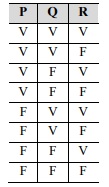
Considerando que a última coluna dessa tabela-verdade seja referente à expressão P → (Q ˄ R), assinale a opção que corresponde à sequência dos valores V ou F dessa última coluna, tomados de cima para baixo.
Considerando que a última coluna dessa tabela-verdade seja referente à expressão P → (Q ˄ R), assinale a opção que corresponde à sequência dos valores V ou F dessa última coluna, tomados de cima para baixo.
Ano: 2026
Banca:
CESPE / CEBRASPE
Órgão:
CBM-MA
Prova:
CESPE / CEBRASPE - 2026 - CBM-MA - Praça Combatente Bombeiro Militar (QPBM-0) |
Q4404314
Legislação Estadual
Um cabo da ativa do Corpo de Bombeiros Militar do
Estado do Maranhão (CBM/MA) foi colocado à disposição da
Defensoria Pública do Estado do Maranhão (DPE/MA), por ato
do chefe do Poder Executivo estadual, observado o número de
vagas do respectivo quadro de organização.
Nessa situação hipotética, segundo a Lei estadual n.º 6.513/1995, o cabo, enquanto estiver em serviço na DPE/MA, será considerado
Nessa situação hipotética, segundo a Lei estadual n.º 6.513/1995, o cabo, enquanto estiver em serviço na DPE/MA, será considerado
Ano: 2026
Banca:
CESPE / CEBRASPE
Órgão:
CBM-MA
Prova:
CESPE / CEBRASPE - 2026 - CBM-MA - Praça Combatente Bombeiro Militar (QPBM-0) |
Q4404315
Legislação Estadual
De acordo com a Lei estadual n.º 6.513/1995, praça do CBM/MA
que, sem estabilidade assegurada, tenha seu comportamento
classificado como mau será
Ano: 2026
Banca:
CESPE / CEBRASPE
Órgão:
CBM-MA
Prova:
CESPE / CEBRASPE - 2026 - CBM-MA - Praça Combatente Bombeiro Militar (QPBM-0) |
Q4404316
Legislação Estadual
Um soldado do CBM/MA praticou conduta que, ao
mesmo tempo, configura transgressão disciplinar e crime militar,
tendo sido instaurados procedimentos para apuração da conduta
nas esferas administrativa e penal-militar.
Acerca dessa situação hipotética, assinale a opção correta conforme a Lei estadual n.º 6.513/1995.
Acerca dessa situação hipotética, assinale a opção correta conforme a Lei estadual n.º 6.513/1995.
Ano: 2026
Banca:
CESPE / CEBRASPE
Órgão:
CBM-MA
Prova:
CESPE / CEBRASPE - 2026 - CBM-MA - Praça Combatente Bombeiro Militar (QPBM-0) |
Q4404317
Legislação Estadual
Com base na Lei estadual n.º 6.513/1995, assinale a opção que
corresponde ao rol completo das licenças cujo gozo poderá ser
interrompido para cumprimento de punição disciplinar.
Ano: 2026
Banca:
CESPE / CEBRASPE
Órgão:
CBM-MA
Prova:
CESPE / CEBRASPE - 2026 - CBM-MA - Praça Combatente Bombeiro Militar (QPBM-0) |
Q4404318
Legislação Estadual
A Lei estadual n.º 10.230/2015 prevê que sejam desenvolvidas,
executadas e apoiadas pelo CBM/MA ações de terapia assistida
com cães, com as finalidades
Ano: 2026
Banca:
CESPE / CEBRASPE
Órgão:
CBM-MA
Prova:
CESPE / CEBRASPE - 2026 - CBM-MA - Praça Combatente Bombeiro Militar (QPBM-0) |
Q4404319
Legislação Estadual
Suponha que um soldado do CBM/MA tenha sido designado para
servir na menor unidade operacional existente, no interior do
estado, instalada em localidade cujo risco não justifique a
instalação de estrutura maior. Essa unidade operacional, nos
termos da Lei estadual n.º 10.230/2015, denomina-se
Ano: 2026
Banca:
CESPE / CEBRASPE
Órgão:
CBM-MA
Prova:
CESPE / CEBRASPE - 2026 - CBM-MA - Praça Combatente Bombeiro Militar (QPBM-0) |
Q4404320
Legislação Estadual
Suponha que um soldado do quadro de praças combatentes do
CBM/MA, por tocar instrumento musical, tenha manifestado
interesse em ser transferido para o quadro de praças especialistas
músicos. Nos termos da Lei estadual n.º 10.230/2015, essa
transferência é
Ano: 2026
Banca:
CESPE / CEBRASPE
Órgão:
CBM-MA
Prova:
CESPE / CEBRASPE - 2026 - CBM-MA - Praça Combatente Bombeiro Militar (QPBM-0) |
Q4404321
Legislação Estadual
Um soldado do CBM/MA, depois de concluído seu curso
de formação, foi lotado em uma unidade do interior do estado e
acabou de completar dois anos de serviço nessa sua área de
provimento originário.
Nos termos da Lei estadual n.º 10.230/2015, eventual movimentação desse soldado pode ocorrer
Nos termos da Lei estadual n.º 10.230/2015, eventual movimentação desse soldado pode ocorrer
Ano: 2026
Banca:
CESPE / CEBRASPE
Órgão:
CBM-MA
Prova:
CESPE / CEBRASPE - 2026 - CBM-MA - Praça Combatente Bombeiro Militar (QPBM-0) |
Q4404323
Legislação Federal
Assinale a opção que indica princípios básicos expressos na
Lei n.º 14.751/2023 a serem observados pelas polícias militares e
pelos corpos de bombeiros militares dos estados, do Distrito
Federal e dos territórios no âmbito de suas atribuições
constitucionais e legais.
Ano: 2026
Banca:
CESPE / CEBRASPE
Órgão:
CBM-MA
Prova:
CESPE / CEBRASPE - 2026 - CBM-MA - Praça Combatente Bombeiro Militar (QPBM-0) |
Q4404324
Medicina
Julgue os seguintes itens, acerca da parada cardiorrespiratória em
bebês e crianças.
I É necessário minimizar as interrupções na ressuscitação cardiopulmonar em bebês e crianças em parada cardiorrespiratória, devendo as pausas nas compressões torácicas ser inferiores a 10 segundos.
II Dada a natureza primária da maioria das paradas cardiorrespiratórias pediátricas, o reconhecimento precoce do estado crítico do bebê ou da criança pelo cuidador é a principal medida para obter o melhor desfecho.
III Após parada cardiorrespiratória em bebês e crianças, é recomendável manter a pressão arterial sistólica e média acima do 4.º percentil para a idade.
Assinale a opção correta.

 Conheça nossos planos