Foram encontradas 75.429 questões
Resolva questões gratuitamente!
Junte-se a mais de 4 milhões de concurseiros!


No Reino Unido e em outras partes da Europa, o casamento entre primos está sendo cada vez mais questionado, particularmente entre os médicos. Eles alertam que os filhos de primos em primeiro grau são mais propensos a sofrer uma série de problemas de saúde. Os riscos mais óbvios para a saúde de filhos de pais com parentesco entre si são os transtornos recessivos, como anemia falciforme, presente na família de Ayesha. Ayesha é a mais velha das três irmãs. Ela tem 29 anos e se casou com seu primo em primeiro grau, em 2017. O casal, que não apresenta anemia falciforme, tem um filho com anemia falciforme e vive um casamento feliz, segundo ela.
Disponível em: https://www.bbc.com/portuguese/articles/ c1lpp0g5pr5o. Acesso em: 5 mar. 2025 (adaptado).
Caso o filho de Ayesha se case com uma prima de primeiro grau que apresenta o mesmo genótipo de Ayesha, qual a probabilidade de Ayesha ter um neto com a doença em questão?
Os viajantes estão sendo alertados sobre os perigos do envenenamento por metanol após a morte de seis turistas no Laos, país do Sudeste Asiático. O metanol é um produto químico industrial encontrado em fluidos anticongelantes e de limpadores de para‑brisa. A metabolização do metanol no organismo gera subprodutos tóxicos chamados formaldeído, formiato e ácido fórmico. Eles se acumulam, atacando nervos e órgãos, o que pode levar à cegueira, ao coma e à morte. Um dos tratamentos é o procedimento para limpar o sangue.
Disponível em: https://www.bbc.com/portuguese/articles/ c4gpj42xerro. Acesso em: 26 fev. 2025 (adaptado).
O tratamento para a contaminação com metanol que a notícia faz referência é chamado de
Os movimentos guerrilheiros perderam capacidade de ação e iniciativa. O tempo passou a contar favoravelmente à ditadura, que conquistava suas bases sociais, se não para um apoio ativo, pelo menos para se manterem neutras, uma espécie de apoio passivo, de fechar os olhos para a repressão, desde que tivessem acesso aos privilégios que lhes eram prometidos.
SADER, Emir. O Anjo Torto. Esquerda (e Direita) no Brasil. São Paulo: Editora Brasiliense, 1995. p. 127-128.
Baseado no texto e na temática envolvida, o sucesso da repressão sobre os movimentos guerrilheiros de esquerda no início da década de 1970 no Brasil contou com
Disponível em: https://economia.uol.com.br/noticias/ redacao/2025/03/13/era-sonho-virou-ofensa-por-que-os-jovenstem-medo-de-ser-clt.htm. Acesso em: 13 mar. 2025.
De acordo com o texto, entre os objetivos da Consolidação das Leis do Trabalho (CLT) estava o de
DAVILA, Jerry et al. A History of World Societes. Boston: Bedford/St. Martin’s, 2015. p. 936-937 (tradução livre).
O trecho faz referência à Política de Apaziguamento adotada, sobretudo pela Inglaterra, entre 1936 e 1939 em relação à Alemanha.
Essa política é indicada no texto como
Disponível em: https://www.bbc.com/portuguese/internacional-51165319. Acesso em: 25 fev. 2025.
Considerando essa teoria e o cenário atual, a relação entre o Heartland e o conflito entre Rússia e Ucrânia está expresso em:
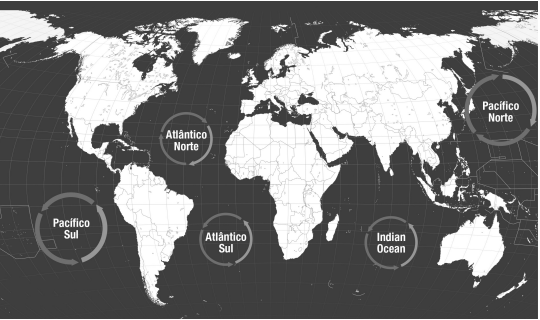
Disponível em: https://www.iberdrola.com/documents/20125/40897/Infografico_cinco_ilhas_plastico.pdf/ fcbcfcb4-bf97-b753-10bb-0350b79b49a3?t=1627897486211. Acesso em: 12 mar. 2025.
O mapa apresenta as cinco grandes ilhas de lixo plástico dispersas pelos oceanos do planeta, responsáveis por graves danos ao meio ambiente e à economia, sobretudo das pequenas comunidades que dependem da pesca para sobreviver.
Sobre a formação das ilhas de plástico, pode-se afirmar que

Disponível em: https://www.em.com.br/app/noticia/internacional/2023/02/06/interna_internacional,1453875/ por-que-terremotos-na-turquia-sao-tao-devastadores.shtml. Acesso em: 25 fev. 2025.
A imagem representa um violento sismo ocorrido em fevereiro de 2023, na região situada na fronteira entre a Turquia e a Síria, que deixou um rastro de destruição. Esse evento resulta do fato de essa área estar situada em uma zona geologicamente instável.
Considerando os processos geológicos envolvidos, pode‑se afirmar que o sismo está associado ao(à)
O dia do nascimento de Cauã foi no mesmo dia em que Adriano completava quantos anos?
Para que Paulo tenha alguma chance de ser aprovado ao fim da quinta avaliação, a quantidade de pontos que ele deverá atingir na quarta avaliação deve ser, no mínimo,
Qual foi a economia desse comprador, em relação ao valor original total que pagaria antes da promoção?
Hebbian Plasticity and Mental Health
Hebbian plasticity is not just about learning new skills like riding a bike — it also helps your brain stay healthy. In some conditions, such as depression or post‑traumatic stress disorder (PTSD), the problematic symptoms can be caused by the poor function of certain brain connections. Imagine if the pathways between important parts of your brain were weak or broken. When brain pathways are weak, it can be harder to think clearly, concentrate, or feel happy. When a person experiences stress or trauma, Hebbian plasticity can also accidentally strengthen harmful connections. This happens because the brain is trying to protect itself, but sometimes it ends up strengthening neural pathways that make a person more vulnerable to negative emotions or stress responses. Fortunately, learning how to strengthen “positive” neural pathways, such as those involved in healthy coping strategies, physical activity, or resilience, can help restore balance, improving people’s moods and overall mental wellbeing.
Available at: https://kids.frontiersin.org/articles/10.3389/ frym.2025.1425512. Accessed on: March 1st, 2025.
The adjective coping in the sentence “Fortunately, learning how to strengthen ‘positive’ neural pathways, such as those involved in healthy coping strategies, physical activity, or resilience [...].” is closest in meaning to
INSTRUCTION: Read the following text to answer the question.
Neuroplasticity: How the brain changes with learning
You cannot learn something without storing it in some form of memory for future use. From neuroscience, we know that memories are encoded by physical changes in the brain. In other words, your brain changes physically whenever you learn anything, and your brain continues to be moulded by experience and learning throughout your life.
Executive summary
• Your brain is never fixed but continues to change with learning and experience throughout your life.
• Most learning in the brain involves rewiring or making and strengthening connections between neurons, the cells of your brain most crucial for learning.
• In most regions of the brain, the only neurons you will have throughout all of your life are already present at birth. Your brain does continue to grow new neurons in at least one very small but potentially important area for learning, but this is very new research and the role of these new neurons for learning is not yet known.
• Neuroplasticity is important for all learning – much of the neuroscience research on neuroplasticity is related to how the brain recovers from injury or damage – but some of the same principles apply to how the brain changes with learning throughout all of life.
Learning and memory and changes in the brain
Let us start with a simple logical argument, to dispel myths and show that logically, of course, your brain is changing with learning:
Learning and memory are necessarily closely linked. You cannot learn something without storing it in some form of memory for use in the future, either for recall as new knowledge or improvement in skills. From neuroscience, we know that memories are encoded by physical changes in the brain (although we still debate exactly what it is that changes and how). Your brain therefore changes physically whenever anything is learnt, and so your experiences and learning throughout all of life change and mould your brain.
There is a common brain myth or popular perception that the brain becomes fully developed sometime in early childhood, implying that nothing further changes, and that further changes in the brain with development in childhood and adolescence are somehow biologically determined, leading to a fully developed state at adulthood.
In reality, the way your brain develops is determined both by your genetics and by your learning and experiences. Biological does not mean predetermined. Your brain is shaped by your experiences and is never fixed but continues to change along with learning across the lifespan.
Available at: https://solportal.ibe-unesco.org/articles/neuroplasticityhow-the-brain-changes-with-learning/. Accessed on: March 1st, 2025.
INSTRUCTION: Read the following text to answer the question.
Neuroplasticity: How the brain changes with learning
You cannot learn something without storing it in some form of memory for future use. From neuroscience, we know that memories are encoded by physical changes in the brain. In other words, your brain changes physically whenever you learn anything, and your brain continues to be moulded by experience and learning throughout your life.
Executive summary
• Your brain is never fixed but continues to change with learning and experience throughout your life.
• Most learning in the brain involves rewiring or making and strengthening connections between neurons, the cells of your brain most crucial for learning.
• In most regions of the brain, the only neurons you will have throughout all of your life are already present at birth. Your brain does continue to grow new neurons in at least one very small but potentially important area for learning, but this is very new research and the role of these new neurons for learning is not yet known.
• Neuroplasticity is important for all learning – much of the neuroscience research on neuroplasticity is related to how the brain recovers from injury or damage – but some of the same principles apply to how the brain changes with learning throughout all of life.
Learning and memory and changes in the brain
Let us start with a simple logical argument, to dispel myths and show that logically, of course, your brain is changing with learning:
Learning and memory are necessarily closely linked. You cannot learn something without storing it in some form of memory for use in the future, either for recall as new knowledge or improvement in skills. From neuroscience, we know that memories are encoded by physical changes in the brain (although we still debate exactly what it is that changes and how). Your brain therefore changes physically whenever anything is learnt, and so your experiences and learning throughout all of life change and mould your brain.
There is a common brain myth or popular perception that the brain becomes fully developed sometime in early childhood, implying that nothing further changes, and that further changes in the brain with development in childhood and adolescence are somehow biologically determined, leading to a fully developed state at adulthood.
In reality, the way your brain develops is determined both by your genetics and by your learning and experiences. Biological does not mean predetermined. Your brain is shaped by your experiences and is never fixed but continues to change along with learning across the lifespan.
Available at: https://solportal.ibe-unesco.org/articles/neuroplasticityhow-the-brain-changes-with-learning/. Accessed on: March 1st, 2025.
INSTRUCTION: Read the following text to answer the question.
Neuroplasticity: How the brain changes with learning
You cannot learn something without storing it in some form of memory for future use. From neuroscience, we know that memories are encoded by physical changes in the brain. In other words, your brain changes physically whenever you learn anything, and your brain continues to be moulded by experience and learning throughout your life.
Executive summary
• Your brain is never fixed but continues to change with learning and experience throughout your life.
• Most learning in the brain involves rewiring or making and strengthening connections between neurons, the cells of your brain most crucial for learning.
• In most regions of the brain, the only neurons you will have throughout all of your life are already present at birth. Your brain does continue to grow new neurons in at least one very small but potentially important area for learning, but this is very new research and the role of these new neurons for learning is not yet known.
• Neuroplasticity is important for all learning – much of the neuroscience research on neuroplasticity is related to how the brain recovers from injury or damage – but some of the same principles apply to how the brain changes with learning throughout all of life.
Learning and memory and changes in the brain
Let us start with a simple logical argument, to dispel myths and show that logically, of course, your brain is changing with learning:
Learning and memory are necessarily closely linked. You cannot learn something without storing it in some form of memory for use in the future, either for recall as new knowledge or improvement in skills. From neuroscience, we know that memories are encoded by physical changes in the brain (although we still debate exactly what it is that changes and how). Your brain therefore changes physically whenever anything is learnt, and so your experiences and learning throughout all of life change and mould your brain.
There is a common brain myth or popular perception that the brain becomes fully developed sometime in early childhood, implying that nothing further changes, and that further changes in the brain with development in childhood and adolescence are somehow biologically determined, leading to a fully developed state at adulthood.
In reality, the way your brain develops is determined both by your genetics and by your learning and experiences. Biological does not mean predetermined. Your brain is shaped by your experiences and is never fixed but continues to change along with learning across the lifespan.
Available at: https://solportal.ibe-unesco.org/articles/neuroplasticityhow-the-brain-changes-with-learning/. Accessed on: March 1st, 2025.
Abstract
Learning and memory happen because of a special brain process called Hebbian plasticity. This process makes the connections between brain cells, called neurons, stronger when the neurons work together. These stronger connections help us think, learn new skills, and remember things. Scientists are studying how Hebbian plasticity works and using tools like transcranial magnetic stimulation (TMS) to change these brain cell connections without the need for surgery. By understanding Hebbian plasticity, researchers hope to find better ways to help people learn, improve memory, and even treat brain‑related problems like depression or memory loss.
Available at: https://kids.frontiersin.org/articles/10.3389/ frym.2025.1425512. Accessed on: March 1st, 2025.
A potential application of understanding Hebbian plasticity, described in the abstract, is
INSTRUÇÃO: Leia o texto a seguir para responder à questão.
Poética
Estou farto do lirismo comedido
Do lirismo bem comportado
Do lirismo funcionário público com livro de ponto expediente protocolo e manifestações de apreço ao Sr. Diretor.
Estou farto do lirismo que para e vai averiguar no dicionário o cunho vernáculo de um vocábulo.
Abaixo os puristas
[…]
Quero antes o lirismo dos loucos
O lirismo dos bêbados
O lirismo difícil e pungente dos bêbedos
O lirismo dos clowns de Shakespeare
– Não quero mais saber do lirismo que não é libertação.
BANDEIRA, Manuel. Poética. Disponível em: https://www. ufrgs.br/enunciarcotidianos/2017/04/11/poetica-manuelbandeira/. Acesso em: 25 fev. 2025. [Fragmento]
INSTRUÇÃO: Leia o texto a seguir para responder à questão.
Poética
Estou farto do lirismo comedido
Do lirismo bem comportado
Do lirismo funcionário público com livro de ponto expediente protocolo e manifestações de apreço ao Sr. Diretor.
Estou farto do lirismo que para e vai averiguar no dicionário o cunho vernáculo de um vocábulo.
Abaixo os puristas
[…]
Quero antes o lirismo dos loucos
O lirismo dos bêbados
O lirismo difícil e pungente dos bêbedos
O lirismo dos clowns de Shakespeare
– Não quero mais saber do lirismo que não é libertação.
BANDEIRA, Manuel. Poética. Disponível em: https://www. ufrgs.br/enunciarcotidianos/2017/04/11/poetica-manuelbandeira/. Acesso em: 25 fev. 2025. [Fragmento]
Nessa construção poética de Manuel Bandeira, o recurso metalinguístico revela‑se na

Disponível em: https://blogdoaftm.com.br/chargemudancas-climaticas-6/. Acesso em: 25 fev. 2025.
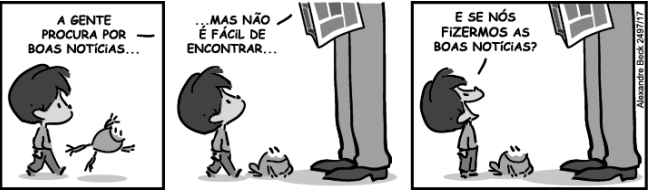
Na fala do personagem, a segunda oração é classificada como coordenada
INSTRUÇÃO: Leia o texto a seguir para responder à questão.
BECK, Alexandre. Armandinho. Disponível em: https://tirasarmandinho.tumblr.com/post/163405308014/tirinha-original. Acesso em: 25 fev. 2025.

 Conheça nossos planos